Showing posts with label United Launch Alliance. Show all posts

Friday, December 5, 2014

United Launch Alliance Delta 4-Heavy rocket lifts Orion to EFT-1 - Video


NASA’s inaugural Orion spaceship has set sail on a two-orbit, four-hour shakedown cruise around the Earth, leaving port atop a United Launch Alliance Delta 4-Heavy rocket and its incandescent power at 7:05 a.m. EST today.

The 46,000-pound craft rocketed into its preliminary orbit, setting the stage for a coast period and another engine firing by the Delta 4-Heavy rocket later this morning to put Orion on a trajectory to travel 15 times higher than the International Space Station before re-entering over the Pacific Ocean and splashing down 600 miles southwest of San Diego at 11:23 a.m. EST (1623 GMT).

“This is going to be a vehicle that could fly for us for 30 years, potentially, and this is the first one, the first tailnumber coming out the chute. This is like the forefather of this great fleet of vehicles that’s going to be coming online,” said astronaut Rex Walheim, part of the Orion development team and member of the final space shuttle crew.

The Orion Spacecraft in development. This image shows its heat shield.

Credit: NASA

“This is the opening of a new era. It is the opening of the Orion program. It’s really exciting because it’s that transition we have been waiting for. It’s been about three-and-a-half years since I last flew on the space shuttle (and) closed the program down with the anticipation these new programs would be coming along. Now here we are. It’s really exciting to see the first flight of Orion,” Walheim said.

This mission is known as Exploration Flight Test No. 1 (EFT 1) to gather real-life data on the performance of Orion’s avionics, software, radiation protection, heat shield, parachutes and recovery systems.


“EFT 1 is a compilation of the riskiest events that we are going to see when we fly people. So this test flight is a great opportunity to fly those and see them in operation. Some of these events are difficult or even impossible to test on the ground. EFT 1 gives us a chance to put all those together,” said Mark Geyer, Orion program manager.

“Using the Delta 4 heavy gets us 15 times higher than space station and about 84 percent of lunar entry velocity,” he said.

“So we start seeing that different physics, we start seeing those very high temperatures, high velocities, so that’s one of the big things we’ll test.

“And as we go through the Van Allen belts, we’re going to see this radiation effect on the computers. We’re going to measure, with dosimeters, the environment but we’re also going to see how the avionics behave, which is actually more important, and how do our mitigations work?”

As for re-entry, “we have a lot of parachutes because we need to slow the vehicle down from about 300 mph to 20 mph, so we do that in stages,” he said.

“We’ve done a lot of drop tests out in Yuma (Arizona) and looked at failure cases, but until you’ve actually dropped it in the exact air density and speed you’re going to see, we’re certainly going to learn stuff from that.”

Monday, December 1, 2014

NASA's Orion Spacecraft at the Launch Pad

With access doors at Nasa Space Launch Complex 37 opened on Nov. 24, 2014, the Nasa Orion spacecraft and Delta IV Heavy stack is visible in its entirety inside the Mobile Service Tower where the vehicle is undergoing launch preparations.

Nasa Orion spacecraft will make its first flight test on Dec. 4 with a morning launch atop the United Launch Alliance Delta IV Heavy rocket.

Orion’s crew module is underneath the Launch Abort System and nose fairing, both of which will jettison about six minutes, 20 seconds after launch.

The tower will be rolled away from the rocket and spacecraft 8 hours, 15 minutes before launch to allow the rocket to be fueled and for other launch operations to proceed.

The spacecraft will orbit the Earth twice, including one loop that will reach 3,600 miles above Earth.

No one will be aboard Orion for this flight test, but the spacecraft is being designed and built to carry astronauts on exploration missions into deep space.

Launch is scheduled for Thursday, Dec. 4 at 7:05 a.m. EST, the opening of a 2 hour, 39-minute window for the day.

Image Credit: NASA/Kim Shiflett

Friday, September 26, 2014

Delta IV Booster Integration Another Step Toward First Orion Flight

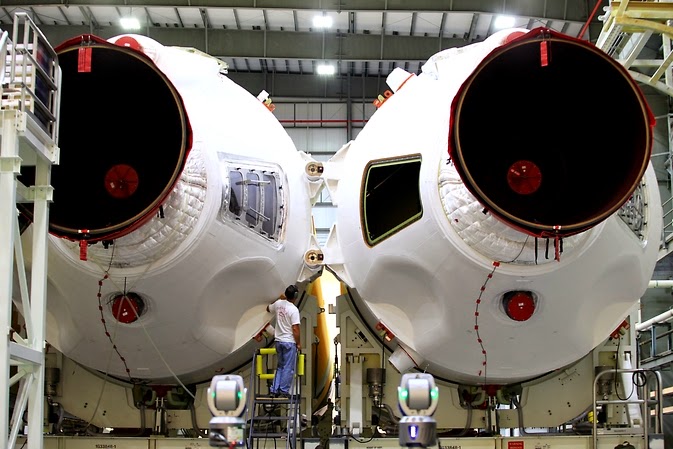
A transporter for oversize loads delivers the port, or left, booster for the United Launch Alliance Delta IV Heavy for Exploration Flight Test-1 into the Horizontal Integration Facility, or HIF, on May 7. 

The port booster joins the other two boosters of the Delta IV Heavy already in the HIF.

Image Credit: NASA/Kim Shiflett

A United Launch Alliance technician monitors progress as core booster elements of a Delta IV Heavy rocket are being integrated in preparation for Exploration Flight Test-1.

Image Credit: NASA/Ben Smegelsky

Engineers took another step forward in preparations for the first test flight of NASA’s new Orion spacecraft, in December.

The three primary core elements of the United Launch Alliance (ULA) Delta IV Heavy rocket recently were integrated, forming the first stage of the launch vehicle that will send Orion far from Earth to allow NASA to evaluate the spacecraft’s performance in space.

The three Delta IV Common Booster Cores were attached in ULA’s Horizontal Integration Facility (HIF), at Cape Canaveral Air Force Station in Florida. The HIF building is located at Space Launch Complex 37 where the mission will lift off.

The first booster was attached to the center rocket in June with the second one was attached in early August.

"The day-to-day processing is performed by ULA," said Merri Anne Stowe of NASA's Fleet Systems Integration Branch of the Launch Services Program (LSP).

"NASA’s role is to keep a watchful eye on everything and be there to help if any issues come up."

Stowe explained that during major testing experts from NASA’s Launch Services Program monitor the work on consoles in Hanger AE at Cape Canaveral Air Force Station.

Hangar AE is home to the Kennedy Space Center’s upgraded Launch Vehicle Data Center. The facility allows engineers to monitor voice, data, telemetry and video systems that support expendable launch vehicle missions.

NASA’s Florida spaceport is also where Orion was built and is being processed.

In the Horizontal Integration Facility at Cape Canaveral Air Force Station, two core elements of a Delta IV Heavy rocket are brought together in preparation for Exploration Flight Test-1. 

Image Credit: NASA/Ben Smegelsky

The Delta IV rocket stages were assembled at the ULA plant in Decatur, Alabama, about 20 miles west of Huntsville.

After completion, the rocket components were shipped down the Tennessee River and Tombigbee Waterway, a canal, to the Gulf of Mexico. From there they traveled to Cape Canaveral, arriving on May 6.

The elements of the rocket's first stage were then transported to the HIF for preflight processing.

"After the three core stages went through their initial inspections and processing, the struts were attached, connecting the booster stages with the center core," Stowe said. "All of this takes place horizontally."

Inside the Horizontal Integration Facility at Space Launch Complex 37 at Cape Canaveral Air Force Station, United Launch Alliance technicians prepare the second stage of a Delta IV Heavy rocket for mating to the central core booster of the three booster stages for the unpiloted Exploration Flight Test-1. 

Image Credit: NASA/Daniel Casper

The three common booster cores are 134 feet in length and 17 feet in diameter.

Each has an RS-68 engine that uses liquid hydrogen and liquid oxygen propellant producing 656,000 pounds of thrust.

All totaled, the three Delta IV boosters collectively generate 1.96 million pounds of thrust.

The second stage of the Delta IV rocket is 45 feet in length and 17 feet in diameter. It uses one RL10-B-2 engine, also burning liquid hydrogen and liquid oxygen propellant creating 25,000 pounds of thrust.

"The second stage was taken to the Delta Operations Center for processing after it arrived," said Stowe. "The second stage was moved to the HIF on Aug. 29 and is scheduled to be horizontally mated to the first stage on Sept. 12."

The same upper stage will be used on the block 1 version of NASA's new heavy-lift rocket, the Space Launch System (SLS). More powerful than any rocket ever built, SLS will be capable of sending humans aboard Orion to deep-space destinations such as an asteroid and Mars.

"The hardware for Exploration Flight Test-1 is coming together well," Stowe said. "We haven't had to deal with any serious problems. All of the advance planning appears to be paying off."

Once all the launch vehicle stages are mated and thoroughly checked out, the next step is the Test Readiness Review.

Thursday, September 18, 2014

Blue Origin to Build New BE-4 liquid rocket engine for US Launch Provider

Jeff Bezos looks on as a new model of Blue Origin's BE-4 liquid rocket engine is revealed during a press event on Sept. 17, 2014.

Credit: United Launch Alliance Instagram

Blue Origin, the secretive private spaceflight company led by billionaire Jeff Bezos, has teamed up with a veteran space launch provider to build a new rocket engine designed to reduce U.S. dependence on Russian hardware.

In an announcement today (Sept. 17), Bezos and the launch provider United Launch Alliance unveiled plans to develop Blue Origin's new BE-4 liquid rocket engine.

The new partnership will allow ULA's next-generation rockets to come equipped with engines that are built in America. At the moment, ULA uses Russian-made RD-180 engines to power its Atlas 5 rockets.

"ULA has put a satellite into orbit almost every month for the past eight years – they're the most reliable launch provider in history and their record of success is astonishing," Bezos, founder of Blue Origin and Amazon.com, said in a statement.

"The team at Blue Origin is methodically developing technologies to enable human access to space at dramatically lower cost and increased reliability, and the BE-4 is a big step forward. With the new ULA partnership, we're accelerating commercial development of the next great US-made rocket engine."

A model of Blue Origin's BE-4 rocket engine on display on Sept. 17, 2014.

Credit: United Launch Alliance Instagram

The United Launch Alliance is currently launches most U.S. government and military satellites using its Atlas 5 rockets, as well as Delta 4 booster variants.

The company is a cooperative venture by Boeing and Lockheed Martin.

Blue Origin's partnership with ULA states that full-scale BE-4 engine testing should begin in 2016, with the first flight due for launch in 2019, according to representatives.

Although ULA and Blue Origin did not release the cost of development for the BE-4 engine, it will be privately funded.

Blue Origin and ULA have committed to funding it 100 percent for the next five years. Blue Origin began testing its BE-3 rocket engine in 2013.

"This agreement ensures ULA will remain the most cost-efficient, innovative and reliable company launching the nation's most important national security, civil, human and commercial missions," Tory Bruno, president and CEO of ULA, said in today's statement.

"Blue Origin has demonstrated its ability to develop high-performance rocket engines and we are excited to bring together the best minds in engineering, supply chain management and commercial business practices to create an all-new affordable, reliable, American rocket engine that will create endless possibilities for the future of space launch."


Tensions between the United States and Russia have been heightened due to Russia's involvement with the conflict in the Ukraine. Because of that political situation, ULA has come under fire for its use of the Russian rocket engines.

Today's Blue Origin-ULA rocket engine news is the second time in two days that a commercial spaceflight vernture including Boeing has made headlines.

On Tuesday (Sept. 16), NASA announced that Boeing's manned CST-100 spacecraft, which is slated to launch on Atlas 5 rockets, was one of two vehicles picked to fly American astronauts as part of the agency's Commercial Crew Transportation Capability program.

Blue Origin's BE-4 engine won't serve as a direct replacement for RD-180s that power Atlas 5 rockets.

Instead, Blue Origin's new engine will outfit ULA's next generation of rockets, according to Blue origin representatives.

NASA also picked the Dragon spacecraft developed by California-based SpaceX, led by billionaire Elon Musk, as its second commercial space taxi for astronauts.

The announcement Tuesday came after a four-year competition of aerospace companies that included Blue Origin's Space Vehicle and the Dream Chaser space plane developed by Sierra Nevada among the spacecraft contenders.

Wednesday, July 2, 2014

ULA Delta II rocket Launch: OCO-2 Heads to Orbit

A United Launch Alliance Delta II rocket launches with the Orbiting Carbon Observatory-2 (OCO-2) satellite onboard from Space Launch Complex 2 at Vandenberg Air Force Base, California.

OCO-2 will measure the global distribution of carbon dioxide, the leading human-produced greenhouse gas driving changes in Earth’s climate.

Image Credit: NASA/Bill Ingalls

Sunday, December 8, 2013

United Launch Alliance Atlas 5 rocket launch carrying NROL-39 payload

A United Launch Alliance Atlas 5 rocket carrying the classified NROL-39 payload for the National Reconnaissance Office (NRO) lifted off from Space Launch Complex-3 at California's Vandenberg Air Force Base on Dec. 5 at 11:14 p.m. PST. 

Designated NROL-39, the mission is in support of national defense.

Credit: United Launch Alliance

A classified U.S. spy payload rocketed into orbit from California on an Atlas 5 launcher Thursday (Dec. 5), joining the nation's eyes and ears in the sky to supply intelligence to the government's national security agencies.

The satellite is owned by the National Reconnaissance Office, but government officials do not disclose the identities of the NRO's spacecraft, only saying the payload will serve national security purposes.

But independent satellite-watchers believe the spacecraft will join the NRO's fleet of spacecraft with radars to penetrate cloaks of clouds and darkness and reveal what adversaries are doing regardless of weather or time of day.

Saturday, November 16, 2013

NASA MAVEN: Mars-Bound spacecraft at the Launch Pad

Two days before the scheduled launch to Mars, the United Launch Alliance Atlas V rocket and NASA’s Mars Atmosphere and Volatile Evolution (MAVEN) spacecraft rolled out of the Cape Canaveral Air Force Station Space Launch Complex 41 Vertical Integration Facility to the launch pad, Saturday, Nov. 16, 2013, Cape Canaveral, Florida.

Credit: NASA/Bill Ingalls

Thursday, June 13, 2013

Antitrust probe of Lockheed-Boeing rocket venture

The Orbital Sciences Corporation Antares rocket is seen as it launches from Pad-0A of the Mid-Atlantic Regional Spaceport at the NASA Wallops Flight Facility in Virginia

Credit: Nasa / Reuters

U.S. regulators have opened a probe into whether a Lockheed-Boeing joint venture that launches U.S. government satellites into space has flouted antitrust laws.

The Federal Trade Commission (FTC) is investigating whether United Launch Alliance (ULA), a joint venture of Lockheed Martin Corp and Boeing Co, violated federal antitrust laws by "monopolizsing" or restraining competition through an exclusivity agreement with the maker of the engines used in its rockets, according to a FTC document obtained by Reuters on Wednesday.

RD Amross, a joint venture of Russia's NPO Energomash and Pratt & Whitney Rocketdyne, a unit of United Technologies Corp, provides RD-180 engines for ULA rockets.

Industry sources say ULA is preventing RD Amross from selling the engines to other rocket makers, including Orbital Sciences Corp, which is trying to break into the lucrative market for government rocket launches.

Jessica Rye
Jessica Rye, spokeswoman for ULA, confirmed the investigation and said the company was cooperating with antitrust regulators.

"ULA's contracts to purchase the RD-180 engine are lawful, pro-competitive and designed to provide the most reliable launch vehicle possible for critical U.S. government missions," Rye said.

"Because this is ongoing investigation, it would be inappropriate for us to comment on specifics."

Pratt & Whitney spokesman Jay DeFrank said his company is aware of the investigation and cooperating with U.S. regulators.

The FTC declined comment.

Barry Beneski, a spokesman for Orbital Sciences, said the company had been contacted by the FTC about the probe.

"We have been contacted by the FTC about their investigation. However we can't be more specific than that," Beneski said.

"In general, the company supports efforts to ensure there is an open and fair competitive environment in the market for launch services."

Lockheed and Boeing formed the joint venture in 2006 after years of competing for contracts under the Air Force's Evolved Expendable Launch Vehicle (EELV) program, which provides launch services for large military, intelligence and NASA satellites.

The companies won U.S. government's approval for the venture by arguing that there was not enough demand for heavy lift rocket launch services to support two competitors since the commercial demand they had expected had failed to materialize for such large rockets.

The U.S. Air Force, frustrated about the high cost of EELV rocket launches, has in recent years tried to infuse more competition into the launch service market.

Monday, February 11, 2013

Landsat Data Continuity Mission and ULA Atlas-V Launcher: Pre-launch Checks

The United Launch Alliance (ULA) Atlas V rocket with the Landsat Data Continuity Mission (LDCM) spacecraft onboard is seen on Sunday, Feb. 10, 2013 at Vandenberg Air Force Base, Calif.

The Landsat Data Continuity Mission (LDCM) mission is a collaboration between NASA and the U.S. Geological Survey that will continue the Landsat program's 40-year data record of monitoring the Earth's landscapes from space. 

The spacecraft is scheduled to launch Feb. 11.

Photo Credit: NASA/Bill Ingalls

Tuesday, December 11, 2012

US to launch a new Pilotless Secretive space plane - X-37B

The United States is planning a new launch of its tiny, pilotless military space plane on Tuesday as part of a futuristic Air Force program that has fueled speculation over its mission.

The X-37B, which weighs five tonnes and is 29 feet (8.9 meters) long, can return material to Earth in the way of the retired shuttle Orbiter program but is designed to stay in orbit for much longer at 270 days.

The last X-37B returned in June after orbiting for 469 days in a test of endurance.

The United Launch Alliance, a joint venture between Boeing and Lockheed Martin, approved the X-37B at Cape Canaveral in Florida after finding no danger following an anomaly during a separate launch two months ago.

The company said in a statement that a Global Positioning System (GPS) satellite was put into orbit as expected on October 4 but that a fuel leak took place inside the thrust chamber, triggering an investigation.

Patrick Air Force Base gave notice of a hazard from a launch between 10:45 am to 5:15 pm (1545 to 2215 GMT) on Tuesday.

Authorities have said little more about the X-37B. An Air Force fact sheet described it as "experimental test program to demonstrate technologies for a reliable, reusable, unmanned space test platform for the US Air Force."

The secretive nature of the equipment on the X-37B has led to speculation in the media over its true nature, with some experts saying it could eventually be designed to tamper with satellites from rival nations.

China in 2007 became the first nation after the United States and the former Soviet Union to shoot down one of its own satellites, in a test seen in Washington as a sign of the rising power's ambitions in space.

The X-37B project was launched by the space agency NASA in 1999 before being adopted by the Defense Advanced Research Projects Agency, which designs new technologies for the US military.