Showing posts with label Infographic. Show all posts

Monday, May 13, 2013

Solar Flares: A User's Guide - Infographic

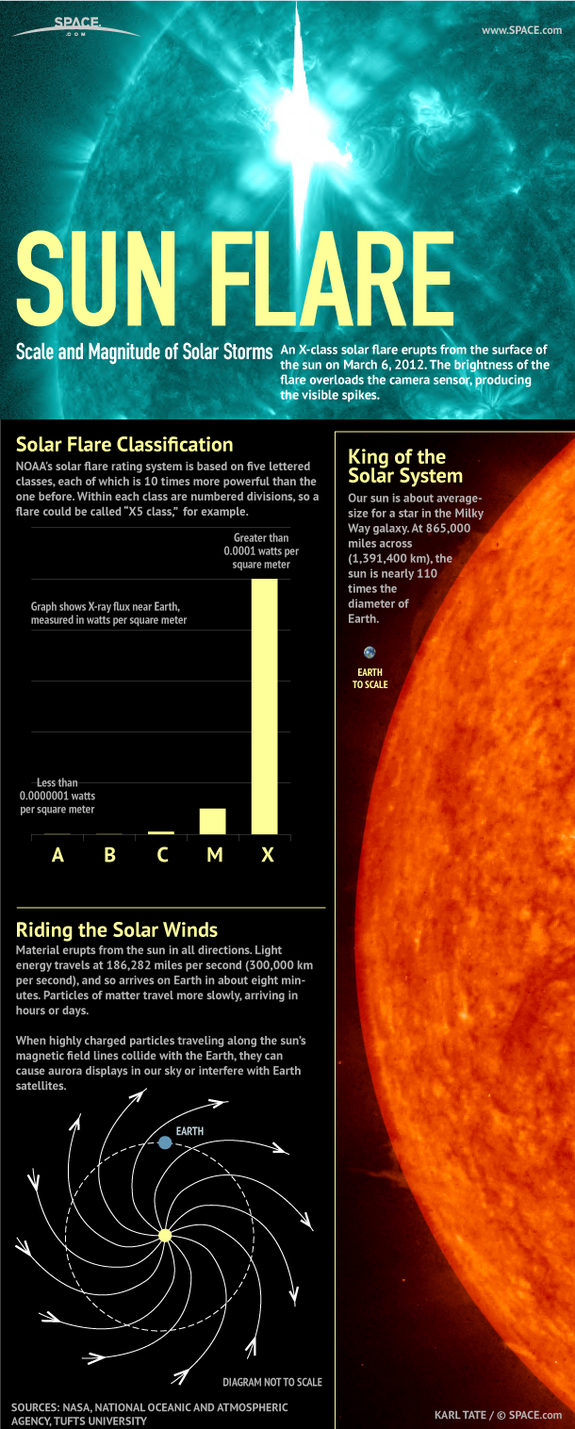
See how different types of solar flares stack up in this SPACE.com infographic.

The sun is by no means a quiet star and follows an 11-year weather cycle that ebbs and flows with solar activity. During active periods, the sun is prone to severe solar flares, but not ever sun storm is the same. See how the different types of solar flares stack up and how solar storms travel across our solar system in the infographic above.

Friday, April 26, 2013

NASA Asteroid Capture Mission Explained (Infographic)

Find out how NASA's plan to move an asteroid works in this SPACE.com infographic.
Source SPACE.com: All about our solar system, outer space and exploration

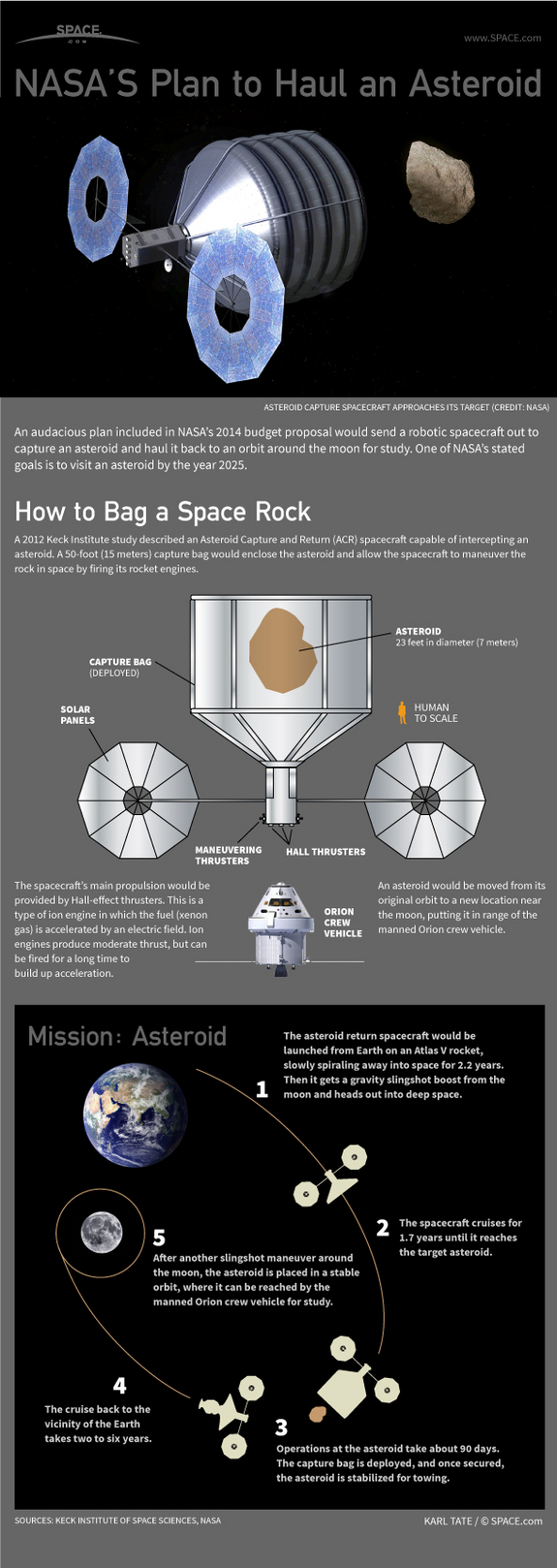
An audacious plan included in NASA’s 2014 budget proposal would send a robotic spacecraft out to capture an asteroid and haul it back to an orbit around the moon for study. One of NASA’s stated goals is to visit an asteroid by the year 2025.

A 2012 Keck Institute study described an Asteroid Capture and Return (ACR) spacecraft capable of intercepting an asteroid. A 50-foot (15 meters) capture bag would enclose the asteroid and allow the spacecraft to maneuver the rock in space by firing its rocket engines.

The spacecraft’s main propulsion would be provided by Hall-effect thrusters. This is a type of ion engine in which the fuel (xenon gas) is accelerated by an electric field. Ion engines produce moderate thrust, but can be fired for a long time to build up acceleration.

An asteroid would be moved from its original orbit to a new location near the moon, putting it in range of the manned Orion crew vehicle.

To move the asteroid, the spacecraft would first be launched from Earth on an Atlas 5 rocket, slowly spiraling away into space for 2.2 years. Then it gets a gravity slingshot boost from the moon and heads out into deep space.

The spacecraft cruises for 1.7 years until it reaches the target asteroid. Operations at the asteroid take about 90 days. The capture bag is deployed, and once secured, the asteroid is stabilized for towing.

The cruise back to the vicinity of the Earth takes two to six years. After another slingshot maneuver around the moon, the asteroid is placed in a stable orbit, where it can be reached by the manned Orion crew vehicle for study.

Monday, April 15, 2013

Orbital Sciences: Antares Rocket & Cygnus Spacecraft Explained - Infographic

Find out about Orbital Sciences' new Antares rocket and Cygnus cargo ferry spacecraft in this SPACE.com Infographic.

Credit: Space.com 

All about our solar system, outer space and exploration

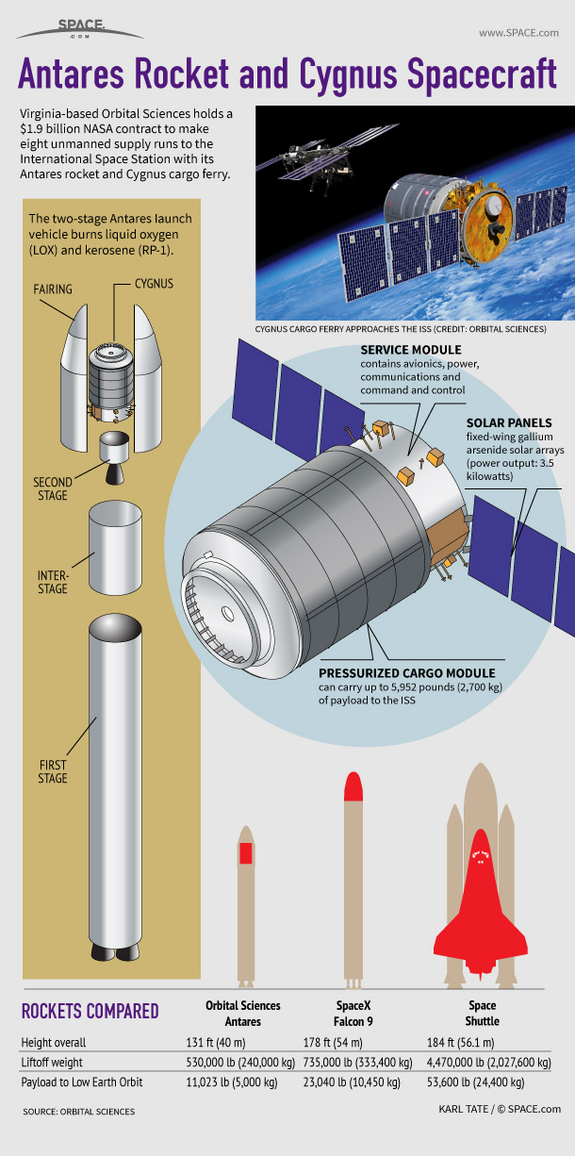
Virginia-based Orbital Sciences holds a $1.9 billion NASA contract to make eight unmanned supply runs to the International Space Station with its Antares rocket and Cygnus cargo ferry.

Antares Launcher
The two-stage Antares launch vehicle burns liquid oxygen (LOX) and kerosene (RP-1). The rocket's height overall is 131 feet (40 meters). Its liftoff weight is 530,000 pounds (240,000 kilograms). The Antares rocket was originally called Taurus 2.

Cygnus Cargo Tanker
The Cygnus pressurized cargo module can carry up to 5,952 pounds (2,700 kg) of payload to the International Space Station.

At the rear of Cygnus is a service module containing avionics, power, communications and command and control hardware. On the outside of the service module are twin fixed-wing gallium arsenide solar arrays capable of putting out 3.5 kilowatts of electricity.

Future Cygnus spacecraft will be enhanced with a larger pressurized cargo module and lightweight solar panels.