Showing posts with label Explained. Show all posts

Thursday, March 6, 2014

NASA's Spitzer Space Telescope: Planet-forming Disks Explained by Magnetism

Magnetic loops carry gas and dust above disks of planet-forming material circling stars, as shown in this artist's conception.

Image Credit: NASA/JPL-Caltech

Astronomers say that magnetic storms in the gas orbiting young stars may explain a mystery that has persisted since before 2006.

Researchers using NASA's Spitzer Space Telescope to study developing stars have had a hard time figuring out why the stars give off more infrared light than expected.

The planet-forming disks that circle the young stars are heated by starlight and glow with infrared light, but Spitzer detected additional infrared light coming from an unknown source.

A new theory, based on three-dimensional models of planet-forming disks, suggests the answer: Gas and dust suspended above the disks on gigantic magnetic loops like those seen on the sun absorb the starlight and glow with infrared light.

Neal Turner
"If you could somehow stand on one of these planet-forming disks and look at the star in the center through the disk atmosphere, you would see what looks like a sunset," said Neal Turner of NASA's Jet Propulsion Laboratory, Pasadena, Calif.

The new models better describe how planet-forming material around stars is stirred up, making its way into future planets, asteroids and comets.

While the idea of magnetic atmospheres on planet-forming disks is not new, this is the first time they have been linked to the mystery of the observed excess infrared light.

According to Turner and colleagues, the magnetic atmospheres are similar to what takes place on the surface of our sun, where moving magnetic field lines spur tremendous solar prominences to flare up in big loops.

Stars are born out of collapsing pockets in enormous clouds of gas and dust, rotating as they shrink down under the pull of gravity.

As a star grows in size, more material rains down toward it from the cloud, and the rotation flattens this material out into a turbulent disk. Ultimately, planets clump together out of the disk material.

In the 1980s, the Infrared Astronomical Satellite mission, a joint project that included NASA, began finding more infrared light than expected around young stars.

Using data from other telescopes, astronomers pieced together the presence of dusty disks of planet-forming material but eventually it became clear the disks alone weren't enough to account for the extra infrared light, especially in the case of stars a few times the mass of the sun.

One theory introduced the idea that instead of a disk, the stars were surrounded by a giant dusty halo, which intercepted the star's visible light and re-radiated it at infrared wavelengths.

Then, recent observations from ground-based telescopes suggested that both a disk and a halo were needed.

Finally, three-dimensional computer modeling of the turbulence in the disks showed the disks ought to have fuzzy surfaces, with layers of low-density gas supported by magnetic fields, similar to the way solar prominences are supported by the sun's magnetic field.

The new work brings these pieces together by calculating how the starlight falls across the disk and its fuzzy atmosphere.

The result is that the atmosphere absorbs and re-radiates enough to account for all the extra infrared light.

Friday, April 26, 2013

NASA Asteroid Capture Mission Explained - Animation


NASA's 2014 budget poposes a mission to robotically capture a small near-Earth asteroid and bring it into a stable lunar orbit where astronauts can visit and explore it, a 'stepping stone' to future missions to farther asteroids.

Credit: NASA

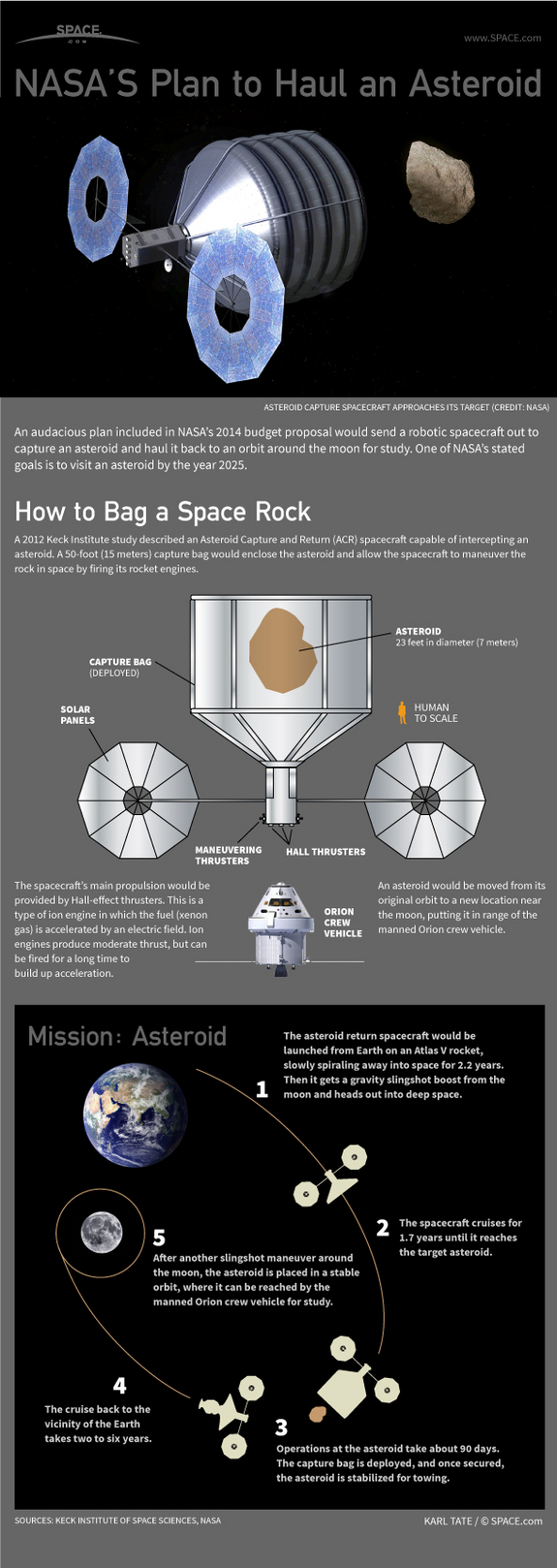
NASA Asteroid Capture Mission Explained (Infographic)

Find out how NASA's plan to move an asteroid works in this SPACE.com infographic.
Source SPACE.com: All about our solar system, outer space and exploration

An audacious plan included in NASA’s 2014 budget proposal would send a robotic spacecraft out to capture an asteroid and haul it back to an orbit around the moon for study. One of NASA’s stated goals is to visit an asteroid by the year 2025.

A 2012 Keck Institute study described an Asteroid Capture and Return (ACR) spacecraft capable of intercepting an asteroid. A 50-foot (15 meters) capture bag would enclose the asteroid and allow the spacecraft to maneuver the rock in space by firing its rocket engines.

The spacecraft’s main propulsion would be provided by Hall-effect thrusters. This is a type of ion engine in which the fuel (xenon gas) is accelerated by an electric field. Ion engines produce moderate thrust, but can be fired for a long time to build up acceleration.

An asteroid would be moved from its original orbit to a new location near the moon, putting it in range of the manned Orion crew vehicle.

To move the asteroid, the spacecraft would first be launched from Earth on an Atlas 5 rocket, slowly spiraling away into space for 2.2 years. Then it gets a gravity slingshot boost from the moon and heads out into deep space.

The spacecraft cruises for 1.7 years until it reaches the target asteroid. Operations at the asteroid take about 90 days. The capture bag is deployed, and once secured, the asteroid is stabilized for towing.

The cruise back to the vicinity of the Earth takes two to six years. After another slingshot maneuver around the moon, the asteroid is placed in a stable orbit, where it can be reached by the manned Orion crew vehicle for study.

Sunday, April 21, 2013

Jupiter's Hot Spots Explained - Video


Jupiter's Hot Spots NASA postdoctoral fellow David Choi discusses his study of dark features in Jupiter's atmosphere called "hot spots," and their connection to large-scale atmospheric waves.

Nasa can now re-examine the data garnered from the earlier Galileo probe, for new information.

Galileo plunged into Jupiter's crushing atmosphere on Sept. 21, 2003. The spacecraft was deliberately destroyed to protect one of its own discoveries - a possible ocean beneath the icy crust of the moon Europa.

Galileo was the first to measure Jupiter's atmosphere with a descent probe and the first to conduct long-term observations of the Jovian system from orbit.

It found evidence of subsurface saltwater on Europa, Ganymede and Callisto and revealed the intensity of volcanic activity on Io.