Showing posts with label Asteroid capture. Show all posts

Thursday, September 12, 2013

Nasa Asteroid Capture: Three Possible Candidates Selected

This NASA artist's rendering obtained on May 31, 2013 shows what capturing an asteroid could look like. 

The US space agency has narrowed its hunt for an asteroid to capture to three, NASA said.

The asteroids fit the requirements of being between seven to 10 meters (yards) in size, and further study should be able to narrow the choice even more, scientists said at a conference in San Diego, California.

"We have two to three which we will characterize in the next year and if all goes well... those will be valid candidates that could be certified targets," said Paul Chodas, senior scientist at the NASA Near-Earth Object Program Office.

The plan is to send a robotic spacecraft to capture the asteroid and drag it into orbit around the Moon.

Once there, astronauts could visit the asteroid and take samples of it back to Earth for study.

The spacecraft used for travel there and back would be the Orion multi-purpose vehicle, which is being built but has not yet been used, as well as a new deep space rocket launcher.

The program aims to break new ground by increasing NASA capabilities beyond low Earth orbit, where the International Space Station circles the globe.

Paul Chodas
NASA has touted the planetary defense capabilities the project would build toward protecting the Earth from a potential hazardous asteroid collision, as well as the technology it would boost for future human missions to deep space.

President Barack Obama has proclaimed the project would be a key step on the way to sending humans to Mars by the 2030s.

Bill Gerstenmaier, associate administrator of NASA's Human Exploration and Operations Directorate, described the asteroid mission as "pretty compelling."

"If you think about grabbing an object in space and then manipulating it for our use and putting it into a destination where we could go back and routinely visit and let commercial companies go visit, I think that is a pretty compelling activity."

Obama's 2014 budget for NASA asked for $100 million for the asteroid project, but the overall costs may be as high as $2 billion.

Bill Gerstenmaier
"It's a little different way than just a date and a destination. We are really good at just picking dates and destinations. But that's really hard in this budget environment where things are constrained and we have flat budgets, et cetera et cetera, to pull that off," said Gerstenmaier.

"It is not just a one-time thing. It actually feeds forward into the broader context of what we want to do with humans in space."

The launch could happen as early as 2017 or as late as 2019.

After launch of the robotic mission, the journey to the asteroid would take a year and a half, and the act of towing it toward the moon could take another three and a half years, NASA said.

The project would use a new fuel technology called solar electric propulsion.

"We are talking about engineering the solar system, in a way. We are talking about taking an asteroid which was once here, and then putting it into a useful orbit for our purposes," said Chodas.

"This is a very large idea here that we are talking about and I think it will reinvigorate interest in the space program," he said.

Friday, April 26, 2013

NASA Asteroid Capture Mission Explained - Animation


NASA's 2014 budget poposes a mission to robotically capture a small near-Earth asteroid and bring it into a stable lunar orbit where astronauts can visit and explore it, a 'stepping stone' to future missions to farther asteroids.

Credit: NASA

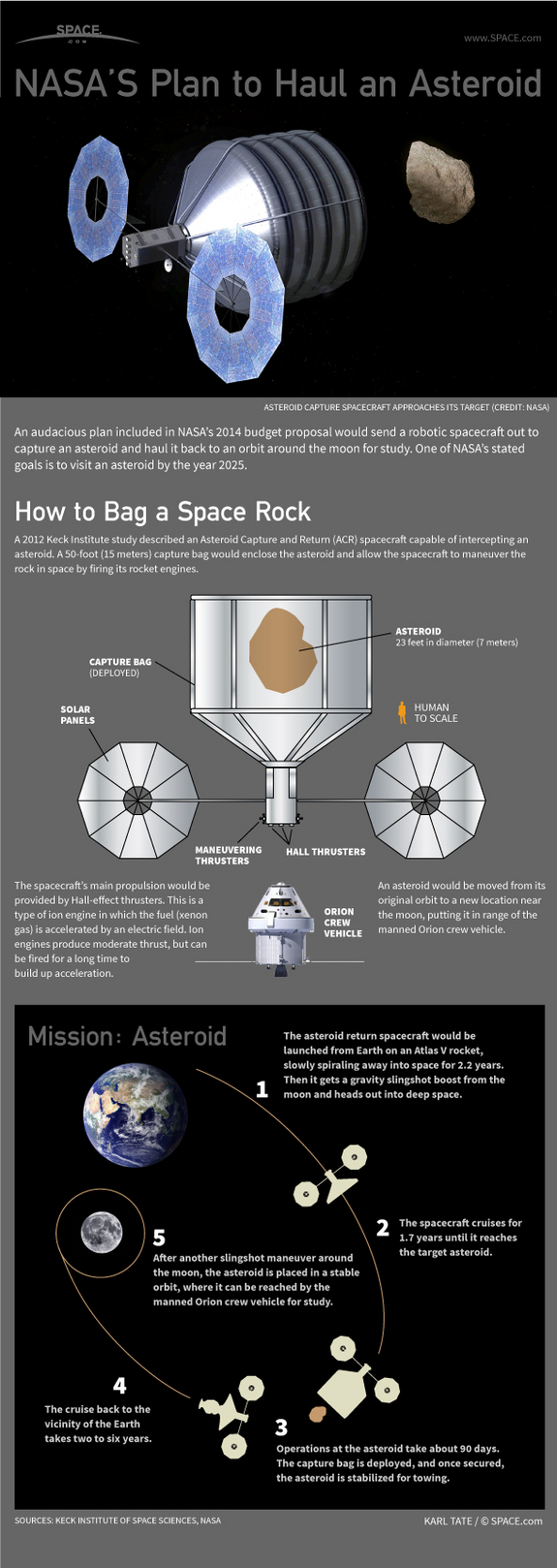
NASA Asteroid Capture Mission Explained (Infographic)

Find out how NASA's plan to move an asteroid works in this SPACE.com infographic.
Source SPACE.com: All about our solar system, outer space and exploration

An audacious plan included in NASA’s 2014 budget proposal would send a robotic spacecraft out to capture an asteroid and haul it back to an orbit around the moon for study. One of NASA’s stated goals is to visit an asteroid by the year 2025.

A 2012 Keck Institute study described an Asteroid Capture and Return (ACR) spacecraft capable of intercepting an asteroid. A 50-foot (15 meters) capture bag would enclose the asteroid and allow the spacecraft to maneuver the rock in space by firing its rocket engines.

The spacecraft’s main propulsion would be provided by Hall-effect thrusters. This is a type of ion engine in which the fuel (xenon gas) is accelerated by an electric field. Ion engines produce moderate thrust, but can be fired for a long time to build up acceleration.

An asteroid would be moved from its original orbit to a new location near the moon, putting it in range of the manned Orion crew vehicle.

To move the asteroid, the spacecraft would first be launched from Earth on an Atlas 5 rocket, slowly spiraling away into space for 2.2 years. Then it gets a gravity slingshot boost from the moon and heads out into deep space.

The spacecraft cruises for 1.7 years until it reaches the target asteroid. Operations at the asteroid take about 90 days. The capture bag is deployed, and once secured, the asteroid is stabilized for towing.

The cruise back to the vicinity of the Earth takes two to six years. After another slingshot maneuver around the moon, the asteroid is placed in a stable orbit, where it can be reached by the manned Orion crew vehicle for study.

Planetary Scientists Protest: NASA Budget Cuts Proposed for 2014 'Disastrous'


Supporters of planetary science are rallying against NASA's proposed 2014 budget, which they say unfairly guts funding for solar system research and exploration.

The Obama administration unveiled the budget plan April 10, requesting $17.7 billion for NASA — $50 million less than the agency got in 2012.

The budget must be approved by Congress before it becomes official. Under the budget proposal, planetary science would receive $1.217 billion in 2014.

Discounting the $50 million earmarked for producing plutonium-238, which fuels deep space vehicles (this used to be paid for by the Department of Energy), and $20 million for asteroid detection in service of a future manned asteroid mission, this represents a $268 million cut from planetary science funding levels approved by Congress for 2013, advocates said.

Carl Sagan
"The Planetary Society has deep concerns about the continued effort to defund planetary science in NASA's 2014 budget proposal," wrote officials from the society, which was founded by astronomer Carl Sagan to promote solar-system exploration, in testimony submitted to the U.S. House of Representatives Committee on Science, Space and Technology April 24.

"Without immediate investment in technology and mission development — not possible under the FY14 proposal — the United States will go 'radio dark' in almost all regions of the solar system by the end of the decade."


In this still from a NASA video, a robotic spacecraft's capture bag swallows an asteroid in order to return it to Earth. 

NASA plans to retrieve an asteroid and park it near the moon by 2025, possibly even by 2021, so astronauts can explore it.

CREDIT: NASA

The proposed budget would include $105 million in funds to support an asteroid-capture mission and other asteroid studies, but eliminate Europa Clipper, a planned robotic mission to Jupiter's intriguing moon Europa, which harbours an ocean buried beneath its icy surface that may support microbial life, and current missions, such as NASA's Cassini spacecraft orbiting Saturn and the Messenger orbiter around Mercury, may come to premature ends.

Bill Nye
Bill Nye, chief executive officer of the Planetary Society, called the budget "shortsighted and disastrous" in a letter urging supporters to write their Congressional representatives in support of planetary science.

The organization aims to send 25,000 messages to Capitol Hill by April 28.

A group of lawmakers also joined in the campaign, penning a letter to NASA administrator Charles Bolden on April 19 asking that he and the Obama administration rethink their 2013 NASA budget, which is still unfinalised.

Senator Barbara Boxer
"We write to express opposition to any Fiscal Year 2013 NASA Operating Plan that disproportionately applies sequester and across-the-board cuts to the science budget," wrote Representative Adam Schiff (D-CA) and Senator Dianne Feinstein (D-CA) in a letter signed by Senator Barbara Boxer (D-CA) and Representative John Culberson (R-TX).

"While we fully understand that the funding levels enumerated in the bill and report are subject to change to reflect the across the board and sequester cuts, we expect that the balance among programs will remain consistent with the structure directed by Congress."