Showing posts with label Solar Flares. Show all posts

Tuesday, October 28, 2014

Giant Sunspot Keeps Firing Off Huge Solar Flares


The largest sunspot observed on the sun in more than 20 years has been firing off powerful solar flares for the past week, and it's still producing strong solar storms.

Today, the huge sunspot erupted with a large solar flare, peaking at around 10:47 a.m. EDT (1447 GMT).

The flare caused a strong radio blackout on Earth, according to the National Weather Service's Space Weather Prediction Center. This solar flare is the fourth X-flare (the most powerful kind of solar storms) in as many days.

On Sunday (Oct. 26), the giant sunspot unleashed a solar flare, which peaked at about 6:56 a.m. EDT (1056 GMT). The sunspot, called Active Region 12192 (also known as AR 2192), also shot out another powerful flare on Saturday. Today and Sunday's flares measured in at X2, while Saturday's is classified as an X1 flare.

Sunday's X2-class flare was "the third X-class flare in 48 hours, erupting from the largest active region seen on the sun in 24 years," NASA spokesperson Karen Fox wrote in an update yesterday (Oct. 26). AR 2129 also shot out an X3.1-class flare on Friday (Oct. 24).

The sun unleashed an X2-class solar flare on Oct. 26, 2014. NASA's Solar Dynamics Observatory captured this photo of the flare (lower right).

Credit: NASA/SDO

Monday, October 20, 2014

Solar Photosphere: Hot explosions on the cool sun

Sizzling star: Hot explosions in an active region of the Sun. 

In this image of the photosphere that was obtained at the end of September 2013 with the help of IRIS, the explosions are the bright spots. 

The image shows a sector with a size of 50,000 kilometers by 25 000 kilometers. 

Credit: NASA

The Sun is more spirited than previously thought. Apart from the solar eruptions, huge bursts of particles and radiation from the outer atmosphere of our star, also the cooler layer right below can be the site of explosions: in some areas magnetic energy builds up and discharges within only a few minutes in temperature eruptions of up to 100000 degrees.

Researchers under the lead of the Max Planck Institute for Solar System Research have now for the first time found evidence of such short-lived heat pockets in data from NASA's space telescope IRIS (Interface Region Imaging Spectrograph).

The Sun is an incredibly hot place, but even though in all its layers the temperatures are daunting, some are hotter than others.

With a temperature of approximately 5000 degrees, the Sun's visible surface, the photosphere, for example, is comparatively cool.

Going outward from there, the temperatures within the Sun's atmosphere rise, first moderately and then sharply, until they reach one million degrees.

"Our analysis shows, that this temperature distribution is not the same everywhere, and is constantly in motion", says Prof. Dr. Hardi Peter from the MPS, the paper's first author.

Together with an international team of scientists, Peter analyzed data from the space telescope IRIS taken from active regions on the Sun.

These regions within the photosphere are characterized by high magnetic field strengths and are the "birth places" of the dark sunspots, which cover the Sun's surface, at some times more, at others less abundantly.

"In these regions we found heat pockets as big as half of Germany. They are up to 20 times as hot as their surroundings", the astrophysicist describes. The heat pockets flash up for only minutes and then return to their normal state.

The amount of energy released during these explosions would be sufficient to provide all of Germany with electrical power for 8000 years.

The massive photospheric explosions cannot be spotted in visible light, but leave traces in the ultraviolet radiation the Sun emits into space.

IRIS can split this ultraviolet radiation into its constituting wavelengths more precisely than any other solar observatory before. In addition, it offers an unprecedented spatial resolution.

When IRIS opened its eyes to the Sun for the first time in July of last year, it could discern structures with a size of only 250 kilometers and examine radiation from such small regions separately.

"To our great surprise, we found well-defined areas within the active regions emitting radiation quite unlike the radiation from their vicinity", says Peter.

The researchers discovered characteristic wavelengths that special highly ionized atoms within the solar plasma such as triply ionized silicon ions emit into space.

"The presence of these wavelengths within the spectra points to very high temperatures", says Peter.

Only under such conditions can silicon loose three of its electrons, but in which of the Sun's layers did this temperature arise? Truly within the cool photosphere? Or maybe, and this would be much less spectacular, farther outside in the much hotter atmosphere?

The spectral data from IRIS proved to be so detailed that the researchers could extract further decisive clues.

For example, they were able to infer the density of the solar plasma where the radiation originated. In addition, they showed that the radiation had encountered singly-ionized iron ions on its way outward. These ions occur only in cooler regions.

"All in all, we found a coherent picture: the unusual radiation must originate in the cool outer photosphere" says Peter.

The researchers believe that the strong magnetic fields in the photosphere provide the necessary energy for the explosions.

In the area of the sun spots, the magnetic field lines protrude in a loop-like fashion from the Sun's surface; hot plasma flows there. When these flows are short-circuited, the explosions occur.

"The new results have fundamentally changed our understanding of the Sun's outer buildup", says Peter. "Instead of a stable temperature distribution, there are apparently dynamical processes within the cool photosphere that can turn everything topsy turvy."

Already in 1917, the American physicist Ferdinand Ellermann discovered areas with higher temperatures within the photosphere.

However, they differed from their surroundings only by a few thousand degrees and can therefore be considered rather minor temperature deviations. Whether the newly discovered explosions are linked to this phenomenon, is still unclear.

One of the other publications in Science magazine, to which scientists from the MPS have contributed, also paints a new picture of the processes on the Sun.

Researchers under the lead of the Harvard-Smithsonian Center for Astrophysics found that the solar wind, the continuous stream of particles from the Sun, does not leave the Sun's surface uniformly, but locally in highly energetic jets. These observations, too, are based on data from IRIS.

More information: 
H. Peter et al. "Hot Explosions in the Cool Atmosphere of the Sun." Science, 17 October 2014 - DOI: 10.1126/science.1255726

H. Tian et al. "Prevalence of Small-scale Jets from the Networks of the Solar Transition Region and Chromosphere." Science, 17 October 2014 - DOI: 10.1126/science.1255732

Tuesday, July 22, 2014

The sun has gone quiet: Sunspots and CME

The Sun by the Atmospheric Imaging Assembly of NASA's Solar Dynamics Observatory

Credit: NASA

The sun has gone quiet. Almost too quiet.

A few weeks ago it was teeming with sunspots, as you would expect since we are supposed to be in the middle of solar maximum-the time in the sun's 11-year cycle when it is the most active but now, there is hardly a sunspot in sight.

In an image taken Friday by NASA's Solar Dynamics Observatory, there is a tiny smidgen of brown just right of center where a small sunspot appears to be developing. But just one day before, there was nothing. It was a totally spotless day.

So what's going on here? Is the "All Quiet Event" as solar physicist Tony Phillips dubbed it, a big deal, or not?

"It is weird, but it's not super weird," said Phillips, who writes about solar activity on his web site SpaceWeather.com.

"To have a spotless day during solar maximum is odd, but then again, this solar maximum we are in has been very wimpy."

Phillips notes that this is the weakest solar maximum to have been observed in the space age, and it is shaking out to be the weakest one in the past 100 years, so the spotless day was not so totally out of left field.

"It all underlines that solar physicists really don't know what the heck is happening on the sun," Phillips said.

"We just don't know how to predict the sun, that is the take away message of this event."

Sunspots are interesting to solar observers because they are the region of the sun where solar activity such as solar flares (giant flashes of light) and coronal mass ejections (when material from the sun goes shooting off into space) originate.

They are caused by highly concentrated magnetic fields that are slightly cooler than the surrounding surface of the sun, which is why they appear dark to us.

Those intense magnetic fields can get twisted up and tangled, which causes a lot of energy to build up. Solar flares and coronal mass ejections occur when that energy is released in a very explosive way.

Alex Young, a heliophysicist at Goddard Space Flight Center, said it is hard to say what is and isn't unusual when it comes to the sun.

"We've only been observing the sun in lots of detail in the last 50 years," he said.

"That's not that long considering it's been around for 4.5 billion years." And it's not like astronomers have never seen the sun this quiet before.

Three years ago, on Aug. 14, 2011 it was completely free of sunspots and, as Phillips points out, that year turned out to have relatively high solar activity overall with several X-class flares.

So in that case, the spotless sun was just a "temporary intermission," as he writes on his web site.

Whether this quiet period will be similarly short-lived or if it will last longer remains to be seen.

"You just can't predict the sun," Phillips said.

Monday, December 9, 2013

NASA IRIS: Providing unprecedented images of Sun

The fine detail in images of prominences in the sun's atmosphere from NASA's Interface Region Imaging Spectrometer (IRIS) -- such as the red swirls shown here -- are challenging the way scientists understand such events. 

Credit: NASA/LMSAL /IRIS

The region located between the surface of the sun and its atmosphere has been revealed as a more violent place than previously understood, according to images and data from NASA's newest solar observatory, the Interface Region Imaging Spectrograph, (IRIS).

Solar observatories look at the sun in layers. By capturing light emitted by atoms of different temperatures, they can focus in on different heights above the sun's surface extending well out into the solar atmosphere, the corona.

On June 27, 2013, IRIS, was launched, to study what's known as the interface region – a layer between the sun's surface and corona that previously was not well observed.

Over its first six moths, IRIS has thrilled scientists with detailed images of the interface region, finding even more turbulence and complexity than expected.

IRIS scientists presented the mission's early observations at a press conference at the Fall American Geophysical Union meeting on Dec. 9, 2013.

Alan Title
"The quality of images and spectra we are receiving from IRIS is amazing," said Alan Title, IRIS principal investigator at Lockheed Martin in Palo Alto, Calif. "And we're getting this kind of quality from a smaller, less expensive mission, which took only 44 months to build."

For the first time, IRIS is making it possible to study the explosive phenomena in the interface region in sufficient detail to determine their role in heating the outer solar atmosphere.

The mission's observations also open a new window into the dynamics of the low solar atmosphere that play a pivotal role in accelerating the solar wind and driving solar eruptive events.

Tracking the complex processes in the interface region requires instrument and modeling capabilities that are only now within our technological reach.

IRIS captures both images and what's known as spectra, which display how much of any given wavelength of light is present.

This, in turn, corresponds to how much material in the solar atmosphere is present at specific velocities, temperatures and densities.

IRIS's success is due not only to its high spatial and temporal resolution, but also because of parallel development of advanced computer models.

The combined images and spectra have provided new imagery of a region that was always known to be dynamic, but shows it to be even more violent and turbulent than imagined.

This is an artist's concept of the Interface Region Imaging Spectrograph, or IRIS, satellite in orbit. Credit: NASA

"We are seeing rich and unprecedented images of violent events in which gases are accelerated to very high velocities while being rapidly heated to hundreds of thousands of degrees," said Bart De Pontieu, the IRIS science lead at Lockheed Martin.

"These types of observations present significant challenges to current theoretical models."


This video compares the Solar Dynamics Observatory's (SDO) resolution with the Interface Region Imaging Spectrograph (IRIS) resolution for the same region of the Sun

Tuesday, July 9, 2013

NASA SOHO: Antimatter detected in solar flares

Antimatter has been detected in solar flares via microwave and magnetic-field data, according to a presentation by NJIT Research Professor of Physics Gregory D. Fleishman and two co-researchers at the 44th meeting of the American Astronomical Society's Solar Physics Division.

This research sheds light on the puzzling strong asymmetry between matter and antimatter by gathering data on a very large scale using the Sun as a laboratory.

While antiparticles can be created and then detected with costly and complex particle-accelerator experiments, such particles are otherwise very difficult to study.

However, Fleishman and the two co-researchers have reported the first remote detection of relativistic antiparticles—positrons—produced in nuclear interactions of accelerated ions in solar flares through the analysis of readily available microwave and magnetic-field data obtained from solar-dedicated facilities and spacecraft.

That such particles are created in solar flares is not a surprise, but this is the first time their immediate effects have been detected.

The results of this research have far-reaching implications for gaining valuable knowledge through remote detection of relativistic antiparticles at the Sun and, potentially, other astrophysical objects by means of radio-telescope observations.

Gregory D. Fleishman
The ability to detect these antiparticles in an astrophysical source promises to enhance our understanding of the basic structure of matter and high-energy processes such as solar flares, which regularly have a widespread and disruptive terrestrial impact, but also offer a natural laboratory to address the most fundamental mysteries of the universe we live in.

Electrons and their antiparticles, positrons, have the same physical behavior except that electrons have a negative charge while positrons, as their name implies, have a positive charge.

This charge difference causes positrons to emit the opposite sense of circularly polarized radio emission, which Fleishman and his colleagues used to distinguish them.

To do that required knowledge of the magnetic field direction in the solar flare, provided by NASA's Solar and Heliospheric Observatory (SOHO), and radio images at two frequencies from Japan's Nobeyama Radioheliograph.

Fleishman and his colleagues found that the radio emission from the flare was polarized in the normal sense (due to more numerous electrons) at the lower frequency (lower energy) where the effect of positrons is expected to be small, but reversed to the opposite sense at the same location, although at the higher frequency (higher energy) where positrons can dominate.

More information: Fleishman, who is affiliated with the NJIT Center for Solar-Terrestrial Research, worked with Alexander T. Altyntsev and Natalia S. Meshalkina, Institute of Solar-Terrestrial Physics, Siberian Branch of the Russian Academy of Sciences.

They are presenting their research in a paper titled "Discovery of Relativistic Positrons in Solar Flares" at the 44th meeting of the Solar Physics Division of the American Astronomical Society, held in Bozeman, Montana, July 8-11.

Sunday, June 9, 2013

JAXA’s Hinode mission Image Solar Interface Region

This image from the Japan Aerospace Exploration Agency’s Hinode mission shows the lower regions of the sun’s atmosphere, the interface region.

A new NASA mission called the Interface Region Imaging Spectrograph (IRIS), will study in greater detail.

Where previous missions have been able to image material at only a few predetermined temperatures in this region, IRIS will observe a wide range of temperatures from 5,000 kelvins to 65,000 kelvins (8,540 F to 116,540 F), and up to 10 million kelvins (about 18 million F) during solar flares.

Its images will resolve structures down to 150 miles across. Image credit: JAXA/Hinode

Monday, May 13, 2013

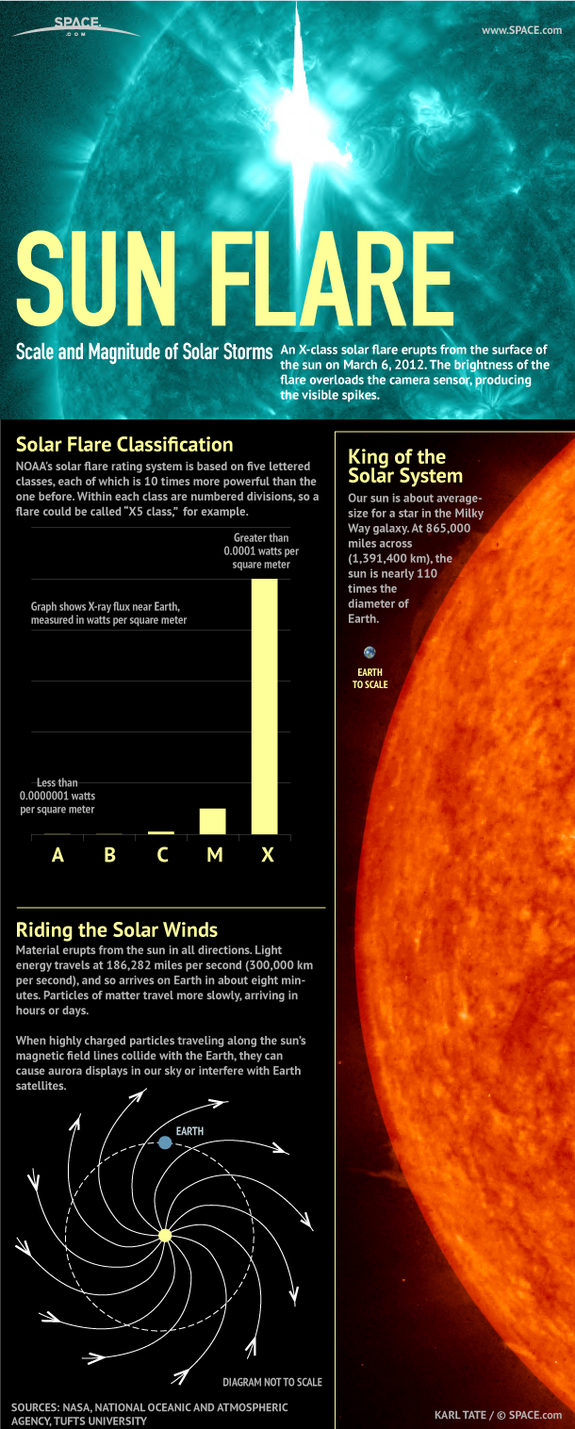
Solar Flares: A User's Guide - Infographic

See how different types of solar flares stack up in this SPACE.com infographic.

The sun is by no means a quiet star and follows an 11-year weather cycle that ebbs and flows with solar activity. During active periods, the sun is prone to severe solar flares, but not ever sun storm is the same. See how the different types of solar flares stack up and how solar storms travel across our solar system in the infographic above.