Showing posts with label Cygnus Spacecraft. Show all posts

Friday, August 15, 2014

Orbital Sciences' Cygnus spacecraft Leaves ISS to burn up in Earth atmosphere

The Cygnus spacecraft as seen when it was released from the International Space Station on Aug. 15, 2014.

Credit: NASA (via Twitter as @NASA)

A private cargo ship loaded down with trash left the International Space Station Friday morning (Aug. 15). Orbital Sciences' Cygnus spacecraft is due to plunge into Earth's atmosphere, burning up above the Pacific Ocean on Sunday (Aug. 17).

The Cygnus spacecraft launched to space on July 13 with close to 3,300 lbs. (1,496 kilograms) of supplies for the six astronauts on the orbiting outpost.

"A flock of nanosatellites was also shipped to the station aboard Cygnus for future release from the Kibo laboratory module’s airlock beginning next week," NASA officials said in a statement.

"Individually known as “Dove” satellites, the group will collect continuous Earth imagery documenting natural and man-made conditions of the environment to improve disaster relief and increase agricultural yields."

Virginia-based Orbital Sciences is one of two private companies that fly unmanned missions to the International Space Station for NASA.

The departure of Cygnus marks the end of the company's second mission (Orb-2) to the space laboratory under a $1.9 billion contract for eight resupply missions.

The other company, SpaceX, uses its Dragon capsule and Falcon 9 rocket to bring cargo to the station under a $1.6 billion NASA deal for 12 missions.

Orbital Sciences' Cygnus spacecraft seen from the International Space Station after its release on Aug. 15, 2014.

Credit: NASA TV

Thursday, July 10, 2014

Orbital Sciences Orbital-2 ISS mission: Antares rocket rollout

Image Credit: NASA/Bill Ingalls

The Orbital Sciences Corporation Antares rocket, with the Cygnus spacecraft onboard, is rolled out of the Horizontal Integration Facility (HIF) to begin the approximately half-mile journey to launch Pad-0A, Thursday, July 10, 2014, at NASA's Wallops Flight Facility in Virginia.

The Antares will launch with the Cygnus spacecraft filled with over 3,000 pounds of supplies for the International Space Station, including science experiments, experiment hardware, spare parts, and crew provisions.

The Orbital-2 mission is Orbital Sciences' second contracted cargo delivery flight to the space station for NASA.

Sunday, January 12, 2014

Orbital Science's Cygnus Spacecraft docks with ISS - Video


The ISS's robotic arm captured the Orbital Sciences' cargo vehicle on January 12, 2014. It is carrying supplies and science experiments.


Credit: NASA

Friday, January 10, 2014

Orbital-1 Space Station Resupply Mission Launches From NASA's Wallops Flight Facility

Orbital Sciences Corp. launched its Cygnus cargo spacecraft aboard its Antares rocket at 1:07 p.m. 

EST Thursday, Jan. 9, 2014, from the Mid-Atlantic Regional Spaceport Pad 0A at NASA’s Wallops Flight Facility in Virginia, beginning the Orbital-1 cargo resupply mission to the International Space Station. 

The Cygnus spacecraft is now traveling 17,500 mph in Earth's orbit to rendezvous with the space station on Sunday, Jan. 12.

Over the next two and a half days, Cygnus will perform a series of engine firings to put it on track for a rendezvous with the station. 

When the vehicle reaches the capture point about 30 feet from the complex, Expedition 38 Flight Engineers Mike Hopkins and Koichi Wakata will use Canadarm2, the station’s 57-foot robotic arm, to reach out and grapple Cygnus at 6:02 a.m. 

The crew then will use the robotic arm to guide Cygnus to its berthing port on the Earth-facing side of the Harmony node for installation beginning around 6:20 a.m. 

NASA television coverage of the rendezvous and berthing begins at 5 a.m. Sunday, Jan. 12, followed at 7 a.m. with coverage of the installation.

For its first official commercial resupply mission, designated Orbital-1, Cygnus is delivering 2,780 pounds of supplies to the space station, including vital science experiments for the Expedition 38 crew members aboard the orbiting laboratory. 

Orbital Sciences successfully proved the capability of the Cygnus spacecraft during its first and only demonstration flight to the station back in September 2013.

Image Credit: NASA/Chris Perry

Friday, December 20, 2013

ISS Astronauts to conduct Three EVAs to repair Coolant Module

American astronauts will undertake a series of urgent spacewalks to repair a broken cooling line on the International Space Station.

NASA has announced that two American astronauts will move soon to replace a busted valve within an external pump module on one of the station's two coolant loops that shut down last week when it reached pre-set temperature limits.

The replacement will be undertaken during three spacewalks by the International Space Station (ISS) crew. The first is set for Saturday, followed by another on Monday and next Wednesday, on Christmas Day.

The spacewalks have directed NASA's attention away from the launch of the Cygnus-3 supply ship, which has been rescheduled for January 2014.

Orbital Sciences Corp.'s unmanned Cygnus cargo craft had been due for launch this week on Virginia's coast.

NASA was forced last week to reroute coolant systems when one of the station's coolant loops, Loop-A, automatically shut down due to a temperature fluctuation.

The ISS crew proceeded to move certain electrical systems over to the second loop, NASA reported.

The two coolant loops circulate ammonia to keep internal and external equipment cool.

"At no time was the crew or the station itself in any danger," NASA reported.

The space agency said that some non-critical systems were "powered down" as teams analyzed how the valve malfunctioned.

This is not the first time a coolant problem has hampered the ISS.

The ISS crew took an unscheduled spacewalk in May to inspect and fix a coolant leak in its power system. They installed a new cooling pump during a six-hour-long session.

That same coolant loop had a similar problem in November 2012, when an emergency spacewalk was needed to fix a leak.

Wednesday, September 18, 2013

Antares Rocket With Cygnus Spacecraft Launches From Wallops Flight Facility

The Orbital Sciences Corporation Antares rocket, with the Cygnus cargo spacecraft aboard, is seen as it launches from Pad-0A of the Mid-Atlantic Regional Spaceport (MARS), NASA Wallops Flight Facility, Va., at 10:58 a.m. EDT on Wed., Sept. 18, 2013. 

Cygnus is on its way to rendezvous with the International Space Station. The spacecraft will deliver about 1,300 pounds (589 kilograms) of cargo, including food and clothing, to the Expedition 37 crew. 

Image Credit: NASA/Bill Ingalls

Sunday, September 15, 2013

Orbital Sciences' Antares Rocket and Cygnus Spacecraft at the Launch Pad

Orbital Sciences Corp. of Dulles, Va., rolled out its Antares rocket and Cygnus spacecraft to the Mid-Atlantic Regional Spaceport Pad-0A at NASA's Wallops Flight Facility in Wallops Island, Va on Friday, Sept. 13, 2013. 

The Antares is scheduled to launch Cygnus at 11:16 a.m. EDT on Tuesday, Sept. 17 on a demonstration cargo resupply mission to the International Space Station. 

Cygnus will deliver about 1,300 pounds (589 kilograms) of cargo, including food and clothing, to the Expedition 37 crew aboard the space station, who will capture and install the spacecraft on Sept. 22 using the station's robotic arm. 

Orbital is building and testing its Antares rocket and Cygnus spacecraft under NASA’s Commercial Orbital Transportation Services (COTS) program. 

Following a successful demonstration mission, Orbital is poised to begin eight cargo flights contracted by NASA to resupply the station. 

Future flights of Cygnus will significantly increase NASA's ability to deliver new science investigations to the nation's only laboratory in microgravity. 

Image Credit: NASA/Brea Reeves

UPDATE
Orbital Sciences Corp. of Dulles, Va., will postpone by at least 24 hours the launch of its Antares rocket and Cygnus spacecraft on a demonstration mission to the International Space Station. 

The new launch window is targeted for Wednesday, Sept. 18 between 10:50 to 11:05 a.m. EDT from the Mid-Atlantic Regional Spaceport Pad-0A at NASA's Wallops Flight Facility in eastern Virginia.

Sunday, September 1, 2013

ISS Astronauts Take Time Off for US Labour Day Holiday

Five of the six Expedition 36 crew members are pictured in the International Space Station's Kibo laboratory during a daily planning conference. 

Pictured from bottom left are European Space Agency astronaut Luca Parmitano, NASA astronaut Chris Cassidy, both flight engineers; Russian cosmonaut Pavel Vinogradov, commander; NASA astronaut Karen Nyberg and Russian cosmonaut Fyodor Yurchikhin, both flight engineers. 

Credit: NASA

Americans across the United States will pause to celebrate the Labor Day holiday on Monday (Sept. 2), even space travelers soaring high above Earth aboard the International Space Station.

There are two American astronauts — NASA's Karen Nyberg and Chris Cassidy — currently serving on the space station's six-person crew, and they are expecting a light work day Monday, NASA officials said.

While station astronauts typically take a break from their usual duties on holidays, they still may need to do a little work.

Nyberg and European Space Agency (ESA) astronaut Luca Parmitano might take part in a quick training session to prepare for the arrival of an unmanned cargo-carrying Cygnus spacecraft, NASA spokesman Josh Byerly told reporters.

The Cygnus capsule is scheduled to launch from NASA's Wallops Flight Facility on Wallops Island, Va., atop an Antares rocket on Sept. 17.

It will mark the first Cygnus test flight to International Space Station.

The unmanned cargo ship was built by the commercial spaceflight company Orbital Sciences Corp.

But aside from Cygnus training, Nyberg and the rest of the station's Expedition 36 crew will likely have the chance to chat with their loved ones in honor of the U.S. holiday.

Space station residents can call their families whenever they have time and they can send emails and video link with the ground.

This year's Labor Day in space should be more subdued than last year's holiday. In 2012, astronauts on the space station were prepping for an extra spacewalk after a sticky bolt prevented NASA astronaut Sunita Williams and Japanese (JAXA) spaceflyer Akihiko Hoshide from replacing a faulty piece of hardware on the outside of the station.

The station is about the size of a five bedroom house has the wingspan of a football field. Construction of the station began in 1998 and it has been continuously staffed with crews of spaceflyers since 2000.

Monday, April 15, 2013

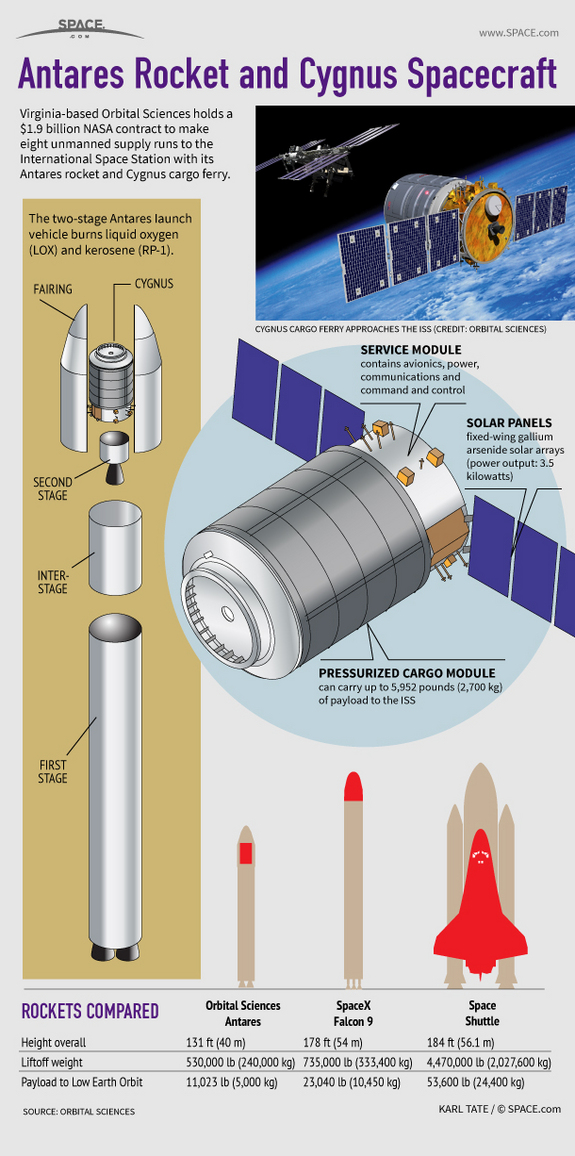
Orbital Sciences: Antares Rocket & Cygnus Spacecraft Explained - Infographic

Find out about Orbital Sciences' new Antares rocket and Cygnus cargo ferry spacecraft in this SPACE.com Infographic.

Credit: Space.com 

All about our solar system, outer space and exploration

Virginia-based Orbital Sciences holds a $1.9 billion NASA contract to make eight unmanned supply runs to the International Space Station with its Antares rocket and Cygnus cargo ferry.

Antares Launcher
The two-stage Antares launch vehicle burns liquid oxygen (LOX) and kerosene (RP-1). The rocket's height overall is 131 feet (40 meters). Its liftoff weight is 530,000 pounds (240,000 kilograms). The Antares rocket was originally called Taurus 2.

Cygnus Cargo Tanker
The Cygnus pressurized cargo module can carry up to 5,952 pounds (2,700 kg) of payload to the International Space Station.

At the rear of Cygnus is a service module containing avionics, power, communications and command and control hardware. On the outside of the service module are twin fixed-wing gallium arsenide solar arrays capable of putting out 3.5 kilowatts of electricity.

Future Cygnus spacecraft will be enhanced with a larger pressurized cargo module and lightweight solar panels.