Spacewalker Maxim Suraev works outside the Poisk mini-research module in January 2010. Image Credit: NASA TV
Russian spacewalkers Max Suraev and Alexander Samokutyaev opened the Pirs docking compartment hatch to the vacuum of space at 9:28 a.m. EDT to begin the third spacewalk for Expedition 41 crew members in as many weeks.
Their spacewalk is expected to last six hours. Two U.S. spacewalks took place Oct. 7 and 15.
Russian spacewalkers Max Suraev and Alexander Samokutyaev. Image Credit: NASA TV
The duo’s first task is to remove the Radiometriya experiment that was installed on the Zvezda service module in 2011 and which is no longer required for data collection.
They will then jettison it for a later reentry into the atmosphere where it will burn up. The experiment gathered data to help scientists predict seismic events and earthquakes.
The veteran cosmonauts will then move on to another external experiment and remove its protective cover.
They will photograph the Expose-R experiment before taking a break during the orbital night period.
After orbital sunrise, they will take more photographs of the work area, translate back to Pirs and place the protective cover inside.
The European Space Agency study exposes organic and biological samples to the harsh environment of space and observes how they are affected by cosmic radiation, vacuum and night and day cycles.
American astronauts will undertake a series of urgent spacewalks to repair a broken cooling line on the International Space Station.
NASA has announced that two American astronauts will move soon to replace a busted valve within an external pump module on one of the station's two coolant loops that shut down last week when it reached pre-set temperature limits.
The replacement will be undertaken during three spacewalks by the International Space Station (ISS) crew. The first is set for Saturday, followed by another on Monday and next Wednesday, on Christmas Day.
The spacewalks have directed NASA's attention away from the launch of the Cygnus-3 supply ship, which has been rescheduled for January 2014.
NASA was forced last week to reroute coolant systems when one of the station's coolant loops, Loop-A, automatically shut down due to a temperature fluctuation.
The ISS crew proceeded to move certain electrical systems over to the second loop, NASA reported.
The two coolant loops circulate ammonia to keep internal and external equipment cool.
"At no time was the crew or the station itself in any danger," NASA reported.
The space agency said that some non-critical systems were "powered down" as teams analyzed how the valve malfunctioned.
This is not the first time a coolant problem has hampered the ISS.
The ISS crew took an unscheduled spacewalk in May to inspect and fix a coolant leak in its power system. They installed a new cooling pump during a six-hour-long session.
That same coolant loop had a similar problem in November 2012, when an emergency spacewalk was needed to fix a leak.
In this frame grab from video provided by NASA, two Russian flight engineers perform maintenance on the International Space Station, Monday, June 24, 2013. The crew includes three Russians, two Americans and one Italian. The Italian and one American will conduct a pair of spacewalks for NASA in July. (AP Photo/NASA)
Two space station astronauts took care of a little outside maintenance Monday.
Russian flight engineers Fyodor Yurchikhin and Alexander Misurkin replaced a main valve on the International Space Station, after emerging from their 250-mile (400-kilometer)-high home.
"To save the time, I'm embroidering," one of the spacewalkers said in Russian, holding a clump of cord as he worked on the fluid valve. "It's not easy to handle all these ropes."
Later, he added, "OK, now we're doing bead work."
Also on the spacewalkers' to-do list: installing clamps and retrieving science experiments.
Some of the work will pave the way for the arrival of a new Russian compartment at the end of this year.
The year's third spacewalk was under the direction of Russian Mission Control outside Moscow. The four other space station residents monitored the action from inside.
Yurchikhin arrived at the space station just a few weeks ago. Misurkin has been on board since March.
The crew includes three Russians, two Americans and one Italian.
The Italian and one American will conduct a pair of spacewalks for NASA in July.
Begun in 1998, the space station still is one room short.
The Russian Space Agency plans to launch a research lab to replace the Pirs air lock that has been in place since 2001.
An unmanned Proton rocket will hoist the lab, which also will serve as an air lock for spacewalk preparations and a docking port for visiting craft.
As for Pirs—Russian for pier—it will be cut loose before the launch of its replacement and burn up upon re-entry as junk.
In a paper published in the journal ACS Nano, scientists described how graphene, a single-atom-thick sheet of carbon, can be made from just about any carbon source, including food, insects, and waste.
“I said we could grow it from any carbon source, for example, a Girl Scout cookie, because Girl Scout cookies were being served at the time,” says James Tour, professor of mechanical engineering and materials science and of computer science at Rice University. “So one of the people in the room said, ‘Yes, please do it. … Let’s see that happen.’”
A sheet of graphene is so thin that one sheet made from one box of shortbread cookies would cover nearly three football fields.
The scientists say the experiment is a whimsical way to make a serious point: that graphene, touted as a miracle material for its toughness and conductivity since its discovery in 2004, can be drawn from many sources.
Tour and graduate students Gedeng Ruan, lead author of the paper, and Zhengzong Sun, also tested other materials, including chocolate, grass, polystyrene plastic, insects (a cockroach leg) and even dog faeces.
In every case, the researchers were able to make high-quality graphene via carbon deposition on copper foil.
In this process, the graphene forms on the opposite side of the foil as solid carbon sources decompose; the other residues are left on the original side. Typically, this happens in about 15 minutes in a furnace flowing with argon and hydrogen gas and turned up to 1,050 degrees Celsius.
Tour expects the cost of graphene to drop quickly as commercial interests develop methods to manufacture it in bulk. In earlier research, Tour described a long-sought way to make graphene-based transparent electrodes by combining graphene with a fine aluminum mesh.
The material could possibly replace expensive indium tin oxide as a basic element in flat-panel and touch-screen displays, solar cells, and LED lighting.
The new findings have “a lot to do with current research topics in academia and in industry,” Tour says. “Carbon—or any element—in one form can be inexpensive and in another form can be very expensive.”
Diamonds are a good example., he says. “You could probably get a very large diamond out of a box of Girl Scout cookies.”
Sandia National Laboratory, the Air Force Office of Scientific Research, and the Office of Naval Research MURI program funded the research.
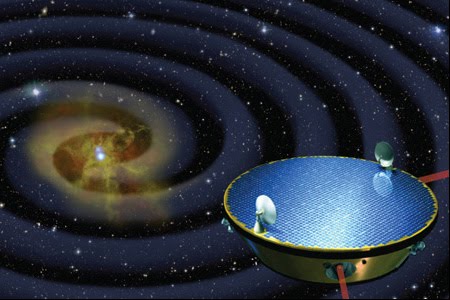
NASA and ESA are planning to launch three spacecraft into orbit around the sun some three million miles apart, and then have them shoot lasers at each other, Popular Science reports.
You may want to stop for a moment and just bask in the coolness of that idea. Back yet? The purpose of this project will be to prove one last part of Einstein's theory of relativity: the existence of gravitational waves, or "huge ripples in time and space that flow outwards from the collision of huge celestial bodies like black holes," as the report said.
To do this, NASA and ESA will deploy LISA, the Laser Interferometer Space Antenna; it consists of three spacecraft that will fire lasers at each other and measure the relative positions of floating cubes of gold and platinum alloy--with a precision of 40 millionths of a millionth of a meter.




 Posts
Posts


