Showing posts with label SPIRE. Show all posts

Wednesday, June 18, 2014

ESA Herschel mission examines New molecules around old stars

ESA Herschel image of the Helix Nebula using the SPIRE instrument at wavelengths around 250 micrometres, superimposed on Hubble image of the nebula. 

The spectrum corresponds to the outer region of the Helix Nebula outlined on the SPIRE image. 

It identifies the OH+ molecular ion, which is needed for the formation of water.

ESA’s Herschel space observatory is the first to detect this molecule in planetary nebulas, the product of dying Sun-like stars. 

Credit: Hubble image: NASA/ESA/C.R. O’Dell (Vanderbilt University), M. Meixner & P. McCullough (STScI); Herschel image: ESA/Herschel/SPIRE/MESS Consortium/M. Etxaluze et al.

Using ESA’s Herschel space observatory, astronomers have discovered that a molecule vital for creating water exists in the burning embers of dying Sun-like stars.

When low- to middleweight stars like our Sun approach the end of their lives, they eventually become dense, white dwarf stars.

In doing so, they cast off their outer layers of dust and gas into space, creating a kaleidoscope of intricate patterns known as planetary nebulas.

These actually have nothing to do with planets, but were named in the late 18th century by astronomer William Herschel, because they appeared as fuzzy circular objects through his telescope, somewhat like the planets in our Solar System.

Over two centuries later, planetary nebulas studied with William Herschel's namesake, the Herschel space observatory, have yielded a surprising discovery.

Like the dramatic supernova explosions of weightier stars, the death cries of the stars responsible for planetary nebulas also enrich the local interstellar environment with elements from which the next generations of stars are born.

While supernovas are capable of forging the heaviest elements, planetary nebulas contain a large proportion of the lighter 'elements of life' such as carbon, nitrogen, and oxygen, made by nuclear fusion in the parent star.

A star like the Sun steadily burns hydrogen in its core for billions of years but once the fuel begins to run out, the central star swells into a red giant, becoming unstable and shedding its outer layers to form a planetary nebula.

The remaining core of the star eventually becomes a hot white dwarf pouring out ultraviolet radiation into its surroundings.

This intense radiation may destroy molecules that had previously been ejected by the star and that are bound up in the clumps or rings of material seen in the periphery of planetary nebulas.

The Ring Nebula at optical wavelengths as seen by the Hubble Space Telescope, with Herschel data acquired with SPIRE and PACS over a wavelength range of 51–672 micrometres for the region identified. 

The spectra have been cropped and the scales stretched in order to show the OH+ emission, a molecular ion important for the formation of water. 

ESA’s Herschel space observatory is the first to detect this molecule in planetary nebulas, the product of dying Sun-like stars.

Credit: Hubble image: NASA/ESA/C. Robert O’Dell (Vanderbilt University) Herschel data: ESA/Herschel/PACS & SPIRE/ HerPlaNS survey/I. Aleman et al. 

The harsh radiation was also assumed to restrict the formation of new molecules in those regions.

But in two separate studies using Herschel astronomers have discovered that a molecule vital to the formation of water seems to rather like this harsh environment, and perhaps even depends upon it to form.

The molecule, known as OH+, is a positively charged combination of single oxygen and hydrogen atoms.

The two studies are the first to identify in planetary nebulas this critical molecule needed for the formation of water, although it remains to be seen if the conditions would actually allow water formation to proceed.

"The proximity of the Helix Nebula means we have a natural laboratory on our cosmic doorstep to study in more detail the chemistry of these objects and their role in recycling molecules through the interstellar medium," says Dr M. Etxaluze.

"Herschel has traced water across the Universe, from star-forming clouds to the asteroid belt in our own Solar System," says Göran Pilbratt, ESA's Herschel project scientist.

"Now we have even found that stars like our Sun could contribute to the formation of water in the Universe, even as they are in their death throes."

More information: "Herschel planetary nebula survey (HerPlaNS). First detection of OH+ in planetary nebulae," by I. Aleman et al., and "Herschel spectral-mapping of the Helix Nebula (NGC 7293): extended CO photodissociation and OH+ emission," by M. Etxaluze et al., are published in Astronomy & Astrophysics.

Saturday, June 14, 2014

Herschel Space Observatory uncovers a weird ring of dusty material

Image credit: ESA/NASA/JPL-Caltech/Whitman College

The Herschel Space Observatory has uncovered a weird ring of dusty material while obtaining one of the sharpest scans to date of a huge cloud of gas and dust, called NGC 7538.

The gigantic ring structure is situated at the center-top of this image.

The odd ovoid possesses the mass of 500 suns, with its long axis spanning about 35 light-years and its short axis about 25 light-years.

Astronomers often see ring and bubble-like structures in cosmic dust clouds.

The strong winds cast out by the most massive stars, called O-type stars, can generate these expanding puffs, as can their explosive deaths as supernovas but no energetic source or remnant of a deceased O-type star, such as a neutron star, is apparent within the center of the ring.

It is possible that a big star blew the bubble and, because stars are all in motion, subsequently left the scene, escaping detection.

Astronomers study stellar nurseries such as NGC 7538 to better learn how stars come into being. The Herschel observations have revealed numerous clumps of material in NGC 7538, a baker's dozen of which may evolve into O-type stars.

Early in the star-formation process, these clumps remain quite cold, just a few tens of degrees above absolute zero.

At these temperatures, the clumps emit the bulk of their radiation in the low-energy, submillimeter and infrared light that Herschel was specifically designed to detect.

Finding the mysterious ring came as an unexpected bonus during the Herschel observing run.

The blue and green colours in this image represent 70- and 160-micron data, respectively, from Herschel's Photoconductor Array Camera and Spectrometer (PACS) instrument.

The red colours are 250-micron observations obtained from Herschel's Spectral and Photometric Imaging Receiver (SPIRE) instrument.

Tuesday, November 26, 2013

ESA Herschel Video: 37 thousand science observations

This animation shows the timeline of over 37 000 scientific observations made by ESA's Herschel space observatory throughout its entire mission, condensed into less than a minute.

The animation was prepared by Pedro Gómez-Alvarez in the Herschel Science Centre Community Support Group and presented by Herschel's Project Scientist Göran Pilbratt during the opening session of The Universe Explored by Herschel symposium held at ESA's ESTEC facility, in Noordwijk, the Netherlands, last month.

The animation runs from launch, on 14 May 2009, until the infrared observatory made its last observation on 29 April 2013.

Running through the centre of the graphic is the 'ecliptic plane' tracing the paths of the planets with respect to Herschel's viewpoint from its orbit around L2, which is located 1.5 million kilometres behind the Earth as viewed from the Sun.

A horseshoe shape marks the Galactic Plane, the direction in which much of the Milky Way's mass lies, and where many of Herschel's observations were focused.

In total, Herschel observed almost a tenth of the entire sky for over 23 500 hours, providing new views into the previously hidden Universe, pointing to unseen star birth and galaxy formation, and tracing water through the Universe from molecular clouds to newborn stars and to their planet-forming discs and belts of comets.

Its two camera/imaging spectrometers, PACS (Photoconductor Array Camera and Spectrometer) and SPIRE (Spectral and Photometric Imaging Receiver), which together covered wavelengths of 55–670 microns, provided about two thirds of Herschel's sky coverage in parallel imaging mode.

These data points are shown in yellow. PACS and SPIRE photometry observations are indicated in blue and green, which together with spectroscopy performed with PACS, SPIRE and the third science instrument, HIFI (Heterodyne Instrument for the Far Infrared, covering wavelength bands of 157–212 microns and 240–625 microns) make up the remainder.

Wednesday, January 30, 2013

ESA Herschel Image: Andromeda's Colourful Rings

The ring-like swirls of dust filling the Andromeda galaxy stand out colourfully in this new image from the Herschel Space Observatory, a European Space Agency mission with important NASA participation.

The glow seen here comes from the longer-wavelength, or far, end of the infrared spectrum, giving astronomers the chance to identify the very coldest dust in our galactic neighbor.

These light wavelengths span from 250 to 500 microns, which are a quarter to half of a millimeter in size.

Herschel's ability to detect the light allows astronomers to see clouds of dust at temperatures of only a few tens of degrees above absolute zero.

These clouds are dark and opaque at shorter wavelengths. The Herschel view also highlights spokes of dust between the concentric rings.

The colours in this image have been enhanced to make them easier to see, but they do reflect real variations in the data. The very coldest clouds are brightest in the longest wavelengths, and coloured red here, while the warmer ones take on a bluish tinge.

These data, together with those from other observatories, reveal that other dust properties, beyond just temperature, are affecting the infrared color of the image.

Clumping of dust grains, or growth of icy mantles on the grains towards the outskirts of the galaxy, appear to contribute to these subtle color variations.

These observations were made by Herschel's Spectral and Photometric Imaging Receiver (SPIRE) instrument. 

The data were processed as part of a project to improve methods for assembling mosaics from SPIRE observations.

Light with a wavelength of 250 microns is rendered as blue, 350-micron is green, and 500-micron light is red. Color saturation has been enhanced to bring out the small differences at these wavelengths.

Image credit: ESA/NASA/JPL-Caltech/NHSC

Friday, September 24, 2010

ESA First Results From Herschel (HSO) Mars Observations


The Herschel Space Observatory is providing its first results on Mars. An accurate globally-averaged temperature profile of the Martian atmosphere may cause scientists to revise their models about atmospheric circulation on Mars.

The first sub-millimeter observation of molecular oxygen on the planet may lead to a completely new picture of the oxygen distribution in the Martian atmosphere.

These are only a few of the new discoveries presented by Dr. Paul Hartogh at the European Planetary Science Congress in Rome.

The Herschel Space Observatory (HSO) is a space-borne far-infrared observation facility of the European Space Agency, launched on 14 May 2009. The 'Water and related chemistry in the Solar System' project, was conceived with the sole aim to determine the origin, evolution, and distribution of water in Mars, the outer planets, Titan, Enceladus and the comets.

"Water vapor plays a key role in the Martian atmospheric chemistry and physics," says Dr. Hartogh of the Max Planck Institute for Solar System Research in Germany. Herschel has observed Mars with its three instruments, the Heterodyne Instrument for the Far Infrared (HIFI), the Photodetector Array Camera and Spectrometer, and the Spectral and Photometric Imaging Receiver (SPIRE).

SPIRE has provided the first continuous spectrum of the Martian atmosphere in the spectral range in the far-IR/sub-mm, as well as, the first complete set of water vapor and carbon monoxide (CO) content in this range.

"SPIRE was designed for very faint sources, however unexpectedly it could even provide high quality data from the brightest far infrared object Herschel observed in the solar system," says Dr. Hartogh.

Wednesday, September 15, 2010

Herschel Finds Hot Water Vapour Around a Carbon Star


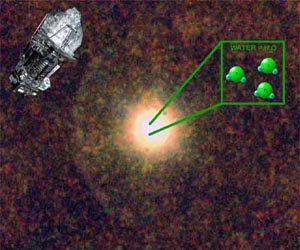
The red giant pulsating carbon star CW Leonis as seen by the PACS and SPIRE cameras and spectrometers on board Herschel.

The star itself is too bright to be seen well but it is releasing material in a violent stellar wind, some of which is seen in a 'bow shock' to the left of the star in this image.

Observations have shown that water vapor is being formed deep down near the surface of the star; a place where it was previously thought to be impossible to appear.

This means that the stellar wind must be much more 'clumpy' than previously foreseen, with some regions having a much weaker wind than others.

This allows ultraviolet light from interstellar space to reach the deeper, warmer regions and trigger the creation of water vapor. Credit: ESA / KU Leuven / LUTH / Observatoire de Paris

Thursday, May 6, 2010

ESA Herschel Images: Our Celestial Backyard

A picture of the first field observed in the H-ATLAS survey, made by combining the images made with the SPIRE camera at 250, 350 and 500 microns.

The colours in the image are not real but have been used to represent the different infrared wavelengths.

The faint blue whisps at the top of the image show dust in our own Galaxy and the bright object just above the centre of the picture is a 'Bok globule', a dense cloud of gas and dust, also in our Galaxy, in which a small star may be forming.

The other objects in the picture are all galaxies, at distances up to 12 billion light-years.

The image shows that the survey is detecting objects in our celestial ‘backyard’ and also other, further ones that we are seeing as they were not long after the Big Bang.

Credits: ESA/ATLAS Consortium