Showing posts with label cameras. Show all posts

Sunday, March 10, 2013

ESA's ExoMars: Neptec wins contract to develop cameras

The main challenge in the development of these cameras will be to design them to withstand the extreme environmental conditions that will be experienced on the surface of Mars.

Neptec Design Group has signed a contract with EADS Astrium UK Limited for the design and build of navigation cameras for the ExoMars Rover.

The ExoMars Programme has the goals of understanding the Martian environments and establishing whether life had or could now exist on Mars.

The Programme comprises two Missions: an Orbiter in 2016; and a Rover Mission in 2018.

Contracts with European organisations represent an increasing portion of Neptec's Space Exploration business as the company expands beyond its core business with the NASA and the Canadian Space Agency (CSA).

"We are thrilled to be a part of this exciting journey in exploring the planet Mars," said Mike Kearns, Neptec President of Space Exploration.

"The vision cameras that we are developing will be the eyes of the rover as it explores the surface of Mars." The main challenge in the development of these cameras will be to design them to withstand the extreme environmental conditions that will be experienced on the surface of Mars.

"This ExoMars programme is an example of what can be accomplished when governments and industry work together in the space sector," said Neptec's CEO Iain Christie.

"The contract for these navigation cameras has involved the co-operation of the Canadian Space Agency, and the European Space Agency."

The ExoMars Programme is a European Space Agency Robotic Exploration Mission under the prime contractorship of Thales Alenia Space Italia, with EADS Astrium UK Limited leading the Rover Vehicle developments.

Thursday, September 13, 2012

Japan's Mount Sakurajima: Volcanic explosion

Japan's Mount Sakurajima explodes in dramatic fashion and it was all captured on four cameras set up in the surrounding area.

Saturday, September 8, 2012

NASA Mars Rover Curiosity: Sniffs, Drives and Tests it's Robotic Arm

The Mars Science Laboratory took in samples of the Martian atmosphere, started driving towards its first target site (Glenelg) and will park to test all the functions of its arm carrying scientific remote sensing intruments.

Thursday, August 9, 2012

NASA Mars Rover Curiosity's Self-Portrait by Navcams

This Picasso-like self-portrait of NASA's Curiosity rover was taken by its navigation cameras, located on the now-upright mast. 

The camera snapped pictures 360-degrees around the rover, while pointing down at the rover deck, up and straight ahead.

Those images are shown here in a polar projection. 

Most of the tiles are thumbnails, or small copies of the full-resolution images that have not been sent back to Earth yet. Two of the tiles are full-resolution.

Image Credit: NASA/JPL-Caltech


Tuesday, August 7, 2012

Guide to NASA MARS Rover Curiosity's Cameras - NavCams

Curiosity also has two pairs of Navigation cameras (Navcams) mounted up high on its mast.

Providing similar image quality as the Hazcams, these cameras will be used to help maneuver the rover to interesting locations.

With a fixed-aperture f/12 focus, the Navcams will capture 45-degree square images.

Teledyne DALSA is proud to contribute to the mission's success.

The image sensors for the Curiosity's Navcams and Hazcams were built in our Bromont, Quebec, semiconductor foundry, as were those on the previous Spirit and Opportunity rovers.

The hazard avoidance cameras are installed on each corner of the rover and the 3D stereoscopic navigation cameras are part of the rover's camera mast.

Guide to NASA MARS Rover Curiosity's Cameras - Haz Cam

Curiosity's hazard avoidance and navigation cameras contain Teledyne DALSA-built CCDs.

The first images from Curiosity came via the machine’s Hazard-Avoidance cameras or Hazcams.

These cameras are responsible for making sure Curiosity doesn’t run into any bad obstacles, and can take black-and-white 1-megapixel images of the area underneath and near the rover.

There are eight Hazcams arranged in pairs on the probe’s front and back, because it can just as easily drive backwards as forwards.

Each camera has a wide-field, fish-eye lens that provides a 124-degree view of the surrounding terrain.

The Hazcams were sheltered behind transparent protective covers immediately after landing, in anticipation of the dust that was kicked up during touchdown, which is why those initial pictures were so splotchy.

Those dust covers will be shot off with a small pyrotechnic device to get clearer images. When the rover gets moving, the front Hazcam pairs will take 3D images of possible targets to help scientists plan the motion of Curiosity’s sample-collecting arm.

Guide to NASA MARS Rover Curiosity's Cameras - MAHLI

For inspecting Martian rocks and soil up close, Curiosity will use its Mars Hand Lens Imager (MAHLI).

Sitting on the end of the rover’s robotic arm, MAHLI’s 2-megapixel color camera can focus on an object as close as three-quarters of an inch away.

It will act as a microscope, resolving material down to 15 microns, roughly half the diameter of a human hair.

MAHLI will be able to work night and day using four white light LEDs and two ultraviolet LEDs.

Images from the camera will be calibrated with a smartphone-sized plaque affixed to the side of the rover that contains colour chips, a stair-step pattern for depth, and a 1909 U.S. penny.

The penny was chosen as a nod to geologists’ tradition of placing a coin for size reference in close-up photographs of rocks.

Guide to NASA MARS Rover Curiosity's Cameras - MastCam

On the ground, the rover’s main workhorse cameras are the impressive MastCams.

Sitting 7 feet above the surface, these 2-megapixel cameras will provide color images and video of the surroundings.

Pictures taken with the MastCams will give you a feeling of what it’s like to stand on Mars, but with superhuman eyesight.

Different filters can be rotated in front of the MastCams, providing images in visible and near-infrared wavelengths.

The two nearly identical MastCams will combine to take 3-D stereo images. They can focus on objects as close as about 7 feet from the rover and see details down to roughly a few hundred microns.

They will see in “true color,” or approximately what your eyes would see if you were there with Curiosity.

Natural lighting on Mars tends to be slightly redder than on Earth because of the high amount of dust in the air.

So the rover will be taking images with a slight adjustment that gives them a warm, orangey glow similar to sunlight at sunset on Earth to capture this effect. The MastCams will also be taking images without this feature.

One of the biggest requests that scientists had for Curiosity was the addition of a telephoto lens.

The previous rovers, Spirit and Opportunity, could see details about as well as a person would on Mars.

But MastCam’s right camera has a 100-mm focal-length lens that provides three times the resolution of previous Mars rover cameras.

It can distinguish between a football and a basketball from seven football fields away.

While the left camera, with its 34-mm lens, can’t see as well, it will provide much wider views – about 15 degrees versus the right camera’s five degree field-of-view.

The MastCams can take full-color 360-degree panoramic images by stitching together 150 individual photos taken in a slowly rotating circle.

Finally, the cameras can also take 720p high-definition video at a rate of about 10 frames per second.

Guide to NASA Mars Curiosity Rover's Cameras - MARDI

Curiosity is packed with no fewer than 17 cameras to shoot high-quality photos and videos in black-and-white, color, and 3-D stereo of the Martian landscape.

While scientists are no doubt quite eager for the information that these images will contain, most of us will be excited to live vicariously through the rover and experience some breathtaking views on Mars.

First up is the Mars Descent Imager (MARDI), which recently beamed back an amazing video of the rover’s nail-biting descent.

MARDI turned on during the final few minutes of the “Seven Minutes of Terror” and recorded a full-color high-definition movie as the ground rushed up to meet the rover.

With this film (and the coming high-def version), you get to experience what the wild ride down to the surface looked like.

MARDI is a 2-megapixel wide-angle camera mounted toward the front on the port side of Curiosity. The camera came to life just after the spacecraft’s heat shield jettisoned, taking images of a roughly 2 by 2.5-mile square, with a resolution of about 8 feet per pixel.

The final fully-in-focus images came when the rover was about 15 feet off the ground. In addition to a thrilling film, MARDI will provide scientists the opportunity to know exactly where Curiosity landed and learn a bit about the surrounding area.

Wednesday, May 2, 2012

JCMT: The first detailed image of filamentary structure in Orion A cloud

The first detailed image of filamentary structure traced in the Northern part of the Orion A cloud, showing where the stars are forming from clumps of cold gas and dust. 

The ability to image condensations of cold dust with the earlier SCUBA camera, and more recently with SCUBA-2, has made the JCMT one of the choice instruments in the world for studying the earliest stages of star formation.

Credit: Johnstone et al.

Thursday, September 22, 2011

Scottish Zoological Team (SZSS) Photograph Rare giant armadillo

A rare giant armadillo has been caught on camera by researchers in the wetlands of central Brazil.

Little is known about the mysterious mammals, which can reach 1.5m in length and weigh up to 50kg.

In the past, the species' nocturnal, solitary lifestyles have posed a considerable challenge for scientists wishing to study them.

Conservationists now hope to learn more about the vulnerable animals using automatic camera traps.

At up to twice the size of more familiar species, giant armadillos (Priodontes maximus) are known to live in undisturbed forest near to water sources in South America.

But the species have a patchy distribution and spend their days in underground burrows making confirmed sightings rare.

Researchers from the Royal Zoological Society of Scotland (RZSS) spent 10 weeks intensively searching for the elusive mammals in a region of the Pantanal, one of the world's largest wetlands spanning Brazil, Bolivia and Paraguay.

Using cameras provided by Chester Zoo, the team were able to capture rare photographs of the animals.

"The cameras will offer critical pieces of information for the assessment of the status of giant armadillo populations in Brazil," said Dr Arnaud Desbiez, a conservation biologist from RZSS who runs the Giant Armadillo Project.

ARMADILLO FACTS

  • Little is known about giant armadillos but scientists have identified that their long claws are suitable for digging up termite mounds for food
  • Unlike their smaller relatives, these large animals are unable to fully roll into a protective ball and so burrow to escape predators
  • Their armour-like shell is made of 11 to 13 hinged bands of bony plates covered in scales

Wednesday, April 27, 2011

DLR Measures Owl Wing Shape in Flight

The flight of birds is still largely unexplored; in particular, the movements performed during the beat of a wing and the airflow around the wing remain a puzzle to scientists.

The German Aerospace Center (Deutsches Zentrum für Luft- und Raumfahrt; DLR), in collaboration with RWTH Aachen University (Rheinisch-Westfälische Technische Hochschule Aachen) and the German Armed Forces University in Munich (Universität der Bundeswehr München) is addressing this question.

Starting on 26 April 2011, the scientists will be photographing the wings of an owl while in flight inside a closed room at RTWH Aachen University to obtain information about the how the shape of the bird's wing changes during flight.

This calls for basic research. Since the launch of the project in 2008, the team of scientists has succeeded in studying owl wings during gliding flight; the forthcoming measurements will be focussing on the wing beat phase.

The results obtained will not only help to determine the airflow around the wing, enabling the flight of birds to be better understood, but will also be incorporated into modern aviation. "It's not as though we are going to apply these results to an A380 – its flight characteristics bear no resemblance to those of an owl.

But the research results can be applied to smaller, unmanned aerial vehicles, or UAVs," explains Andreas Dillmann, Head of the DLR Institute of Aerodynamics and Flow Technology.


Researching the sequence of movements in flight
It is not easy to study the shape of a bird's wing during flight. In contrast to a mechanical device, whose location is known, it is not possible to forecast where a living creature will be next.

"In some of the tests, the owl may fly slightly higher, or slightly lower; it all depends. Although this may cause difficulties, the owls should not be influenced in any way, since we want to ensure that the flight is as authentic as possible," explains Thomas Wolf from the DLR Institute of Aerodynamics and Flow Technology.

To determine the position of the owl in the room and the shape of its wing surface area, Wolf projects a pattern onto the upper and lower sides of the owl's wings and records it using state-of-the-art video technology.

Afterwards, he and his colleagues can assign various image points to this pattern on the computer, from which they can calculate the shape of the wing surface. This enables researchers to track the sequences of movements.

The optical measuring system has an accuracy of approximately 0.5 millimetres. The entire wing has been analysed during gliding flight, with the exception of the leading edge. Currently, the curvature of the wing prevents this part from being measured accurately; software to accomplish this is under development.


These trials will use eight cameras, four taking photographs from above and the other four from below. The dot pattern will be projected onto the wings of the owl from above and below as well.

This projector-based measuring system can also be useful for the aviation sector; some mechanical components, such as a turbine, cannot be 'painted' with patterns or templates for accurate measurement purposes – the paint would burn off when the turbine started.

However, if an optical measurement check for quality control purposes is required, it is possible to apply such a pattern through the use of projectors.

Read more here

Thursday, March 10, 2011

Disposable endoscopic camera: Size of a grain of salt

Tiny video cameras mounted on the end of long thin fiber optic cables, commonly known as endoscopes, have proven invaluable to doctors and researchers wishing to peer inside the human body.

Endoscopes can be rather pricey, however, and like anything else that gets put inside peoples' bodies, need to be sanitized after each use.

A newly-developed type of endoscope is claimed to address those drawbacks, by being so inexpensive to produce that it can be thrown away after each use – Mother Nature presumably would not approve. Not only that, but it also features what is likely the world's smallest complete video camera, which is just one cubic millimeter in size.

The prototype endoscope was designed at Germany's Fraunhofer Institute for Reliability and Microintegration, in collaboration with Awaiba GmbH and the Fraunhofer Institute for Applied Optics and Precision Engineering.

Ordinarily, digital video cameras consist of a lens, a sensor, and electrical contacts that relay the data from the sensor. Up to 28,000 sensors are cut out from a silicon disc known as a wafer, after which each one must be individually wired up with contacts and mounted to a lens.

In Fraunhofer's system, contacts are added to one side of the sensor wafer while it's still all in one piece. That wafer can then be joined face-to-face with a lens wafer, after which complete grain-of-salt-sized cameras can be cut out from the two joined wafers.

Not only is this approach reportedly much more cost-effective, but it also allows the cameras to be smaller and more self-contained – usually, endoscopic cameras consist of a lens at one end of the cable, with a sensor at the other.

The new camera has a resolution of 62,500 pixels, and it transmits its images via an electrical cable, as opposed to an optical fiber. Its creators believe it could be used not only in medicine, but also in fields such as automotive design, where it could act as an aerodynamic replacement for side mirrors, or be used to monitor drivers for signs of fatigue.

They hope to bring the device to market next year.

Wednesday, September 15, 2010

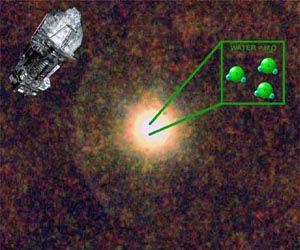
Herschel Finds Hot Water Vapour Around a Carbon Star


The red giant pulsating carbon star CW Leonis as seen by the PACS and SPIRE cameras and spectrometers on board Herschel.

The star itself is too bright to be seen well but it is releasing material in a violent stellar wind, some of which is seen in a 'bow shock' to the left of the star in this image.

Observations have shown that water vapor is being formed deep down near the surface of the star; a place where it was previously thought to be impossible to appear.

This means that the stellar wind must be much more 'clumpy' than previously foreseen, with some regions having a much weaker wind than others.

This allows ultraviolet light from interstellar space to reach the deeper, warmer regions and trigger the creation of water vapor. Credit: ESA / KU Leuven / LUTH / Observatoire de Paris