The pale rock in the upper center of this image, about the size of a human forearm, includes a target called "Esperance," which was inspected by NASA's Mars Exploration Rover Opportunity.
This image is a composite of three exposures taken by Opportunity's panoramic camera during the 3,262nd Martian day, or sol, of the rover's work on Mars (March 28, 2013).
CREDIT: NASA/JPL-Caltech/Cornell/Arizona State Univ.
NASA's Mars rover Opportunity has made perhaps the biggest discovery of its nearly 10-year career, finding evidence that life may have been able to get a foothold on the Red Planet long ago.
The Opportunity rover spotted clay minerals in an ancient rock on the rim of Mars' Endeavour Crater, suggesting that benign, neutral-pH water once flowed through the area, scientists said.
"This is water you could drink," Opportunity principal investigator Steve Squyres of Cornell University told reporters today (June 7), explaining why the rock, dubbed "Esperance," stands out from other water-soaked stones the rover has studied.
"This is water that was probably much more favorable in its chemistry, in its pH, in its level of acidity, for things like prebiotic chemistry — the kind of chemistry that could lead to the origin of life," Squyres added.
Showing posts with label finds. Show all posts
Friday, June 7, 2013
Thursday, May 9, 2013
ESA Hubble finds dead stars 'polluted' with planetary debris
This illustration is an artist's impression of the thin, rocky debris disc discovered around the two Hyades white dwarfs.
Rocky asteroids are thought to have been perturbed by planets within the system and diverted inwards towards the star, where they broke up, circled into a debris ring, and were then dragged onto the star itself.
Credit: NASA, ESA, STScI, and G. Bacon (STScI)
The NASA/ESA Hubble Space Telescope has found signs of Earth-like planets in an unlikely place: the atmospheres of a pair of burnt-out stars in a nearby star cluster.
The white dwarf stars are being polluted by debris from asteroid-like objects falling onto them. This discovery suggests that rocky planet assembly is common in clusters, say researchers.
The stars, known as white dwarfs—small, dim remnants of stars once like the Sun—reside 150 light-years away in the Hyades star cluster, in the constellation of Taurus (The Bull).
The cluster is relatively young, at only 625 million years old.
Astronomers believe that all stars formed in clusters. However, searches for planets in these clusters have not been fruitful—of the roughly 800 exoplanets known, only four are known to orbit stars in clusters.
This scarcity may be due to the nature of the cluster stars, which are young and active, producing stellar flares and other outbursts that make it difficult to study them in detail.
A new study led by Jay Farihi of the University of Cambridge, UK, instead observed "retired" cluster stars to hunt for signs of planet formation.
Hubble's spectroscopic observations identified silicon in the atmospheres of two white dwarfs, a major ingredient of the rocky material that forms Earth and other terrestrial planets in the Solar System.
This silicon may have come from asteroids that were shredded by the white dwarfs' gravity when they veered too close to the stars.
The rocky debris likely formed a ring around the dead stars, which then funnelled the material inwards.
The debris detected whirling around the white dwarfs suggests that terrestrial planets formed when these stars were born.
After the stars collapsed to form white dwarfs, surviving gas giant planets may have gravitationally nudged members of any leftover asteroid belts into star-grazing orbits.
"We have identified chemical evidence for the building blocks of rocky planets," says Farihi. "When these stars were born, they built planets, and there's a good chance that they currently retain some of them. The signs of rocky debris we are seeing are evidence of this—it is at least as rocky as the most primitive terrestrial bodies in our Solar System."
Rocky asteroids are thought to have been perturbed by planets within the system and diverted inwards towards the star, where they broke up, circled into a debris ring, and were then dragged onto the star itself.
Credit: NASA, ESA, STScI, and G. Bacon (STScI)
The NASA/ESA Hubble Space Telescope has found signs of Earth-like planets in an unlikely place: the atmospheres of a pair of burnt-out stars in a nearby star cluster.
The white dwarf stars are being polluted by debris from asteroid-like objects falling onto them. This discovery suggests that rocky planet assembly is common in clusters, say researchers.
The stars, known as white dwarfs—small, dim remnants of stars once like the Sun—reside 150 light-years away in the Hyades star cluster, in the constellation of Taurus (The Bull).
The cluster is relatively young, at only 625 million years old.
Astronomers believe that all stars formed in clusters. However, searches for planets in these clusters have not been fruitful—of the roughly 800 exoplanets known, only four are known to orbit stars in clusters.
This scarcity may be due to the nature of the cluster stars, which are young and active, producing stellar flares and other outbursts that make it difficult to study them in detail.
![]() |
| Jay Farihi |
Hubble's spectroscopic observations identified silicon in the atmospheres of two white dwarfs, a major ingredient of the rocky material that forms Earth and other terrestrial planets in the Solar System.
This silicon may have come from asteroids that were shredded by the white dwarfs' gravity when they veered too close to the stars.
The rocky debris likely formed a ring around the dead stars, which then funnelled the material inwards.
The debris detected whirling around the white dwarfs suggests that terrestrial planets formed when these stars were born.
After the stars collapsed to form white dwarfs, surviving gas giant planets may have gravitationally nudged members of any leftover asteroid belts into star-grazing orbits.
"We have identified chemical evidence for the building blocks of rocky planets," says Farihi. "When these stars were born, they built planets, and there's a good chance that they currently retain some of them. The signs of rocky debris we are seeing are evidence of this—it is at least as rocky as the most primitive terrestrial bodies in our Solar System."
Labels:
dead stars,
ESA,
finds,
Hubble,
Nasa,
planetary debris,
polluted
Wednesday, September 15, 2010
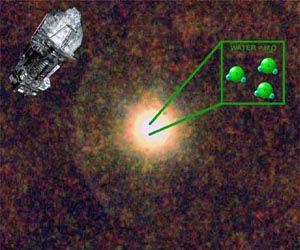
Herschel Finds Hot Water Vapour Around a Carbon Star

The red giant pulsating carbon star CW Leonis as seen by the PACS and SPIRE cameras and spectrometers on board Herschel.
The star itself is too bright to be seen well but it is releasing material in a violent stellar wind, some of which is seen in a 'bow shock' to the left of the star in this image.
Observations have shown that water vapor is being formed deep down near the surface of the star; a place where it was previously thought to be impossible to appear.
This means that the stellar wind must be much more 'clumpy' than previously foreseen, with some regions having a much weaker wind than others.
This allows ultraviolet light from interstellar space to reach the deeper, warmer regions and trigger the creation of water vapor. Credit: ESA / KU Leuven / LUTH / Observatoire de Paris
Labels:
Around,
cameras,
Carbon Star,
CWLeonis,
finds,
Herschel,
Hot Water Vapour,
PACS,
spectrometers,
SPIRE
Friday, July 23, 2010
NASA finds largest molecule
This artist's impression illustrates fullerenes being formed in a planetary nebula, and drifting out into the interstellar medium. Credit: NASA/JPL-Caltech/T. Pyle (SSC)/ESA/K. Noll (STScI)Astronomers have found evidence of buckyballs - carbon molecules shaped like soccer balls - in the nebula around a distant white dwarf star. The discovery marks the largest molecules known to exist in space.
Normally found in chemistry labs, where they are made by vaporizing graphite in the presence of helium, buckyballs were long suspected to form inside stars.
"As soon as they were discovered in the lab it was actually suggested they would be very good candidates to be found in space," astronomer Jan Cami of the University of Western Ontario, who led the new study, told SPACE.com.
Researchers had searched for buckyballs before in the gas and dust between and around stars, but the evidence was inconclusive. Cami and his colleagues identified buckyball molecules, known as C60 because they are made of 60 carbon atoms each.
The buckyballs are about 1 nanometer in size, about three times larger than water molecules, which are about 0.3 nanometers in size and consist of three atoms (one oxygen atom and two hydrogen atoms). One nanometer is a billionth of a meter, or about one ten-thousandth the diameter of a human hair.
The buckyball molecules were discovered in the planetary nebula Tc-1, which is about 6,500 light-years away in the southern constellation Ara. Despite their name, planetary nebulas are actually clouds of gas around stars, not planets.
"What we see is a very clean and very recognizable fingerprint for only two species," Cami said - C60 and a closely related molecule called C70, made of 70 carbon atoms. Both C60 and C70 belong to a class of molecules termed buckminsterfullerenes, or just fullerenes, after architect Buckminster Fuller.
Together the two fullerenes make up about 3 percent of the available carbon around the star, the researchers reported.
Tc-1 contains what is known as an asymptotic giant branch (AGB) star. The inner regions of these stars have become dense, dim stars called white dwarfs, while their outer stellar envelopes have sloughed off.
The resulting cloud of shed layers undergoes chemical reactions and is ionized by radiation from the inner white dwarf, creating a planetary nebula that will eventually become part of the interstellar medium
Thursday, July 1, 2010
Cosmic Evolution Survey (COSMOS) finds 'Slingshot in Space'
There are two possible explanations for this 'slingshot' in space: kickback by a triple black hole system, or the effects of gravitational waves produced after two supermassive black holes merged a few million years earlier.The discovery of this object comes from a large, multi-wavelength survey, known as the Cosmic Evolution Survey (COSMOS).
This survey includes data from Chandra, HST, XMM- Newton, as well as ground-based observatories.
Of the 2,600 X-ray sources found in COSMOS, only one -- named CID-42 and located in a galaxy about 3.9 billion light years away -- coincides with two very close, compact optical sources.
Image Credits: X-ray: NASA/CXC/SAO/F.Civano et al. Optical: NASA/STScI
Labels:
Cosmic Evolution Survey,
cosmos,
finds,
Slingshot in Space
Wednesday, June 16, 2010
NASA Hubble finds Jupiter's hidden Stripe
New Hubble images reveal what happened to one of Jupiter’s main cloud belts: It’s hiding behind ammonia clouds.“Weather forecast for Jupiter’s Southern Equatorial Belt: cloudy with a chance of ammonia,” planetary scientist Heidi Hammel of the Space Science Institute in Boulder, Colorado said in a press release Wednesday.
The gas giant’s characteristic band of dark clouds started fading late last year and had vanished completely by early May, 2010.
Images taken with Hubble’s Wide Field Camera 3 on June 7 — just over three days after an unknown object smacked into the planet — found a layer of white ammonia ice crystal clouds. The ammonia clouds float at a higher altitude than the missing brown clouds, obscuring them from view.
The images show a preview of what’s to come for the dark stripe, too. A chain of dark spots along the boundary of Jupiter’s south tropical zone peek through the white cloud layer as the ammonia thins and dissipates.
“The Hubble images tell us these spots are holes resulting from localized downdrafts. We often see these types of holes when a change is about to occur,” said planetary scientist Amy Simon-Miller of NASA.
The clouds blocking the famous equatorial stripe should clear out similarly in a couple of months, the team predicts.
“The Southern Equatorial Belt last faded in the early 1970s. We haven’t been able to study this phenomenon at this level of detail before,” Simon-Miller added. “The changes of the last few years are adding to an extraordinary database on dramatic cloud changes on Jupiter.”

The images also provided clues to the identity of the mystery object that hit Jupiter on June 3.
A lack of dark debris at the impact site, which would have been kicked up by the object exploding beneath the clouds, suggests that the object was relatively small and burned up in Jupiter’s atmosphere like a meteor.
“Hubble was only one of several observatories that looked for signs of Jupiter’s impact scar, with more results on their way,” planetary scientist Leigh Fletcher of the University of Oxford noted on Twitter. “Gemini, Keck, VLT and IRTF were all racing to find signs of the impact within hours of the event taking place.”
Subscribe to:
Posts (Atom)