Showing posts with label Dusty. Show all posts

Saturday, June 14, 2014

Herschel Space Observatory uncovers a weird ring of dusty material

Image credit: ESA/NASA/JPL-Caltech/Whitman College

The Herschel Space Observatory has uncovered a weird ring of dusty material while obtaining one of the sharpest scans to date of a huge cloud of gas and dust, called NGC 7538.

The gigantic ring structure is situated at the center-top of this image.

The odd ovoid possesses the mass of 500 suns, with its long axis spanning about 35 light-years and its short axis about 25 light-years.

Astronomers often see ring and bubble-like structures in cosmic dust clouds.

The strong winds cast out by the most massive stars, called O-type stars, can generate these expanding puffs, as can their explosive deaths as supernovas but no energetic source or remnant of a deceased O-type star, such as a neutron star, is apparent within the center of the ring.

It is possible that a big star blew the bubble and, because stars are all in motion, subsequently left the scene, escaping detection.

Astronomers study stellar nurseries such as NGC 7538 to better learn how stars come into being. The Herschel observations have revealed numerous clumps of material in NGC 7538, a baker's dozen of which may evolve into O-type stars.

Early in the star-formation process, these clumps remain quite cold, just a few tens of degrees above absolute zero.

At these temperatures, the clumps emit the bulk of their radiation in the low-energy, submillimeter and infrared light that Herschel was specifically designed to detect.

Finding the mysterious ring came as an unexpected bonus during the Herschel observing run.

The blue and green colours in this image represent 70- and 160-micron data, respectively, from Herschel's Photoconductor Array Camera and Spectrometer (PACS) instrument.

The red colours are 250-micron observations obtained from Herschel's Spectral and Photometric Imaging Receiver (SPIRE) instrument.

Wednesday, November 6, 2013

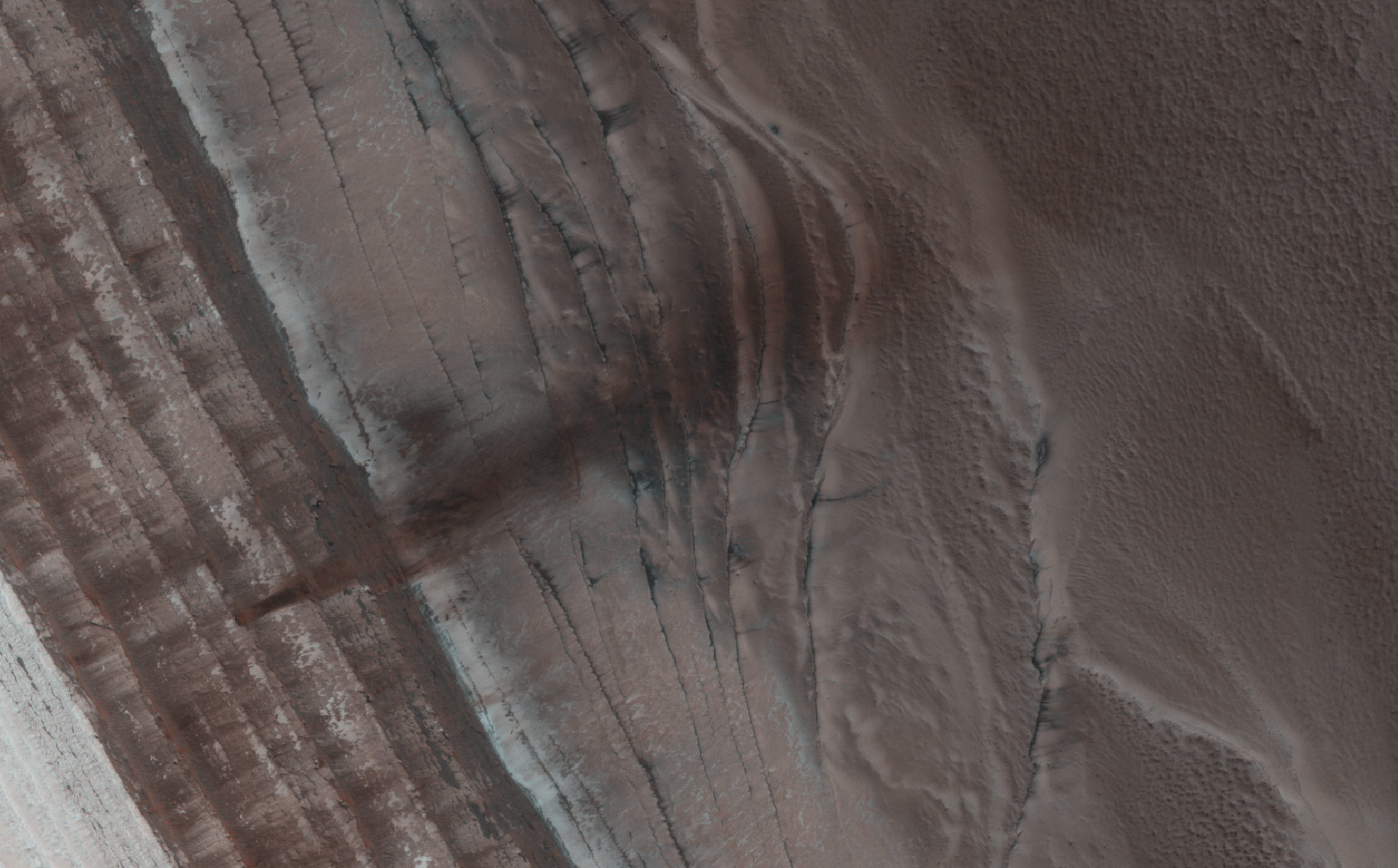
NASA MARS HiRise Image: dark and dusty avalanche

Fallen soil and dust stains an icy cliffside on Mars. 

Credit: NASA/JPL/University of Arizona

Mars may be geologically inactive but that doesn't mean there's nothing happening there—seasonal changes on the Red Planet can have some very dramatic effects on the landscape, as this recent image from the HiRISE camera shows!

When increasing light from the springtime Sun warms up the sides of sheer cliffs made from countless layers of water and carbon dioxide ice near Mars' north pole, some of that CO2 ice sublimes, sending cascades of loose soil and dust down to the terraced base below.

This uncovered material stains the frost-covered polar surface dark, outlining the paths of avalanches for HiRISE to easily spot from orbit. (See the original HiRISE image here.)

Circling Mars since March 2006, the HiRISE camera aboard NASA's Mars Reconnaissance Orbiter has even captured some of these polar landslides in action.

The rust-colored avalanche shown above has fallen hundreds of meters from the middle of a layered ice deposit, spreading nearly a kilometer across the frozen ridges at the base of the cliff. The view was acquired on Sept. 13, 2013.

Check out a video explaining this view and the processes that created it below, narrated by Phil Plait (aka the Bad Astronomer).

Friday, October 19, 2012

ESA Herschel Image: Large Dusty Magellanic Space Cloud

This image shows the Large Magellanic Cloud galaxy in infrared light as seen by ESA's Herschel Space Observatory, a mission with important NASA contributions, and NASA's Spitzer Space Telescope.

In the instruments' combined data, this nearby dwarf galaxy looks like a fiery, circular explosion.

Rather than fire, however, those ribbons are actually giant ripples of dust spanning tens or hundreds of light-years.

Significant fields of star formation are noticeable in the centre, just left of center and at right.

The brightest centre-left region is called 30 Doradus, or the Tarantula Nebula, for its appearance in visible light.

Credit: NASA/ JPL-Caltech