Showing posts with label Finland. Show all posts

Saturday, June 1, 2013

ESA CubeSat Space Tethers need to be Snap-proof

Space tethers hold intriguing potential for satellite manoeuvring, attitude control and even power generation. 

Unfortunately, about half of all orbital tether tests have either failed to deploy or snapped, probably due to micrometeoroid impacts.

ESA is developing on a new snap-proof design for their ongoing Satellite program.

Scanning-electron microscope image of the new design of an ultra-thin  snap-proof solar sail tether.

The tether is soon to be operationally tested on Estonia's ESTCube-1, which is being launched into orbit along with ESA's Proba-V satellite on the next Vega rocket.

Harnessing manufacturing techniques from the microelectronics industry, this aluminium tether measures just 50 micrometres across - across half the diameter of the average human hair - with a smaller 25 micrometre wire interweaved onto it.

The University of Helsinki's interweaving technique, with several wires joined together every centimetre, will hopefully keep the tether intact to run an electric charge down it, even if all but one subwires in the tether are cut.

Designed, built and operated by the students of several Estonian universities and led by the University of Tartu with Tartu Observatory, ESTCube-1 is part of ESA's Plan for Cooperating States (PECS) agreement with Estonia.

PECS is a one-year programme of activity taking place as a prelude to the country joining ESA as a Member State.

The electric solar sail, or 'E-sail' being tested by this CubeSat mission, passes electricity through wires such as these to generate electrostatic forces which in turn generate momentum.

In low orbit, E-sails could be used as brakes to deorbit satellites. Beyond Earth's magnetic field, satellites could one day make use of the solar wind to gain a nearly free ride across the Solar System.

ESTCube-1 will unfurl a 10 m-long single-strand E-sail to show its potential as a compact and economical deorbiting method, measuring the resulting force acting on the E-sail as it comes into contact with space plasma.

A 100 m E-sail tether will fly on Finnish student CubeSat Aalto-1 next year. Artist's impression shown below. The thin E-sail tether line is visible in the picture.


Friday, August 12, 2011

Solar Kitchen Restaurant in Helsinki

Chef Antto Melasniemi is seen at the Lapin Kulta Solar Kitchen Restaurant in Helsinki, where cooking is done using purely solar energy. Headed by Chef Antto Melasniemi, the unusual restaurant will be following the sun through Europe this summer. To produce its food the kitchen relies on concentrated solar discs. Apparently, unlike traditional ways of cooking solar heat affects the taste and texture of the dish. This is partly due to the fact the sun heats all of the food simultaneously instead of just directing heat to the top or bottom of a pot or pan. When the sun is at its peak dishes can be cooked in a matter of minutes, but less sunshine equals slower cooking times.
Chef Antto Melasniemi is seen at the Lapin Kulta Solar Kitchen Restaurant in Helsinki, where cooking is done using purely solar energy.

Headed by Chef Antto Melasniemi, the unusual restaurant will be following the sun through Europe this summer.

To produce its food the kitchen relies on concentrated solar discs.

Apparently, unlike traditional ways of cooking solar heat affects the taste and texture of the dish.

This is partly due to the fact the sun heats all of the food simultaneously instead of just directing heat to the top or bottom of a pot or pan.

When the sun is at its peak dishes can be cooked in a matter of minutes, but less sunshine equals slower cooking times.

Picture: Lehtikuva OY / Rex Features

Friday, June 3, 2011

APOD: Midnight Solar Eclipse

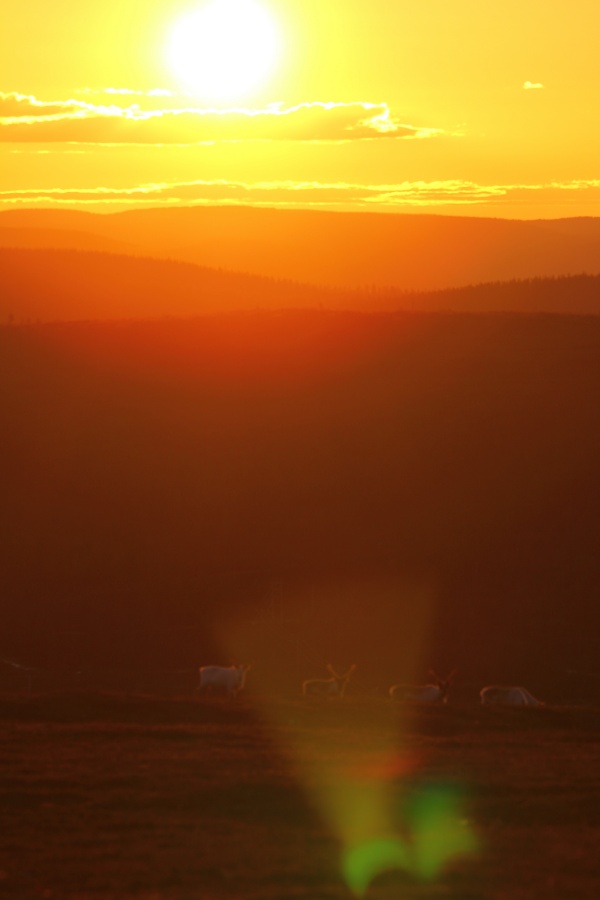
On June 1, the shadow of the New Moon was cast across a land of the midnight Sun in this year's second partial solar eclipse.

This picture of the geocentric celestial event above the Arctic Circle was taken near midnight from northern Finland's Kaunispää Hill in Lapland. Of course the region's reindeer were able to watch as both Moon and Sun hugged the northern horizon just above a cloud bank.

Also visible from parts of Alaska and Canada, the eclipse began at sunrise in Siberia and northern China at 19:25 UT, ending about 3.5 hours later north of Newfoundland in the Atlantic Ocean.

Remarkably, just one lunation later, on July 1 the New Moon's shadow will again reach out and touch the Earth in a partial solar eclipse, limited in visibility to a relatively small area in the Antarctic Ocean. July's eclipse will be followed by the fourth and final partial solar eclipse of 2011 on November 25.

That eclipse will be seen from a southern land of the midnight Sun.

Tuesday, July 6, 2010

ESA SSA: Space hazards: Luxembourg and Finland

OGS building
ESA's Optical Ground Station (OGS)is located at the Observatorio del Teide on Tenerife, and is situated at an altitude of 2393 metres.

Luxembourg and Finland are the two latest participants in ESA's new Space Situational Awareness programme, bringing the total number of subscribing Member States to 13.

ESA received formal notification from both the Luxembourg and Finland national delegations that they will subscribe to the Space Situational Awareness Preparatory Programme (SSA-PP). Subsequently, at the 5th SSA Programme Board meeting held 28 May, their participation was unanimously agreed.

The countries' decision to take part in SSA-PP is a strong boost to the Programme and will provide a formal framework through which their existing national assets can be federated into the overall SSA system.

Wednesday, December 9, 2009

Finland leads UN food body helping farmers fight climate change

The programme will also for the first time "create a global database on current and projected greenhouse gas emissions in land and agriculture for the most important agricultural commodities, countries and regions."

The Food and Agriculture Organisation is to promote the potential for agriculture in the developing world to lower greenhouse gas emissions, the UN body said on Tuesday.

"Finland is the first country to contribute to a 60 million dollar FAO programme to support climate change mitigation in agriculture in developing countries," the Rome-based body said in a statement.

"The multi-donor programme aims to promote sustainable low-emission agriculture in developing countries over the coming five years, in partnership with countries and other relevant organisations," the FAO said.

Agriculture accounts for 14 percent of global greenhouse gas emissions and is in a position to make a significant contribution to reducing emissions, particularly in developing nations, the FAO said.

"Many suitable technologies and farming practices to sequester carbon in smallholder agriculture already exist," said FAO Assistant Director-General Alexander Mueller.

"These include practices used in conservation and organic agriculture, based on no/low tillage, utilising residues for composting or mulching, use of perennial crops to cover soil, re-seeding or improving grazing management on grasslands and agroforestry, which combines crops and trees."

The programme will also for the first time "create a global database on current and projected greenhouse gas emissions in land and agriculture for the most important agricultural commodities, countries and regions."

The FAO said last week that while farming could offer a cost-effective way of cutting greenhouse emissions, it had been "largely excluded" from the current UN climate summit in Copenhagen.