Showing posts with label Firefly. Show all posts

Friday, August 15, 2014

NASA: The Future benefits of CubeSats

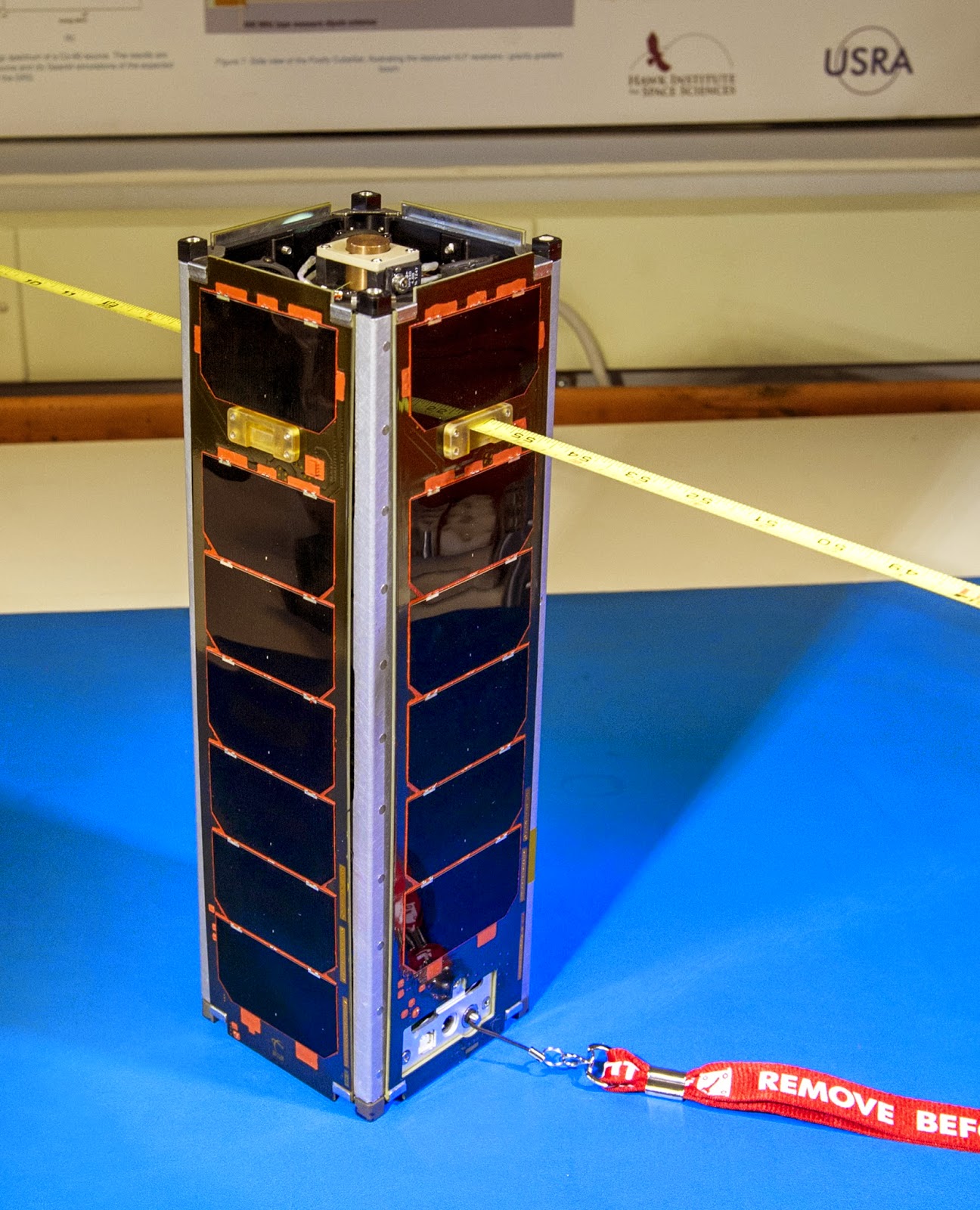
Three cans of soda would fill the Firefly CubeSat to the brim but don't let its size fool youm NASA has big plans for these tiny satellites.

Image Credit: NASA/Bill Hrybyk

To investigate climate change, scientists and engineers at NASA’s Goddard Space Flight Center are developing the IceCube satellite, which will be no larger than a loaf of bread.

In 2016, this satellite will mature technology that scientists will use to analyze cloud ice in the atmosphere.

“We’re using IceCube to test a radiometer that we want to fly on a big space mission,” said Jeffrey Piepmeier, associate head of Goddard’s Microwave Instruments and Technology Branch.

“Climate scientists have never used this frequency to measure cloud ice from space before.”

The project highlights a growing trend toward testing instruments and running scientific experiments aboard CubeSats.

“Every pound that you send into space costs a phenomenal amount of money,” said Todd Bonalsky, an electrical engineer at Goddard.

“Hence in the investment in CubeSats, which are tiny, complete satellites that are cheaper and easier to build than their larger counterparts.”

At about a foot in length and four inches wide, these three-unit (3U) CubeSats are similar in design to IceCube.

Image Credit: NASA

Bonalsky’s Dellingr CubeSat is slated to launch in March 2015.

Employing a magnetometer system Bonalsky miniaturised for CubeSat use, Dellingr will measure magnetic fluctuations to help scientists better understand how space weather affects Earth.

Dellingr will be the first CubeSat to fly this type of science grade magnetometer system.

Scientists however face a number of challenges when working on CubeSats. Due to their size, CubeSats cannot power many of NASA’s formidable scientific instruments, and there are limits to what can be miniaturised.

The Hubble Space Telescope for example uses a mirror nearly eight feet wide to capture light and translate it into images that a smaller mirror could not produce.

Doug Rowland, a solar scientist at NASA, faced this dilemma when gathering data from his Firefly CubeSat.

He built it to investigate the correlation between lightning and gamma radiation, but his CubeSat can only download 20 milliseconds slots of data to Earth each day.

“The Firefly just doesn’t have enough electrical power to simultaneously run its GPS receiver, its communications antenna and our experiment at the same time,” Rowland said.

“On a big spacecraft, you’d have a thousand times as much data, at least, and you’d have other ways to transmit the data down to Earth.”

Todd Bonalsky holds the solar panel that will power the Dellingr satellite.

Image Credit: NASA/Kristen Basham

Despite such drawbacks, the size and cost of CubeSats open up new strategies for scientific investigations.

In conventional missions, every component must function exactly as designed, but, depending on the mission, a single CubeSat is expendable.

“Instead of pouring money into one big satellite, we try to make a swarm,” said Robert Clayton, a Goddard intern from Dartmouth College.

“It’s okay if we lose two or three from our swarm of 20. We instead focus on making each CubeSat as cheap and reproducible as possible.”

CubeSats can thus slash a scientific mission’s budget and allow scientists to measure multiple data points that would be unobtainable otherwise. Using multiple spacecraft for a single mission is by no means a novel concept.

The Solar Terrestrial Relations Observatory for example is a pair of nearly identical observatories that trace solar matter as it flows from the sun.

However losing one of these expensive observatories would spell catastrophe for the mission, as opposed to losing one CubeSat in a swarm.

Friday, February 21, 2014

NASA ORS-3 Mission: STPSat-3 and 28 CubeSats deployed into Earth orbit

The Minotaur 1 four-stage rocket carrying the Air Force's Space Test Program Satellite-3 (STPSat-3) and 28 other CubeSats also carried a compact Autonomous Flight Safety System unit that operated in "shadow mode" to track the rocket's path as it lifted off the gantry and streaked across the horizon. 

Credit: Chris Perry /NASA Wallops

A spectacular launch from Virginia's eastern shore recently resulted in the successful deployment of Air Force's Space Test Program Satellite-3 (STPSat-3) and 28 other CubeSats into orbit, but that wasn't the only first for the mission or the bustling spaceport at NASA's Wallops Flight Facility.

Range safety officers also used the ORS-3 mission, run by the U.S. military's Operationally Responsive Space Office, to carry out the first of three planned certification tests of a new technology that promises to eventually eliminate the need for expensive down-range tracking and command infrastructure to manually terminate rockets if they veer off course.

Barton Bull
According to Barton Bull, the chief engineer of the Wallops Research Range, the Minotaur 1 four-stage rocket carrying the Air Force's Space Test Program Satellite-3 (STPSat-3) and 28 other so-called CubeSats also carried a compact Autonomous Flight Safety System (AFSS) unit that integrated GPS, an inertial measurement unit and Wallops-developed algorithms to track the rocket's path as it lifted off the gantry and streaked across the horizon.

Developed by ATK, a supplier of aerospace and defense products from its location in Plymouth, Minn., the shoe box-size unit worked in shadow mode during its first certification test.

As part of that test, range officers programmed the unit to respond to a simulated signal indicating that the rocket had gone off course and to send a self-destruct or detonate command at the appropriate time.

Initial Data 'Positive'
"We're still looking at the data, but initial indications are pretty positive," said Bull, whose organization created the unit's software.

"Preliminary data indicate that the unit sent the simulated termination command at the right time."

Traditionally, range-safety officials use radar from ground stations operating in the Outer Banks of North Carolina, Bermuda and Antigua to track flight vehicles and a ground-based command system to terminate rockets that deviate from their flight plans.

Due to increasing costs to maintain and staff these systems, NASA and the military launched a program several years ago to develop an autonomous system that would migrate flight-safety functions onto the rocket itself.

"All these systems need to be tied together and that costs money and time," Bull said. "Our objective is to save money and allow faster decision-making." Initial testing of AFSS began more than three years ago.

However, in those flight demonstrations the team used a system cobbled together with commercial, off-the-shelf components married to the Wallops-developed software.

The test during ORS-3, however, employed the actual unit that ATK built under contract.

As a result of the unit's successful function test, the AFSS team plans to execute another test during a rocket launch from the Pacific Missile Range Facility in Kauai, Hawaii, in the coming months.

A launch date has not been set. Once the team finishes the certification, it believes AFSS will become fully operational in a couple years.

New Mission Graphics System Debuts
In addition to carrying out the first AFSS test toward certification, the mission debuted and tested a new, user-friendly mission-graphics system that updates radar and other data on a computer screen, Bull said.

"It takes an enormous amount of time to set up these systems" and make sure all the data, which typically arrive in different formats, are easily displayed, he added.

The new system is more configurable and faster to set up.


"This was a mission of firsts on many different levels," Bull said. The team deployed a record-breaking 29 CubeSats, including, among others, Firefly (developed at NASA's Goddard Space Flight Center in Greenbelt, Md.), which is studying lightening and its possible connection to incredibly powerful bursts called terrestrial gamma-ray flashes, or TGFs, just miles off the ground.

Also aboard were NASA's so-called "PhoneSat," which is testing a smartphone's capability as a communication technology for nanosatellites, and 11 student-developed research satellites.

A student team from a high school in Alexandria, Va., provided one of the 11, also a first.

"I think we were all pleased with the results," Bull said.