Showing posts with label Ganymede. Show all posts

Tuesday, October 28, 2014

Spooky shadow play gives Jupiter a giant eye

Credit: NASA, ESA, and A. Simon (Goddard Space Flight Center)

The Hubble Space Telescope treats astronomers to gorgeous close-up views of the eerie outer planets but it's a bit of a trick when it seems like the planet's looking back at you!

In this view, the shadow of the Jovian moon Ganymede swept across the center of the Great Red Spot, a giant storm on the planet."

"This gave Jupiter the uncanny appearance of having a pupil in the center of a 10,000-mile-diameter "eye." Now if it blinks, we may really have to worry!

Hubble treats astronomers to gorgeous close-up views of the eerie outer planets, but it's a bit of a trick when it seems like the planet's looking back at you!

This happened on April 21, 2014, when Hubble was being used to monitor changes in Jupiter's immense Great Red Spot (GRS) storm.

During the exposures, the shadow of the Jovian moon Ganymede swept across the center of the GRS.

This gave the giant planet the uncanny appearance of having a pupil in the center of a 10,000-mile-diameter "eye."

Momentarily, Jupiter took on the appearance of a Cyclops planet! The shadows from Jupiter's four major satellites routinely cross the face of Jupiter.

This natural-colour picture was taken with Hubble's Wide Field Camera 3.

Wednesday, July 9, 2014

Laboratory models suggest that stretching forces shaped Ganymede's surface

An image of a tabletop-size analogue model (left) shows details of fault systems created by extension that visually match an image by spacecraft Galileo of faulted terrain on Ganymede (right). 

Credit: Left Image: Courtesy of Southwest Research Institute; 

Right Image: Courtesy of NASA/JPL SSI

Processes that shaped the ridges and troughs on the surface of Jupiter's icy moon Ganymede are likely similar to tectonic processes seen on Earth, according to a team of researchers led by Southwest Research Institute (SwRI).

To arrive at this conclusion, the team subjected physical models made of clay to stretching forces that simulate tectonic action. The results were published in Geophysical Research Letters.

Physical analogue models simulate geologic structures in laboratory settings so that the developmental sequence of various phenomena can be studied as they occur.

The team, including researchers from SwRI, Wheaton College, NASA's Jet Propulsion Laboratory and NuStar Energy LP, created complex patterns of faults in their models, similar to the ridge and trough features seen in some regions of Ganymede.

The models consisted of a "wet clay cake" material possessing brittle characteristics to simulate how the icy moon's lithosphere, the outermost solid shell, responds to stresses by cracking.

The laboratory models suggest that characteristic patterns of ridges and troughs, called grooved terrain on Ganymede, result from its surface being stretched.

"The physical models showed a marked similarity to the surface features observed on Ganymede," said co-author Dr. Danielle Wyrick, a senior research scientist in the SwRI Space Science and Engineering Division.

"From the experiments, it appears that a process in which the crust breaks into separate blocks by large amounts of extension is the primary mechanism for creating these distinct features."

"Physical analogue modeling allows us to simulate the formation of complex three-dimensional geological structures on Ganymede, without actually going to Ganymede," said co-author Dr. David Ferrill, director of the Earth, Material and Planetary Sciences Department in the SwRI Geosciences and Engineering Division.

"These scaled models are able to reproduce the fine geometric details of geologic processes, such as faulting, and to develop and test hypotheses for landscape evolution on planetary bodies."

SwRI researchers previously have used physical analog models to examine the process by which pit crater chains, a series of linear pits, or depressions, develop on Mars, and how magma in the Martian subsurface deforms the surface of the Red Planet.

More information: The paper, "Physical models of grooved terrain tectonics on Ganymede," by D.W. Sims, D.Y. Wyrick, D.A. Ferrill, A.P. Morris, G.C. Collins, R.T. Pappalardo and S.L. Colton, was published by Geophysical Research Letters, 16 June 2014, Volume 41, Issue 11, pages 3774–3778, DOI: 10.1002/2014GL060359

Saturday, July 5, 2014

Radio Signals from Jupiter Aids Search for Life and Liquid Water

This artist's impression shows Jupiter and its moon Europa using captured Jupiter and Europa images in visible light. 

The Hubble ultraviolet images showing the faint emission from the water vapour plumes have been superimposed, respecting the size but not the brightness of the plumes. 

Image courtesy NASA, ESA, and M. Kornmesser, University of California, Santa Cruz.

Powerful radio signals that Jupiter generates could be used to help researchers scan its giant moons for oceans that could be home to extraterrestrial life, according to a recent study submitted to the journal Icarus (In PDF format).

Jupiter, the largest planet in the Solar System, possesses 67 known moons, including three giant icy moons that might possess liquid oceans underneath their frozen surfaces.

Astrobiologists want to investigate Europa, Ganymede and Callisto for extraterrestrial life, as there is life virtually wherever there is liquid water on Earth.

Of Jupiter's three largest icy moons, Europa, which is roughly the size of Earth's moon, is favored as having the greatest potential to sustain life.

Magnetic readings captured by NASA's Galileo spacecraft provided compelling hints that it has an ocean, and radio scans by the probe suggest a water-rich layer beneath the surface between 50 to 105 miles (80 to 170 kilometers) thick.

Recent findings even suggest its ocean could be loaded with enough oxygen to support millions of tons worth of marine life.

Scientists would like to analyze Europa's ocean directly, perhaps with missions to bore into Europa's icy shell using heat to melt through the ice, whirling blades to clear away rocks, and robot subs to explore the ocean.

However, it remains uncertain how thick this shell is, complicating any plans to penetrate it.

Models of its thickness, based on the amount of heat the shell receives from the Sun and Europa itself, predict it to be roughly 18 miles (30 kilometers) thick.

In contrast, analyses of the Galileo spacecraft's data suggest the shell is no more than 9 miles (15 kilometers) thick, and maybe as little as 2.5 miles (4 kilometers) thick.

True colour and feature-highlighted photos of Europa. 

The bright feature towards the lower right of the disk is the 45 km diameter crater Pwyll. 

Credit: NASA.

Ice-penetrating radar is currently the most promising technique to directly confirm the existence of any ocean hidden within Jupiter's icy moons.

Radar works by transmitting radio signals, detecting any radio signals that reflect back, and analyzing these signals to deduce details about what they reflected off of, much like how a person might use a flashlight to illuminate objects hidden in the dark.

Ice and ground-penetrating radar systems look for signals that indicate buried objects and boundaries between layers.

In Europa's case, this means looking for the boundaries between the icy crust and any hidden ocean, and between such an ocean and Europa's rocky core.

To detect these oceans with ice-penetrating radar, low-frequency signals of less than 30 megahertz are needed to overcome radio wave absorption by the ice, as well as the unpredictable scattering of radio waves by the crinkled surfaces of these moons.

The low-frequency radio waves that researchers would like to use are decametric, meaning they have wavelengths tens of meters long.


Jupiter's Decametric waves
One problem with attempting ice-penetrating decametric radar on Jupiter's moons has to do with the powerful decametric radio bursts coming from Jupiter itself.

Altogether, these signals are more than 3,000 times stronger than any leaking into the Solar System from the rest of the galaxy.

Jupiter's decametric waves come from clouds of electrically charged particles trapped in Jupiter's magnetic field.

To overcome Jupiter's loud radio signals, a mission probing Jupiter's moons would need a relatively strong transmitter, a massive device that might be difficult to power and fit aboard the limited confines of a spacecraft.

Read the full article about how the research team plan to overcome the difficulties of Jupiter's natural emanation and generation of decametric waves.

More Information: A Passive Probe for Subsurface Oceans and Liquid Water in Jupiter's Icy Moons - Authors: Andrew Romero-Wolf, Steve Vance, Frank Maiwald, Essam Heggy, Paul Ries, Kurt Liewer

Friday, May 2, 2014

Ganymede harbours layered sandwich of oceans and ice

This artist's concept of Jupiter's moon Ganymede, the largest moon in the solar system, illustrates the layered sandwich model of its interior oceans. 

Credit: NASA /JPL-Caltech

The largest moon in our solar system, a companion to Jupiter named Ganymede, might have ice and oceans stacked up in several layers like a club sandwich, according to new NASA-funded research that models the moon's makeup.

Previously, the moon was thought to harbor a thick ocean sandwiched between just two layers of ice, one on top and one on bottom.

Steve Vance
"Ganymede's ocean might be organized like a layered sandwich," said Steve Vance of NASA's Jet Propulsion Laboratory in Pasadena, Calif., explaining the moon's resemblance to multi-tiered sandwiches.

The study, led by Vance, provides new theoretical evidence for the team's "layered sandwich" model, first proposed last year.

The research appears in the journal Planetary and Space Science.

The results support the idea that primitive life might have possibly arisen on the icy moon.

Scientists say that places where water and rock interact are important for the development of life; for example, it's possible life began on Earth in bubbling vents on our sea floor.

Prior to the new study, Ganymede's rocky sea bottom was thought to be coated with ice, not liquid, a problem for the emergence of life.

The "layered sandwich" findings suggest otherwise: the first layer on top of the rocky core might be salty water.

"This is good news for Ganymede," said Vance. "Its ocean is huge, with enormous pressures, so it was thought that dense ice had to form at the bottom of the ocean."

"When we added salts to our models, we came up with liquids dense enough to sink to the sea floor."

NASA scientists first suspected an ocean in Ganymede in the 1970s, based on models of the large moon, which is bigger than Mercury.

In the 1990s, NASA's Galileo mission flew by Ganymede, confirming the moon's ocean, and showing it extends to depths of hundreds of miles.

The spacecraft also found evidence for salty seas, likely containing the salt magnesium sulphate (Epsom salt).

Previous models of Ganymede's oceans assumed that salt didn't change the properties of liquid very much with pressure.

Vance and his team showed, through laboratory experiments, how much salt really increases the density of liquids under the extreme conditions inside Ganymede and similar moons.

It may seem strange that salt can make the ocean denser, but you can see for yourself how this works by adding plain old table salt to a glass of water.

Rather than increasing in volume, the liquid shrinks and becomes denser. This is because the salt ions attract water molecules.

More information: "Ganymede's Internal Structure Including Thermodynamics of Magnesium Sulfate Oceans in Contact with Ice," Steve Vance et al., Planetary and Space Science, 2014, in press, dx.doi.org/10.1016/j.pss.2014.03.011

Thursday, February 13, 2014

Global map of Ganymede, Jupiter's biggest moon

Making the map of Ganymede was a long and complex task. 

Some of the scientists behind the map were graduate students and postdocs at Brown University when the Galileo data began to arrive in the 1990s. 

Image courtesy U.S. Geological Survey.

Scientists, including Brown University geologists and students, have completed the first global geological map of Ganymede, Jupiter's largest moon and the largest in the solar system.

With its varied terrain and possible underground ocean, Ganymede is considered a prime target in the search for habitable environments in the solar system, and the researchers hope this new map will aid in future exploration.

Geoffrey Collins
The work, led by Geoffrey Collins, a Ph.D. graduate of Brown now a professor at Wheaton College in Massachusetts, took years to complete.

"It is very rewarding to see the results of all of our efforts here at Brown come together into this integrated global compilation that will now be used to plan the next phase of scientific exploration of the Galilean satellites," said Jim Head, the Scherck Distinguished Professor of Geological Sciences at Brown and one of the map's co-authors.


The researchers combined images from the Voyager and Galileo spacecraft to put the map together. Voyager was the first mission to fly through the Jupiter satellite system and passed by the icy surface of Ganymede in 1979.

Those first images revealed a complex surface, segmented and fractured into dark and light terrain.

In 1995, the Galileo spacecraft was placed in orbit around Jupiter and began to return high-resolution images of the surface that help to understand many of the features seen at low-resolution by Voyager.

Jim Head
Head was a co-investigator on the Galileo's Solid State Imaging (SSI) experiment.

In that role, he and his team were responsible for planning the imaging sequences for Ganymede in order to identify and investigate the scientific targets of highest priority.

The team worked for several years to obtain the data necessary to make the global map.

"This was an amazing time," Head said. "Brown graduate and undergraduate students worked shoulder-to-shoulder in the Planetary Geosciences Laboratory in Lincoln Field Building, studying the newly acquired images and choosing new sites of scientific interest."

"The discoveries were daily and the adrenaline was surging as we rushed to collect our thoughts and plans, review them with the SSI Team, and get them uploaded to the spacecraft in time for the next encounter."

"I'm so glad all that work has paid off in the form of this detailed global map," Head said.

"It is equally rewarding to see that the Brown team has now moved on to positions of leadership in the planetary exploration research community."

The new geological map of Ganymede, published yesterday by the U.S. Geological Survey

Wednesday, June 19, 2013

ESA and Russia Plan Probe Landing on Jupiter's Moon, Ganymede

An artist's illustration of the JUpiter ICy moons Explorer spacecraft in the Jovian system. The mission will launch in 2022 and arrive at Jupiter in 2030 to study the planet and its largest moons.

CREDIT: ESA/AOES

A Russian probe being designed to land on Ganymede, Jupiter's largest moon, could launch toward the gas giant with a European spacecraft being developed to explore Jupiter's icy ocean-covered satellites, according to European space officials.

The benefits of such a joint launch arrangement, including sharing reconnaissance and mapping from Europe's Jupiter Icy Moons Explorer (JUICE), are not lost on scientists. But more Earthly concerns, such as government finances and the realities of technical developments, could thwart the proposal.

"It all depends on if the Russians are ready to fly at the same time as us," said Alvaro Gimenez Canete, director of the European Space Agency (ESA)'s science and robotic exploration programs.

The solar system's giant
JUICE is scheduled to launch in 2022 and arrive at Jupiter in 2030, entering orbit around the huge planet and making repeated flybys of three of its largest moons — Ganymede, Callisto and Europa.

In September 2032, the European spacecraft will arrive at Ganymede, becoming the first probe to enter orbit around the moon of another planet. Equipped with radar, a mapping camera and other instruments, JUICE will measure the thickness of global ice sheets covering Jupiter's moons and produce terrain and mineral maps of Ganymede.

Such data will prove to be a rich resource not only for researchers, but also for engineers planning missions to explore Ganymede's surface and study what lies beneath the moon's crust of ice, Gimenez told reporters at the Paris Air Show this week.

"Russia's plan is to implement a Ganymede Lander, which is a very ambitious mission," said Fabio Favata, head of ESA's science planning and community coordination office, which oversees the strategic direction of the space agency's space science programs.

Favata said the Russian mission, for now known by scientists simply as the Ganymede Lander, has captured the interest of Europe's planetary science community.

An illustration of Russia's planned Ganymede lander that could explore the Jupiter moon as part of the European Space Agency's Jupiter Icy Moons Explorer mission.

CREDIT: ESA/Roscosmos

Europa or Ganymede?

Russian mission planners initially proposed the lander to target Europa, another of Jupiter's moons with a frozen crust thinner than the ice cap covering Ganymede. After a NASA mission to orbit Europa never materialized, Russia retooled the project to focus on Ganymede, falling in line with the goals of Europe's Jupiter mission.

There are numerous advantages of landing on Ganymede as opposed to Europa. The radiation environment at Ganymede is less severe than at Europa, which lies closer to Jupiter; this is one of the reasons ESA picked Ganymede as the destination for JUICE, Gimenez said.

According to presentations at a workshop hosted by Russia's Space Research Institute in Moscow in March, Russian scientists say mapping and reconnaissance of Ganymede are required before any attempted landing. Russia's concept for the mission, which assumes no international collaboration for now, includes an orbiter and a lander to be dispatched to Ganymede in 2023 or 2024.

The scope of a potential partnership between Europe and Russia on robotic Jupiter exploration ranges from no collaboration to a completely merged program in which JUICE and the Ganymede Lander would launch from Earth together on the journey into the outer solar system.

Another option — perhaps the most likely, scientists say — is a loose collaboration involving complementary scientific goals, shared development of science instruments, and the use of the JUICE mission to help select a landing site on Ganymede.

Tuesday, March 19, 2013

Russian Ganymede Lander Mission more difficult than expected

Russia's proposed landing mission to Ganymede was discussed extensively last week at an international meeting hosted by the Space Research Institute of the Russian Academy of Sciences.

The mission to explore, and perhaps to drill, the Solar system's largest moon, presumably in close cooperation with the European Space Agency (ESA), would be a major challenge for Russia's space and science industries.

The project is generally approved, but success is far from assured.

The mission to Ganymede, now better known by the simple name of "Ganymede Lander", is the latest reincarnation of Russia's contribution to the Laplas project, promoted by the European Space Agency (ESA) in the early 2000s.

With Laplas becoming the single-spacecraft project JUICE (JUpiter ICy moon Explorer, until christened officially), Russian plans have also undergone major changes, although their main objective, sending a lander to Jupiter's biggest moon, remained intact.

The initial aim was to explore Europa, a smaller Jovian moon, where there is an ocean of liquid water beneath its frozen surface (around 10 km thick) and is therefore considered a good prospect for the exploration of habitable conditions.

Ganymede also holds liquid water, but much deeper, under an icy crust of around 130-150 km. On the other hand, this moon is farther from Jupiter with less radiation than Europa, putting spacecraft at a much lower risk.

However, the main argument for shifting to Ganymede was that the European mission now no longer plans to stay near Europa long enough to provide the high resolution images needed to select a landing site.

It is supposed now that the JUICE orbiting spacecraft will provide the Russian lander with preliminary reconnaissance data and perhaps act as a communication relay station for data sent between Ganymede and Earth.

Hence, the current scenario is that the European mission is developing independently while Russia's landing spacecraft has its own scientific payload and objectives.

As the success of the landing relies on many technical issues closely concerned with JUICE, the Russian equipment and goals must be taken into account from the start when designing the eventual lander.

A more detailed mission scenario was presented by Maksim Martynov, deputy general designer of the S.A. Lavochkin Association and head of the design bureau.

Following the "play safe" rule, it is supposed that Russia will send two spacecraft to Ganymede, a lander and a small additional orbiter to secure the landing site as a back-up option to information from JUICE.

Even though launched simultaneously from a Proton launcher, they will arrive separately. After reconnaissance and remote studies of the moon, the lander will be delivered to the surface to begin its studies.

The start is planned for 2022-23 with the completion in 2029-30 (JUICE is currently scheduled for 2022) and subsequent arrival on Ganymede within a few months.

Tuesday, February 26, 2013

ESA JUICE Mission to Jupiter's Icy Moons

An artist's illustration of the JUpiter ICy moons Explorer spacecraft in the Jovian system. The mission will launch in 2022 and arrive at Jupiter in 2030 to study the planet and its largest moons.

CREDIT: ESA/AOES

An ambitious European mission that will launch a robotic probe to explore Jupiter's icy moons in 2022 has got its science gear.

The European Space Agency has picked 11 instruments for the planned JUpiter ICy moons Explorer, or JUICE, spacecraft.

The mission is expected to reach Jupiter, the largest planet in the solar system, in 2030 and spend at least three years studying the gas giant's major moons Callisto, Europa, and Ganymede.

The Jovian satellites are intriguing to scientists because they are thought to have vast oceans beneath their icy outer crust.

"Jupiter and its icy moons constitute a kind of mini-Solar System in their own right, offering European scientists and our international partners the chance to learn more about the formation of potentially habitable worlds around other stars," said Dmitrij Titov, JUICE study scientist for ESA, in a Feb. 21 statement.

The JUICE mission will observe Jupiter's atmosphere and magnetosphere, as well all four Galilean moons: Europa, Callisto, Ganymede and the volcanic Io.

The spacecraft is expected to make 12 flybys of crater-covered Callisto, as well as two close passes of Europa in an attempt to gather the first-ever measurements of the thickness of that moon's frozen crust, ESA officials said.


The spacecraft will eventually end up orbiting Ganymede, the largest moon in our solar system, to study its surface and internal structure. Ganymede is also the only known moon in the solar system with its own magnetic field, and JUICE will closely observe the moon's interactions with Jupiter's magnetosphere, ESA officials said.

The collection of approved instruments to help scientists complete these tasks includes cameras, spectrometers, a laser altimeter and an ice-penetrating radar, as well as a magnetometer, plasma and particle monitors, and radio science hardware, ESA officials said. Teams from 15 European countries and the United States and Japan will develop the tools.

"The suite of instruments addresses all of the mission's science goals, from in-situ measurements of Jupiter's vast magnetic field and plasma environment, to remote observations of the surfaces and interiors of the three icy moons," Luigi Colangeli, coordinator of ESA's solar system missions, said in a statement.

Saturday, September 29, 2012

Jupiter's Big Moon Ganymede Albedo Mapped by Amateur Astronomer

An amateur astronomer has created the first-ever homemade brightness map of Jupiter's huge moon Ganymede in a magnificent display of how non-professional skywatchers can contribute to the field of observational astronomy.

Greek skywatcher Emmanuel Kardasis of the Hellenic Amateur Astronomy Association (HAAA) created the new Ganymede map using a common "hobby" telescope and off-the-shelf camera and computer equipment.

His map matches up well with images of Ganymede's surface taken by professionals, said officials with the European Planetary Science Congress (EPSC), which is meeting this week in Madrid.

For example, Kardasis' reflected brightness (or albedo) map identifies such Ganymede features as Phrygia Sulcus, a system of grooves and ridges thousands of miles across, and a low-lying dark area called the Nicholson region.

To create the images, Kardasis attached a camera to his telescope and recorded a video of the ice-covered Ganymede, which is the largest moon in the solar system at 3,273 miles (5,268 kilometers) across.

He picked the video's sharpest frames, then enhanced them using photo-editing software, EPSC officials said.

"Ganymede has a tiny disk as seen from Earth so was a good test for my techniques," Kardisis said in a statement.

"If the same methods were applied to other worlds, perhaps [Jupiter's] volcanic moon Io, we could capture surface fluctuations."

"Professional observatories may create better images, but they cannot monitor our rapidly and ever-changing universe."

"The equipment amateurs need to generate products like his Ganymede map is relatively easy to find" Kardasis said.

"Creating useful images of planets requires a telescope with a diameter of at least eight inches. For tiny discs, such as the moons of Jupiter, bigger is definitely better," he said.

"My Ganymede images were made using an 11-inch telescope. You also need a good motor drive on your tripod, a sensitive camera, some freely available software and lots of patience!"

Wednesday, May 2, 2012

ESA selects Juice: €1bn Juice probe to Jupiter

The European Space Agency (ESA) is to mount a billion-euro mission to Jupiter and its icy moons.

The probe, called Juice, has just been approved at a meeting of member state delegations in Paris.

It would be built in time for a launch in 2022, although it would be a further eight years before it reached the Jovian system.

The mission has emerged from a five-year-long competition to find the next "large class" space venture in Europe.

Juice stands for JUpiter ICy moon Explorer. The concept proposes an instrument-packed, nearly five-tonne satellite to be sent out to the Solar System's biggest planet, to make a careful investigation of three of its biggest moons.

The spacecraft would use the gravity of Jupiter to initiate a series of close fly-bys around Callisto and Europa, and then finally to put itself in a settled orbit around Ganymede.

Emphasis would be put on "habitability" - in trying to understand whether there is any possibility that these moons could host microbial life.

Callisto, Europa and Ganymede are all suspected to have oceans of water below their icy surfaces. As such, they may have environments conducive to simple biology.

"People probably don't realise that habitable zones don't necessarily need to be close to a star - in our case, close to the Sun," explained Prof Michele Dougherty, a Juice science team member from Imperial College London, UK.

"There are four conditions required for life to form. You need water; you need an energy source - so the ice can become liquid; you need the right chemistry - nitrogen, carbon, hydrogen; and the fourth thing you need is stability - a length of time that allows life to form.

"The great thing about the icy moons in the Jupiter system is that we think those four conditions might exist there; and Juice will tell us if that is the case," she reported.

The mission will cost Esa on the order of €830m (£695m; $1.1bn) over its entire life cycle. This includes the cost of manufacturing the spacecraft bus, or chassis, launching the satellite and operating it until 2033.

This sum does not however include Juice's 11 instruments. Funding for these comes from the member states. When this money is taken into account, the final budget for Juice is expected to be just short of €1.1bn.

It has not yet been decided which European nations will provide which instruments. An Announcement of Opportunity will be released this summer with a view to identifying the instrument providers by the start of next year.

The final and formal go-ahead for Juice should be given in 2014. In ESA-speak, this stage is referred to as "adoption".

It is the moment when all the elements required to build the satellite are in place and the full costings are established.

It is also the point at which any international participation is recognised.

Monday, March 5, 2012

Amateur Astronomer Captures Jupiter

Image Credit: NASA/Damian Peach

This image of Jupiter and its moons, icy Io and, the largest of Jupter's moons, Ganymede was acquired by amateur astronomer Damian Peach, when Jupiter was close to opposition. 

South is up and the "Great Red Spot" is visible in the image.

Ground-based astronomy will play a vital role in the success of NASA's Juno mission.

Because Jupiter has such a dynamic atmosphere, images from amateur astronomers will assist the JunoCam instrument team predict what features will be visible when the camera's images are taken.

With its suite of science instruments, the Juno spacecraft will investigate the existence of a solid planetary core, map the planet's intense magnetic field, measure the amount of water and ammonia in the deep atmosphere and observe the planet's auroras.

Image credit: NASA/JPL

Juno's primary goal is to improve our understanding of Jupiter's formation and evolution.

The spacecraft will spend a year investigating the planet's origins, interior structure, deep atmosphere and magnetosphere.

Juno's study of Jupiter will help us to understand the history of our own solar system and provide new insight into how planetary systems form and develop in our galaxy and beyond.

Juno's principal investigator is Scott Bolton, Director of Southwest Research Institute in San Antonio, Texas. NASA's Jet Propulsion Laboratory in Pasadena, Calif., manages the mission.

Lockheed Martin Space Systems of Denver, Colo., is building the spacecraft. The Italian Space Agency, Rome, is contributing an infrared spectrometer instrument and a portion of the radio science experiment.

Tuesday, January 26, 2010

Jupiter: Difference Between Ganymede And Callisto

The Difference Between Ganymede And Callisto

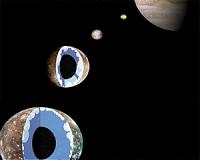
Jupiter (right) and the Galilean satellites (right to left) Io, Europa, Ganymede, and Callisto. Cutaways show the interior states of Ganymede and Callisto after many impacts by icy planetesimals during the late heavy bombardment. Colors represent density, with black showing the rocky core (with a density 3 g/cm^3), blue showing mixed ice and rock (densities 1.8 to 1.9 g/cm^3) and white showing rock-free ice.

Differences in the number and speed of cometary impacts onto Jupiter's large moons Ganymede and Callisto some 3.8 billion years ago can explain their vastly different surfaces and interior states, according to research by scientists at the Southwest Research Institute appearing online in Nature Geoscience Jan. 24, 2010.

Ganymede and Callisto are similar in size and are made of a similar mixture of ice and rock, but data from the Galileo and Voyager spacecraft show that they look different at the surface and on the inside. A conclusive explanation for the differences between Ganymede and Callisto has eluded scientists since the Voyager Jupiter encounters 30 years ago.

Dr. Amy C. Barr and Dr. Robin M. Canup of the SwRI Planetary Science Directorate created a model of melting by cometary impacts and rock core formation to show that Ganymede and Callisto's evolutionary paths diverged about 3.8 billion years ago during the Late Heavy Bombardment, the phase in lunar history dominated by large impact events.

"Impacts during this period melted Ganymede so thoroughly and deeply that the heat could not be quickly removed. All of Ganymede's rock sank to its center the same way that all the chocolate chips sink to the bottom of a melted carton of ice cream," says Barr. "Callisto received fewer impacts at lower velocities and avoided complete melting."