Showing posts with label Kirobo. Show all posts

Friday, December 20, 2013

KIROBO: Japan robot chats with astronaut on ISS space station

In this undated photo released by KIBO ROBOT PROJECT in Tokyo Friday, Dec. 20, 2013, the robot, named Kirobo, and Japanese astronaut Koichi Wakata pose for a photo as they exchange small talks in Japanese at the International Space Station. 

The first humanoid robot in space performed its first mission at the space station - holding a series of conversations with Wakata and keeping him company. 

The talks are part of an experiment testing the robot's autonomous conversation functions. 

Kirobo is programmed to process questions and select words from its vocabulary to construct an answer, instead of giving pre-programmed responses to specific questions. 

AP Photo/KIBO ROBOT PROJECT

The first humanoid robot in space made small talk with a Japanese astronaut and said it had no problem with zero gravity on the International Space Station.

Footage released by the robot's developers on Friday showed Kirobo performing its first mission on the station, talking in Japanese with astronaut Koichi Wakata to test its autonomous conversation functions.

Wakata says he's glad to meet Kirobo, and asks the robotic companion how it feels about being in a zero-gravity environment.

"I'm used to it now, no problem at all," Kirobo quips.

Kirobo is programmed to process questions and select words from its vocabulary to construct an answer, instead of giving pre-programmed responses to specific questions.
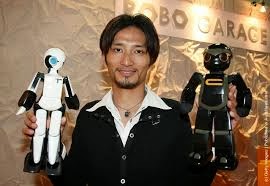
The creator of the robot, Tomotaka Takahashi, said the autonomous functions meant nobody knew how well Kirobo would be able to answer Wakata's questions.

Though Kirobo had some awkward pauses and Wakata spoke more slowly than usual at times in their chat earlier this month, Takahashi said conversations smoothed out over time.

"Through layers of communication, we were able to observe the initial stages of a relationship begin to develop between a human and a robot, and I think that was our biggest success" he said.

In this undated photo released by KIBO ROBOT PROJECT in Tokyo Friday, Dec. 20, 2013, the robot, named Kirobo, and Japanese astronaut Koichi Wakata make small talk in Japanese at the International Space Station. 

The first humanoid robot in space performed its first mission at the space station - holding a series of conversations with Wakata and keeping him company.

The talks are part of an experiment testing the robot's autonomous conversation functions. 

Kirobo is programmed to process questions and select words from its vocabulary to construct an answer, instead of giving pre-programmed responses to specific questions. 

AP Photo/KIBO ROBOT PROJECT

Kirobo took off from Japan's Tanegashima Space Center for the International Space Station this summer aboard a space cargo transporter. Wakata arrived in November and will assume command of the station in March.

The project is a joint endeavor between advertising company Dentsu, automaker Toyota, and Takahashi at the University of Tokyo's Research Center for Advanced Science and Technology.

Tuesday, November 12, 2013

NASA Robonaut-2 to grow legs

video platformvideo managementvideo solutionsvideo player
NASA has announced its intention to add legs to the Robonaut 2 (R2) robot currently aboard the International Space Station (ISS), sometime next year.

The move is part of a 50 year project (currently in year 17) by NASA to investigate the possibilities of using robots on space missions. Adding legs to R2 will increase its standing height to eight feet and its weight to 500 pounds.

R2 was first delivered to the ISS in 2011 as just a head, torso and arms by the Space Shuttle Discovery and is the first dexterous robot in space (Japan's talking Kirobo robot has arms and legs but they offer virtually no functionality.)

Designed at NASA's Johnson Space center in Houston Texas, R2's purpose is to perform many of the activities that are now carried out by human astronauts.

R2 is actually one of four robonauts that NASA has built, each with a different mission in mind.

Future parts for R2 include interchangeable wheels for rolling around on the surface of a planet or moon (one configuration involves having R2 roll around on four wheels instead of just two for added stability).

NASA also plans to create a line of hands that allow the robot to perform a variety of tasks, one of which would almost certainly be taking part in missions that involve conducting space walks to perform duties or to make repairs to the ISS.

In adding legs to R2, NASA plans to eventually have the robot move autonomously around the ISS—them being long will help with movingly quickly in and out of hatches. But that's part of a long learning process.

R2 will have to start out by taking baby steps as the cramped quarters of the ISS leaves little room for clumsiness—one bump could send a human astronaut careening helplessly through a compartment likely crashing into a wall, or sensitive equipment.

The ultimate goal is have R2 move as gracefully as an antelope both inside the ISS and out while performing tasks that are either mundane or dangerous.

Having the robot perform spacewalks, for example, would also save on costs as it wouldn't require life-support and other back-up systems necessary to keep humans safe when venturing out.

Thursday, September 5, 2013

Kirobo: Japan's robo-astronaut aboard the ISS

This 2013 Kibo-Robot photo, taken on August 21, 2013, shows pint-sized android Kirobo speaking from inside the International Space Station (ISS). 

The robot is part of a study aimed at seeing how a non-human companion can provide emotional support for people isolated over long periods.

A pint-sized android has uttered the first robotic words in space, showcasing Japan's drive to combine cutting-edge technology with cuteness.

The wide-eyed and bootie-wearing "Kirobo"—roughly the size of a chihuahua—broadcast a message from inside the International Space Station, greeting citizens of Earth and paying cheeky tribute to Neil Armstrong.

"On August 21, 2013, a robot took one small step toward a brighter future for all," Kirobo said in a video that showed the humanoid creation drifting weightlessly on-board the ISS, as it moved its legs in the air.

The images made their global debut on Wednesday as part of Tokyo's bid for the 2020 Games during a presentation ahead of a meeting of the International Olympic Committee in Buenos Aires which will decide the host city.

"Good morning to everyone on Earth. This is Kirobo. I am the world's first talking robot astronaut. Nice to meet you," it said in Japanese.

The humanoid was created jointly by advertising firm Dentsu, the University of Tokyo, robot developer Robo Garage and Toyota.

The robot stands just 34 centimetres (13.4 inches) tall and weighs about one kilogram (2.2 pounds).

It left Earth on August 4 on a cargo-carrying rocket that was also delivering supplies to the ISS.

Kirobo is programmed to communicate in Japanese and keep records of its conversations with Koichi Wakata, the first Japanese astronaut to command the ISS.

The robot is part of a study aimed at seeing how a non-human companion can provide emotional support for people isolated over long periods.

Sunday, August 4, 2013

JAXA Launches Talking 'Robot Astronaut' Kirobo In HTV-4

A Japanese H-2B rocket launches the HTV-4 (Kounotori 4) robotic cargo ship toward the International Space Station on Aug. 4, 2013 Japan Standard Time (Aug. 3, 2013 EDT/GMT) from Tanegashima Space Center in southern Japan.

Credit: NASA TV/JAXA

Call it one giant leap for robot kind: A small talking robot launched into space aboard a Japanese cargo ship Saturday (Aug. 3) to keep astronauts company on the International Space Station.

The Japan Aerospace Exploration Agency (JAXA) launched the humanoid Kirobo "robot astronaut" into orbit from the Tanegashima Space Center in southern Japan as part of nearly 3.5 tons of supplies and equipment to resupply the space station's six-person crew.

Kirobo was put through a series of zero-gravity and other safety tests before it was deemed ready for flight. Image posted June 27, 2013.

Credit: Kibo Robot Project

Kirobo was packed inside Japan's unmanned HTV-4 (Kounotori 4) cargo ship when it launched into orbit atop the country's H-2B rocket at 3:48 p.m. EDT (1948 GMT), though it was early Sunday morning (Aug. 4) Japan Standard Time at the time of liftoff. The HTV-4 spacecraft will arrive at the space station on Aug. 9.

The Kirobo space robot is a diminutive mechanical person just 13 inches (34 centimeters) tall built to converse with astronauts on long space voyages.

The robot, and its ground-based counterpart Mirata, are part of the Kibo Robot Project to study human-robot interaction technology.

Kirobo speaks Japanese and is expected to talk to JAXA astronaut Koichi Wakata when he arrives at the space station in November.

Kibo, which means "hope" in Japanese, is the name of Japan's research laboratory module aboard the International Space Station. The name of Kirobo is a merging of Kibo and robot, project officials have said.

Kirobo will take part in the first robot-to-human conversation with veteran Japanese astronaut Koichi Wakata when they are both onboard the space station

Wednesday, June 26, 2013

Kirobo: Japan's conversation robot ready for outer space - Video

Humanoid communication robot Kirobo, left, talks with Fuminori Kataoka, project general manager from Toyota Motor Corp., during a press unveiling in Tokyo Wednesday, June 26, 2013. 

The world's first space conversation experiment between a robot and humans is ready to be launched. 

Developers from the Kirobo project, named after "kibo" or hope in Japanese and "robot," gathered to demonstrate the humanoid robot's ability to talk. 

Credit: AP Photo/Shizuo Kambayashi

The world's first space conversation experiment between a robot and humans is ready to be launched.

Developers from the Kirobo project, named after "kibo" or hope in Japanese and "robot," gathered in Tokyo Wednesday to demonstrate the humanoid robot's ability to talk.

"Russia was the first to go outer space, the U.S. was the first to go to the moon, we want Japan to be the first to send a robot-astronaut to space that can communicate with humans," said Yorichika Nishijima, the Kirobo project manager.


Tomotaka Takahashi, CEO of Robo Garage Co. and associate professor at the University of Tokyo, said he hopes robots like Kirobo that hold conversations will eventually be used to assist astronauts working in space.

"When people think of robots in outer space, they tend to seek ones that do things physically," said Takahashi. "But I think there is something that could come from focusing on humanoid robots that focus on communication."

Humanoid communication robot Kirobo is shown during a press unveiling in Tokyo Wednesday, June 26, 2013. 

The world's first space conversation experiment between a robot and humans is ready to be launched. 

Developers from the Kirobo project, named after "kibo" or hope in Japanese and "robot," gathered to demonstrate the humanoid robot's ability to talk. 

Credit: AP Photo/Shizuo Kambayashi