Showing posts with label Local Group. Show all posts

Monday, September 29, 2014

Hubble finds jets and explosions in NGC 7793

Credit: ESA /Hubble & NASA, Acknowledgement: D. Calzetti (University of Massachusetts) and the LEGUS Team

This new image from the NASA/ESA Hubble Space Telescope shows NGC 7793, a spiral galaxy in the constellation of Sculptor some 13 million light-years away from Earth.

NGC 7793 is one of the brightest galaxies in the Sculptor Group, one of the closest groups of galaxies to the Local Group, the group of galaxies containing our galaxy, the Milky Way and the Magellanic Clouds.

The image shows NGC 7793's spiral arms and small central bulge.

Unlike some other spirals, NGC 7793 doesn't have a very pronounced spiral structure, and its shape is further muddled by the mottled pattern of dark dust that stretches across the frame.

The occasional burst of bright pink can be seen in the galaxy, highlighting stellar nurseries containing newly-forming baby stars.

Although it may look serene and beautiful from our perspective, this galaxy is actually a very dramatic and violent place.

Astronomers have discovered a powerful micro-quasar within NGC 7793, a system containing a black hole actively feeding on material from a companion star.

A micro-quasar is an object that has some of the properties of quasars in miniature. While many full-sized quasars are known at the cores of other galaxies, it is unusual to find a quasar in a galaxy's disk rather than at its center.

Micro-quasars are almost like scale models, they allow astronomers to study quasars in detail. As material falls inwards towards this black hole, it creates a swirling disk around it.

Some of the infalling gas is propelled violently outwards at extremely high speeds, creating jets streaking out into space in opposite directions.

In the case of NGC 7793, these jets are incredibly powerful, and are in the process of creating an expanding bubble of hot gas some 1,000 light-years across.

Tuesday, August 12, 2014

NASA Chandra: Signal from Dark Matter

An X-ray image of the hot gas in the central region of the Perseus Cluster of galaxies, taken by the Chandra X-ray Observatory

The Perseus Cluster is one of the most massive objects in the Universe with thousands of galaxies immersed in an enormous cloud of superheated gas. 

The image shows enormous bright loops, ripples, and jet-like streaks throughout the cluster. 

Astronomers may have detected an emission line from a form of dark matter, the sterile neutrino, in the spectrum of galaxy clusters like Perseus. 

Credit: Chandra/NASA/ESA

Galaxies are often found in groups or clusters, the largest known aggregations of matter and dark matter.

The Milky Way, for example, is a member of the "Local Group" of about three dozen galaxies, including the Andromeda Galaxy located about 2 million light-years away.

Very large clusters can contain thousands of galaxies, all bound together by gravity.

The closest large cluster of galaxies to us, the Virgo Cluster with about 2000 members, is about 50 million light-years away.

The space between galaxies is not empty. It is filled with hot intergalactic gas whose temperature is of order ten million kelvin, or even higher.

The gas is enriched with heavy elements that escape from the galaxies and accumulate in the intracluster medium over billions of years of galactic and stellar evolution.

These intracluster gas elements can be detected from their emission lines in X-ray, and include oxygen, neon, magnesium, silicon, sulphur, argon, calcium, iron, nickel, and even chromium and manganese.

The relative abundances of these elements contain valuable information on the rate of supernovae in the different types of galaxies in the clusters since supernovae make and/or disburse them into the gas.

Therefore it came as something of a surprise when CfA astronomers and their colleagues discovered a faint line corresponding to no known element.

Esra Bulbul, Adam Foster, Randall Smith, Scott Randall and their team were studying the averaged X-ray spectrum of a set of seventy-three clusters (including Virgo) looking for emission lines too faint to be seen in any single one when they uncovered a line with no known match in a particular spectral interval not expected to have any features.

The scientists propose a tantalizing suggestion: the line is the result of the decay of a putative, long-sought-after dark matter particle, the so-called sterile neutrino.

It had been suggested that the hot X-ray emitting gas in a galaxy cluster might be a good place to look for dark matter signatures, and if the sterile neutrino result is confirmed it would mark a breakthrough in dark matter research (it is of course possible that it is a statistical or other error).

Recent unpublished results from another group tend to support the detection of this feature; the team suggests that observations with the planned Japanese Astro-H X-ray mission in 2015 will be critical to confirm and resolve the nature of this line.

More information: "Detection of an Unidentified Emission Line in the Stacked X-Ray Spectrum of Galaxy Clusters," Esra Bulbul, Maxim Markevitch, Adam Foster, Randall K. Smith, Michael Loewenstein, and Scott W. Randall, ApJ 789, 13, 2014.

Friday, August 1, 2014

Scottish Research: Milky Way Galaxy is smaller than believed

The Milky Way is smaller than astronomers previously thought, according to new research by Dr Jorge Penarrubia of Scotland's Edinburgh University.

For the first time, scientists have been able to precisely measure the mass of the galaxy that contains our solar system.

Researchers have found that the Milky Way is approximately half the weight of a neighbouring galaxy, Andromeda, which has a similar structure to our own.

The Milky Way and Andromeda are the two largest in a region of galaxies which astronomers call the Local Group.

Scientists say that Andromeda's extra weight must be present in the form of dark matter, a little-understood invisible substance which makes up most of the outer regions of galaxies.

They estimate that Andromeda contains twice as much dark matter as the Milky Way, causing it to be twice as heavy.

Researchers say their work should help them learn more about how the outer regions of galaxies are structured. Their findings also provide further evidence in support of a theory which suggests that the universe is expanding.

Although both galaxies appear to be of similar dimensions, until now scientists had been unable to prove which is larger.
We always suspected that Andromeda is more massive than the Milky Way, but weighing both galaxies simultaneously proved to be extremely challenging. 
Our study combined recent measurements of the relative motion between our galaxy and Andromeda with the largest catalogue of nearby galaxies ever compiled to make this possible. - Dr Jorge PeƱarrubia, Edinburgh University, School of Physics and Astronomy.

Previous studies were only able to measure the mass enclosed within both galaxies' inner regions. In this new study, researchers were also able to work out the mass of invisible matter found in the outer regions of both galaxies, and reveal their total weights. They say 90 per cent of both galaxies' matter is invisible.

An image of the Andromeda galaxy, Messier 31.

Credit: Malyshchyts Viktar / Fotolia

A team of scientists led by the University of Edinburgh used recently published data on the known distances between galaxies, as well as their velocities, to calculate the total masses of Andromeda and the Milky Way.

Journal Reference: Jorge PeƱarrubia, Yin-Zhe Ma, Matthew G. Walker, and Alan McConnachie. A dynamical model of the local cosmic expansion. Monthly Notices of the Royal Astronomical Society,, 2014; 443: 2204-2222 DOI: 10.1093/mnras/stu879

Tuesday, March 11, 2014

Council of Giants: Astronomers map out Earth's place in the universe

This is a diagram showing the brightest galaxies within 20 million light years of the Milky Way, as seen from above. 

The largest galaxies, here shown in yellow at different points around the dotted line, make up the "Council of Giants." 

Credit: Marshall McCall / York University

We live in a galaxy known as the Milky Way – a vast conglomeration of 300 billion stars, planets whizzing around them, and clouds of gas and dust floating in between.

Though it has long been known that the Milky Way and its orbiting companion Andromeda are the dominant members of a small group of galaxies, the Local Group, which is about 3 million light years across, much less was known about our immediate neighbourhood in the universe.

Marshall McCall
Now, a new paper by York University Physics & Astronomy Professor Marshall McCall, published today in the Monthly Notices of the Royal Astronomical Society, maps out bright galaxies within 35-million light years of the Earth, offering up an expanded picture of what lies beyond our doorstep.

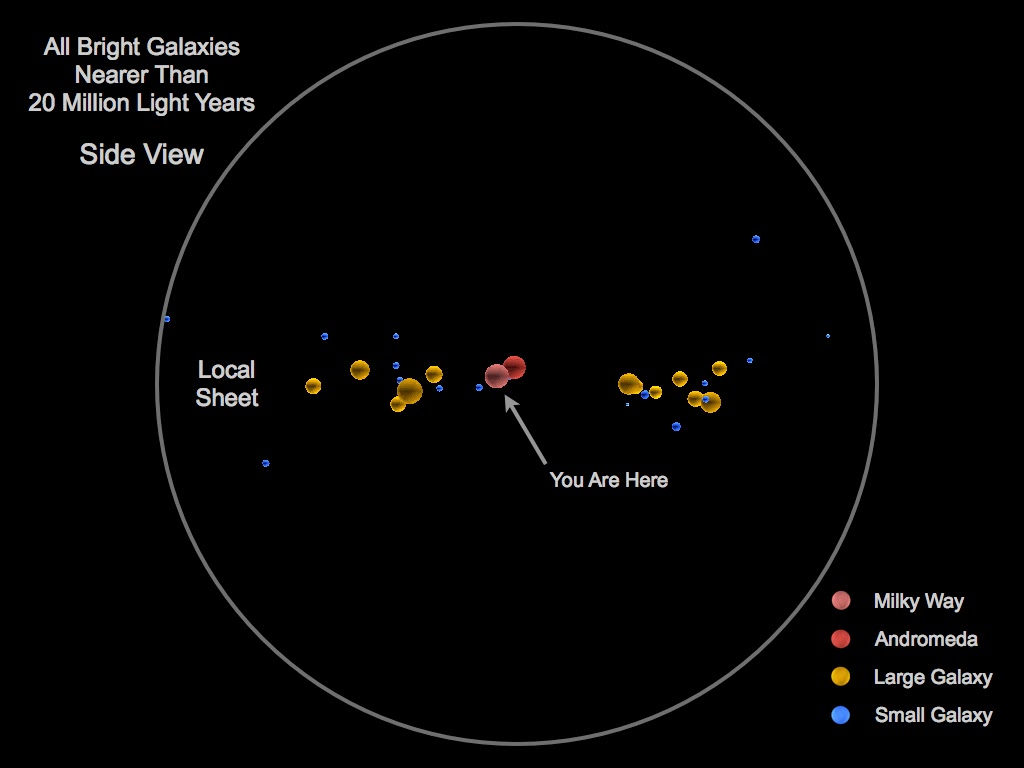
"All bright galaxies within 20 million light years, including us, are organized in a 'Local Sheet' 34-million light years across and only 1.5-million light years thick," says McCall.

"The Milky Way and Andromeda are encircled by twelve large galaxies arranged in a ring about 24-million light years across – this 'Council of Giants' stands in gravitational judgment of the Local Group by restricting its range of influence."

This is a diagram showing the brightest galaxies within 20 million light years of the Milky Way, this time viewed from the side. 

Credit: Marshall McCall / York University

McCall says twelve of the fourteen giants in the Local Sheet, including the Milky Way and Andromeda, are "spiral galaxies" which have highly flattened disks in which stars are forming.

The remaining two are more puffy "elliptical galaxies", whose stellar bulks were laid down long ago.

This movie illustrates the positions of the nearby galaxies, including those in the ‘Council of Giants’, in three dimensions. Credit: Marshall McCall / York University

Intriguingly, the two ellipticals sit on opposite sides of the Council. Winds expelled in the earliest phases of their development might have shepherded gas towards the Local Group, thereby helping to build the disks of the Milky Way and Andromeda.

McCall also examined how galaxies in the Council are spinning. He comments: "Thinking of a galaxy as a screw in a piece of wood, the direction of spin can be described as the direction the screw would move (in or out) if it were turned the same way as the galaxy rotates."

"Unexpectedly, the spin directions of Council giants are arranged around a small circle on the sky. This unusual alignment might have been set up by gravitational torques imposed by the Milky Way and Andromeda when the universe was smaller."

More Information: A Council of Giants - M.McCall, mnras.stu199