Showing posts with label MIDAS. Show all posts

Tuesday, January 13, 2015

ESA Rosetta: Comet 67/P surrounded by dusty vapour cloud

ESA Rosetta NAVCAM Close-up of Comet 67P on January 3, 2015, showing the larger of the two lobes (boulder Cheops labelled), multiple jets of dust, and what are most likely dust particles or aggregates in the comet’s coma or atmosphere. 

Credit: ESA/Rosetta/NAVCAM

Comets fly around the Sun surrounded by a cloud of vapour and grime that's as old as the Solar System itself.

You've probably noticed little flecks and streaks in photos returned by the Rosetta spacecraft in the blackness of space surrounding comet 67P/Churyumov-Gerasimenko.

After a recent year-end break, the ESA Rosetta team has returned with new updates on the comet including a series of four images recently released as a mosaic.

The pictures were processed to highlight surface features; the space around the nucleus is black in comparison. But if we take a closer look at what first appears void, we soon discover it's not empty at all.
Add caption
In photos taken January 3rd, the writer of ESA's Rosetta blog notes that "some of the streaks and specks seen around the nucleus will likely be dust grains ejected from the comet, captured in the 4.3 second exposure time."

Using an image-editing tool like Photoshop, we can hold back the glare of the nucleus and "open up" the shadows around the comet.

Jets of dust released by vaporizing ice are the most obvious features to emerge.

The soft, low-contrast plumes plow into the vacuum around the nucleus wrapping it in a silky cocoon of gas and dust, a tenuous atmosphere that reflects sunlight far more weakly than the comet itself.

While staring at dust spots may not produce the same magical feelings as watching a sunrise, it's fascinating nonetheless to contemplate what we're seeing.

If you've been struck by the beauty of a comet's meteor-like head trailing a wispy tail, you're looking at what countless individual grains of dust can do when sculpted by the master hand of the Sun.

Perusing images of 67P, we see the process in its infancy as individual grains and small clots are released into space to be fashioned into something grander.

Dust and gases released by the comet reflect so little light compared to the nucleus they require special processing to see clearly. 

In this photo, many of the small, irregular specks may be cometary dust grains captured in the 4.3 second exposure. 

Credit: ESA/Rosetta/NAVCAM

Rosetta's Micro-Imaging Dust Analysis System or MIDAS measures the rate at which dust sweeps past the spacecraft and its size distribution.

MIDAS catches dust grains by exposing a sticky target surface into space and waiting for a mote to drift by.

It snatched its first one last November, a larger than expected mote measuring about 1/100 of a millimeter across with a complex shape and fluffy texture.

Analysis of the composition of another dust grain named "Boris" made by the COSIMA instrument has identified sodium and magnesium.

Magnesium is no surprise as 95% of known minerals observed in comets resemble olivine and pyroxenes, common in meteorites and in the upper mantle of the Earth.

Sodium has also been seen before in comas and tails, and originates in dust grains, but its mineral source remains uncertain.

As we might study the makeup of the dust Pig-Pen leaves in his wake to identify traces of earthly dirt, micro-organisms, pollen, pollution, and even recent volcanic eruptions, so we examine each mote that sprays Rosetta's way, looking for clues to the origin of the planets and Solar System.

At right is a streak that could either be a larger, fast-moving dust particle that trailed during the exposure or perhaps a cosmic ray hit. 

Credit: ESA/Rosetta/NAVCAM

The mosaic image of the comet taken on January 3rd and processed, like most of ESA’s comet images, to highlight surface features. 

Credit: ESA/Rosetta/NAVCAM

Image of the first dust grain (center) captured by MIDAS. The bar at top left is 0.01 mm wide. 

Credit: Courtesy Mark Bentley

COSIMA’s first dust grains. Left: an image of the target plate (measuring 1 cm by 1 cm) on which the grains were collected; right: a section of the plate showing it on August 17th (top) when no dust grains were visible and 24 August 24th (bottom) when two large dust grains were detected. 

The plate is illuminated from the right by LEDs, and the length of the shadows is proportional to the height of the dust grains. 

Credit: ESA /Rosetta /MPS for COSIMA Team MPS /CSNSM /UNIBW /TUORLA /IWF /IAS /ESA / BUW /MPE /LPC2E /LCM /FMI /UTU /LISA /UOFC /vH&S

Friday, May 2, 2014

ESA Rosetta commissioning in final stages

Artist’s impression of the ESA Rosetta orbiter. 

Credit: ESA/ATG medialab

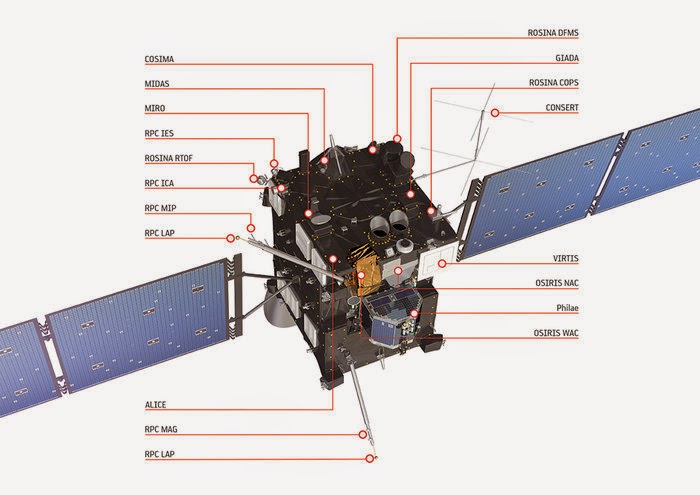
All of ESA Rosetta's 11 science instruments and the lander Philae have now been successfully switched on!

But the data are still being analysed to confirm the mission's readiness for science operations, so the commissioning period is not officially complete until those final reports from the instrument teams are in (this is expected to take place on 13 May, and we'll provide another update then).

The instrument commissioning period lasted for an intense six weeks, with each instrument assigned dedicated timeslots to be put through their paces.

ESA Rosetta lander Philae
Some of the instruments behaved a little erratically at first (who wouldn't after being woken up after a nearly three-year sleep), which required a few of the observations to be repeated towards the end of the commissioning period.

For example, see the most recent blog contribution from the RPC-ICA instrument team for the challenges they encountered.

Now all of the instruments have been successfully reactivated and the necessary measurements have been taken.

Some were also treated to software upgrades, read more about COSIMA's upgrade here, and MIDAS here.

The majority of instruments have since been switched back off until the science readiness reviews are complete and Rosetta is closer to comet 67P/CG, but OSIRIS and the spacecraft's NavCams continue to take images for navigation purposes.

OSIRIS is also taking lightcurve measurements to determine the comet's rotation period.

Final preparations are now being made for a series of rendezvous manoeuvres that will bring the spacecraft closer to the comet, ready for arriving at 67P/CG in August; as of today, there's just over 2 million kilometres to go.

A separate blog entry will be posted in the next week to outline in more detail these critical manoeuvres.