Showing posts with label comet 67/P. Show all posts

Tuesday, January 27, 2015

ESA Rosetta: Fissure spanning 100 metres discovered on Comet 67/P

A fissure spanning over 100 meters across the neck of Rosetta’s comet 67P raises the question of if, or when, the comet will break up. 

The fissure is part of released studies by Rosetta scientists in the journal Science. 

Credit: ESA/Rosetta, Illustration, T.Reyes

Not all comets break up as they vent and age, but for ESA Rosetta's comet 67P, the Rubber Duckie comet, a crack in the neck raises concerns.

Some comets may just fizzle and uniformly expel their volatiles throughout their surfaces. They may become like puffballs, shrink some but remain intact.

Comet 67P is the other extreme. The expulsion of volatile material has led to a shape and a point of no return; it is destined to break in two.

The fissure is part of the analysis in a new set of science papers published this week.

The images show a fissure spanning a few hundred meters across the neck of the two lobe comet.

The fissure is just one of the many incredible features on Comet 67P and is reported in research articles released in the January 22, 2015, edition of the journal Science.

Left: A map looking at the northern (right-hand rule, positive,) pole of 67P showing the total energy received from the Sun per rotation on 6 August 2014. 

The base of the neck (Hapi) receives ~15% less energy than the most illuminated region, 3.5 × 10⁶ J m-2 (per rotation). 

If self-heating were not included, the base of the neck would receive ~30% less total energy. 

Right: Similar to the left panel but showing total energy received over an entire orbital period in J m-2 (per orbit). 

Credit:ESA

What it means is not certain, but Rosetta team scientists have stated that flexing of the comet might be causing the fissure.

As the comet approaches the Sun, the solar radiation is raising the temperature of the surface material.

Like all materials, the comet's will expand and contract with temperature. And diurnal (daily) changes in the tidal forces from the Sun is a factor, too.'

The crack, or fissure, could spell the beginning of the end for comet 67P/Churyumov–Gerasimenko. It is located in the neck area, in the region named Hapi, between the two lobes that make 67P appear so much like a Rubber Duck from a distance.

The fissure could represent a focal point of many properties and forces at work, such as the rotation rate and axis – basically head over heels of the comet.

The fissure lies in the most active area at present, and possibly the most active area overall.

Though the Hapi region appears to receive nearly constant sunlight, at this time, Rosetta measurements (below) show otherwise – receiving 15% less sunlight than elsewhere.

Top left: The Hathor cliff face is to the right in this view. The aligned linear structures can be clearly seen. 

The smooth Hapi region is seen at the base of the Hathor cliff. Boulders are prevalent along the long axis of the Hapi region. 

Bottom left and right: Crack in the Hapi region. 

The left panel shows the crack (indicated by red arrows) extending across Hapi and beyond. 

The right panel shows the crack where it has left Hapi and is extending into Anuket, with Seth at the uppermost left and Hapi in the lower left. 

Credit: ESA/Rosetta

Sunlight and heating are major factors and the neck likely experiences the greatest mechanical stresses, internal torques, from heating or tidal forces from the sun as it rotates and approaches perihelion.

Rosetta scientists are still not certain whether 67P is two bodies in contact, a contact binary, or a shape that formed from material expelled about the neck area leading to its narrowing.

The Philae lander's MUPUS thermal sensor measured a temperature of –153°C (–243°F) at the landing site, while VIRTIS, an instrument on the primary spacecraft Rosetta, has measured -70°C (-94°F) at present.

These temperatures will rise as perihelion is reached on August 13, 2015, at a distance of 1.2432 A.U. (24% further from the Sun than Earth). At present – January 23rd – 67P is 2.486 A.U. from the Sun (2 1/2 times farther from the Sun than Earth).

While not a close approach to the Sun for a comet, the Solar radiation intensity will increase by 4 times between the present (January 2014) and perihelion in August.

Stresses due to temperature changes from diurnal variations, the changing Sun angle during perihelion approach, from loss of material, and finally from changes in the tidal forces on a daily basis (12.4043 hours) may lead to changes in the fissure causing it to possibly widen or increase in length.

Rosetta will continue escorting the comet and delivering images of the whole surface that will give Rosetta scientists the observations and measurements to determine 67P/Churyumov–Gerasimenko's condition now and its fate in the longer term.

Read the full article here

Friday, January 23, 2015

ESA Rosetta Comet 67/P Mission: Rosetta Team Uncovers More Secrets

A colour image of Comet 67P/Churyumov-Gerasimenko composed of three images taken by Rosetta’s scientific imaging system OSIRIS in the red, green and blue filters; the images were taken on August 6, 2014 from a distance of 120 km from the comet. 

Image credit: ESA / Rosetta / MPS / OSIRIS Team / UPD /LAM / IAA / SSO / INTA / UPM / DASP / IDA.

The familiar shape of the comet has now had many of its vital statistics measured: the small lobe measures 2.6 × 2.3 × 1.8 km and the large lobe 4.1 × 3.3 × 1.8 km.

The total volume of the comet is 21.4 km3. Rosetta’s Radio Science Instrument has measured its mass to be 10 billion tons, yielding a density of 470 kg/m3.

By assuming an overall composition dominated by water ice and dust with a density of 1,500–2,000 kg/m3, Rosetta scientists show that the comet has a very high porosity of 70–80 percent, with the interior structure likely comprising weakly bonded ice-dust clumps with small void spaces between them.

The OSIRIS instrument has imaged some 70 percent of the surface to date: the remaining unseen area lies in the southern hemisphere that has not yet been fully illuminated since Rosetta’s arrival.

The scientists have so far identified 19 regions separated by distinct boundaries and, following the ancient Egyptian theme of the Rosetta mission, these regions are named for Egyptian deities, and are grouped according to the type of terrain dominant within.

The 19 regions identified on 67P/Churyumov–Gerasimenko are separated by distinct geomorphological boundaries; they are grouped according to the type of terrain dominant within each region. 

Five basic categories of terrain type have been determined: dust-covered (Ma’at, Ash and Babi); brittle materials with pits and circular structures (Seth); large-scale depressions (Hatmehit, Nut and Aten); smooth terrains (Hapi, Imhotep and Anubis), and exposed, more consolidated surfaces (Maftet, Bastet, Serqet, Hathor, Anuket, Khepry, Aker, Atum and Apis). 

Image credit: ESA / Rosetta / MPS / OSIRIS Team / UPD /LAM / IAA / SSO / INTA / UPM / DASP / IDA.

Five basic, but diverse, categories of terrain type have been determined: dust-covered; brittle materials with pits and circular structures; large-scale depressions; smooth terrains; and exposed more consolidated surfaces.

Much of the northern hemisphere is covered in dust. As the comet is heated, ice turns directly into gas that escapes to form the atmosphere or coma.

Dust is dragged along with the gas at slower speeds, and particles that are not traveling fast enough to overcome the weak gravity fall back to the surface instead.

Some sources of discrete jets of activity have also been identified. While a significant proportion of activity emanates from the smooth neck region, jets have also been spotted rising from pits.

The gases that escape from the surface have also been seen to play an important role in transporting dust across the surface, producing dune-like ripples, and boulders with ‘wind-tails,’ the boulders act as natural obstacles to the direction of the gas flow, creating streaks of material ‘downwind’ of them.

“Because comets have very little gravity, dust and gas flow freely into space. But we were surprised to find a cloud of particles orbiting the comet that are large and heavy enough to defy the Sun’s radiation pressure,” said Dr Dennis Bodewits of the University of Maryland.

The scientists were able to make this discovery thanks to OSIRIS’ very sensitive cameras.

“Each pixel is about 30 cm. You couldn’t see a coffee cup, but you could see a large lunchbox. The resolution is about 10 times higher than Google Earth.”

According to the team, 67P/Churyumov-Gerasimenko was releasing the earthly equivalent of 1.2 liters of water into space every second at the end of August 2014.

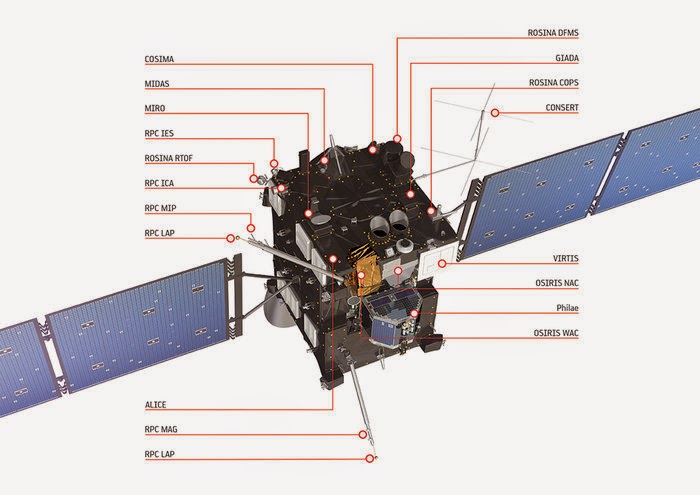
MIRO (Microwave Instrument for the Rosetta Orbiter)

Credit: ESA

“In observations, made by the Microwave Instrument for Rosetta Orbiter (MIRO), over a period of three months, the amount of water in vapor form that the comet was dumping into space grew about tenfold,” said Dr Sam Gulkis of NASA’s Jet Propulsion Laboratory in Pasadena.

“To be up close and personal with a comet for an extended period of time has provided us with an unprecedented opportunity to see how comets transform from cold, icy bodies to active objects spewing out gas and dust as they get closer to the Sun.”

Thursday, January 22, 2015

ESA Rosetta Mission: Sneak peek at Comet 67/P's "underside" - Cheops

ESA Rosetta NavCam captures a four-image mosaic of 67P/Churyumov-Gerasimenko on Jan. 16, 2015. 

Credit: ESA/Rosetta /NAVCAM – CC BY-SA IGO 3.0

A particularly dramatic view of comet 67P/C-G due to the angle of solar illumination, this is a mosaic made from four images acquired by ESA Rosetta's NavCam on January 16, 2015, from a distance of 28.4 km (17.6 miles).

The assembled image shows the larger "bottom" lobe of comet 67/P, with a flat region called Imhotep along the left side and, on the lower right, the transition area stretching up to the comet's smaller "head" lobe.

Outgassing jets can be seen as faint streaks at the upper right, and ejected dust grains show up as bright specks above its surface.

Also in this view is one of 67P's larger boulders, a somewhat pyramid-shaped rock dubbed "Cheops."

Position of the Cheops boulder on 67P 

Credit: ESA /Rosetta /Navcam

One in a cluster of boulders on 67P's "underside," Cheops is about 45 meters wide and 25 meters high (148 x 82 feet).

When it was first observed in Rosetta images Cheops and the nearby cluster reminded scientists of the pyramids at Giza in Egypt, and so it was named for the largest of those pyramids, the Great Pyramid, a tomb for the pharaoh Cheops (the Hellenised name for Khufu) built around 2,550 BCE.

Scientists are still working to determine the nature of 67P's boulders. It's not yet known what they are made of or how they came to be where they are observed today.

Did they fall into their current positions? Or were they exposed upwards from below as a result of the comet's activity? And why do they have alternating rough and smooth areas on their surfaces?

"It almost looks as if loose dust covering the surface of the comet has settled in the boulder's cracks, but, of course, it is much too early to be sure," said OSIRIS Principal Investigator Holger Sierks from the Max Planck Institute for Solar System Research (MPS) in Germany.

As comet 67P approaches perihelion over the course of the next six months we will get to see firsthand via Rosetta what sorts of changes occur to its surface features, including office-building-sized boulders like Cheops.

OSIRIS image of Cheops acquired on Sept. 19, 2014. 

Credit: ESA /Rosetta /MPS for OSIRIS Team MPS /UPD /LAM /IAA /SSO /INTA /UPM /DASP /IDA

Tuesday, January 13, 2015

ESA Rosetta: Comet 67/P surrounded by dusty vapour cloud

ESA Rosetta NAVCAM Close-up of Comet 67P on January 3, 2015, showing the larger of the two lobes (boulder Cheops labelled), multiple jets of dust, and what are most likely dust particles or aggregates in the comet’s coma or atmosphere. 

Credit: ESA/Rosetta/NAVCAM

Comets fly around the Sun surrounded by a cloud of vapour and grime that's as old as the Solar System itself.

You've probably noticed little flecks and streaks in photos returned by the Rosetta spacecraft in the blackness of space surrounding comet 67P/Churyumov-Gerasimenko.

After a recent year-end break, the ESA Rosetta team has returned with new updates on the comet including a series of four images recently released as a mosaic.

The pictures were processed to highlight surface features; the space around the nucleus is black in comparison. But if we take a closer look at what first appears void, we soon discover it's not empty at all.

Add caption
In photos taken January 3rd, the writer of ESA's Rosetta blog notes that "some of the streaks and specks seen around the nucleus will likely be dust grains ejected from the comet, captured in the 4.3 second exposure time."

Using an image-editing tool like Photoshop, we can hold back the glare of the nucleus and "open up" the shadows around the comet.

Jets of dust released by vaporizing ice are the most obvious features to emerge.

The soft, low-contrast plumes plow into the vacuum around the nucleus wrapping it in a silky cocoon of gas and dust, a tenuous atmosphere that reflects sunlight far more weakly than the comet itself.

While staring at dust spots may not produce the same magical feelings as watching a sunrise, it's fascinating nonetheless to contemplate what we're seeing.

If you've been struck by the beauty of a comet's meteor-like head trailing a wispy tail, you're looking at what countless individual grains of dust can do when sculpted by the master hand of the Sun.

Perusing images of 67P, we see the process in its infancy as individual grains and small clots are released into space to be fashioned into something grander.

Dust and gases released by the comet reflect so little light compared to the nucleus they require special processing to see clearly. 

In this photo, many of the small, irregular specks may be cometary dust grains captured in the 4.3 second exposure. 

Credit: ESA/Rosetta/NAVCAM

Rosetta's Micro-Imaging Dust Analysis System or MIDAS measures the rate at which dust sweeps past the spacecraft and its size distribution.

MIDAS catches dust grains by exposing a sticky target surface into space and waiting for a mote to drift by.

It snatched its first one last November, a larger than expected mote measuring about 1/100 of a millimeter across with a complex shape and fluffy texture.

Analysis of the composition of another dust grain named "Boris" made by the COSIMA instrument has identified sodium and magnesium.

Magnesium is no surprise as 95% of known minerals observed in comets resemble olivine and pyroxenes, common in meteorites and in the upper mantle of the Earth.

Sodium has also been seen before in comas and tails, and originates in dust grains, but its mineral source remains uncertain.

As we might study the makeup of the dust Pig-Pen leaves in his wake to identify traces of earthly dirt, micro-organisms, pollen, pollution, and even recent volcanic eruptions, so we examine each mote that sprays Rosetta's way, looking for clues to the origin of the planets and Solar System.

At right is a streak that could either be a larger, fast-moving dust particle that trailed during the exposure or perhaps a cosmic ray hit. 

Credit: ESA/Rosetta/NAVCAM

The mosaic image of the comet taken on January 3rd and processed, like most of ESA’s comet images, to highlight surface features. 

Credit: ESA/Rosetta/NAVCAM

Image of the first dust grain (center) captured by MIDAS. The bar at top left is 0.01 mm wide. 

Credit: Courtesy Mark Bentley

COSIMA’s first dust grains. Left: an image of the target plate (measuring 1 cm by 1 cm) on which the grains were collected; right: a section of the plate showing it on August 17th (top) when no dust grains were visible and 24 August 24th (bottom) when two large dust grains were detected. 

The plate is illuminated from the right by LEDs, and the length of the shadows is proportional to the height of the dust grains. 

Credit: ESA /Rosetta /MPS for COSIMA Team MPS /CSNSM /UNIBW /TUORLA /IWF /IAS /ESA / BUW /MPE /LPC2E /LCM /FMI /UTU /LISA /UOFC /vH&S

Thursday, January 8, 2015

ESA Rosetta: Latest Four-image mosaic of Comet 67/P

This four-image mosaic from ESA Rosetta spacecraft comprises images taken from a distance of 28.4 km from the centre of Comet 67P/Churyumov-Gerasimenko on 3 January. 

The image resolution is  2.4 m/pixel and the mosaic measures 4.4 x 4.2 km. 

Credit: ESA

This four-image mosaic from ESA Rosetta spacecraft comprises images taken from a distance of 28.4 km from the centre of Comet 67P/Churyumov-Gerasimenko on 3 January.

The image resolution at this distance is 2.4 m/pixel and the individual 1024 x 1024 frames measure 2.5 km across.

The mosaic is slightly cropped and rotated and measures about 4.4 x 4.2 km.

Because rotation and translation of the comet during the imaging sequence make it difficult to create an accurate mosaic, always refer to the individual images before drawing conclusions about any strange structures or low intensity extended emission.

The mosaic shows a great view across the Imhotep region, which includes the Cheops boulder on the larger of the two comet lobes.

The name of this region was revealed during the AGU conference in December (see the 17 Dec post).

The smaller of the comet’s lobes is situated to the far left of the mosaic.

The illumination conditions contribute to the interesting view of the features standing out against the shadowed foreground, close to the centre.

Some of the streaks and specks seen around the nucleus will likely be dust grains ejected from the comet, captured in the 4.3 second exposure time.

Wednesday, December 17, 2014

ESA Rosetta Mission: Philae Landing on Comet 67/P 'all a blur'

The CIVA image from ESA Rosetta's Philae Lander is all blurred because the lander is bouncing away from the surface of the comet.

Credit: ESA

An image has been released that shows the hairy moment that the Philae comet lander bounced back into space.

The little robot touched down on 4km-wide 67P in November - but not before rebounding twice.

The new picture is a big blur, which is not surprising given that the lander was far from static.

It was acquired by Philae's CIVA camera system, which was primed to start shooting the moment the robot settled on to the surface.

Sharp images of the comet's terrain were eventually taken, but by then the robot had shot 1km across the surface and into a dark "ditch".

The shadowed hole limited the amount of sunlight reaching Philae's power generator, restricting its ability to charge its batteries.

The probe now lies dormant, waiting for better lighting conditions, which could arrive in the next few weeks as the comet moves into the inner-Solar System.

An update on the mission was given here at the American Geophysical Union's Fall Meeting in San Francisco.

Philae co-principal investigator Jean-Pierre Bibring also showed some reprocessed imagery taken by CIVA camera when Philae had finally come to a stop.

These pictures have been shown before, but the manipulation undertaken by scientists has revealed some new details.

In one, which Prof Bibring dubbed "Perihelion Cliff", it is possible to see glare marks. The Frenchman said these were reflections from the lander.

The glare is probably the reflection of the Philae lander itself.

Credit: ESA

Philae managed to despatch a good deal of science data from the surface before going into hibernation.

This information was successfully passed by the orbiting mothership, Rosetta, to Earth - and scientists continue to make their interpretations.

Meanwhile, the hunt goes on for Philae. Its precise location on the surface of 67P is unknown.

Rosetta took a series of pictures of the comet's surface on 12, 13 and 14 December. When these pictures are downlinked to Earth, researchers are hopeful they will find their lost probe.

Understanding precisely where Philae is on the comet will help engineers understand its predicament and the likely time of an awakening.

Part of this work is already under way using the limited number of pictures sent back from CIVA.

A preliminary model of the final landing location and its difficult terrain has been constructed.

Philae Lander's CIVA camera images have been used to construct a model of the final landing location.

Credit: ESA

Friday, December 12, 2014

ESA Rosetta: First colour image of Comet 67/P

Scientists superimposed images taken with three different filters.

Credit: ESA

The first colour image from the ESA Rosetta spacecraft shows that Comet 67P is even more dark and monochrome than expected.

Despite being carefully assembled from three images taken with red, green and blue filters, the shot still looks effectively black-and-white.

It comes from the Osiris camera, which is on board the orbiting craft that last month made history by dropping a lander onto the comet's surface.

The Osiris team says 67P is "as black as coal" and surprisingly uniform.

The image was released by the Max Planck Institute for Solar System Research, which leads the consortium behind the camera.

"We like to refer to Osiris as the eyes of Rosetta," said the instrument's principal investigator Dr Holger Sierks.

But the camera is unlike human eyes, and so the colour image had to be produced by combining three separate shots.

This was no easy task. Rosetta is constantly moving and the comet beneath is spinning, so various changes in angle had to be accounted for.

The result is an image that looks remarkably similar to previous, greyscale views of 67P.

"As it turns out, 67P looks dark grey, in reality almost as black as coal," Dr Sierks said.

By the time the image is brightened enough for us to see the comet's features, it looks much lighter grey - but not what anyone would call colourful.

Using observations from the ground, scientists had already observed that Comet 67P, like many other small bodies in our Solar System, appeared to be grey "on average".

But the new results reveal that it seems to be this dark, coal colour all over - with little variation.

That suggests that its surface composition is fairly uniform and shows no sign of ice patches, which would appear bluish.

The comet's ice is presumably hidden below its dusty, boulder-strewn surface.

Thursday, December 11, 2014

ESA Rosetta: First measurements of Comet 67/P’s water ratio

ESA Rosetta’s measurement of the deuterium-to-hydrogen ratio (D/H) measured in the water vapour around Comet 67P/Churyumov–Gerasimenko. 

The measurements were made using ROSINA’s DFMS double focusing mass spectrometer between 8 August and 5 September 2014.

Credit: ESA, DLR.

Deuterium is an isotope of hydrogen with an added neutron.

The ratio of deuterium to hydrogen in water is a key diagnostic to determining where in the Solar System an object originated and in what proportion asteroids and/or comets contributed to Earth’s oceans.

The graph displays the different values of D/H in water observed in various bodies in the Solar System.

The data points are grouped by colour as planets and moons (blue), chondritic meteorites from the Asteroid Belt (grey), comets originating from the Oort cloud (purple) and Jupiter family comets (pink). Rosetta’s Jupiter-family comet is highlighted in yellow.

Diamonds represent data obtained in situ; circles represent data obtained by astronomical methods.

The lower part of the graph shows the value of D/H measured in molecular hydrogen in the atmosphere of the giant planets of the Solar System (Jupiter, Saturn, Uranus, Neptune) and an estimate of the typical value in molecular hydrogen for the protosolar nebula, from which all objects in our Solar System formed.

The ratio for Earth’s oceans is 1.56 ×10⁻⁴ (shown as the blue horizontal line in the upper part of the graph).

The value for Comet 67P/Churyumov–Gerasimenko is found to be 5.3 x 10⁻⁴, more than three times greater than for Earth’s oceans.

The discovery fuels the debate on the origin of Earth’s oceans and whether asteroids or comets played the bigger role in delivering water.

Thursday, November 13, 2014

ESA Rosetta team broadcast new pictures from Philae lander

Prof Jean Pierre Bibring (CNES) ESA Rosetta science team leader at the ESA update broadcast revealing new pictures from Philae lander sitting on the Comet 67/P.

The Philae is sitting close to a rocky cliff like structure, with 2 legs out of three on firm surface. The surface appears to be rocky not powdery.

The instruments on Philae are firing up to gather as much science data as possible while the onboard matteries are running.

Given that the Philae may be sitting on partial shade there is some doubt as to whether the solar panels can be deployed to extend the power cycle of the instruments' data gathering.

Prof Ulamec (DLR) of the ESA Rosetta team shows the approx area (the blue diamond) that the team believe Philae is located, on the comet.

There is some concern that is in the shade of a cliff-like structure.

The ESA team are under great pressure to produce pictures and data from the comet and this is clearly showing up in the professional but sleep deprived presentations.


Short animated sequence showing Philae leaving Rosetta on its descent to Comet 67/P.

This image from Rosetta shows a tiny dot that is the Philae lander in transit to comet 67/P. 


This is a composite picture made up of the others (above) showing an almost panaramic view around Philae.

ESA Rosetta mission: Philae Lander is safe on Comet 67/P - image

A brand new image shows the view from the Philae lander of the surface of the comet

The robot probe Philae that made a historic comet landing is now stable after initially failing to attach to the surface, and is sending pictures.

Efforts are now being made to locate the precise position of the European Space Agency probe on the comet.

Engineers say it may have bounced hundreds of metres back off the surface after first touching down.

Scientists hope the probe will analyse the comet's surface to yield insights into the origins of our Solar System.

The first pictures indicate that the lander is sitting at an angle - perhaps on a slope, or maybe even on its side. But the team is continuing to receive "great data" from Philae.

Esa's Rosetta satellite carried Philae on a 6.4 billion-km (4bn-mile) journey to Comet 67P/Churyumov-Gerasimenko.

ESA Rosetta mission: Philae Lander hanging on to Comet 67/P and broadcasting

ESA Rosetta's robotic probe, Philae Lander made a historic comet landing on comet 67/P and is now said to be stable after initially failing to attach to the surface.

Pictures are coming back from the craft as scientists debate how to proceed.

The OSIRIS camera (Optical, Spectrocopic and Infrared Remote Imaging System) is vital to the mission and it would be a huge disappointment if it fails to function.

ESA Rosetta team made a statement that it is still 'not possible to analyze images from the lander, raising speculation about the state of the craft and its instruments. We are told that the radar is not working.

Has the lander landed upright after bouncing 3 times on the surface? Has it toppled in the soft surface? Has it sunk too deeply into the surface? or are the instruments simply malfunctioning?

The Rosetta team should be able to see a large part of the comet from its current location because, technically, the lander has an albedo a lot larger then the comet.

European Space Agency engineers working on the lander say it may have bounced 3 times, and lifted off hundreds of metres back up off the surface, after first touching down.

Scientists hope the probe will analyse the comet's surface to yield insights into the origins of our Solar System.

The Esa's Rosetta satellite carried Philae on a 6.4 billion-km (4bn-mile) journey to Comet 67P/Churyumov-Gerasimenko.

The robot probe, the size of a washing machine, was launched from the satellite on Wednesday and spent seven hours travelling to the comet.

News of the first landing was confirmed at about 16:05 GMT on Wednesday.

ESA Rosetta mission: Philae Lander has difficulty hanging on to comet 67/P

It was a day when science fiction became science fact. With minute-perfect accuracy, scientists landed a probe on a comet following a ten year journey through the solar system.

The European Space Agency predicted that the first signal would arrive back on Earth at 4.03pm confirming that the Philae lander had touched down after being detached from its mother ship Rosetta.

And at 4.03pm the instruments at control centre in Darmstadt, Germany, sparked into life as the probe made contact and furrowed brows were replaced with beaming smiles and tears.

“We are on the comet!” announced Dr Stephan Ulamec, Philae’s Lander Manager. “We are sitting on the surface and Philae is talking to us.”

However initial jubilation was followed by some anxiety after it emerged that the landing harpoons had not activated, meaning that the probe was simply sitting on the soft surface without being securely attached.

Just hours later Dr Ulamec was forced to admit that the scientists had lost contact with the probe and did not actually know where it was.

"It's complicated to land on a comet. It's also complicated to understand what has happened during the landing. What we know is that we touched down and we landed on the comet. We had a very clear signal and we also received data from the lander. That is the very good news

"The not so good news is that the anchoring harpoons did not fire. So the lander is not anchored to the surface. Did we just land in a soft-sand box and everything is fine? Or is there something else happening. We still do not fully understand what has happened.

"Some of the data indicated that the lander may have lifted off again. It touched down and was rebouncing. So maybe today, we didn't just land once, we landed twice."

Scientists had already spent a nerve-racking 24 hours prior to the landing trying to work out why Philae would not power up after its 10 year slumber in space.

They also quickly realised that the thruster jets, designed to help the comet stay on the surface before the landing anchors are deployed, were not working at all. Without the thrusters it was feared the probe would simply bounce off the surface and back into space.

Despite the concerns, they decided to go ahead with the detachment at 8.35am on Wednesday morning. The probe made a perfect seven hour descent onto the comet 67P/Churyumov-Gerasimenko.

But on Wednesday evening scientists were facing the agonising decision of whether to attempt to activate the anchors again and risk pushing the craft back into space, or leave the probe untethered.

“Our big concern is at the moment is whether we are standing stably. We are considering if we need to retry shooting the anchors. said a spokesman for the Philae lander in Cologne.

Yet the science community was in firm agreement that the £1.3 billion mission had been an incredible success and a huge leap forward for astrophysics.

“It is a milestone for space exploration,” said Prof Tom Marsh of the University of Warwick’s Astronomy and Astrophysics group.

“An incredibly difficult task successfully accomplished at a distance of 520 million miles. It does not get much better than this.

“To think that we have landed on an object often thought in the past to be harbingers of doom is remarkable to me. I am looking forward to what we will now learn from Philae. A truly fabulous achievement.”

Wednesday, November 12, 2014

ESA Rosetta mission: Comet 67/P image captured by Philae Lander ROLIS instrument

The image shows comet 67P/CG acquired by the ROLIS instrument on the Philae lander during descent on Nov 12, 2014 14:38:41 UT from a distance of approximately 3 km from the surface. 

The landing site is imaged with a resolution of about 3m per pixel.

The ROLIS instrument is a down-looking imager that acquires images during the descent and doubles as a multispectral close-up camera after the landing.

The aim of the ROLIS experiment is to study the texture and microstructure of the comet's surface.

ROLIS (ROsetta Lander Imaging System) is a descent and close-up camera on the Philae Lander. It has been developed by the DLR Institute of Planetary Research, Berlin.

The lander separated from the orbiter at 09:03 GMT (10:03 CET) and touched down on Comet 67P/Churyumov–Gerasimenko seven hours later.

ESA Rosetta mission: Philae lander touches down on Comet 67/P

Philae’s parting image of Rosetta, taken shortly after separation

ESA’s Rosetta mission has soft-landed its Philae probe on a comet, the first time in history that such an extraordinary feat has been achieved.

After a tense wait during the seven-hour descent to the surface of Comet 67P/Churyumov–Gerasimenko, the signal confirming the successful touchdown arrived on Earth at 16:03 GMT (17:03 CET).

The confirmation was relayed via the Rosetta orbiter to Earth and picked up simultaneously by ESA’s ground station in Malargüe, Argentina and NASA’s station in Madrid, Spain.

The signal was immediately confirmed at ESA’s Space Operations Centre, ESOC, in Darmstadt, and DLR’s Lander Control Centre in Cologne, both in Germany.

The first data from the lander’s instruments were transmitted to the Philae Science, Operations and Navigation Centre at France’s CNES space agency in Toulouse.

“Our ambitious Rosetta mission has secured a place in the history books: not only is it the first to rendezvous with and orbit a comet, but it is now also the first to deliver a lander to a comet’s surface,” noted Jean-Jacques Dordain, ESA’s Director General.

“With Rosetta we are opening a door to the origin of planet Earth and fostering a better understanding of our future."

"ESA and its Rosetta mission partners have achieved something extraordinary today.”

“After more than 10 years travelling through space, we’re now making the best ever scientific analysis of one of the oldest remnants of our Solar System,” said Alvaro Giménez, ESA’s Director of Science and Robotic Exploration.

“Decades of preparation have paved the way for today’s success, ensuring that Rosetta continues to be a game-changer in cometary science and space exploration.”

“We are extremely relieved to be safely on the surface of the comet, especially given the extra challenges that we faced with the health of the lander,” said Stephan Ulamec, Philae Lander Manager at the DLR German Aerospace Center.

“In the next hours we’ll learn exactly where and how we’ve landed, and we’ll start getting as much science as we can from the surface of this fascinating world.”

Rosetta was launched on 2 March 2004 and travelled 6.4 billion kilometres through the Solar System before arriving at the comet on 6 August 2014.

“Rosetta’s journey has been a continuous operational challenge, requiring an innovative approach, precision and long experience,” said Thomas Reiter, ESA Director of Human Spaceflight and Operations.

“This success is testimony to the outstanding teamwork and the unique knowhow in operating spacecraft acquired at the European Space Agency over the decades.” 

ESA Rosetta mission: Philae Lander successfully lands on comet 67/P

European ESA Rosetta probes's robot lander, Philae has made the first, historic landing on a comet, after descending from its mothership.

The lander touched down on Comet 67P/Churyumov-Gerasimenko at about 1605 GMT.

There were cheers and hugs at the control room in Darmstadt, Germany, after the signal was confirmed.

It was designed to shine a light on some of the mysteries of these icy relics from the formation of the Solar System.

The landing caps a 6.4 billion-kilometre journey that was begun a decade ago.

"This is a big step for human civilisation," said Jean-Jacques Dordain, the director-general of the European Space Agency (Esa).

Shortly after the touchdown was confirmed, Stephan Ulamec, the mission's lander chief, said: "Philae is talking to us... we are on the comet."

The robot deployed harpoons to fasten itself to the 2.5-mile-wide ball of ice and dust.

Scientists will use Philae to take pictures of the comet's landscape and to analyse its chemical composition.

They are hoping the its surface materials will hold fresh insights into the origins of our Solar System more than 4.5 billion years ago.

ESA Rosetta Spacecraft Set to Harpoon Comet 67/P

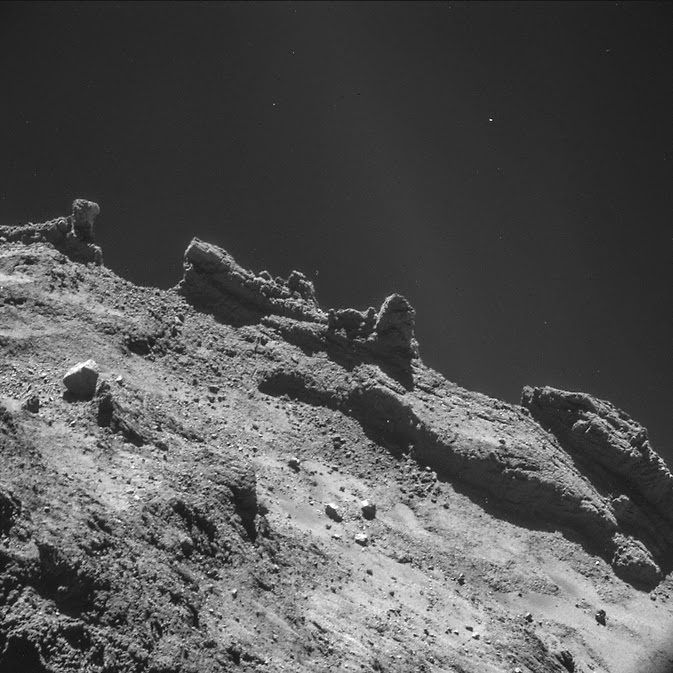
A jagged horizon of the nucleus of comet 67P/Churyumov-Gerasimenko appears in this image taken by the navigation camera on the European Space Agency's Rosetta spacecraft during the second half of October 2014. 

The image was taken from a distance of less than 6 miles (10 kilometers) from the surface.

Image Credit: ESA/Rosetta/NAVCAM


A patch of relatively smooth ground on the nucleus surface of comet 67P/Churyumov-Gerasimenko appears in this image taken by the navigation camera on the European Space Agency's Rosetta spacecraft in October 2014. 

The image was taken from a distance of less than 6 miles (10 kilometers).

Image Credit: ESA/Rosetta/NAVCAM

Some relatively rough terrain on the nucleus of comet 67P/Churyumov-Gerasimenko appears in this image taken by the navigation camera on the European Space Agency's Rosetta spacecraft in the second half of October 2014. 

The image was taken from a distance of less than 6 miles (10 kilometers).

Image Credit: ESA/Rosetta/NAVCAM

Early tomorrow morning, the European Space Agency's Rosetta spacecraft will deploy its comet lander, "Philae."

A little over seven hours later (8 a.m. PST/11 a.m. EST), the experiment-laden, harpoon-firing Philae is scheduled to touch down on the surface of comet 67P/Churyumov-Gerasimenko.

It will be the first time in history that a spacecraft has attempted a soft landing on a comet. Rosetta is an international mission led by the European Space Agency (ESA), with instruments provided by its member states, and additional support and instruments provided by NASA.

"I know it sounds like something out of Moby Dick, but when you think about the gravity field of a comet, it makes a lot of sense to harpoon one," said Art Chmielewski, project manager for the U.S. participation in Rosetta, from NASA's Jet Propulsion Laboratory in Pasadena, California.

"Comet 67P has approximately 100,000 times less gravity than Earth does. So, if you don't want to float away, you have to go to extraordinary measures to attach yourself to its dusty surface."

"The Philae lander has two harpoons, shock-absorbing landing gear, and a drill located on each of the lander's three feet. It even has a small, upward-firing rocket engine. All this to help keep it on the surface."

The descent of Philae begins at 1:03 a.m. PST (4:03 a.m. EST) when Rosetta releases the 220-pound (100-kilogram) Philae from an altitude of about 14 miles (23 kilometers) from the center of the comet's nucleus.

As Philae descends, it will fall slowly without propulsion or guidance, gradually gathering speed in the comet's weak gravitational field.

During the seven-hour descent, the lander will take images and conduct science experiments, sampling the environment close to the comet.

It will take a "farewell" image of the Rosetta orbiter shortly after separation, along with a number of images as it approaches the comet surface.

The targeted landing site is called Agilkia after an island in the Nile River in southern of Egypt where ancient buildings from the Nile's flooded Philae island were relocated.

Once the lander has touched down and safely anchored, it will begin a primary science mission, which extends to about two-and-a-half days.

Philae will take a panorama of its surroundings and perform on-the-spot analysis of the composition of the comet's surface.

It can drill samples from a depth of nine inches (23 centimeters) and feed them to the onboard laboratory for analysis.

The lander will also measure electrical and mechanical characteristics of the surface of the nucleus.
After the Philae landing is completed, Rosetta will begin the next major part of its mission, the escort phase.

Wednesday, November 5, 2014

ESA Rosetta: Landing Site on Comet 67/P named "Agilkia"

This image taken by ESA's Rosetta robe, shows the Philae lander's possible future landing site, called "Agilkia," on Comet 67P/Churyumov-Gerasimenko. 

Image taken on Oct. 30, 2014. 

Credit: ESA /Rosetta /NAVCAM

A probe chasing a comet is about to make a daring attempt to land on its deep-space target, and now, the robot's landing site officially has a name.

The Rosetta mission's Philae lander is expected to make its home on Comet 67P/Churyumov-Gerasimenko at a site now called "Agilkia," European Space Agency officials announced today (Nov. 4).

The new name was chosen from 8,000 entries after space agency officials issued a request to the public for suggestions.

The name Agilkia was suggested by more than 150 people as part of the competition. (Until today, the landing site was unofficially called "Site J.")

The new name comes from an island on the Nile River in Egypt. The name fits with the other monikers given to different parts of the comet-chasing mission.

The Philae lander is named for an obelisk discovered on Philae Island in the Nile, while Rosetta, the spacecraft that has carried Philae into deep space, is named after the Rosetta Stone, an ancient Egyptian tablet that helped modern archaeologists translate hieroglyphics.

Some of the artifacts found on Philae Island were actually relocated to Agilkia Island to protect them.

"The decision was very tough," the DLR German Aerospace Center's Felix Huber, chairman of the Philae Lander Steering Committee, said in a statement.

"We received so many good suggestions on how to name Site J, and we were delighted with such an enthusiastic response from all over the world. We wish to thank all participants for sharing their great ideas with us."

The goal of the $1.6 billion (1.3 billion euros) Rosetta mission is to learn more about the science of comets.

Scientists are also interested in researching what comets might reveal about the way life evolved in the solar system.

Officials chose the landing site because it has some smooth terrain, and could be the safest area to set down the probe.

While many people suggested Agilkia as the landing site name, ESA officials chose Alexandre Brouste of France as the winner of the competition.

Brouste will get to watch the live landing event, expected to take place on Nov. 12, from ESA's Space Operations Control Centre in Darmstadt, Germany.

"In eight days' time, Philae will be deployed from the orbiter onto Agilkia," Fred Jansen, ESA Rosetta mission manager, said in the same statement.

"On 12 November, we'll be attempting a unique comet landing, an even more ambitious endeavor to unlock secrets of our most remote origins." 

Tuesday, November 4, 2014

ESA Rosetta Team release composite picture of Comet 67/P

Four-image mosaic of Comet 67P/C-G on 30 October. 

Credits: ESA /Rosetta /NAVCAM

The mosaic comprises four individual NAVCAM images taken on 30 October when the Rosetta spacecraft was 26.8 km from the centre of the comet.

The image resolution at this distance is 2.27 m/pixel, and thus each 1024 x 1024 frame covers 2.3 km at the comet. The slightly cropped mosaic covers 4.0 x 3.7 km.

Even at this increased distance from the nucleus, the time between the four NAVCAM images means that it is difficult to make a completely accurate mosaic.

Thus, as always, caution is needed in interpreting some features on the surface and faint emission around the nucleus.

The four individual images that make up this mosaic are provided here.

The centre of the landing site is located roughly in the top centre, close to the horizon in this viewing angle; check against this image to help with orientation.

The large depression that characterises the smaller lobe of the comet can be seen in the right-hand side at top right, while parts of the larger lobe can be seen in the lower half, with the still unseen portion of the comet again cast in dramatic shadow.

Thursday, October 16, 2014

ESA Rosetta’s Comet Landing Site J Close Up

An annotated mosaic from the Rosetta spacecraft shows “Site J,” the primary landing site on comet 67P/Churyumov–Gerasimenko for the mission’s Philae lander.

Image Credit: ESA /Rosetta /MPS /UPD /LAM /IAA /SSO /INTA /UPM /DASP /IDA

A mosaic from the European Space Agency’s Rosetta spacecraft shows “Site J,” the primary landing site on comet 67P/Churyumov–Gerasimenko for the mission’s Philae lander. Rosetta is the first mission to attempt a soft landing on a comet.

The mosaic comprises two images taken by Rosetta’s OSIRIS narrow-angle camera on Sept. 14, 2014, from a distance of about 19 miles (30 kilometers).

The image scale is 1.6 feet (0.5 meters) per pixel. The red ellipse is centered on the landing site and is approximately 1,600 feet (500 meters) in diameter.

Site J is located on the smaller of the comet’s two lobes. On Nov. 12, the Rosetta spacecraft will release Philae at 01:03 a.m. PST/10:03 CET/09:03 UTC (the time the signal is received on Earth). Touchdown of Philae on Site J is expected about seven hours later, at around 8 a.m. PST/17:00 CET/16:00 UTC (Earth Received Time).

Launched in March 2004, Rosetta was reactivated in January 2014 after a record 957 days in hibernation.

Composed of an orbiter and lander, Rosetta's objectives since arriving at comet 67P/Churyumov-Gerasimenko earlier this month have been to study the celestial object up close in unprecedented detail, prepare for landing a probe on the comet's nucleus in November, and following the landing, track the comet's changes as it sweeps past the sun.

Comets are time capsules containing primitive material left over from the epoch when the sun and its planets formed.

Rosetta's lander will obtain the first images taken from a comet's surface and will provide comprehensive analysis of the comet's possible primordial composition by drilling into the surface.

Rosetta also will be the first spacecraft to witness at close proximity how a comet changes as it is subjected to the increasing intensity of the sun's radiation.

Observations will help scientists learn more about the origin and evolution of our solar system and the role comets may have played in seeding Earth with water, and perhaps even life.