Showing posts with label Philae lander. Show all posts

Friday, November 21, 2014

ESA Rosetta mission: After the comet landing comes the real Science

Artist’s impression of ESA’s Rosetta cometary probe

The spacecraft is covered with dark thermal insulation in order to keep it warm while venturing into the coldness of the outer Solar System, beyond Mars orbit. 

Credit: ESA

With the Philae lander’s mission complete, ESA's Rosetta probe will now continue its own extraordinary exploration, orbiting Comet 67P/Churymov–Gerasimenko during the coming year as the enigmatic body arcs ever closer to our Sun.

Last week, ESA's Rosetta spacecraft delivered its Philae lander to the surface of the comet for a dramatic touchdown.

The lander’s planned mission ended after about 64 hours when its batteries ran out, but not before it delivered a full set of results that are now being analysed by scientists across Europe.

Rosetta’s own mission is far from over and the spacecraft remains in excellent condition, with all of its systems and instruments performing as expected.

“With lander delivery complete, Rosetta will resume routine science observations and we will transition to the ‘comet escort phase',” says Flight Director Andrea Accomazzo.

“This science-gathering phase will take us into next year as we go with the comet towards the Sun, passing perihelion, or closest approach, on 13 August, at 186 million kilometres from our star.”

Thursday, November 20, 2014

ESA Rosetta mission: Philae lander - the sound of a Comet Touchdown

Image credit: ESA/ATG medialab – Audio file credit: ESA /Rosetta /Philae /SESAME /DLR

Sensors in the feet of Rosetta’s lander Philae have recorded the sound of touchdown as it first came into contact with Comet 67P/Churyumov-Gerasimenko. 


The instrument, SESAME-CASSE, was turned on during the descent and clearly registered the first touchdown as Philae came into contact with the comet, in the form of vibrations detected in the soles of the lander’s feet.

Focus on SESAME. Sensors are located in the three feet as well as in the units of the APXS (centre) and MUPUS-Pen (to the upper right of centre) instruments. Credits: ESA/ATG medialab

SESAME is the lander’s Surface Electrical Sounding and Acoustic Monitoring Experiment, and comprises three suites of instruments:

  • CASSE – the Comet Acoustic Surface Sounding Experiment, which allows mechanical parameters of the surface to be deduced, along with details of the structure of the subsurface;
  • DIM – the Dust Impact Monitor, which measures properties of impacting comet grains;
  • PP – the Permittivity Probe, which determines one of the key electrical properties of the material beneath Philae, which is linked to the water ice content of the surface.


Klaus Seidensticker from the DLR Institute of Planetary Research says: “Our data record the first touchdown and show that Philae’s feet first penetrated a soft surface layer – possibly a dust layer – several centimetres thick until they hit a hard surface – probably a sintered ice-dust layer – a few milliseconds later.”

Monday, November 17, 2014

ESA Rosetta mission: Philae lander OSIRIS NAC Camera captures landing data

This collection of images was acquired when Rosetta was about 15km above the surface of 67P

High-resolution pictures have now been released of the Philae probe in the act of landing on Comet 67P last Wednesday.

They were acquired by the OSIRIS Narrow Angle Camera (NAC) on the Rosetta satellite, which had dropped the little robot towards the surface of the "ice mountain".

The images are presented as a mosaic covering the half-hour or so around the "first touchdown," the probe then bounced to a stop about 1km away.

Philae lost battery power on Saturday and is no longer talking with Earth.

Scientists still have not located the craft's current resting spot.

But European Space Agency (ESA) controllers have not given up hope of hearing from the plucky robot again, if it can somehow get enough light on to its solar panels to recharge its systems.

Getting a precise fix on its location, to then photograph its present predicament would provide a better idea of whether this is likely to happen.

The new NAC images will certainly help in this respect because they show the direction the lander took as it bounced away.

At the weekend, ESA presented some fascinating views of the first touchdown taken by Rosetta's navigation cameras, but the OSIRIS NAC system has substantially better resolution.

It's a trap
The new mosaic is produced by the Max Planck Institute for Solar System Research, which operates Osiris.

It details Philae's descent, and the impact mark it leaves on 67P's surface. You then see the 100kg probe heading away on its initial bounce.

NB: All times are in GMT on Wednesday. The resolution is 28 cm/pixel.

This rebound reached hundreds of metres above the comet and lasted almost two hours.

When Philae came back down, it made another small leap, which took it into a high-walled trap.

Telemetry and pictures from the robot itself indicate this location is covered in deep shadow for most of 67P's day.

As a consequence, Philae receives insufficient solar power to re-boot and form a radio link to the orbiting Rosetta spacecraft.

ESA cannot be sure the robot will ever come back to life, but even if it does not the agency says it is "hugely happy" with what was achieved in the more than 50 hours following landing.

The probe managed to complete over 80% of its planned primary science campaign on the surface.

MUPUS
'Rock' hard
This data was pulled off the robot just before its sagging energy reserves dropped it into sleep mode.

Little of the results have so far been released by the various instrument teams. The one major exception is MUPUS.

This sensor package from DLR the German space agency's Institute for Planetary Research deployed a thermometer on the end of a hammer.

It retrieved a number of temperature profiles but broke as it tried to burrow its way into the comet's subsurface.

Scientists say this shows the icy material underlying 67P's dust covering to be far harder than anyone anticipated - having the tensile strength of some rocks.

It also helps explain why Philae bounced so high on that first touchdown.

The 4km-wide comet has little gravity, so when key landing systems designed to hold the robot down failed at the crucial moment, the probe would have been relying on thick, soft, compressive layers to absorb its impact.

However much dust it did encounter at that moment, it clearly was not enough to prevent Philae making its giant rebound.

Saturday, November 15, 2014

ESA Rosetta Mission: Philae Lander - Game Over!


The first spacecraft ever to land on a comet has fallen silent, entering a potentially long, cold sleep after running out of power.

The European Space Agency's Philae lander completed its last transmission Friday (Nov. 14) at 7:36 p.m. EST (0036 GMT) before settling into a hibernation state as its batteries ran out.

The probe had been studying the surface of Comet 67P/Churyumov–Gerasimenko for 57 hours when it went to sleep, possibly for good.

Philae landed on the comet on Wednesday (Nov. 12) as part of ESA's historic Rosetta mission.

"It has been a huge success, the whole team is delighted," Philae lander manager Stephan Ulamec of DLR German Aerospace Agency, who tracked the comet landing from ESA's Space Operations Center in Darmstadt, Germany, said in an ESA statement.

"Despite the unplanned series of three touchdowns, all of our instruments could be operated and now it's time to see what we've got."

ESA Rosetta mission: Crippled Philae lander endeavours to transmit relevant data

Animator's picture of Philae on the comet 67/P now appears more idealistic and hugely optimistic.

A report on the Philae spacecraft's verified Twitter feed suggests the probe has successfully "hopped" into a new position which may enable its solar panels to work

There was fresh hope for the Rosetta mission after scientists reconnected with the probe which could be holding key information about how life on Earth began.

The 25-year mission was thrown into jeopardy after the Philae craft bounced away from its landing site on the comet 67P/Churyumov-Gerasimenko and became stuck under a cliff.

Scientists had been working on attempts to find and move the probe before it ran out of battery power.

But on Friday those plans were abandoned and instead they began drilling beneath the surface of the comet in an attempt to get some samples on board for analysis.

ESA Philae landers' instruments listed. Consert, Romap, SD2 and Mupus have been initiated but results are unknown.

Contact with the lander was lost before the data could be sent back to Earth, but late last night Philae re-established radio contact with its orbiting Rosetta satellite and is sending data from the surface.

However, less than an hour later scientist confirmed the lander was "getting tired" and the battery voltage was approaching the limit.

Daniel Scuka, Senior Editor for Spacecraft Operations at ESOC, said on the mission blog: "While the search for the final landing site is still on-going, the lander is racing against the clock to meet as many of the core science goals as possible before the primary battery is exhausted.

"Under the low illumination conditions at Philae's location, it is unlikely that the secondary batteries will charge up enough to enable extended surface operations."

They confirmed that they had received data from Philae, and that the drill had moved up and down, but they were unsure what data they had.

A report on the spacecraft's verified Twitter feed, Philae Lander @Philae2014, suggests the craft has successfully "hopped" into a new position, possibly one that will enable more sunlight to shine on its solar panels.

The first of two messages at about 11pm read: "I just started lifting myself up a little and will now rotate and try and optimise the solar power."

This was quickly followed by another which said: "My rotation was successful (35 degrees). Looks like a whole new comet from this angle."

Philae has imaged three different spots on the comet, it was confirmed.

This may be the sum total of knowledge taken out of the Rosetta Philae lander chapter of the mission.

However, in a less optimistic update just before midnight Mr Scuka added: "On board Philae, system voltage has fallen very close to 21.5V; below that, the battery won't last much longer. At this time, there is insufficient sunlight to provide power."

Rosetta The comet is a remnant from the early solar system and may hold clues about how life on Earth began.

Many scientists believe that comets were the driving force, delivering water and amino acids to the planet during the "bombardment phase" about four billion years ago.

If the link with the probe is lost, there is a faint possibility that the solar panels will begin working again when the comet's orbit brings it closer to the Sun.

"We can only hope that as we approach the Sun, maybe in August, if we don't have dust or a huge coma [a dust cloud around the comet] blocking the Sun, then perhaps there would be a chance we could come back and at least see how the lander is doing," said Valentina Lommats, of the German Space Agency.

Crucially, the team had still not located the lander on Friday. On Thursday, team members said they believed Philae had bounced twice before settling in a crater east of the original landing site.

However, scans by the Osiris camera on board the Rosetta mother ship failed to locate the probe.

Rosetta has now started scanning other areas.

An animated gif of the Philae lander departing from Rosetta on its risky but calamitous journey onto the comet 67/P.

However, scientists were confident that they had collected a huge amount of a data, around 90 per cent of what they were hoping for before the solar panels were needed to extend the mission.

Even if Philae's job is finished, the Rosetta mission is to continue.

Rosetta will remain alongside the comet as it moves closer to the Sun.

Instruments on board will analyse the gases of the tail and the comet's interior, measure dust grains and study its atmosphere and gravity.

The comet will reach its closest distance to the Sun on Aug 13 next year, at about 115 million miles, roughly between the orbits of Earth and Mars.

Thursday, November 13, 2014

ESA Rosetta team broadcast new pictures from Philae lander

Prof Jean Pierre Bibring (CNES) ESA Rosetta science team leader at the ESA update broadcast revealing new pictures from Philae lander sitting on the Comet 67/P.

The Philae is sitting close to a rocky cliff like structure, with 2 legs out of three on firm surface. The surface appears to be rocky not powdery.

The instruments on Philae are firing up to gather as much science data as possible while the onboard matteries are running.

Given that the Philae may be sitting on partial shade there is some doubt as to whether the solar panels can be deployed to extend the power cycle of the instruments' data gathering.

Prof Ulamec (DLR) of the ESA Rosetta team shows the approx area (the blue diamond) that the team believe Philae is located, on the comet.

There is some concern that is in the shade of a cliff-like structure.

The ESA team are under great pressure to produce pictures and data from the comet and this is clearly showing up in the professional but sleep deprived presentations.


Short animated sequence showing Philae leaving Rosetta on its descent to Comet 67/P.

This image from Rosetta shows a tiny dot that is the Philae lander in transit to comet 67/P. 


This is a composite picture made up of the others (above) showing an almost panaramic view around Philae.

ESA Rosetta mission: Philae Lander is safe on Comet 67/P - image

A brand new image shows the view from the Philae lander of the surface of the comet

The robot probe Philae that made a historic comet landing is now stable after initially failing to attach to the surface, and is sending pictures.

Efforts are now being made to locate the precise position of the European Space Agency probe on the comet.

Engineers say it may have bounced hundreds of metres back off the surface after first touching down.

Scientists hope the probe will analyse the comet's surface to yield insights into the origins of our Solar System.

The first pictures indicate that the lander is sitting at an angle - perhaps on a slope, or maybe even on its side. But the team is continuing to receive "great data" from Philae.

Esa's Rosetta satellite carried Philae on a 6.4 billion-km (4bn-mile) journey to Comet 67P/Churyumov-Gerasimenko.

ESA Rosetta mission: Philae Lander hanging on to Comet 67/P and broadcasting

ESA Rosetta's robotic probe, Philae Lander made a historic comet landing on comet 67/P and is now said to be stable after initially failing to attach to the surface.

Pictures are coming back from the craft as scientists debate how to proceed.

The OSIRIS camera (Optical, Spectrocopic and Infrared Remote Imaging System) is vital to the mission and it would be a huge disappointment if it fails to function.

ESA Rosetta team made a statement that it is still 'not possible to analyze images from the lander, raising speculation about the state of the craft and its instruments. We are told that the radar is not working.

Has the lander landed upright after bouncing 3 times on the surface? Has it toppled in the soft surface? Has it sunk too deeply into the surface? or are the instruments simply malfunctioning?

The Rosetta team should be able to see a large part of the comet from its current location because, technically, the lander has an albedo a lot larger then the comet.

European Space Agency engineers working on the lander say it may have bounced 3 times, and lifted off hundreds of metres back up off the surface, after first touching down.

Scientists hope the probe will analyse the comet's surface to yield insights into the origins of our Solar System.

The Esa's Rosetta satellite carried Philae on a 6.4 billion-km (4bn-mile) journey to Comet 67P/Churyumov-Gerasimenko.

The robot probe, the size of a washing machine, was launched from the satellite on Wednesday and spent seven hours travelling to the comet.

News of the first landing was confirmed at about 16:05 GMT on Wednesday.

ESA Rosetta mission: Philae Lander has difficulty hanging on to comet 67/P

It was a day when science fiction became science fact. With minute-perfect accuracy, scientists landed a probe on a comet following a ten year journey through the solar system.

The European Space Agency predicted that the first signal would arrive back on Earth at 4.03pm confirming that the Philae lander had touched down after being detached from its mother ship Rosetta.

And at 4.03pm the instruments at control centre in Darmstadt, Germany, sparked into life as the probe made contact and furrowed brows were replaced with beaming smiles and tears.

“We are on the comet!” announced Dr Stephan Ulamec, Philae’s Lander Manager. “We are sitting on the surface and Philae is talking to us.”

However initial jubilation was followed by some anxiety after it emerged that the landing harpoons had not activated, meaning that the probe was simply sitting on the soft surface without being securely attached.

Just hours later Dr Ulamec was forced to admit that the scientists had lost contact with the probe and did not actually know where it was.

"It's complicated to land on a comet. It's also complicated to understand what has happened during the landing. What we know is that we touched down and we landed on the comet. We had a very clear signal and we also received data from the lander. That is the very good news

"The not so good news is that the anchoring harpoons did not fire. So the lander is not anchored to the surface. Did we just land in a soft-sand box and everything is fine? Or is there something else happening. We still do not fully understand what has happened.

"Some of the data indicated that the lander may have lifted off again. It touched down and was rebouncing. So maybe today, we didn't just land once, we landed twice."

Scientists had already spent a nerve-racking 24 hours prior to the landing trying to work out why Philae would not power up after its 10 year slumber in space.

They also quickly realised that the thruster jets, designed to help the comet stay on the surface before the landing anchors are deployed, were not working at all. Without the thrusters it was feared the probe would simply bounce off the surface and back into space.

Despite the concerns, they decided to go ahead with the detachment at 8.35am on Wednesday morning. The probe made a perfect seven hour descent onto the comet 67P/Churyumov-Gerasimenko.

But on Wednesday evening scientists were facing the agonising decision of whether to attempt to activate the anchors again and risk pushing the craft back into space, or leave the probe untethered.

“Our big concern is at the moment is whether we are standing stably. We are considering if we need to retry shooting the anchors. said a spokesman for the Philae lander in Cologne.

Yet the science community was in firm agreement that the £1.3 billion mission had been an incredible success and a huge leap forward for astrophysics.

“It is a milestone for space exploration,” said Prof Tom Marsh of the University of Warwick’s Astronomy and Astrophysics group.

“An incredibly difficult task successfully accomplished at a distance of 520 million miles. It does not get much better than this.

“To think that we have landed on an object often thought in the past to be harbingers of doom is remarkable to me. I am looking forward to what we will now learn from Philae. A truly fabulous achievement.”

Wednesday, November 12, 2014

ESA Rosetta Philae Lander may have bounced on landing

Philae may have landed not once but twice, that’s the final message from Esa this evening.

According to Stephan Ulamec, Philae Lander Manager, DLR, the lander team believe that Philae may have bounced from the surface and settled again in a slightly different place.

Engineers know that the anchoring harpoons did not fire. It is also known that the communications link to Rosetta failed intermittently in an irregular pattern shortly after the landing but always immediately re-established itself.

However, science data has been received and is currently being processed, but the promised first panorama from the surface has not been released.

Rosetta is now out of touch with Philae as the orbiter has dipped below the horizon of the comet. The link to Philae was lost a little earlier than expected but this is probably because a hill or boulder was in the way of the line of sight.

Right now, Philae should be working through its first automatic sequence of science experiments. Contact will be re-established through Rosetta later tonight, and the data downlinked.

There will also be more telemetry to assist the engineers in understanding the exact sequence of events during the landing.

We will know more tomorrow.

ESA Rosetta mission: Comet 67/P image captured by Philae Lander ROLIS instrument

The image shows comet 67P/CG acquired by the ROLIS instrument on the Philae lander during descent on Nov 12, 2014 14:38:41 UT from a distance of approximately 3 km from the surface. 

The landing site is imaged with a resolution of about 3m per pixel.

The ROLIS instrument is a down-looking imager that acquires images during the descent and doubles as a multispectral close-up camera after the landing.

The aim of the ROLIS experiment is to study the texture and microstructure of the comet's surface.

ROLIS (ROsetta Lander Imaging System) is a descent and close-up camera on the Philae Lander. It has been developed by the DLR Institute of Planetary Research, Berlin.

The lander separated from the orbiter at 09:03 GMT (10:03 CET) and touched down on Comet 67P/Churyumov–Gerasimenko seven hours later.

ESA Rosetta mission: Philae lander touches down on Comet 67/P

Philae’s parting image of Rosetta, taken shortly after separation

ESA’s Rosetta mission has soft-landed its Philae probe on a comet, the first time in history that such an extraordinary feat has been achieved.

After a tense wait during the seven-hour descent to the surface of Comet 67P/Churyumov–Gerasimenko, the signal confirming the successful touchdown arrived on Earth at 16:03 GMT (17:03 CET).

The confirmation was relayed via the Rosetta orbiter to Earth and picked up simultaneously by ESA’s ground station in Malargüe, Argentina and NASA’s station in Madrid, Spain.

The signal was immediately confirmed at ESA’s Space Operations Centre, ESOC, in Darmstadt, and DLR’s Lander Control Centre in Cologne, both in Germany.

The first data from the lander’s instruments were transmitted to the Philae Science, Operations and Navigation Centre at France’s CNES space agency in Toulouse.

“Our ambitious Rosetta mission has secured a place in the history books: not only is it the first to rendezvous with and orbit a comet, but it is now also the first to deliver a lander to a comet’s surface,” noted Jean-Jacques Dordain, ESA’s Director General.

“With Rosetta we are opening a door to the origin of planet Earth and fostering a better understanding of our future."

"ESA and its Rosetta mission partners have achieved something extraordinary today.”

“After more than 10 years travelling through space, we’re now making the best ever scientific analysis of one of the oldest remnants of our Solar System,” said Alvaro Giménez, ESA’s Director of Science and Robotic Exploration.

“Decades of preparation have paved the way for today’s success, ensuring that Rosetta continues to be a game-changer in cometary science and space exploration.”

“We are extremely relieved to be safely on the surface of the comet, especially given the extra challenges that we faced with the health of the lander,” said Stephan Ulamec, Philae Lander Manager at the DLR German Aerospace Center.

“In the next hours we’ll learn exactly where and how we’ve landed, and we’ll start getting as much science as we can from the surface of this fascinating world.”

Rosetta was launched on 2 March 2004 and travelled 6.4 billion kilometres through the Solar System before arriving at the comet on 6 August 2014.

“Rosetta’s journey has been a continuous operational challenge, requiring an innovative approach, precision and long experience,” said Thomas Reiter, ESA Director of Human Spaceflight and Operations.

“This success is testimony to the outstanding teamwork and the unique knowhow in operating spacecraft acquired at the European Space Agency over the decades.” 

ESA Rosetta mission: Philae Lander successfully lands on comet 67/P

European ESA Rosetta probes's robot lander, Philae has made the first, historic landing on a comet, after descending from its mothership.

The lander touched down on Comet 67P/Churyumov-Gerasimenko at about 1605 GMT.

There were cheers and hugs at the control room in Darmstadt, Germany, after the signal was confirmed.

It was designed to shine a light on some of the mysteries of these icy relics from the formation of the Solar System.

The landing caps a 6.4 billion-kilometre journey that was begun a decade ago.

"This is a big step for human civilisation," said Jean-Jacques Dordain, the director-general of the European Space Agency (Esa).

Shortly after the touchdown was confirmed, Stephan Ulamec, the mission's lander chief, said: "Philae is talking to us... we are on the comet."

The robot deployed harpoons to fasten itself to the 2.5-mile-wide ball of ice and dust.

Scientists will use Philae to take pictures of the comet's landscape and to analyse its chemical composition.

They are hoping the its surface materials will hold fresh insights into the origins of our Solar System more than 4.5 billion years ago.

ESA Rosetta Spacecraft Set to Harpoon Comet 67/P

A jagged horizon of the nucleus of comet 67P/Churyumov-Gerasimenko appears in this image taken by the navigation camera on the European Space Agency's Rosetta spacecraft during the second half of October 2014. 

The image was taken from a distance of less than 6 miles (10 kilometers) from the surface.

Image Credit: ESA/Rosetta/NAVCAM


A patch of relatively smooth ground on the nucleus surface of comet 67P/Churyumov-Gerasimenko appears in this image taken by the navigation camera on the European Space Agency's Rosetta spacecraft in October 2014. 

The image was taken from a distance of less than 6 miles (10 kilometers).

Image Credit: ESA/Rosetta/NAVCAM

Some relatively rough terrain on the nucleus of comet 67P/Churyumov-Gerasimenko appears in this image taken by the navigation camera on the European Space Agency's Rosetta spacecraft in the second half of October 2014. 

The image was taken from a distance of less than 6 miles (10 kilometers).

Image Credit: ESA/Rosetta/NAVCAM

Early tomorrow morning, the European Space Agency's Rosetta spacecraft will deploy its comet lander, "Philae."

A little over seven hours later (8 a.m. PST/11 a.m. EST), the experiment-laden, harpoon-firing Philae is scheduled to touch down on the surface of comet 67P/Churyumov-Gerasimenko.

It will be the first time in history that a spacecraft has attempted a soft landing on a comet. Rosetta is an international mission led by the European Space Agency (ESA), with instruments provided by its member states, and additional support and instruments provided by NASA.

"I know it sounds like something out of Moby Dick, but when you think about the gravity field of a comet, it makes a lot of sense to harpoon one," said Art Chmielewski, project manager for the U.S. participation in Rosetta, from NASA's Jet Propulsion Laboratory in Pasadena, California.

"Comet 67P has approximately 100,000 times less gravity than Earth does. So, if you don't want to float away, you have to go to extraordinary measures to attach yourself to its dusty surface."

"The Philae lander has two harpoons, shock-absorbing landing gear, and a drill located on each of the lander's three feet. It even has a small, upward-firing rocket engine. All this to help keep it on the surface."

The descent of Philae begins at 1:03 a.m. PST (4:03 a.m. EST) when Rosetta releases the 220-pound (100-kilogram) Philae from an altitude of about 14 miles (23 kilometers) from the center of the comet's nucleus.

As Philae descends, it will fall slowly without propulsion or guidance, gradually gathering speed in the comet's weak gravitational field.

During the seven-hour descent, the lander will take images and conduct science experiments, sampling the environment close to the comet.

It will take a "farewell" image of the Rosetta orbiter shortly after separation, along with a number of images as it approaches the comet surface.

The targeted landing site is called Agilkia after an island in the Nile River in southern of Egypt where ancient buildings from the Nile's flooded Philae island were relocated.

Once the lander has touched down and safely anchored, it will begin a primary science mission, which extends to about two-and-a-half days.

Philae will take a panorama of its surroundings and perform on-the-spot analysis of the composition of the comet's surface.

It can drill samples from a depth of nine inches (23 centimeters) and feed them to the onboard laboratory for analysis.

The lander will also measure electrical and mechanical characteristics of the surface of the nucleus.
After the Philae landing is completed, Rosetta will begin the next major part of its mission, the escort phase.

Tuesday, November 11, 2014

ESA Rosetta mission: setback as landing probe slow to wake up

A last-minute glitch in the 10-year mission of ESA's Rosetta spacecraft has ensured a nerve-shredding experience for scientists when they try to land it on a comet.

Rosetta’s Philae landing module did not power up properly when its controllers at the European Space Agency (ESA) switched it on for the first time on Tuesday, causing concern about whether it will work during the landing attempt.

Since it was launched in 2004, Rosetta has travelled four billion miles in its quest to find out, among other things, whether comets could have sparked life on Earth.

If the probe is successfully brought down on the surface of comet 67P/Churyumov-Gerasimenko, it will test samples for amino acids, which could show that similar comets “seeded” Earth with the chemicals needed for life.

If all goes to plan, the Philae probe will detach from Rosetta at 9.03am on Wednesday, with touchdown scheduled for 4.02pm.

Matt Taylor, a Rosetta project scientist, said: “We had a hiccup when we first powered it up. There was a little bit of a delay with it coming online. We don’t know what caused it and we are seeking to find out the cause.

“Obviously it’s a concern for the next step. But everything appears to be working OK now so we’re keeping our fingers crossed.”

Scientists said that the craft was on the right orbit, and the Twitter feed for Philae announced that it was “definitely” warmed up after the early glitches.

Comets throughout history have been associated with ill omen; harbingers of doom which streaked across the skies foretelling plague, death and apocalypse.

But the Rosetta mission could prove that they are actually responsible for all of life on Earth, and possibly life beyond it as well.

The scientists will be particularly excited if they find “left-handed” amino acids, so-called because they have mirror image “right-handed” forms, as those are the type which make up most of life on Earth.

Finding them on a comet would not only give the strongest indication yet that we have alien ancestry, but it would show that Earth-like life could exist on other planets.

John Plane, professor of atmospheric chemistry at the University of Leeds, said: “It’s hugely exciting. One of the great mysteries is whether life came from comets. And if these 'left-handed’ amino acids are found, then clearly these comets will be seeding other planets as well.

“We will be able to look in great detail at what is in the ice.”

There is also a theory that the icy comets brought huge amounts of water to Earth during a period of intense bombardment 4 billion years ago.

Prof Stanley Cowley, of the University of Leicester’s department of physics and astronomy, said: “Comets represent bodies which were left over, essentially unprocessed, from the formation of the solar system some 4.5  billion years ago.

“It is therefore an interesting relic from that otherwise inaccessible epoch.

“Comet impacts are thought to have been one of the principal means by which water was delivered to the early Earth, possibly contributing half the water in our oceans.”

The comet is orbiting at 34,000 miles per hour. It is 360 million miles away from Earth, about half way between the orbits of Mars and Jupiter.

The surface is a jumble of cliffs, boulders and steep slopes. If Philae is released when Rosetta is just a centimetre out of alignment, the lander could fall hundreds of metres away from the chosen touchdown spot.

On Tuesday night, the European Space Agency website said that Rosetta was on course to deliver the probe on the correct trajectory, thus completing the first “critical moment” of the landing.

Dr Daniel Brown, an astronomy lecturer at Nottingham Trent University, said: “Although we have landed on planets, moons and asteroids, it has never been attempted for a nucleus of a comet, and with good reason.

“These objects have a very low gravity, are loosely composed of ice, dust and rocks, and are very irregular in shape. They are temperamental in their behaviour and notoriously difficult to predict.”

The probe is expected to land and fix itself to the two-mile-long comet using harpoons and drills.

It will then begin to analyse the ice, organic material and chemicals present in the comet’s nucleus, and later, as it gets closer to the Sun and begins to heat up, the emissions of gases such as carbon dioxide.

Prof Alan Fitzsimmons from the astrophysics research centre at Queen’s University, Belfast, and colleagues have spent more than a decade studying comet 67P/Churyumov-Gerasimenko and measuring its properties.

“We have waited over 10 years for this day, but with the comet being over 317 million miles away, all we can do now is cross our fingers and hope,” he said.

“The Rosetta mission realises the ambition of mankind to explore our origins and discover what is out there.”

The distance between Earth and the comet means that mission control will not find out whether the landing has been a success for 28 minutes and 20 seconds due to the amount of time it will take the radio waves to travel and transmit the data.

While Philae is on the surface, Rosetta will continue flying in formation with the comet at a distance of about 18 miles.

Rosetta has already been travelling for more than a decade. The craft was launched on March 2, 2004, from Kourou, French Guiana.

It is named after the Rosetta Stone, which provided the key to deciphering hieroglyphics. Scientists hope the spacecraft will provide a similar breakthrough in our understanding of the past.

The Philae probe is named after the island in the Nile where an obelisk was found which also displayed inscriptions in two ancient languages and helped with deciphering the Rosetta Stone.

Wednesday, November 5, 2014

ESA Rosetta: Landing Site on Comet 67/P named "Agilkia"

This image taken by ESA's Rosetta robe, shows the Philae lander's possible future landing site, called "Agilkia," on Comet 67P/Churyumov-Gerasimenko. 

Image taken on Oct. 30, 2014. 

Credit: ESA /Rosetta /NAVCAM

A probe chasing a comet is about to make a daring attempt to land on its deep-space target, and now, the robot's landing site officially has a name.

The Rosetta mission's Philae lander is expected to make its home on Comet 67P/Churyumov-Gerasimenko at a site now called "Agilkia," European Space Agency officials announced today (Nov. 4).

The new name was chosen from 8,000 entries after space agency officials issued a request to the public for suggestions.

The name Agilkia was suggested by more than 150 people as part of the competition. (Until today, the landing site was unofficially called "Site J.")

The new name comes from an island on the Nile River in Egypt. The name fits with the other monikers given to different parts of the comet-chasing mission.

The Philae lander is named for an obelisk discovered on Philae Island in the Nile, while Rosetta, the spacecraft that has carried Philae into deep space, is named after the Rosetta Stone, an ancient Egyptian tablet that helped modern archaeologists translate hieroglyphics.

Some of the artifacts found on Philae Island were actually relocated to Agilkia Island to protect them.

"The decision was very tough," the DLR German Aerospace Center's Felix Huber, chairman of the Philae Lander Steering Committee, said in a statement.

"We received so many good suggestions on how to name Site J, and we were delighted with such an enthusiastic response from all over the world. We wish to thank all participants for sharing their great ideas with us."

The goal of the $1.6 billion (1.3 billion euros) Rosetta mission is to learn more about the science of comets.

Scientists are also interested in researching what comets might reveal about the way life evolved in the solar system.
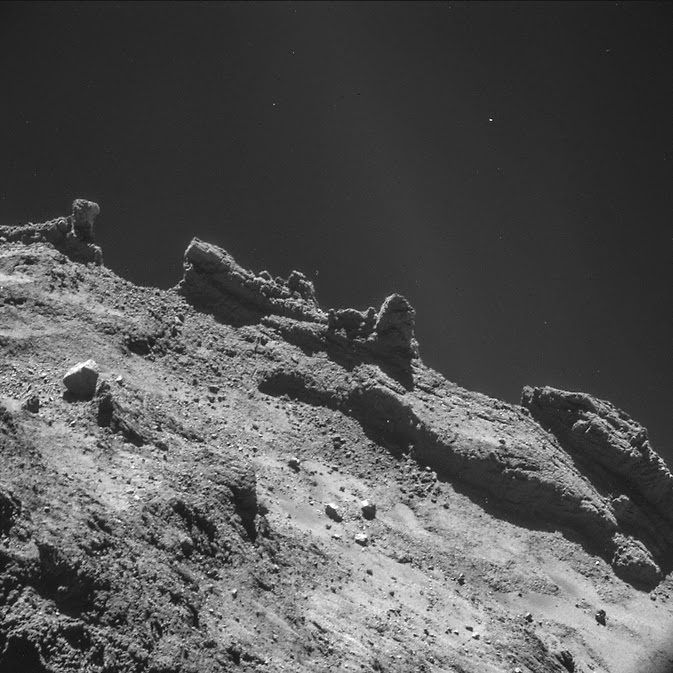
Officials chose the landing site because it has some smooth terrain, and could be the safest area to set down the probe.

While many people suggested Agilkia as the landing site name, ESA officials chose Alexandre Brouste of France as the winner of the competition.

Brouste will get to watch the live landing event, expected to take place on Nov. 12, from ESA's Space Operations Control Centre in Darmstadt, Germany.

"In eight days' time, Philae will be deployed from the orbiter onto Agilkia," Fred Jansen, ESA Rosetta mission manager, said in the same statement.

"On 12 November, we'll be attempting a unique comet landing, an even more ambitious endeavor to unlock secrets of our most remote origins." 

Thursday, October 16, 2014

ESA Rosetta's lander, Philae snaps image of comet 67P/Churyumov-Gerasimenko

A camera aboard Rosetta's lander, Philae, snapped this image of comet 67P/Churyumov-Gerasimenko on Oct. 7.

Credit: ESA /Rosetta /Philae /CIVA

With an icy comet lurking just over its shoulder, a far-flung European spacecraft snapped a selfie in outer space.

The photographer was Philae, a small lander attached to the European Space Agency's (ESA) Rosetta probe.

At the time (Oct. 7), Philae was just 10 miles (16 kilometers) away from the Comet 67P/Churyumov-Gerasimenko, but they're about to get much closer.

On Nov. 12, Philae is scheduled to separate from Rosetta to make an unprecedented touchdown on the comet.

After a decade-long, 4-billion-mile (6 billion km) journey from Earth, Rosetta was awakened from a deep sleep in January.

Then, through a series of carefully choreographed maneuvers, the probe arrived at 67P/Churyumov-Gerasimenko in August and became the first spacecraft to ever orbit a comet.

The new image, released by ESA this week, shows off Rosetta's glinting 52-foot-long (16-meter) solar arrays.

The composition is almost identical to a selfie Philae snapped last month, but at 31 miles (50 kilometers) away, the comet looked much smaller in that photo.

Tuesday, October 7, 2014

ESA Rosetta: jets of dust and outgassing from Comet 67/P

An image taken by ESA's Rosetta probe on Sept. 26, 2014 shows jets of dust and gas escaping from the nucleus of Comet 67P/Churyumov-Gerasimenko.

Credit: ESA/Rosetta/NAVCAM

A European spacecraft's comet companion is starting to wake up as it gets closer and closer to the sun.

The European Space Agency's Rosetta probe, which arrived in orbit around Comet 67P/Churyumov-Gerasimenko in August after a 10-year deep-space chase, has photographed jets of gas and dust erupting from the icy wanderer's surface.

"The main talking point of this image is the spectacular region of activity at the neck of 67P/C-G," European Space Agency (ESA) officials wrote in a description of the photo, a four-image montage taken on Sept. 26 when Rosetta was 16 miles (26 kilometers) from the comet.

"What we’re seeing is the product of ices sublimating and gases escaping from inside the comet, carrying streams of dust out into space," they added.

"As the comet gets progressively closer to the sun along its orbit, the surface will become warmer, and the level of activity will increase, producing a vast coma around the nucleus, along with a tail."

The $1.7 billion (1.3 billion euros) Rosetta mission launched in March 2004 and took a circuitous path through space, finally catching up to the 2.5-mile-wide (4 km) Comet 67P on Aug. 6 of this year. On that date, Rosetta became the first probe ever to orbit a comet.

The Rosetta team aims to make some more history soon. On Nov. 12, the probe will deploy a lander called Philae, which will spiral slowly down toward 67P and, if all goes according to plan, become the first robot to make a soft touchdown on a comet.

Philae will snap photos and analyze samples of the comet.

Rosetta should continue studying 67P through at least December 2015, observing how the icy body changes as it approaches the sun.

Wednesday, September 24, 2014

ESA Rosetta Probe Snaps Spectacular Comet 67/P Close-Ups


Europe's Rosetta spacecraft has returned some of the most detailed images yet of the comet it caught last month after a decade-long chase through deep space.

Rosetta snapped the four new comet photos, which mission scientists stitched into a single mosaic, on Sept. 19, at a distance of 17.7 miles (28.6 kilometers) from the center of Comet 67P/Churyumov-Gerasimenko.

The mosaic shows ridges on 67P's "neck" and many cliffs and boulders scattered across the comet's surface. Some of the photos overlap, so the same comet features can be seen in multiple images.

Rosetta spacecraft obtained this four-image NAVCAM mosaic of Comet 67P/Churyumov-Gerasimenko, with images taken on Sept. 19, 2014, when it was 18 miles (28.6 km) from the comet. 

Credit: ESA/Rosetta/NAVCAM

Rosetta launched in March 2004 and finally caught up to 67P on Aug. 6 of this year, thus becoming the first spacecraft ever to orbit a comet.

The probe has been taking photos and measurements of 67P ever since, allowing astronomers to construct the first map of the 2.5-mile-long (4 km) celestial object.

European Space Agency (ESA) researchers used a program called Microsoft ICE to stitch the four new Rosetta photos together.

A few areas on the left needed exposure adjustments, and the whole image's contrast was enhanced a little, ESA officials said.

Astronomers in Ukraine first spotted Comet 67P, which completes one lap around the sun every 6.5 years, in 1969.

The object is unusually dark for a comet, most of which are reflective and covered in ice; so far, astronomers haven't spotted any ice patches on 67P

Rosetta spacecraft produced this four-image montage of comet 67P/C-G, with images taken on Sept. 19, 2014. 

Black borders separate the images, and there is some overlap. 

 Credit: SA/Rosetta/NAVCAM

Achieving orbit around 67P was a cosmic first, and the Rosetta team plans to make some more history soon.

The mission plan calls for Rosetta to drop a lander called Philae down onto the comet on Nov. 11.

Philae will land on the smaller of 67P's two lobes to study the comet's surface and analyze its composition and atmosphere.

Philae also has a drill, which it will use to take samples.

ESA officials expect that Rosetta will fly with and study the comet until December 2015. They hope the mission provides insight into how comets change as they approach the sun.

Tuesday, September 23, 2014

ESA Rosetta's Philae Lander Instrument package

Rosetta’s Philae lander includes a carefully selected set of instruments and is being prepared for a November 11th dispatch to analyze a comet’s surface.

Credit: ESA, Composite – T.Reyes

When traveling to far off lands, one packs carefully. What you carry must be comprehensive but not so much that it is a burden, and once you arrive, you must be prepared to do something extraordinary to make the long journey worthwhile.

What will the lander do once it arrives and gets settled in its new surroundings?

As Henry David Thoreau said, "It is not worthwhile to go around the world to count the cats in Zanzibar." So it is with the Rosetta lander Philae.

With the stage set, a landing site chosen and landing date of November 11th, the Philae lander is equipped with a carefully thought-out set of scientific instruments.

Comprehensive and compact, Philae is a like a Swiss Army knife of tools to undertake the first on-site (in-situ) examination of a comet.

Now, consider the scientific instruments on Philae which were selected about 15 years ago. Just like any good traveler, budgets had to be set which functioned as constraints on the instrument selection that could be packed and carried along on the journey.

There was a maximum weight, maximum volume, and power. The final mass of Philae is 100 kg (220 lbs). Its volume is 1 × 1 × 0.8 meters (3.3 × 3.3 × 2.6 ft) about the size of a four burner oven-range.

However, Philae must function on a small amount of stored energy upon arrival: 1000 Watt-Hours (equivalent of a 100 watt bulb running for 10 hours).

Once that power is drained, it will produce a maximum of 8 watts of electricity from Solar panels to be stored in a 130 Watt-Hour battery.

Without any assurance that they would land fortuitously and produce more power, the Philae designers provided a high capacity battery that is charged, one time only, by the primary spacecraft solar arrays (64 sq meters) before the descent to the comet.

With an initial science command sequence on-board Philae and the battery power stored from Rosetta, Philae will not waste any time to begin analysis, not unlike a forensic analysis, to do a "dissection" of a comet.

Thereafter, they utilize the smaller battery which will take at least 16 hours to recharge but will permit Philae to study 67P/Churyumov-Gerasimenko for potentially months.

There are 10 science instrument packages on the Philae lander. The instruments use absorbed, scattered, and emitted light, electrical conductivity, magnetism, heat, and even acoustics to assay the properties of the comet.

Those properties include the surface structure (the morphology and chemical makeup of surface material), interior structure of P67, and the magnetic field and plasmas (ionized gases) above the surface.

Additionally, Philae has an arm for one instrument and the Philae main body can be rotated 360 degrees around its Z-axis. The post which supports Philae and includes a impact dampener.

ROLIS
CIVA and ROLIS imaging systems. CIVA represents three cameras which share some hardware with ROLIS.

CIVA-P (Panoramic) is seven identical cameras, distributed around the Philae body but with two functioning in tandem for stereo imaging.

Each has a 60 degree field of view and uses as 1024×1024 CCD detector.

As most people can recall, digital cameras have advanced quickly in the last 15 years.

Philae's imagers were designed in the late 1990s, near state-of-the-art, but today they are surpassed, at least in number of pixels, by most smartphones.

However, besides hardware, image processing in software has advanced as well and the images may be enhanced to double their resolution.

CIVA-P will have the immediate task, as part of the initial autonomous command sequence, of surveying the complete landing site.

It is critical to the deployment of other instruments. It will also utilize the Z-axis rotation of the Philae body to survey.

CIVA-M/V is a microscopic 3-color imager (7 micron resolution) and CIVA-M/I is a near infra-red spectrometer (wavelength range of 1 to 4 microns) that will inspect each of the samples that is delivered to the COSAC & PTOLEMY ovens before the samples are heated.

ROLIS is a single camera, also with a 1024×1024 CCD detector, with the primary role of surveying the landing site during the descent phase.

The camera is fixed and downward pointing with an f/5 (f-ratio) focus adjustable lens with a 57 degree field of view.

During descent it is set to infinity and will take images every 5 seconds. Its electronics will compress the data to minimize the total data that must be stored and transmitted to Rosetta.

Focus will adjust just prior to touchdown but thereafter, the camera functions in macro mode to spectroscopically survey the comet immediately underneath Philae.

Rotation of the Philae body will create a "working circle" for ROLIS.

The multi-role design of ROLIS clearly shows how scientists and engineers worked together to overall reduce weight, volume, and power consumption, and make Philae possible and, together with Rosetta, fit within payload limits of the launch vehicle, power limitations of the solar cells and batteries, limitations of the command and data system and radio transmitters.


APXS: Alpha Proton X-ray Spectrometer.
This is a near must-have instrument of the space scientist's Swiss Army Knife. APXS spectrometers have become a common fixture on all Mars Rover missions and Philae's is an upgraded version of Mars Pathfinder's.

The legacy of the APXS design is the early experiments by Ernest Rutherford and others that led to discovering the structure of the atom and the quantum nature of light and matter.

This instrument has a small source of Alpha particle emission (Curium 244) essential to its operation.

The principles of Rutherford Back-scattering of Alpha particles is used to detect the presence of lighter elements such as Hydrogen or Beryllium (those close to an Alpha particle in mass, a Helium nucleus).

The mass of such lighter elemental particles will absorb a measurable amount of energy from the Alpha particle during an elastic collision; as happens in Rutherford back-scattering near 180 degrees.

However, some Alpha particles are absorbed rather than reflected by the nuclei of the material.

Absorption of an Alpha particle causes emission of a proton with a measurable kinetic energy that is also unique to the elemental particle from which it came (in the cometary material); this is used to detect heavier elements such as magnesium or sulfur.

Lastly, inner shell electrons in the material of interest can be expelled by Alpha particles.

When electrons from outer shells replace these lost electrons, they emit an X-Ray of specific energy (quantum) that is unique to that elementary particle; thus, heavier elements such as Iron or Nickel are detectable.

APXS is the embodiment of early 20th Century Particles Physics.

CONSERT: COmet Nucleus Sounding Experiment by Radio wave Transmission, as the name suggests, will transmit radio waves into the comet's nucleus.

The Rosetta orbiter transmits 90 MHz radio waves and simultaneously Philae stands on the surface to receive with the comet residing between them.

Consequently, the time of travel through the comet and the remaining energy of the radio waves is a signature of the material through which it propagated.

Many radio transmissions and receptions by CONSERT through a multitude of angles will be required to determine the interior structure of the comet.

It is similar to how one might sense the shape of a shadowy object standing in front of you by panning one's head left and right to watch how the silhouette changes; altogether your brain perceives the shape of the object.

With CONSERT data, a complex deconvolution process using computers is necessary. The precision to which the comet's interior is known improves with more measurements.

MUPUS
MUPUS: Multi-Purpose Sensor for Surface and Subsurface Science is a suite of detectors for measuring the energy balance, thermal and mechanical properties of the comet's surface and subsurface down to a depth of 30 cm (1 foot).

There are three major parts to MUPUS. There is the PEN which is the penetrator tube.

PEN is attached to a hammering arm that extends up to 1.2 meters from the body.

It deploys with sufficient downward force to penetrate and bury PEN below the surface; multiple hammer strokes are possible.

At the tip, or anchor, of PEN (the penetrator tube) is an accelerometer and standard PT100 (Platinum Resistance Thermometer).

Together, the anchor sensors will determine the hardness profile at the landing site and the thermal diffusivity at the final depth [ref].

As it penetrates the surfaces, more or less deceleration indicates harder or softer material. The PEN includes an array of 16 thermal detectors along its length to measure subsurface temperatures and thermal conductivity.

The PEN also has a heat source to transmit heat to the cometary material and measure its thermal dynamics. With the heat source off, detectors in PEN will monitor the temperature and energy balance of the comet as it approaches the Sun and heats up.

The second part is the MUPUS TM, a radiometer atop the PEN which will measure thermal dynamics of the surface. TM consists of four thermopile sensors with optical filters to cover a wavelength range from 6-25 µm.

SD2
SD2 Sample Drill and Distribution device will penetrate the surface and subsurface to a depth of 20 cm. Each retrieved sample will be a few cubic millimeters in volume and distributed to 26 ovens mounted on a carousel.

The ovens heat the sample which creates a gas that is delivered to the gas chromatographs and mass spectrometers that are COSAC and PTOLEMY.

Observations and analysis of APXS and ROLIS data will be used to determine the sampling locations all of which will be on a "working circle" from the rotation of Philae's body about its Z-axis.

COSAC
COSAC: Cometary Sampling and Composition experiment. The first gas chromatograph (GC) I saw was in a college lab and was being used by the lab manager for forensic tests supporting the local police department.

The intent of Philae is nothing less than to perform forensic tests on a comet hundred of million of miles from Earth.

Philae is effectively Sherlock Holmes' spy glass and Sherlock is all the researchers back on Earth.

The COSAC gas chromatograph includes a mass spectrometer and will measure the quantities of elements and molecules, particularly complex organic molecules, making up comet material.

While that first lab GC I saw was closer to the size of Philae, the two GCs in Philae are about the size of shoe boxes.

PTOLEMY
PTOLEMY: An Evolved Gas Analyzer [ref], a different type of gas chromatograph. The purpose of PTOLEMY is to measure the quantities of specific isotopes to derive the isotopic ratios, for example, 2 parts isotope C12 to one part C13.

By definition, isotopes of an element have the same number of protons but different numbers of neutrons in their nuclei. One example is the 3 isotopes of Carbon, C12, C13 and C14; the numbers being the number of neutrons.

Some isotopes are stable while others can be unstable – radioactive and decay into stable forms of the same element or into other elements.

What is of interest to PTOLEMY investigators is the ratio of stable isotopes (natural and not those affected by, or that result from, radioactive decay) for the elements H, C, N, O and S, but particularly Carbon.

The ratios will be telltale indicators of where and how comets are created. Until now, spectroscopic measurements of comets to determine isotopic ratios have been from a distance and the accuracy has been inadequate for drawing firm conclusions about the origin of comets and how comets are linked to the creation of planets and the evolution of the Solar Nebula, the birthplace of our planetary system surrounding the Sun, our star.

An evolved gas analyzer will heat up a sample (~1000 C) to transform the materials into a gaseous state which a spectrometer can very accurately measure quantities.

A similar instrument, TEGA (Thermal Evolved Gas Analyzer) was an instrument on Mars Phoenix lander.

SESAME: Surface Electrical Sounding and Acoustic Monitoring Experiment. 

This instrument involves three unique detectors.

The first is the SESAME/CASSE, the acoustic detector. Each landing foot of Philae has acoustic emitters and receivers.

Each of the legs will take turns transmitting acoustic waves (100 Hertz to KiloHertz range) into the comet which the sensors of the other legs will measure.

How that wave is attenuated, that is, weakened and transformed, by the cometary material it passes through, can be used along with other cometary properties gained from Philae instruments, to determine daily and seasonal variations in the comet's structure to a depth of about 2 meters.

Also, in a passive (listening) mode, CASSE will monitor sound waves from creaks, groans inside the comet caused potentially by stresses from Solar heating and venting gases.

Side view schematics of the inner structure of the lander compartment showing the location of COSACPTOLEMY, the CONSERT antennas, the SESAME dust sensor and CIVA cameras. 

Philae is about the size of a dishwasher or four burner oven. 

Credit:“Capabilities of Philae, the Rosetta Lander, J. Biele, S. Ulamec, September 2007

Next is the SESAME/PP detector – the Permittivity Probe. Permittivity is the measure of the resistance a material has to electric fields. SESAME/PP will deliver an oscillating (sine wave) electric field into the comet.

Philae's feet carry the receivers, electrodes and AC sine generators to emit the electric field. The resistance of the cometary material to about a 2 meter depth is thus measured providing another essential property of the comet, the permittivity.

The third detector is called SESAME/DIM. This is the comet dust counter. There were several references used to compile these instrument descriptions.

"The Dust Impact Monitor (DIM) cube on top of the Lander balcony is a dust sensor with three active orthogonal (50 × 16) mm piezo sensors. From the measurement of the transient peak voltage and half contact duration, velocities and radii of impacting dust particles can be calculated.

Particles with radii from about 0.5 µm to 3 mm and velocities from 0.025–0.25 m/s can be measured.

If the background noise is very high, or the rate and/or the amplitudes of the burst signal are too high, the system automatically switches to the so called Average Continuous mode; i.e., only the average signal will be obtained, giving a measure of the dust flux."

ROMAP: Rosetta Lander Magnetometer and Plasma detector also includes a third detector, a pressure sensor.

Several spacecraft have flown by comets and an intrinsic magnetic field, one created by the comet's nucleus (the main body) has never been detected.

If an intrinsic magnetic field exists, it is likely to be very weak and landing on the surface would be necessary.

Finding one would be extraordinary and would turn theories regarding comets on their heads. Low and behold Philae has a fluxgate magnetometer.

The Earth's magnetic field surrounding us is measured in the 10s of thousands of nano-Teslas (SI unit, billionth of a Tesla).

Beyond Earth's field, the planets, asteroids, and comets are all immersed in the Sun's magnetic field which, near the Earth, is measured in single digits, 5 to 10 nano-Tesla.

Philae's detector has a range of +/- 2000 nanoTesla; a just in case range but one readily offered by fluxgates. It has a sensitivity of 1/100th of a nanoTesla.

So, ESA and Rosetta came prepared. The magnetometer can detect a very minute field if it's there. Now let's consider the Plasma detector.

Philae’s APXS: Alpha Proton X-Ray Spectrometer

Credit: Inst. for Inorganic Chemistry & Analytical Chemistry, Max-Planck Institute for Chemistry

Much of the dynamics of the Universe involves the interaction of plasma, ionized gases (generally missing one or more electrons thus carrying a positive electric charge) with magnetic fields.

Comets also involve such interactions and Philae carries a plasma detector to measure the energy, density and direction of electrons and of positively charged ions.

Active comets are releasing essentially a neutral gas into space plus small solid (dust) particles. The Sun's ultraviolet radiation partially ionizes the cometary gas of the comet's tail, that is, creates a plasma.

At some distance from the comet nucleus depending on how hot and dense that plasma is, there is a standoff between the Sun's magnetic field and the plasma of the tail.

The Sun's B field drapes around the comet's tail kind of like a white sheet draped over a Halloween trick-or-treater but without eye holes.

So at P67's surface, Philae's ROMAP/SPM detector, electrostatic analyzers and a Faraday Cup sensor will measure free electrons and ions in the not so empty space.

A "cold" plasma surrounds the comet; SPM will detect ion kinetic energy in the range of 40 to 8000 electron-volts (eV) and electrons from 0.35 eV to 4200 eV.

Last but not least, ROMAP includes a pressure sensor which can measure very low pressure, a millionth or a billionth or less than the air pressure we enjoy on Earth.

A Penning Vacuum gauge is utilized which ionizes the primarily neutral gas near the surface and measures the current that is generated.

Philae will carry 10 instrument suites to the surface of 67P/Churyumov-Gerasimenko but altogether the ten represent 15 different types of detectors.

Some are interdependent, that is, in order to derive certain properties, one needs multiple data sets.

Landing Philae on the comet surface will provide the means to measure many properties of a comet for the fist time and others with significantly higher accuracy.

Altogether, scientists will come closer to understanding the origins of comets and their contribution to the evolution of the Solar System.