
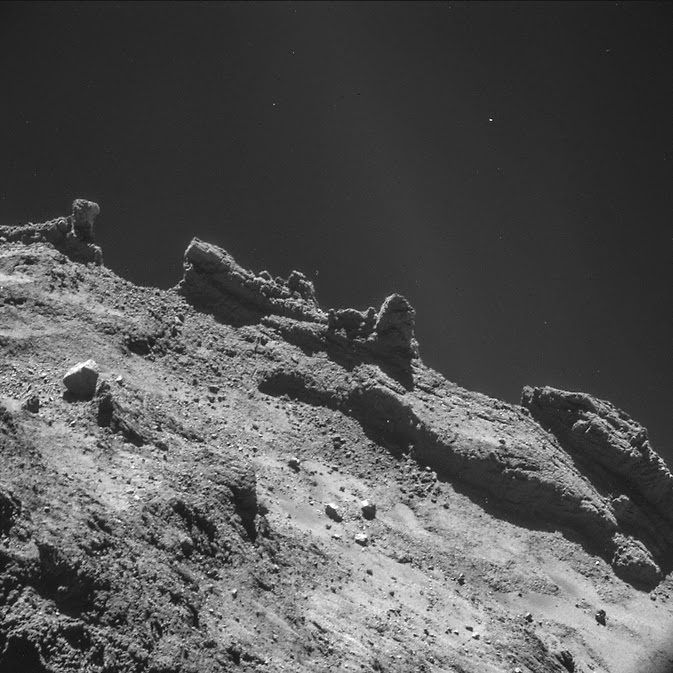
 A jagged horizon of the nucleus of comet 67P/Churyumov-Gerasimenko appears in this image taken by the navigation camera on the European Space Agency's Rosetta spacecraft during the second half of October 2014.
 The image was taken from a distance of less than 6 miles (10 kilometers) from the surface.
Image Credit: ESA/Rosetta/NAVCAM

A patch of relatively smooth ground on the nucleus surface of comet 67P/Churyumov-Gerasimenko appears in this image taken by the navigation camera on the European Space Agency's Rosetta spacecraft in October 2014.
The image was taken from a distance of less than 6 miles (10 kilometers).
Image Credit: ESA/Rosetta/NAVCAM

The image was taken from a distance of less than 6 miles (10 kilometers).
Image Credit: ESA/Rosetta/NAVCAM
Early tomorrow morning, the European Space Agency's Rosetta spacecraft will deploy its comet lander, "Philae."
A little over seven hours later (8 a.m. PST/11 a.m. EST), the experiment-laden, harpoon-firing Philae is scheduled to touch down on the surface of comet 67P/Churyumov-Gerasimenko.
It will be the first time in history that a spacecraft has attempted a soft landing on a comet. Rosetta is an international mission led by the European Space Agency (ESA), with instruments provided by its member states, and additional support and instruments provided by NASA.
"I know it sounds like something out of Moby Dick, but when you think about the gravity field of a comet, it makes a lot of sense to harpoon one," said Art Chmielewski, project manager for the U.S. participation in Rosetta, from NASA's Jet Propulsion Laboratory in Pasadena, California.
"Comet 67P has approximately 100,000 times less gravity than Earth does. So, if you don't want to float away, you have to go to extraordinary measures to attach yourself to its dusty surface."
"The Philae lander has two harpoons, shock-absorbing landing gear, and a drill located on each of the lander's three feet. It even has a small, upward-firing rocket engine. All this to help keep it on the surface."
The descent of Philae begins at 1:03 a.m. PST (4:03 a.m. EST) when Rosetta releases the 220-pound (100-kilogram) Philae from an altitude of about 14 miles (23 kilometers) from the center of the comet's nucleus.
As Philae descends, it will fall slowly without propulsion or guidance, gradually gathering speed in the comet's weak gravitational field.
During the seven-hour descent, the lander will take images and conduct science experiments, sampling the environment close to the comet.
It will take a "farewell" image of the Rosetta orbiter shortly after separation, along with a number of images as it approaches the comet surface.
The targeted landing site is called Agilkia after an island in the Nile River in southern of Egypt where ancient buildings from the Nile's flooded Philae island were relocated.
Once the lander has touched down and safely anchored, it will begin a primary science mission, which extends to about two-and-a-half days.
Philae will take a panorama of its surroundings and perform on-the-spot analysis of the composition of the comet's surface.
It can drill samples from a depth of nine inches (23 centimeters) and feed them to the onboard laboratory for analysis.
The lander will also measure electrical and mechanical characteristics of the surface of the nucleus.
After the Philae landing is completed, Rosetta will begin the next major part of its mission, the escort phase.


 Posts
Posts


