Showing posts with label Paris Air Show. Show all posts

Tuesday, June 18, 2013

ESA ExoMars 2016 set to complete construction


ESA's mission to Mars in 2016 has entered the final stage of construction with the signature of a contract today with Thales Alenia Space at the Paris Air & Space Show.

ExoMars will fly two missions, in 2016 and 2018, in a partnership between ESA and the Russian space agency, Roscosmos.

Its main goal is to answer one of the outstanding scientific questions of our time: has life ever existed on Mars?

In addition, ExoMars will develop new European technical capabilities in landing, roving, drilling and preparing samples to pave the way for a future Mars sample-return mission in the 2020s.

The first mission will be launched in 2016 and will include the Trace Gas Orbiter (TGO) to search for evidence of methane and other atmospheric gases that could be signs of active biological or geological processes.

It will also deliver the Entry, Descent and Landing Demonstrator Module (EDM) to the surface of Mars, to demonstrate key technologies needed for the 2018 mission and future landing missions.

The 2018 mission will land a rover on Mars – the first with the capability of drilling to depths of 2 m to collect samples that have been shielded from the harsh conditions on the surface, where radiation and oxidants can destroy organic materials.

In addition, the 2018 mission carries a Surface Platform with scientific instruments to investigate the martian environment.

The agreement, signed today in the ESA pavilion at the Paris Air & Space Show, marks a major milestone for the mission and for Thales Alenia Space, the industrial prime contractor on ExoMars.

Signature of Rider 1 to ESA Contract for Exomars. Credit: ESA

The agreement was signed by the old brigade of European Space Programs; Prof Giménez and Vincenzo Giorgio, Vice President Exploration & Science of Thales Alenia Space during a ceremony attended by the Agency's Director General, Jean-Jacques Dordain.

Also attending were Maria Carrozza, the Italian Minister for Education, Universities and Research, Enrico Saggese, President of the Italian space agency, and Jean-Loïc Galle, CEO of Thales Alenia Space.

Monday, June 17, 2013

ESA Plan for modified Ariane-5 rocket gets backing at Paris Air Show

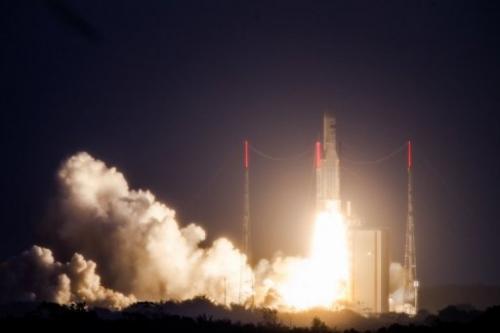
An Ariane 5 rocket carrying two satellites is pictured after blasting off on February 7, 2013, at the European space centre in Kourou, French Guiana.

Two major figures in the European space industry on Monday backed plans to modify the Ariane 5 rocket to help it shoot larger satellites into orbit.

Two major figures in the European space industry on Monday backed plans to modify the Ariane 5 rocket to help it shoot larger satellites into orbit.

The head of the European Space Agency, Jean-Jacques Dordain, said he would ask ESA member states for fast-track approval to have the modification carried out by the end of 2015.

"The proposal has been made, and this week or next week we will be discussing at the next (ESA) Launchers Programme Board," he told a press conference at the Paris Air Show.

"(...) The goal is to have the modification operational by 2015 at the latest," he said.

The idea had been floated by the new head of satellite launch firm Arianespace, Stephane Israel, whose firm markets services from Kourou, French Guiana, by ESA's Ariane and Vega rockets and Russia's veteran Soyuz.

In an interview with AFP earlier this month, Israel called for a modification of the successful Ariane 5 ECA launcher so that it can handle larger electric-propelled satellites, one of the most promising areas of the satellite launch market.

The proposed "Ariane 5 ECA Adaptation" would have a larger fairing, or nose cone, to accomodate the more voluminous payload.

Separately, the new head of France's National Centre for Space Studies (CNES), a major contributor to ESA and shareholder in Arianespace, said Monday he also backed the "adaptation" plan.

"Obviously, this is something that we fully support, as it's the key to ensuring that the Ariane 5 ECA can meet trends in the satellite market," said Jean-Yves Le Gall, who moved from Arianespace to CNES earlier this year.

Israel's proposal coincides with a mood of belt-tightening among ESA's 20 nations, many of whom are grappling with budget problems at home.

Dordain, though, did not seem to think that getting the modification money would be a problem. "It's not extravagant sums... around 30 million (euros)," or $39.9 million, he said.

France and Switzerland, whose industries would carry out most of the modification work, would be asked to contribute the lion's share, he indicated.

Israel said the Ariane adaptation would not affect plans for an Ariane 5 ME, which ESA hopes will be ready by 2017, or for its successor Ariane 6, whose maiden launch would be in 2021-2022.

Europe has been faced with tough decisions about how to cope with the fast-changing satellite launch market.

Some experts see a movement towards larger satellites but others expect a trend to smaller ones that can be launched in batches.

Sunday, June 16, 2013

Paris Air Show peek: EADS Airbus and Boeing Wide-bodies battle it out

The EADS Airbus A350 makes a pass over the airport during its maiden flight from Blagnac airport near Toulouse, southwestern France, Friday, June 14, 2013. 

The EADS Airbus A350 has taken off on its maiden flight, setting the stage for intensifying competition with U.S. rival Boeing in the long-haul wide-body aircraft market. 

Credit: AP Photo /Bob Edme

The Paris Air Show, which opens for business on Monday Jun. 17, brings hundreds of aircraft to the skies around the French capital, the usual tense competition between aircraft manufacturers Boeing and Airbus, and a slew of innovations large and small.

BATTLE OF THE WIDE-BODIES
The much-anticipated Airbus A350 flew for the first time on Friday, launching a new air race between the European plane maker and Boeing for long-haul wide-body aircraft.

Boeing has dominated the market so far, but troubles with the lithium ion batteries in its 787 Dreamliner are giving customers a reason to give a close look at Airbus' first all-new plane in eight years.

The CEO of Airbus parent EADS, Tom Enders, has said he expects a "few hundred" new orders.

Boeing executives, meanwhile, downplayed the air show's importance for orders, noting that the two companies have historically split the commercial aircraft market.

A year ago, at the Paris Air Show's sister event in Britain, Boeing beat Airbus for the number of orders announced.

The U.S. company took in $37 billion in orders and commitments, well above EADS Airbus' $16.9 billion.

But the announcements during the air shows are not always a reliable indicator of business since prices are often negotiated down heavily and big orders don't always coincide with the event.

The race for the title of biggest plane maker is as tight as ever. Over the whole of 2012, Airbus delivered 588 planes. That was a record, but one Boeing beat with 601 deliveries, the first time since 2003 it came out on top.

UAV - DRONES
They have swooped into wildfires to take temperatures and tracked animals across Africa. They have guided a fuel tanker to safety through icy waters.

Drones are increasingly being used for non-military purposes and are expected to feature prominently at the Paris Air Show.

There are still tough restrictions on their flight for safety reasons, but while the Federal Aviation Authority works on new rules, the makers of drones will aim to show off innovation and technical prowess at the show.

Eurocopter, a company based in France, will showcase new technology that can transform a manned helicopter into one that flies without a pilot.

US SEQUESTRATION TAKES TOLL
American fighter jets aren't taking to the skies above Paris, nor will they be seen on the ground, for the first time in more than two decades thanks to the U.S. government's spending cuts—the infamous 'sequestration'.

The U.S. pavilion remains the largest, but the event will be less of a sales showcase for latest military hardware and more a place for suppliers to meet up with potential customers.

Russia, on the other hand, is looking to make a splash by presenting fighter jets and military helicopters at the show for the first time since 2001.

The Sukhoi manufacturer will showcase its Su-35, a twin-engine multipurpose fighter, for the first time outside Russia. Britain and France also will have fighter jets on display.


EVERY LITTLE BCOUNTS
Less flashy but just as important for the industry will be the myriad technological innovations that parts suppliers will come to Paris to present. The biggest issue? The cost of fuel.

The price of jet fuel has more than tripled worldwide since 2003—a trend both jet manufacturers and airlines expect to continue. Electric- or solar-powered commercial flights are wildly improbable and biofuels aren't yet economically viable, so airlines are looking to improve mileage any way possible.

For long-haul flights, that means more carbon-fiber in airplane bodies and other design tweaks, such as electric motors for taxiing. For passengers, it means no end in sight on extra baggage fees.