Showing posts with label modified. Show all posts

Wednesday, July 9, 2014

New Mars map reveals history of a surface modified by water

A new geological map of part of the ancient Martian highlands produced by Scott C. Mest and David A. Crown of the Planetary Science Institute provides new insights into the planet's history of water modifying the planet's surface.

"This map depicts the complicated sequence of geologic processes that have served to modify ancient, rugged highland terrains surrounding the Hellas impact basin and shows evidence for the persistent effects of water and ice in degrading the Martian surface," Crown said.

The most prominent examples for the presence of water in this area are the canyon systems of Waikato Vallis in the north part of the map and Reull Vallis in the central part of the map.

These canyons are believed to have formed when underground water was released from plains materials to the surface, causing the ground to collapse.

The water could have been stored within the plains in localized aquifers or as ice, which could have melted due to the heat from nearby volcanoes.

"The canyon systems of Waikato Vallis and Reull Vallis are unlike anything we see here on Earth, so trying to understand how they formed requires us to be detectives," Mest said.

"We use images and topographic data from spacecraft to map the locations of these features, evaluate their relationships to each other, and estimate their ages from superposed impact craters, then we can begin to get a better understanding of the geologic processes that modified the surface and the sequences of events that present us with the surface we see today."

Based on Viking Orbiter images, Waikato and Reull Valles were thought to have been part of one long system.

However, by conducting detailed mapping using many of the newest and highest resolution data (e.g., MRO CTX, MRO HiRISE, Mars Odyssey THEMIS, and MOLA), Mest and Crown were able to show that these were two separate systems separated by an area of plains (Eridania Planitia).

Careful estimates of the ages of the canyons and the plains reveal a sequence of events starting with the water released from Waikato Vallis, which would have been stored for a time in the plains as a shallow lake.

As Reull Vallis was forming separately, the canyon breached a crater rim that was holding back the water in the lake; the lake drained gradually, which can be seen by many smaller channels incised on the floor of Reull Vallis.

In addition to these systems that dominate the landscape in this area, the plains and highland terrains contain many small channels that were carved by water flowing over the surface, likely around the same time that the canyons were forming.

Lastly, most highland peaks and the walls of many impact craters show evidence that ice-rich sediments flowed downhill, forming features that resemble rock glaciers on Earth; these features represent the most recent water-related activity in the area, and may be active today.

More information: "Geologic Map of MTM -30247, -35247 and -40247 Quadrangles, Reull Vallis Region of Mars" is published as a U.S. Geological Survey Scientific Investigations Map: pubs.usgs.gov/sim/3245/

Monday, December 16, 2013

NASA testing modified "pumpkin suit" for asteroid mission spacewalks - Video

NASA is taking steps to make spacewalking on an asteroid a reality. 

In the Neutral Buoyancy Laboratory (NBL) near the agency's Johnson Space Center in Houston, engineers are testing a modified version of the pumpkin-orange Advanced Crew Escape System (ACES) worn by space shuttle astronauts during launch and reentry for use by future crew in the Orion spacecraft.

As the agency plans human deep space missions, including a voyage to a relocated asteroid, care is being taken to efficiently use space inside Orion.

The white Extravehicular Mobility Unit spacesuits used by crews to conducts spacewalks on the International Space Station are too bulky to carry in the spacecraft, so NASA is looking at ways to alter the ACES suits for multiple uses both inside and outside the spacecraft.


"The shell of them is very much the same, and to the casual user you may not even notice the difference, but internally we modified them to work with the plumbing inside Orion," said Dustin Gohmert, Crew Survival Systems Manager at Johnson.

Through a series of tests in the NBL, engineers are learning what features need to be included to improve the suit's mobility beyond the needs of the trip from the launch pad to space and its return to Earth, such as enhanced gloves and elbow joints with improved mobility for spacewalks.

The ACES pumpkin suit was worn by space shuttle crews beginning in 1994 and builds on the earliest spacesuit worn by Ed White during the first venture outside a spacecraft in 1965.

"We're stepping back to our heritage to be able to use one suit for multiple tasks," said Gohmert.

Monday, June 17, 2013

ESA Plan for modified Ariane-5 rocket gets backing at Paris Air Show

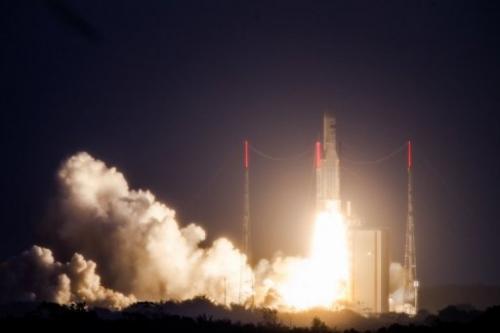
An Ariane 5 rocket carrying two satellites is pictured after blasting off on February 7, 2013, at the European space centre in Kourou, French Guiana.

Two major figures in the European space industry on Monday backed plans to modify the Ariane 5 rocket to help it shoot larger satellites into orbit.

Two major figures in the European space industry on Monday backed plans to modify the Ariane 5 rocket to help it shoot larger satellites into orbit.

The head of the European Space Agency, Jean-Jacques Dordain, said he would ask ESA member states for fast-track approval to have the modification carried out by the end of 2015.

"The proposal has been made, and this week or next week we will be discussing at the next (ESA) Launchers Programme Board," he told a press conference at the Paris Air Show.

"(...) The goal is to have the modification operational by 2015 at the latest," he said.

The idea had been floated by the new head of satellite launch firm Arianespace, Stephane Israel, whose firm markets services from Kourou, French Guiana, by ESA's Ariane and Vega rockets and Russia's veteran Soyuz.

In an interview with AFP earlier this month, Israel called for a modification of the successful Ariane 5 ECA launcher so that it can handle larger electric-propelled satellites, one of the most promising areas of the satellite launch market.

The proposed "Ariane 5 ECA Adaptation" would have a larger fairing, or nose cone, to accomodate the more voluminous payload.

Separately, the new head of France's National Centre for Space Studies (CNES), a major contributor to ESA and shareholder in Arianespace, said Monday he also backed the "adaptation" plan.

"Obviously, this is something that we fully support, as it's the key to ensuring that the Ariane 5 ECA can meet trends in the satellite market," said Jean-Yves Le Gall, who moved from Arianespace to CNES earlier this year.

Israel's proposal coincides with a mood of belt-tightening among ESA's 20 nations, many of whom are grappling with budget problems at home.

Dordain, though, did not seem to think that getting the modification money would be a problem. "It's not extravagant sums... around 30 million (euros)," or $39.9 million, he said.

France and Switzerland, whose industries would carry out most of the modification work, would be asked to contribute the lion's share, he indicated.

Israel said the Ariane adaptation would not affect plans for an Ariane 5 ME, which ESA hopes will be ready by 2017, or for its successor Ariane 6, whose maiden launch would be in 2021-2022.

Europe has been faced with tough decisions about how to cope with the fast-changing satellite launch market.

Some experts see a movement towards larger satellites but others expect a trend to smaller ones that can be launched in batches.