Showing posts with label ROV. Show all posts

Friday, April 11, 2014

WHOI NEREUS: Scientists use ROV to explore Kermadec Trench‎

Researchers will use the deep-submergence vehicle Nereus in their explorations. 

Credit: WHOI

What lives in the deepest part of the ocean, the abyss?

A team of researchers funded by the National Science Foundation (NSF) will use the world's only full-ocean-depth, hybrid, remotely-operated vehicle, Nereus, and other advanced technology to find out.

They will explore the Kermadec Trench at the bottom of the Pacific Ocean.

The trench, located off New Zealand, is the fifth deepest trench in the world. Its maximum depth is 32,963 feet or 6.24 miles (10,047 meters).

It's also one of the coldest trenches due to the inflow of deep waters from Antarctica.

The 40-day expedition to the Kermadec Trench, which begins on April 12, 2014, kicks off a three-year collaborative effort.

The project, known as the Hadal Ecosystem Studies Project (HADES), will conduct the first systematic study of life in ocean trenches, comparing it to the neighbouring abyssal plains, flat areas of the seafloor usually found at depths between 9,843 and 19,685 feet (3,000 and 6,000 meters).

David Garrison
"The proposal to study the deep-sea environment as part of HADES was high-risk, but, we hope, also high-reward," says David Garrison, program director in NSF's Division of Ocean Sciences, which funds HADES.

"Through this exciting project, we will shine a light into the darkness of Earth's deep-ocean trenches, discovering surprising results all along the way."

Among least-explored environments on Earth
A result of extreme pressures in these deep-sea environments and the technical challenges involved in reaching them, ocean trenches remain among the least-explored environments on the planet.

Tim Shank
"We know relatively little about life in ocean trenches, the deepest marine habitats on Earth," says Tim Shank, a biologist at the Woods Hole Oceanographic Institution, one of the participating organizations.

"We didn't have the technology to do these kinds of detailed studies before. This will be a first-order look at community structure, adaptation and evolution: how life exists in the trenches."

NSF HADES principal investigators are Tim Shank, Jeff Drazen of the University of Hawaii and Paul Yancey of Whitman College.

Telepresence technology aboard the NOAA research vessel Thomas G. Thompson will allow the public to share in the discoveries.

Live-streaming Web events from the seafloor will include narration from the science team.

The researchers' work will also be chronicled in video, still images and blog updates on the expedition website.

Tuesday, November 26, 2013

U-Cat Robot Turtle: Underwater archaeologists to inspect shipwrecks


The Robot Safari in London Science Museum will see the world premiere of the underwater robot U-CAT, a highly maneuverable robot turtle, designed to penetrate shipwrecks.

U-CAT's locomotion principle is similar to sea turtles. Independently driven four flippers make the robot highly maneuverable; it can swim forward and backward, up and down and turn on spot in all directions.

Maneuverability is a desirable feature when inspecting confined spaces such as shipwrecks. The robot carries an onboard camera and the video footage can be later used to reconstruct the underwater site.

"U-CAT is specifically designed to meet the end-user requirements. Conventional underwater robots use propellers for locomotion. Fin propulsors of U-CAT can drive the robot in all directions without disturbing water and beating up silt from the bottom, which would decrease visibility inside the shipwreck", says Taavi Salumäe, the designer of the U-CAT concept and researcher in Centre for Biorobotics, Tallinn University of Technology.

"The so called biomimetic robots, robots based on animals and plants, is an increasing trend in robotics where we try to overcome the technological bottlenecks by looking at alternative technical solutions provided by nature ", explains Prof. Maarja Kruusmaa, a Head of Centre for Biorobotics.

Credit: Centre for Biorobotics, Tallinn University of Technology

Thursday, August 1, 2013

MORPH International Exercise: Underwater UAV drones explore the Med

MORPH, the world's first fleet of "marine drones" is being put through its paces in the Mediterranean port of Toulon.

Five European countries -- France, Germany, Italy, Spain and Portugal -- have sent prototypes here under a four-year, four-million-euro ($5.32-million) programme to build a squad of unmanned underwater rovers.

The MEDUSAS, first launched in 2010, has been thoroughly tested at sea and its autonomy and reliability have been instrumental in other projects. 

In previous missions, equipped with one acoustic modem, it collected data sets that are currently being used to test the efficacy of single beacon navigation algorithms. 

Deployed from a surface vessel, but communicating among themselves and using artificial intelligence, the wireless scouts would spread out in a surveillance network.

Using video cameras and echosounders, the explorers would help to create 3D maps of underwater terrain, benefitting oceanographers, archaeologists, offshore oil and gas drillers, pollution monitors, marine biologists and other civilian users.

But there is an obvious naval use too, for a flexible network of small, hard-to-detect drones would multiply the surveillance capacity against mines and other threats.

Vincent Rigaud
"Underwater robots are not new -- we've been involved in them for years," said Vincent Rigaud, director of underwater systems at the French Institute for Research for Exploitation of the Sea (Ifremer), one of the world's top names in oceanography.

"What is new, though, is creating a fleet of them, with autonomous capacity."

Achieving this means overcoming two major hurdles, Rigaud explained.

One is software: creating artificial intelligence programmes that give the options for cooperating in a group and coping with the uncertainties of the marine environment, with its tides and currents.

The other is communications. Airborne drones can talk to each other, and to their controller, by the instant means of radio.

But radio waves do not penetrate underwater, which leaves sound the only option for communication among the marine drones.

Rather like a school of dolphins chirping to each other, the robots use acoustic signals to swap information and instructions -- and as experiments have shown, this is not an easy thing.

The communication is frustratingly long because the data flow is so slow, and the tenuous sound link is easily disrupted by other sources of noise, such as a passing vessel.

Pere Ridao
"It's like going back to modems in the dawn of the computer age," said Pere Ridao of the University of Girona in Spain.

"The maximum flow rate is about 100,000 times slower than a typical ADSL connection. It takes several minutes to send a picture."

On a mission, the robots would share a rough map of the underwater terrain, showing major obstacles to avoid, but would then work by themselves within designated parameters.

What they see and monitor would be stored in onboard memories which would then be downloaded after they are recovered.

Powerful computers would crunch the raw data into useable applications.

Antonio Pascoal
"The vehicles are not physically connected but virtually connected," explained Antonio Pascoal, a professor at Portugal's Superior Technical Institute (IST).

"The idea is for them to dialogue and adapt to marine geometry without human intervention."

The programme, called MORPH (Marine Robotic System of Self-Organising, Logically Linked Physical Nodes), was launched in February 2012 with the help of the European Commission. Thirty-two scientists are taking part.

Sunday, January 20, 2013

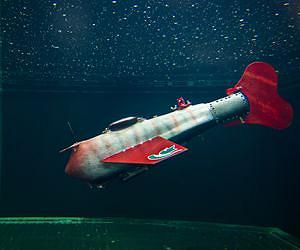
GRACE the Robot Fish: Data Gathering ROV from MSU

A team of MSU researchers has developed a robotic fish that can swim and glide long distances while gathering data such as water quality and temperature. 

Photo by G.L. Kohuth.

A high-tech robotic fish hatched at Michigan State University has a new look. A new skill and a new name.

MSU scientists have made a number of improvements on the fish, including the ability to glide long distances, which is the most important change to date.

The fish now has the ability to glide through the water practically indefinitely, using little to no energy, while gathering valuable data that can aid in the cleaning of our lakes and rivers.

Designed and built by Xiaobo Tan, MSU associate professor of electrical and computer engineering, and his team, the fish is equipped with an array of sensors that not only allow it to travel autonomously, but also measure water temperature, quality and other pertinent facts.


"Swimming requires constant flapping of the tail," Tan said, "which means the battery is constantly being discharged and typically wouldn't last more than a few hours."

The disadvantage to gliding, he said, is that it is slower and less maneuverable.

"This is why we integrated both locomotion modes - gliding and swimming - in our robot," Tan said. "Such integration also allows the robot to adapt to different environments, from shallow streams to deep lakes, from calm ponds to rivers, with rapid currents."

The robot's ability to glide is achieved through a newly installed pump that pushes water in and out of the fish, depending on whether the scientists want the robot to ascend or descend.

Also, the robot's battery pack sits on a kind of rail that moves backward and forward, in sync with the pumping action, to allow the robot to glide through water on a desired path.

The robotic fish now has a name: Grace, which stands for "Gliding Robot ACE."

Late last year Tan and his team took Grace for a test drive on the Kalamazoo River, where it exceeded all expectations.

"She swam at three sites along the river and wirelessly sent back sensor readings," Tan said.

"I'm not sure, but we may have set a world record - demonstrating robotic fish-based sampling with commercial water-quality sensors in a real-world environment."