Showing posts with label rivers. Show all posts

Wednesday, January 21, 2015

Meteorologists investigate Airborne jet streams bringing both floods and drought relief

A satellite image showing water-vapour concentration reveals an atmospheric river (yellow) streaming northeast across the Pacific Ocean.

Californians call it the Pineapple Express: a weather pattern that zips across the Pacific Ocean from Hawaii, delivering not baskets of tropical fruit, but buckets of rain and snow.

In meteorological terms, the Pineapple Express is an atmospheric river, a narrow band of air that carries huge amounts of moisture.

For the next six weeks, meteorologists will be plying the eastern Pacific by air and sea, in the hope of catching several atmospheric rivers barrelling towards the coast.

It is the biggest push yet to understand these phenomena, which have received serious scientific attention only in the past decade.

Atmospheric rivers get their start over warm tropical waters; they then flow eastwards and towards the poles a kilometre or two above the ocean surface.

They may stretch for thousands of kilometres, but are only a few hundred kilometres wide. When they hit land, they start to drop their moisture in torrential downpours or blizzards.

“When we have too many atmospheric rivers, floods can occur, and when we don’t have enough we gradually fall into drought,” says Marty Ralph, a meteorologist at the Scripps Institution of Oceanography in La Jolla, California, and a leader of the field campaign.

In Europe, atmospheric rivers affect mostly the western part of the continent, but they can be felt as far inland as Poland.

In North America, the entire west coast is affected, and parts of the central and eastern United States occasionally feel the effects of atmospheric rivers that develop over the Gulf of Mexico.

The moisture is often welcome, bringing up to half of the year’s water supply in affected areas1.

A 2013 study found that as many as three-quarters of all droughts in the Pacific Northwest between 1950 and 2010 had been brought to an end by atmospheric-river storms2.

California has been stricken by drought for years (Nature 512, 121–122; 2014), but last month, an atmospheric river dropped enough rain to erase one-third of the water deficit of one major reservoir in just two days.

Climate change may bring stronger and more frequent atmospheric rivers, because the warmer the atmosphere is, the more water it can hold, says David Lavers, a meteorologist at Scripps who is not involved in the project.

“The more you know about how the atmosphere behaves,” he says, “the better position you’re in to prepare for extreme events.”

Read the full article on Nature website - Nature 517, 424–425 (22 January 2015) doi:10.1038/517424a

Wednesday, March 5, 2014

Sustainability: How Wolves Change Rivers - Video


Visit Sustainableman.org/ to explore the world of sustainability.

For more from George Monbiot, visit monbiot.com and for more on "rewilding" and/or check out George Monbiot's book Feral: rewilding the land, the sea and human life.

NOTE: The "deer" the narrator refers to are in fact "elk," one of the largest of the deer family. The scientific report that this video is based on refers to elk so we wanted to be accurate with the truth of the story.

"When we try to pick out anything by itself, we find it hitched to everything else in the Universe." - John Muir (English naturalist)

When wolves were reintroduced to Yellowstone National Park in the United States after being absent nearly 70 years, the most remarkable "trophic cascade" occurred.

What is a trophic cascade and how exactly do wolves change rivers? George Monbiot explains in this movie remix.

Narration from TED: "For more wonder, rewild the world" by George Monbiot.

Sunday, February 23, 2014

Fireworks Galaxy: Rivers of Hydrogen Gas Fuel Spiral Galaxies

Three distinct features are visible in this composite image of NGC 6946

The bright heart of the galaxy in optical light (blue), the dense hydrogen in the spirals (orange), and the extended halo surrounding the galaxy (red). 

New research also shows a faint filament that could be hydrogen flowing from the intergalactic medium into the galaxy to fuel star formation.

Credit: D.J. Pisano (WVU); B. Saxton (NRAO/AUI/NSF); Palomar Observatory – Space Telescope Science Institute 2nd Digital Sky Survey (Caltech); Westerbork Synthesis Radio Telescope

Inpouring rivers of hydrogen gas could explain how spiral galaxies maintain the constant star formation that dominates their hearts, a new study reports.

Using the Green Bank Telescope (GBT) in West Virginia, scientists observed a tenuous filament of gas streaming into the galaxy NGC 6946, known as the "Fireworks Galaxy" because of the large number of supernovae observed within it.

The find may provide insight into the source of fuel that powers the ongoing birth of young stars, researchers said.

D.J. Pisano
"We knew that the fuel for star formation had to come from somewhere," study lead author D.J. Pisano, of West Virginia University (WVU), said in a statement.

"So far, however, we've detected only about 10 percent of what would be necessary to explain what we observe in many galaxies."

Located 22 million light-years from Earth on the border of the constellations Cepheus and Cygnus, NGC 6946 is a medium-sized spiral galaxy pointed face-on toward the Milky Way.

Previous studies revealed a halo of hydrogen gas around NGC 6946 common to spiral galaxies.

Such halos are formed by hydrogen ejected from the galaxies by star formation and violent supernova explosions.

These interactions heat the gas in the halo to extreme temperatures.

When Pisano turned the GBT toward the spiral galaxy for further examination, however, he discovered a ribbon of gas too cool to have suffered the heating processes undergone by the halo gas.

On average, the Milky Way churns out between 1 to 5 new stars per year. Rich in gas, NGC 6946 is far more active. For example, it has hosted at least 9 explosive supernovae in the past century.

"A leading theory is that rivers of hydrogen — known as cold flows — may be ferrying hydrogen through intergalactic space, clandestinely fueling star formation," Pisano said. "But this tenuous hydrogen has simply been too diffuse to detect, until now."

The immense, unblocked dish of the Green Bank Telescope (GBT), combined with its location in the US National Radio Quiet Zone, where radio transmissions are limited, allow the large disk to detect the faint hydrogen signal that would be present in a cold flow.

Another possibility is that the hydrogen detected originated from a close encounter with another galaxy in the past.

The gravitational interaction between the two could have stretched out a ribbon of neutral atomic hydrogen, researchers said.

Such a ribbon would contain stars that astronomers should be able to easily observe, though none have yet been spotted. Further studies of the streamer hydrogen gas will help clarify its role.

The research was published in the Astronomical Journal.

Sunday, January 20, 2013

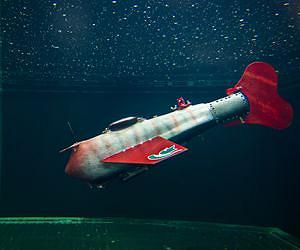
GRACE the Robot Fish: Data Gathering ROV from MSU

A team of MSU researchers has developed a robotic fish that can swim and glide long distances while gathering data such as water quality and temperature. 

Photo by G.L. Kohuth.

A high-tech robotic fish hatched at Michigan State University has a new look. A new skill and a new name.

MSU scientists have made a number of improvements on the fish, including the ability to glide long distances, which is the most important change to date.

The fish now has the ability to glide through the water practically indefinitely, using little to no energy, while gathering valuable data that can aid in the cleaning of our lakes and rivers.

Designed and built by Xiaobo Tan, MSU associate professor of electrical and computer engineering, and his team, the fish is equipped with an array of sensors that not only allow it to travel autonomously, but also measure water temperature, quality and other pertinent facts.


"Swimming requires constant flapping of the tail," Tan said, "which means the battery is constantly being discharged and typically wouldn't last more than a few hours."

The disadvantage to gliding, he said, is that it is slower and less maneuverable.

"This is why we integrated both locomotion modes - gliding and swimming - in our robot," Tan said. "Such integration also allows the robot to adapt to different environments, from shallow streams to deep lakes, from calm ponds to rivers, with rapid currents."

The robot's ability to glide is achieved through a newly installed pump that pushes water in and out of the fish, depending on whether the scientists want the robot to ascend or descend.

Also, the robot's battery pack sits on a kind of rail that moves backward and forward, in sync with the pumping action, to allow the robot to glide through water on a desired path.

The robotic fish now has a name: Grace, which stands for "Gliding Robot ACE."

Late last year Tan and his team took Grace for a test drive on the Kalamazoo River, where it exceeded all expectations.

"She swam at three sites along the river and wirelessly sent back sensor readings," Tan said.

"I'm not sure, but we may have set a world record - demonstrating robotic fish-based sampling with commercial water-quality sensors in a real-world environment."