Showing posts with label Supersonic. Show all posts

Wednesday, June 18, 2014

NASA aeronautics makes strides to bring back supersonic passenger travel

NASA F/A-18 mission support aircraft were used to create low-intensity sonic booms during a resaerch project at the agency's Armstrong Flight Research Center in Edwards, California. 

The Waveforms and Sonic boom Perception and Response (WSPR), project gathered data from a select group of more than 100 volunteer Edwards Air Force Base residents on their individual attitudes toward sonic booms produced by aircraft in supersonic flight over Edwards. 

Credit: NASA/Jim Ross

The return of supersonic passenger travel may be coming closer to reality thanks to NASA's efforts to define a new standard for low sonic booms.

Several NASA aeronautics researchers will present their work in Atlanta this week at Aviation 2014, an annual event of the American Institute of Aeronautics and Astronautics.

They will share with the global aviation community the progress they are making in overcoming some of the biggest hurdles to supersonic passenger travel.

The research generates data crucial for developing a low-boom standard for the civil aviation industry.

NASA works closely with the Federal Aviation Administration and the international aerospace community, including the International Civil Aviation Organization, to gather data and develop new procedures and requirements that may help in a reconsideration of the current ban on supersonic flight over land.

"Lessening sonic booms, shock waves caused by an aircraft flying faster than the speed of sound, is the most significant hurdle to reintroducing commercial supersonic flight," said Peter Coen, head of the High Speed Project in NASA's Aeronautics Research Mission Directorate at the agency's Headquarters in Washington.

"Other barriers include high altitude emissions, fuel efficiency and community noise around airports."

Engineers at NASA centers in California, Ohio and Virginia that conduct aviation research are tackling sonic booms from a number of angles, including how to design a low-boom aircraft and characterize the noise.

NASA researchers have studied how to quantify the loudness and annoyance of the boom by asking people to listen to the sounds in a specially designed noise test chamber.

A recent flight research campaign at NASA's Armstrong Flight Research Center in Edwards, California, had residents explore ways to assess the public's response to sonic booms in a real-world setting.

Researchers at Armstrong have an advantage, pilots are permitted to fly at supersonic speeds because the facility is located on Edwards Air Force Base.

"People here are more familiar with sonic booms," said Armstrong aerospace engineer Larry Cliatt. "Eventually, we want to take this to a broader level of people who have never heard a sonic boom."

Similar work is conducted at NASA's Langley Research Center in Hampton, Virginia, where volunteers from the local community rated sonic booms according to how disruptive they determined the sound to be.

"They each listened to a total of 140 sounds, and based on their average response, we can begin to estimate the general public's reactions," explained Langley acoustics engineer Alexandra Loubeau.

She also conducted a study at Langley comparing results from tools used to predict sonic boom noise at ground-level.

"Because of the interaction with the atmosphere, it is important to be as consistent as possible in the implementation and usage of these tools."

"The comparisons done so far have shown good agreement, but there are some inconsistencies that need to be studied," Loubeau said.

Other studies are focused on predicting the sonic boom and on design approaches to reducing it. Participants from Japan, the United States and France attended the first Sonic Boom Prediction Workshop, where they evaluated simple configurations, cylindrical bodies with and without wings—and complex full aircraft designs.

"We are working to understand the worldwide state of the art in predicting sonic booms from an aircraft point of view," said Mike Park, a fluid mechanics engineer at Langley.

"We found for simple configurations we can analyze and predict sonic booms extremely well. For complex configurations we still have some work to do."

Monday, November 4, 2013

Lockheed Martin developing Supersonic Spaceplane SR-72

Lockheed Martin SR-72
Lockheed Martin has begun work on a successor to the supersonic Blackbird SR-71 spy plane.

The unmanned SR-72 will use an engine that combines a turbine and a ramjet to reach its top speed of Mach 6 - about 3,600mph (5,800km/h).

Like its predecessor, the SR-72 will be designed for high-altitude surveillance but might also be fitted with weapons to strike targets.

Lockheed said the aircraft should be operational by 2030.

Jet engines
The SR-72 is being developed at Lockheed Martin's Skunk Works R&D centre in California that designed and built the original Blackbird.

That aircraft first flew in 1964 and was a mainstay of US Air Force spying and surveillance work until 1998. It typically flew at altitudes of 24,000m (80,000ft) and could reach speeds of Mach 3.

Blackbird SR-71 spy plane
In a blogpost about the SR-72, Lockheed Martin said the aircraft would operate at similar altitudes but would fly far faster.

At Mach 6 the plane could travel the 3,500 miles (5,500km) from New York to London in less than an hour.

While spy satellites can photograph enemy territory, the relatively long time it takes for them to be moved to a new orbit so they pass over a target can limit their usefulness.

By contrast, wrote Lockheed Martin, the SR-72 "would be so fast, an adversary would have no time to react or hide".

For the SR-72, Lockheed Martin is drawing on work done on the Falcon HTV-2 hypersonic technology vehicle.

This is a test-bed for the futuristic technologies needed to support safe hypersonic flight and cope with the extreme conditions encountered by any object flying at such a speed.

For instance, on one test flight of the HTV-2, the aircraft hit a top speed of Mach 20 and its flight surfaces reached 1,927C (3,500F).

To reach Mach 6, the SR-72 will use an engine that acts like a normal jet turbine until speeds of Mach 3 are reached but which then operates like a ramjet to accelerate beyond that.

"Speed is the next aviation advancement to counter emerging threats in the next several decades," said Brad Leland, Lockheed Martin's hypersonic programme manager on the blog.

"The technology would be a game-changer in theatre, similar to how stealth is changing the battlespace today."

Saturday, September 7, 2013

Aerion: Are there supersonic business jets (SSBJ) in the future

Could supersonic travel be available again before then? 

Quite possibly, if Aerion has anything to do with it and it will be in the form of supersonic business jets (SSBJ). 

Several companies have been working on these concepts, and while the credit crunch of 2008 slowed down progress, now it looks possible that an SSBJ could be in service by the end of the decade.

It should be a lot easier to get an SSBJ project off the ground. A smaller SST is less complex, and could use off-the-shelf components such as engines, so development costs should be lower.

In addition, advances in materials, especially carbon composites, mean advanced aerodynamics can now be converted from the CAD-CAM computer to reality.

For the business customer, the appeal is clear. Rather than being tied to an airline schedule, you can fly wherever – and whenever you want.

So even if an SSBJ wouldn’t quite match Concorde’s Mach 2 performance, the door-to-door time is likely to be much faster.

And aircraft manufacturers may find it easier to persuade multinational CEOs to buy SSBJs as a productivity tool than to convince the stony-faced airline accountants to invest millions in a fleet of supersonic airliners.

The race is on
Leading the race to get the first SSBJ to market is Aerion, which unveiled its radical concept in 2007.

Unlike most SST designs, the Aerion SBJ has been designed to operate subsonically as well as supersonically.

It uses supersonic laminar flow wings – short, unswept wings, rather than delta wings favoured by most SST concepts.

Aerion says this gives it the ability to cruise smoothly at just below the sound barrier, as well as supersonically at its maximum speed of Mach 1.6.

The subsonic performance is necessary as it is still illegal to operate supersonically over many land areas – such as the US, or western Europe.

With a range of around 7,500km it would be possible to fly directly from, say, Frankfurt to Chicago – flying subsonically over land and supersonically over sea.

This would take less than five hours, compared with around nine hours by conventional subsonic jet.

The Aerion SBJ uses carbonfibre composites for the wings, and a section of the wing has been tested successfully already, mounted underneath one of Nasa’s Boeing F-15 supersonic test planes.

As a result of its straight wing design and full-span flaps, typical approach speed will be 120 knots, similar to a regular bizjet, and the aircraft will be able to operate routinely from business airports with 2,000m-long runways – removing the need to join security queues at major airports.

Wednesday, October 17, 2012

NASA: Boeing Supersonic Model Points to Fast Future

If human beings are ever to fly faster than the speed of sound from one side of the country to another, we first have to figure out how to reduce the level of sonic boom generated by supersonic flight.

Earlier this fall, a subscale model of a potential future low-boom supersonic aircraft designed by The Boeing Company was installed for testing in the supersonic wind tunnel at NASA's Glenn Research Center in Cleveland.

This model is a larger of two models used in the test.

The model contains a force measurement balance used to capture force measurements (lift, drag).

Depending on the type of test and on the tunnel, the model can be oriented any way. The picture model is actually upside down.

Another smaller model was used to capture measurements of the off-body pressures that create a sonic boom.

The tests are among those being conducted by NASA and its partners to identify technologies and designs to achieve a level of sonic boom so low that it barely registers on buildings and people below.

Image Credit: NASA/Michelle M. Murphy

Sunday, February 19, 2012

Sukhoi T-4 in the Russian Air Force Museum in Monino

Sukhoi T-4 in the Russian Air Force Museum in Monino

Tuesday, October 25, 2011

Lockheed Martin's Green Supersonic Machine

An artist's impression of Nasa and Lockheed Martin's Green Supersonic Machine, capable of supersonic, sub-orbital space flight. 

Planes travelling at five times the speed of sound and passenger aircraft flying in formation could come to pass in the last part of this century, according to a report by the Institution of Mechanical Engineers.

Picture: NASA/Lockheed Martin/PA

Friday, September 2, 2011

NASA Hubble Movies: Provide Unprecedented View of Supersonic Jets From Young Stars

The glowing, clumpy streams of material shown in these NASA Hubble Space Telescope images are the signposts of star birth. Called Herbig-Haro or HH objects, these outflows speed along at over 440,000 miles an hour.

When they "rear-end" slower gas, bow shocks (the blue features) arise as the material heats up.

In HH 2 (lower right) several bow shocks (the compact blue and white features) occur where fast-moving clumps bunch up. In HH 34 (lower left) a grouping of merged bow shocks reveals regions that brighten and fade over time as the heated material cools, shown in red, where the shocks intersect.

In HH 47 (top) a long jet of material has burst out of a dark cloud of gas and dust that hides the newly forming star. Credit: NASA/ESA/P. Hartigan (Rice University)

New movies created from years of still images collected by NASA's Hubble Space Telescope provide new details about the stellar birthing process, showing energetic jets of glowing gas ejected from young stars in unprecedented detail.

The jets are a byproduct of gas accretion around newly forming stars and shoot off at supersonic speeds of about 100 miles per second in opposite directions through space.

These phenomena are providing clues about the final stages of a star's birth, offering a peek at how our Sun came into existence 4.5 billion years ago.

Hubble's unique sharpness allows astronomers to see changes in the jets over just a few years' time. Most astronomical processes change over timescales that are much longer than a human lifetime.

A team of scientists led by astronomer Patrick Hartigan of Rice University in Houston, Texas, collected enough high-resolution Hubble images over a 14-year period to stitch together time-lapse movies of the jets ejected from three young stars

NASA Hubble story

Saturday, August 20, 2011

DARPA: HTV-2 hit Mach 20 before crash

A superfast unmanned military plane traveled at 20 times the speed of sound and managed to control itself for three minutes before crashing into the Pacific Ocean in a recent test, military officials said.

The prototype Falcon Hypersonic Technology Vehicle 2 (HTV-2), billed as the fastest aircraft ever built, splashed down in the Pacific earlier than planned on Aug. 11 shortly after launching from California's Vandenberg Air Force Base on its second-ever test flight.

The HTV-2 experienced some sort of anomaly, prompting the vehicle's autonomous flight safety system to guide it to a controlled splashdown, according to the Defense Advanced Research Projects Agency (DARPA), which oversaw the flight.

Despite the problem, the aircraft reached speeds around Mach 20 (about 13,000 mph) and was able to control its flight for several minutes, officials said.

Wednesday, August 17, 2011

NASA Selects XCOR to Participate in Suborbital Flight Contract

XCOR's suborbital reusable launch vehicle, Lynx, is capable of up to four flights per day using advanced rapid call-up and turnaround operations.

NASA has selected XCOR Aerospace to provide suborbital flight and payload integration services for research and scientific missions in a program that will offer up to $10 million dollars in contracts to match payload customers with flight vehicle services.

The awards were announced by NASA's Flight Opportunities Program, a part of NASA's Office of the Chief Technologist at NASA Headquarters in Washington, DC that is managed at Dryden Flight Research Center in Edwards, California.

"Through this award, NASA has recognized XCOR's Lynx suborbital vehicle as a useful payload platform that will benefit both NASA's R and D needs and the private research, scientific, and educational communities," said Jeff Greason, XCOR CEO.

"By encouraging and incentivizing frequent, low cost access to space, NASA is helping to ensure America's future as a leader in space."

XCOR's suborbital reusable launch vehicle, Lynx, is capable of up to four flights per day using advanced rapid call-up and turnaround operations.

The Lynx will provide three to four minutes of microgravity as well as, if desired, exposure to the harsh environment of space. This will provide opportunities to investigate the largely unexplored regions of our upper atmosphere.

XCOR has partnered with four leading payload integration providers in the US to give NASA and the research community a first-rate experience for the Program's missions.

The Planetary Science Institute (PSI) of Arizona, Southwest Research Institute (SwRI) in Texas, NanoRacks LLC of Kentucky and Washington, DC, and Spaceflight Services of Washington will provide payload processing and related support services based on their multiple areas of expertise.

These independent payload service providers specialize in atmospheric science, physics, microgravity research, planetary science, Earth observation, and life sciences, and other areas.

XCOR Aerospace is a California corporation located in Mojave, Calif. The company is in the business of developing and producing safe, reliable and reusable rocket powered vehicles, propulsion systems, advanced non-flammable composites and other enabling technologies.

Tuesday, April 5, 2011

NASA Spitzer Discovery: Time-Delayed Jets Around Young Star

Astronomers have discovered that two symmetrical jets shooting away from opposite sides of a blossoming star are experiencing a time delay: knots of gas and dust from one jet blast off four-and-a-half years later than identical knots from the other jet.

The finding, which required the infrared vision of NASA's Spitzer Space Telescope, is helping astronomers understand how jets are produced around forming stars, including those resembling our sun when it was young.

"More studies are needed to determine if other jets have time delays," said Alberto Noriega-Crespo of NASA's Spitzer Science Center at the California Institute of Technology in Pasadena, who is a co-author of the new study to be published in the April 1 issue of Astrophysical Journal Letters. "Now we know that in at least one case, there appears to be a delay, which tells us that some sort of communication may be going on between the jets that takes time to occur."

Jets are an active phase in a young star's life. A star begins as a collapsing, roundish cloud of gas and dust. By ejecting supersonic jets of gas, the cloud slows down its spinning. As material falls onto the growing star, it develops a surrounding disk of swirling material and twin jets that shoot off from above and below the disk, like a spinning top.

Once the star ignites and shines with starlight, the jets will die off and the disk will thin out. Ultimately, planets may clump together out of material left in the spinning disk.

The discovery of the time delay, in the jets called Herbig-Haro 34, has also led the astronomers to narrow in on the size of the zone from which the jets originate. The new Spitzer observations limit this zone to a circle around the young star with a radius of 3 astronomical units. An astronomical unit is the distance between our sun and Earth. This is about 10 times smaller than previous estimates.

"Where we stand today on Earth was perhaps once a very violent place where high-velocity gas and dust were ejected from the disk circling around our very young sun," said Alex Raga of the Universidad Nacional Autonoma de Mexico, the first author of the paper. "If so, the formation of planets like Earth depends on how and when this phenomenon ended. Essentially, every star like our own sun has gone through a similar cloud-disk-jets formation process."

One of the jets in Herbig-Haro 34 had been studied extensively for years, but the other remained hidden behind a dark cloud. Spitzer's sensitive infrared vision was able to pierce this cloud, revealing the obscured jet in greater detail than ever before. Spitzer images show that the newfound jet is perfectly symmetrical to its twin, with identical knots of ejected material.

This symmetry turned out to be key to the discovery of the jets' time delay. By measuring the exact distances from the knots to the star, the astronomy team was able to figure out that, for every knot of material punched out by one jet, a similar knot is shot out in the opposite direction 4.5 years later.

This calculation also depended on the speed of the jets, which was known from previous studies by NASA's Hubble Space Telescope. Other symmetrical jets similar to Herbig-Haro 34 have been observed closely before, but it is not clear if they are also experiencing time delays.

Saturday, January 22, 2011

Concorde G-BOAA arrives in Edinburgh

It's the 35th anniversary of the Concorde G-BOAA flight from London to Bahrain on January 21 1976.

It was the first commercial flight by a British Airways Concorde and they're  celebrating with a weekend of fun and celebrations at National Museum of Flight, East Fortune, Edinburgh, Scotland

Tuesday, September 21, 2010

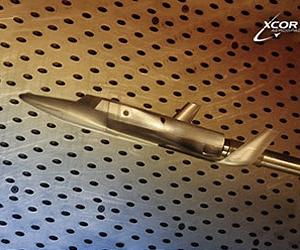
The Lynx Supersonic Wind Tunnel Model

The Lynx Supersonic Wind Tunnel Model positioned In the MSFC wind tunnel

XCOR Aerospace has announced they have completed the primary supersonic wind tunnel testing of the Lynx suborbital spacecraft. The tests were performed at NASA Marshall Space Flight Center (MSFC) using a precision scale model and demonstrated the integrity of the Lynx aerodynamic shape and provided data to make final refinements to the vehicle.

These new data provide confidence that the Lynx aerodynamic shape will have stable and controllable flight throughout the range of Mach numbers and angles of attack needed for the Lynx mission.

The recent tests add to subsonic wind tunnel testing data obtained by XCOR late last year at the Air Force Research Laboratory in Dayton. As part of a Cooperative Research and Development Agreement (CRADA), XCOR, NASA and the Air Force will all benefit from the data. The tests are a joint effort between XCOR and the AFRL's Air Vehicles Directorate.

Lynx is a two-seat, single-stage winged suborbital vehicle that lifts off from a runway powered by non-toxic, reusable rocket engines. The vehicle can carry safely to the edge of space and back a pilot, one spaceflight participant, and engineering and scientific payloads. The Lynx can be flown up to four times a day with minimal touch labor between flights.

Saturday, June 26, 2010

Lockhead Martin's Supersonic Vision


Image: This artist's rendering shows an advanced concept design of an environmentally friendly supersonic airframe and propulsion system. Credit: Lockheed Martin Corporation

NASA has awarded an 18-month, $1.96 million study contract to a team led by Lockheed Martin Corporation to generate environmentally friendly supersonic airframe and propulsion concepts and develop technology maturation plans to make those concepts a reality.

Goals of the team—which includes GE Global Research, Purdue University, and Wyle Laboratories—are to produce a future Next Generation Air Transportation System system-level solution, conduct extensive teaming, and leverage past experience and methodology to provide an integrated advanced vehicle concept operational in the 2030-2035 timeframe.

The team will use analytical and design tools to assess performance parameters to find synergistic combinations of technologies and concepts for aerodynamic, structural, aero-servo-propulso-elastics, boom, airport noise, emissions and fuels.

Results of the study will include an optimized supersonic vision vehicle, identification of the highest-value enabling technologies to make that vehicle a reality, and technology roadmaps that lay out an industry-wide path to maturing necessary technologies.

The intention is to devise a revolutionary concept that has the ability to showcase green technologies, which would be an exciting vision that promotes understanding of future supersonic travel.

NASA Supersonic Green Machine


This future aircraft design concept for supersonic flight over land comes from the team led by the Lockheed Martin Corporation.

The team's simulation shows possibility for achieving overland flight by dramatically lowering the level of sonic booms.

They do this through the use of an "inverted-V" engine-under wing configuration.

Other revolutionary technologies help achieve range, payload and environmental goals.

This supersonic cruise concept is among the designs presented in April 2010 to the NASA Aeronautics Research Mission Directorate for its NASA Research Announcement-funded studies into advanced aircraft that could enter service in the 2030-2035 timeframe.

Image credit: NASA/Lockheed Martin Corporation

More images available at the NASA Image Gallery