Showing posts with label model. Show all posts

Wednesday, October 22, 2014

Researchers construct a model of impact for El Nino / La Nina events

The 1997 El Nino seen by TOPEX/Poseidon

Credit: NASA

A small team made up of researchers from the U.S. and Europe has constructed a model that helps map parts of the world that are most at risk of flooding due to El Niño/La Niña events.

In their paper published in Proceedings of the National Academy of Sciences, the team describes how they compared weather data over the past half century with economic impacts of actual floods to create a model that may soon be used to help predict flooding events in the future.

By now, most everyone has heard about El Niño/La Niña weather events, El Niño is where warm water west of South America causes more rain to fall in some places.

La Niña is where the same waters are cooler than normal resulting in different changes to rain patterns.

Perhaps less well known is that such events have a worldwide impact, causing more flooding than normal in some parts of the world and less in others.

Ofen the flooding results in damage to property and loss of life, thus it would be a good thing if forecasts could be made, warning people in areas most at risk.

Unfortunately, up till now, such forecasts have not been available because such events don't always cause the same types of flooding in the same places.

In this new effort, the researchers sought to provide a model for building such a forecasting ability by using data over a long period of time.

"El Niño Southern Oscillation (ENSO) is the most dominant interannual signal of climate variability and has a strong influence on climate over large parts of the world."

"In turn, it strongly influences many natural hazards (such as hurricanes and droughts) and their resulting socioeconomic impacts, including economic damage and loss of life."

"However, although ENSO is known to influence hydrology in many regions of the world, little is known about its influence on the socioeconomic impacts of floods (i.e., flood risk)."

The research team obtained weather data for the years 1959 to 2000, pulling out periods of El Niño/La Niña weather events which they then compared with reports of damage due to flooding.

Next they compared those results with flood reports during normal times and used what they found to create a model.

The model showed that during El Niño events, 34 percent of the Earth's surface had higher or lower than normal amounts of flooding, that number jumped to 38 percent for La Niña weather events.

The model also showed which parts of the planet are more susceptible on average, to flooding due to such events.

The Southwest in the U.S. for example and parts of South America, both experience more flooding during El Niño events, while places like the Sahel in Africa, and most of Australia experience less.

The research team acknowledges that their model is still in its infancy but believe that over time, as more research is conducted, it will improve to the point that it will be useful in helping areas prepare for flooding during El Niño/La Niña weather events.

More information: Strong influence of El Niño Southern Oscillation on flood risk around the world, PNAS, Philip J. Ward, DOI: 10.1073/pnas.1409822111

Sunday, July 27, 2014

LEGO Model of ESA NASA Hubble Space Telescope

Gabriel Russo's idea for a Hubble Space Telescope model could become a real LEGO toy set if fans vote.

Credit: GRusso /LEGO Ideas

The Hubble Space Telescope is an iconic spacecraft responsible for almost a quarter of a century of astronomical discoveries and stunning stellar images.

As such, it is due time for it to be immortalised as a Lego model.

At least that is the idea of Gabriel Russo, a Lego fan and admirer of the orbiting observatory, who designed a Lego brick version of the space telescope and uploaded it to the Danish toy company's social website, "LEGO Ideas."

And judging by the number of supporters Russo's Hubble has recruited to date, just over 6,300 at press time, he is far from the only person who thinks it is a good idea.

"A Lego model of this amazing piece of space engineering would come as a perfect homage to its 25th anniversary in 2015," Russo wrote as a part of his model's description on the website.

LEGO have also recently celebrated the anniversary of the Moon Landing in LEGO.

The build in the picture took around 2-3 weeks for building techniques.

The "Moon" was just a grey blanket made similar to the Luna ground.

This set will include the Brick-Built version of the "Eagle" also known as the "Luna Lander", Neil Armstrong with his unique printed face and a removable helmet and a clip on chrome gold visor, Buzz Aldrin also with his unique printed face and a removable helmet and a clip on chrome gold visor and last but not final...Michael Collins, Again with his unique printed face and a removable helmet and a clip on chrome gold visor.

Angus MacLane's character Wall-E produced by LEGO.

LEGO Ideas, which was previously known as CUUSOO, invites Lego fans to share their proposals for new brick-built models.

Other fans and the public can then cast their votes on the website for their favourite ideas.

The concepts that successfully attract 10,000 supporters are considered by the toy company for commercial distribution.

Wednesday, July 23, 2014

Astrophysicists model the formation of the oldest star in Milky Way

The illustration shows projections of the gas density, temperature and the fraction of ionized carbon in the central region where the star forms, in simulations with different abundances of the heavy elements, from 0.01 to 0.0001 times the solar value. 

The results show that a strong transition occurs for a carbon abundance of 0.01 times the solar value, providing a pathway for the formation of low-mass stars. 

Credit: Institute for Astrophysics Göttingen

A team of researchers led by Dr. Stefano Bovino at the Institute for Astrophysics Göttingen (IAG) has conducted high-resolution simulations investigating the formation of the oldest-known star in our galaxy, SMSS J031300.36-670839.3, on a Cray supercomputer of the North-German Supercomputing Alliance.

Using the star's abundance patterns, the scientists have performed cosmological simulations which include the dynamics of gas and dark matter as well as the chemical evolution.

From this simulation, the scientists expect to obtain an improved understanding of the transition from the first to the second generation of stars in the universe.

The results of their study were published in the Astrophysical Journal Letters.

The stars of the first generation have formed out of a primordial gas consisting only of hydrogen and helium.

Their mass was ranging from ten to five hundred times the mass of our Sun.

Nuclear processes in the interior of these stars have created heavy elements like iron, silicon, carbon and oxygen.

When these stars died during the first supernova explosions, the heavy elements have been ejected, and stars of the second generation could form.

"Even for the oldest-known star in the Milky Way galaxy, our simulations indicate that the gas efficiently cools due to the presence of heavy elements," says Dr. Bovino. Such conditions favour the formation of low-mass stars.

The results therefore strongly suggest that the transition to the second generation already occurred after the first supernova explosion.

"The heavy elements provide additional mechanisms for the gas to cool, and it is very important to follow their chemical evolution," explains Dr. Tommaso Grassi from the Center for Star and Planet Formation at the University of Copenhagen.

The scientists have considered SMSS J031300.36-670839.3 for their study, as its abundance patterns were previously shown to be consistent with one single low-energy supernova.

"It seems very likely that this star is indeed one of the very first stars forming out of the metal-enriched gas, providing the chemical conditions right after the first supernova explosion," says Prof. Dominik Schleicher at the IAG.

While this star has a tiny amount of heavy elements, it has a relatively higher carbon abundance.

It in fact represents an entire class with similar properties, and the scientists expect a very similar formation pathway for the entire class.

"The mass of the stars mostly depends on the temperature of the gas, as gravity needs to overcome the thermal pressure during star formation," says Dr. Muhammad Latif, a scientist in the Göttingen Collaborative Research Center 963 on Astrophysical Flow Instabilities and Turbulence.


The new simulations became feasible through the development of the chemistry package KROME, an effort led by Dr. Grassi in Copenhagen.

In the future, the scientists plan to explore a wide range of possible conditions to understand the formation of the most metal-poor stars observed in our Milky Way galaxy.

More information: "Formation of carbon-enhanced metal-poor stars in the presence of far ultraviolet radiation," Stefano Bovino et al., 2014, Astrophysical Journal Letters, Volume 790, L35: dx.doi.org/10.1088/2041-8205/790/2/L35 , On Arxiv: arxiv.org/abs/1406.4450

Tuesday, February 25, 2014

Child's heart printed in 3D to aid complex surgery


Louisville Kentucky cardiothoracic surgeon Erle Austin has performed successful heart repair surgery on a 14 month old infant named Roland Lian Cung Bawi, heart surgery on such a young patient is not unheard of, of course, what's new is that Austin was able to map out his surgical approach using a nearly exact model of the patients heart, it had been printed on a 3D printer.

Erle Austin
Young Roland had been born with four congenital heart defects—doctors had known since before he was born that his heart had problems.

Fixing them all would prove to be a challenge. When it came time to plan the surgery, Austin consulted with other surgeons and found each of them had different ideas on the best way to fix the heart.

The ideal approach would involve the least amount of cutting and suturing—but that can be hard to plan using only conventional scanning techniques.

Looking for more precision, Austin turned to the engineering school at the University of Louisville, they'd been researching different kinds of 3D printing technology.

Researchers at the University worked with radiologists at Kosair Children's Hospital to create a means for converting data from a CT scan of Roland's heart to data that could be used with a 3D printer.

The two seemed a perfect match as CT scanning uses the same basic idea as 3D printing, it takes pictures of slices and puts them together on a computer screen to form a whole, and 3D printing is achieved by laying down one layer or "slice" of material at a time.

The 3D printing team used a MakerBot Replicator 2X, to print the heart (in three pieces) at twice its normal size, they also used a flexible type of plastic filament known as "Ninja Flex" instead of ABS.

Ninja Flex allowed the surgeon to bend the finished heart in ways that resembled a real human heart.

Printing the heart took approximately 20 hours at a cost of roughly $600.

Austin told local news reporters that the printed heart let him plan the surgery in ways he'd never experienced before, it allowed for a single surgery (this past February 10) and greatly reduced cutting and suturing, which ultimately led to a much quicker recovery for Roland, who by all accounts is now doing just fine.

Wednesday, February 19, 2014

A black hole shreds a star, and a bright flare is formed - Video

Computer simulation of the disruption of a star by a black hole shows the formation of an "accretion disk" of stellar material spiraling into the black hole. 

This image shows an early stage in the formation of the disk. 

Credit: James Guillochon

Ramirez-Ruiz, a professor of astronomy and astrophysics at the University of California, Santa Cruz, uses computer simulations to explore the universe's most violent events, so when the first detailed observations of a star being ripped apart by a black hole were reported in 2012 (Gezari et al., Nature), he was eager to compare the data with his simulations.

Ramirez-Ruiz
He was also highly skeptical of one of the published conclusions: that the disrupted star was a rare helium star.

"I was sure it was a normal hydrogen star and we were just not understanding what's going on," said Ramirez-Ruiz.

In a paper accepted for publication in the Astrophysical Journal and available online at arXiv.org, Ramirez-Ruiz and his students explain what happens during the disruption of a normal sun-like star by a supermassive black hole, and they show why observers might fail to see evidence of the hydrogen in the star.


First author and UCSC graduate student James Guillochon (now an Einstein Fellow at Harvard University) and undergraduate Haik Manukian worked with Ramirez-Ruiz to run a series of detailed computer simulations of encounters between stars and black holes.

James Guillochon
Supermassive black holes are thought to lurk at the centers of most galaxies. Some (known as active galactic nuclei) are very bright, emitting intense radiation from superheated gas falling into the black hole.

But the central black holes of most galaxies in the local universe have run out of gas and are quiescent.

Only when an unlucky star approaches too close and gets shredded by the black hole's powerful tidal forces does the galactic center emit a bright flare of light.

Astronomers call this a "tidal disruption event" (TDE), and in a typical galaxy it happens about once every 10,000 years.

"That means you have to survey the nearest 10,000 galaxies in order to see one event, so for many years this was very much a theoretical field," Ramirez-Ruiz said.

Then came Pan-STARRS (Panoramic Survey Telescope and Rapid Response System), which is surveying the sky on a continual basis and has begun detecting and recording observations of these very rare events.

The first one, known as PS1-10jh, was detected in 2010 and published in 2012.

Astronomers recorded the light curve (the rise and fall in brightness over time) and took a spectrum at peak brightness to study the different wavelengths of light.

The spectrum of an active galactic nucleus (AGN) shows characteristic "emission lines" at specific wavelengths corresponding to the most common elements such as hydrogen and helium.

These emission lines appear as spikes of increased intensity in a continuous spectrum. The shocking thing about PS1-10jh was the absence of a hydrogen line in the spectrum.

"It's very unusual to have seen helium and not hydrogen. Stars are mainly made of hydrogen, and stars made only of helium are extremely rare, so this was a huge issue," Guillochon said.

"People said maybe it was a giant star with a helium core and a hydrogen envelope, and the black hole removed the hydrogen first and then the helium core in a second pass."

Guillochon began to explore the possibilities using computer simulations. The results provide a new understanding of the origin of the emission lines in a tidal disruption event.

They show that the flare of light from a tidal disruption contains information about the type of star and the size of the black hole, and they show that PS1-10jh involved the most common type of star (a main-sequence star much like our sun) and a relatively small supermassive black hole.

More Information: 'PS1-10jh: The Disruption of a Main-Sequence Star of Near-Solar Composition': James Guillochon, Haik Manukian, Enrico Ramirez-Ruiz (UC Santa Cruz) arXiv:1304.6397 [astro-ph.HE] (or arXiv:1304.6397v2 [astro-ph.HE])

Friday, January 17, 2014

Some planet-like Kuiper belt objects don't fit "Nice" model

The bodies in the Kuiper Belt. Credit: Don Dixon

The Kuiper belt—the region beyond the orbit of Neptune inhabited by a number of small bodies of rock and ice—hides many clues about the early days of the Solar System.

According to the standard picture of Solar System formation, many planetesimals were born in the chaotic region where the giant planets now reside.

Some were thrown out beyond the orbit of Neptune, while others stayed put in the form of Trojan asteroids (which orbit in the same trajectory as Jupiter and other planets). This is called the Nice model.

However, not all Kuiper belt objects (KBOs) play nicely with the Nice model (the model is named after the city of Nice in France.)

A new study of large scale surveys of KBOs revealed that those with nearly circular orbits lying roughly in the same plane as the orbits of the major planets don't fit the Nice model, while those with irregular orbits do.

It's a puzzling anomaly, one with no immediate resolution, but it hints that we need to refine our Solar System formation models.

This new study is described in a recently released paper by Wesley Fraser, Mike Brown, Alessandro Morbidelli, Alex Parker, and Konstantin Batygin published in the Astrophysical Journal,.

These researchers combined data from seven different surveys of KBOs to determine roughly how many of each size of object are in the Solar System, which in turn is a good gauge of the environment in which they formed.

The difference between this and previous studies is the use of absolute magnitudes—a measure of how bright an object really is—as opposed to their apparent magnitudes, which are simply how bright an object appears.

The two types of magnitude are related by the distance an object is from Earth, so the observational challenge comes down to accurate distance measurements.

Absolute magnitude is also related to the size of an KBO and its albedo (how much light it reflects), both important physical quantities for understanding formation and composition.

Finding the absolute magnitudes for KBOs is more challenging than apparent magnitudes for obvious reasons: these are small objects, often not resolved as anything other than points of light in a telescope.

That means requires measuring the distance to each KBO as accurately as possible. As the authors of the study point out, even small errors in distance measurements can have a large effect on the estimated absolute magnitude.

In terms of orbits, KBOs fall into two categories: "hot" and "cold", confusing terms having nothing to do with temperature.

The "cold" KBOs are those with nearly circular orbits (low eccentricity, in mathematical terms) and low inclinations, meaning their trajectories lie nearly in the ecliptic plane, where the eight canonical planets also orbit.

In other words, these objects have nearly planet-like orbits. The "hot" KBOs have elongated orbits and higher inclinations, behavior more akin to comets.


The authors of the new study found that the hot KBOs have the same distribution of sizes as the Trojan asteroids, meaning there are the same relative number of small, medium, and large KBOs and similarly sized Trojans.

That hints at a probable common origin in the early days of the Solar System. This is in line with the Nice model, which predicts that, as they migrated into their current orbits, the giant planets kicked many planetesimals out beyond Neptune.

However, the cold KBOs don't match that pattern at all: there are fewer large KBOs relative to smaller objects.

To make matters more strange, both hot and cold seem to follow the same pattern for the smaller bodies, only deviating at larger masses, which is at odds with expectations if the cold KBOs formed where they orbit today.

To put it another way, the Nice model as it stands could explain the hot KBOs and Trojans, but not the cold. That doesn't mean all is lost, of course.

The Nice model seems to do very well except for a few nagging problems, so it's unlikely that it's completely wrong. As we've learned from studying exoplanet systems, planet formation models are a work in progress—and astronomers are an ingenious lot.

Wednesday, July 24, 2013

UK team designs human mission to Mars concept model

Scientists at Imperial College London have designed a concept mission to land astronauts on Mars.

The plan envisages a three-person crew journeying to Mars aboard a small two-part craft.

The craft would rotate to generate artificial gravity and use a heat shield to protect itself against solar flares.

The crew would then return to Martian orbit in a pre-sent craft fuelled using ice from beneath the planet's surface.

The concept is intended to spark further debate about the technical obstacles and risks that would have to be overcome in order to put humans on Mars.

"Every part of this mission scenario has been demonstrated one way or the other, including the in situ propellant production on the surface of Mars," said Prof Tom Pike, who led the Imperial design team.

"There are big, big jumps between a demonstration at one level and putting together the engineering systems for a mission, but they are engineering challenges. They are not fundamentally about making new discoveries."

The new Imperial concept comes amid renewed interest in the Red Planet with two private groups having proposed missions in recent months.

The Imperial team have designed a two-part craft, consisting of a Martian lander with a heat shield, inside which the crew would also ascend into Earth orbit.

Directly beneath the lander on the launch pad would be a "cruise habitat vehicle", a cylindrical craft split into three floors and measuring some 10m (30ft) in height and 4m in diameter.

Once in Earth orbit, the astronauts would move from the lander into the larger habitat vehicle before a rocket burst would propel the conjoined craft on a trajectory to Mars.

The quickest journey time would be nine months when Earth and Mars are in optimum alignment.

Shortly into the journey, the lander and cruise vehicle would unwind from each other on a steel cable tether to a distance of some 60m. Short thruster bursts from both vehicles would then set them spinning around a centre of gravity.

This would create artificial gravity within the habitat vehicle similar to Earth's gravity, which the scientists believe would prevent the type of muscle and bone wastage that weightlessness would cause, which would render the astronauts unable to walk on Mars once they arrived.

Later in the mission, the spin rate could be reduced to better emulate Martian conditions, where gravity is 40% that on Earth.

During the journey, the crew's health would be monitored closely with wireless sensors - but they would rely entirely on medication aboard the craft and the skills of their fellow crew members should they fall sick.

Read the full article here

Wednesday, October 17, 2012

NASA: Boeing Supersonic Model Points to Fast Future

If human beings are ever to fly faster than the speed of sound from one side of the country to another, we first have to figure out how to reduce the level of sonic boom generated by supersonic flight.

Earlier this fall, a subscale model of a potential future low-boom supersonic aircraft designed by The Boeing Company was installed for testing in the supersonic wind tunnel at NASA's Glenn Research Center in Cleveland.

This model is a larger of two models used in the test.

The model contains a force measurement balance used to capture force measurements (lift, drag).

Depending on the type of test and on the tunnel, the model can be oriented any way. The picture model is actually upside down.

Another smaller model was used to capture measurements of the off-body pressures that create a sonic boom.

The tests are among those being conducted by NASA and its partners to identify technologies and designs to achieve a level of sonic boom so low that it barely registers on buildings and people below.

Image Credit: NASA/Michelle M. Murphy

Monday, August 27, 2012

Scientists use A-Train satellites to measure how pollution particles affect clouds

Described as a satellite constellation, the 'A-Train' is shown in this artist's conception. 

The close timing and engineering of these satellites along a track means that they function as if they were all on the same platform. 

Data collected by the A-Train gave scientists in this CloudSat study more complete information on atmospheric particles around the globe. Photo: NASA.

Grabbing a virtual tiger by the tail, scientists led by researchers at Pacific Northwest National Laboratory directly linked a cloud's inclination to rain to its effects on the climate.

Using global satellite data and complex calculations, they were able—for the first time—to develop a proxy measurement for one of the most vexing questions in atmospheric science: how tiny particles in the atmosphere affect the amount of cloud.

Using this new metric, they showed that aerosols' effects on clouds are overestimated by as much as 30 percent in a global climate model. The results were published in the journal Geophysical Research Letters.

"Our study helps narrow the large aerosol-cloud interaction uncertainties in projections of future global warming," said Dr. Minghuai Wang, atmospheric scientist at PNNL and lead author of the study.

"Wide ranges of estimates in aerosol effects on clouds have made it challenging to understand how clouds really affect the climate." Understanding clouds and their effects on climate is a formidable challenge in trying to predict how the climate will change by the end of the century.

On the line are questions of future melting of the polar ice, drought and water shortages, and increases in extreme weather events. One particularly tough question is how tiny pollution-caused particles in the atmosphere will affect clouds.

This study shows how satellite observations can be used to hone in on aerosol effects on clouds and make it possible to better understand how clouds will affect climate.

"The use of satellite observations in studying climate processes like these is absolutely critical because it is the only way to obtain cloud and aerosol measurements over the whole globe," said Dr. Mikhail Ovchinnikov, PNNL atmospheric scientist and co-author of the study.

The study, led by PNNL scientists, constructed a new metric for rain frequency susceptibility, then closely correlated that metric to the aerosol effect on cloud amount, which is the total amount of water in the cloud and the cloud's size.

This metric, along with satellite measurements, was then used in three global climate models to find new ranges of cloud amount change due to pollution-caused aerosol particles, compared to current estimates.

The team, for the first time, used "A-Train" satellite observations which collect coincident global measurements of aerosols, clouds, and precipitation to develop a new metric, termed rain frequency susceptibility or "S-POP."

This metric provides a quantitative measure of the sensitivity of rain frequency to the amount of aerosols in clouds.

They showed how S-POP is closely correlated to aerosols' effects on cloud amount, using three global climate models, including a multi-scale aerosol climate model developed at PNNL (PNNL-MMF) that embeds a cloud-resolving model at each grid column of a host global climate model.

Finally, the relationship between S-POP and the aerosol effects on cloud amount from the global climate models together with the observed rain frequency susceptibility from A-Train observations were used to estimate aerosol effects on cloud amount in global climate models.

They showed that in one global model, the National Center for Atmospheric Research's Community Atmosphere Model version 5 (CAM5), aerosol effects on clouds were overestimated by 30 percent.

This research also provides a guide for the development and evaluation of new parameterizations, techniques to computationally represent complex small-scale systems, of aerosol effects on clouds in global climate models.

The researchers plan to apply S-POP to evaluate cloud amount based on rain frequency susceptibility in other global climate models, and guide further improvement of the aerosol indirect effects estimations in CAM5 and the PNNL-MMF multi-scale aerosol-climate model.

Read the paper: "Constraining Cloud Lifetime Effects of Aerosols Using A-Train Satellite Observations," Geophysical Research Letters 39:L15709. DOI:10.1029/2012GL052204

Tuesday, September 21, 2010

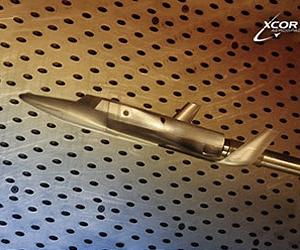
The Lynx Supersonic Wind Tunnel Model

The Lynx Supersonic Wind Tunnel Model positioned In the MSFC wind tunnel

XCOR Aerospace has announced they have completed the primary supersonic wind tunnel testing of the Lynx suborbital spacecraft. The tests were performed at NASA Marshall Space Flight Center (MSFC) using a precision scale model and demonstrated the integrity of the Lynx aerodynamic shape and provided data to make final refinements to the vehicle.

These new data provide confidence that the Lynx aerodynamic shape will have stable and controllable flight throughout the range of Mach numbers and angles of attack needed for the Lynx mission.

The recent tests add to subsonic wind tunnel testing data obtained by XCOR late last year at the Air Force Research Laboratory in Dayton. As part of a Cooperative Research and Development Agreement (CRADA), XCOR, NASA and the Air Force will all benefit from the data. The tests are a joint effort between XCOR and the AFRL's Air Vehicles Directorate.

Lynx is a two-seat, single-stage winged suborbital vehicle that lifts off from a runway powered by non-toxic, reusable rocket engines. The vehicle can carry safely to the edge of space and back a pilot, one spaceflight participant, and engineering and scientific payloads. The Lynx can be flown up to four times a day with minimal touch labor between flights.

Monday, August 31, 2009

Tevatron tightens up the race with LHC for the Higgs - New Scientist

Tevatron near Chicago could be in the running to discover the Higgs boson (Image: Fermilab)

(Image: Fermilab)

Tevatron near Chicago could be in the running to discover the Higgs boson

WITH the Large Hadron Collider (LHC) still in the repair shop, the race to find the Higgs boson has become a lot tighter, thanks to the older and less powerful but functioning, Tevatron collider near Chicago.

"The Tevatron definitely has a chance," says Greg Landsberg of Brown University in Providence, Rhode Island, who works on one of the LHC's detectors.

With the LHC due to restart only in November at CERN near Geneva, Switzerland, the Tevatron has been gaining ground in the search for the Higgs, the particle thought to give mass to other elementary particles. At last week's Lepton Photon conference in Hamburg, Germany, Tevatron physicists said that by early 2011 they will have recorded enough data to allow them to either find or rule out the Higgs as predicted by the standard model.

Tevatron physicists said that by early 2011 they will have the data to either find the Higgs or rule it out

The LHC will have to sprint to catch up, and it won't be easy. While the LHC's higher energies should produce more Higgs particles, it will also boost the production of other particles that can mimic a Higgs, says Gordon Kane of the University of Michigan in Ann Arbor. Telling between the two will require a precise understanding of how the LHC's detectors are working, which takes time to develop.

The LHC, however, could become the first to find particles of dark matter, a search for which the Tevatron is not well suited