Showing posts with label Formed. Show all posts

Friday, October 17, 2014

HZDR Research: Cosmic jets of young stars formed by magnetic fields

This is an artist's rendering showing the birth of a star: A dust and gas cloud is forming a spiraling disk around a massive baby star while jets of material shoot from its core. 

Credit: ESO/L. Calada

Astrophysical jets are counted among our Universe's most spectacular phenomena: From the centers of black holes, quasars, or protostars, these rays of matter sometimes protrude several light years into space.

Now, for the first time ever, an international team of researchers has successfully tested a new model that explains how magnetic fields form these emissions in young stars.

Scientists at the Helmholtz-Zentrum Dresden-Rossendorf (HZDR) were part of this research.

Their findings have been published in the journal Science. The insights gleaned from this research may even apply to cancer therapy.

Whenever an object in space forms a rotating disc of matter, chances are that it gives rise to a "jet" – a thin, straight emission of matter which emanates from the disc's center and that looks like a spintop.

These structures can be observed especially during the formation of new stars, but understanding how such thin beams are able to form within the disc is something that continues to elude scientists.

Now, HZDR researchers, along with their European, American, and Asian colleagues, have investigated this process in the lab.

At the Laboratoire pour l'Utilisation des Lasers Intenses (LULI), in France, scientists hit a plastic sample with laser light which set the electrons at the target's core in motion, transforming the solid plastic object into conductive plasma.

"Think of it as a sort of rapidly expanding hot cloud of electrons and ions. On a small scale, the plasma represents a young star's accumulation of matter," explains Professor Thomas Cowan, the study's co-author and Director of the HZDR Institute of Radiation Physics.

Miniature versions of young stars for the lab
What made the experiment special was the fact that the plasma was exposed to a very powerful pulsed magnetic field.

The idea behind it: under a magnetic field's influence, the normally widely scattered plasma begins to focus, forming a hollow center.

This ultimately produces a shockwave, from which a very thin beam starts to project, a jet.

The experiment was set up in such a way as to allow for extrapolation to conditions as they would be encountered in the Universe: within as little as 20 nanoseconds, over 100,000 times faster than a fly flapping its wings, the lab plasma forms structures similar to a young star's jet in approximately six years.

This allowed the researchers to test their model with astronomical observations, which were made possible through space telescopes, in the last two decades.

The data were in good agreement. In a jet, for instance, a crossing over of particle streams can occur, which in turn results in the formation of very hot spots.

"X-ray measurements of actual jets show these features at the exact same points as our true-to-scale plasma model in the lab," says Cowan.

With its help, the researchers were able to offer a model that, for the first time ever, is capable of explaining the formation of jets solely by way of magnetic fields.

Previous approaches had considered the rotation of matter about the young star another influencing factor.

The realisation that plasma can be focused in this way may prove a real practical boon in the field of medical engineering.

According to Cowan, it's conceivable that with the help of pulsed magnetic fields, a particularly thin proton beam could be produced for use in radiation therapy.

It's what Florian Kroll, Ph.D. student at the HZDR and one of the study's co-authors, is investigating.

Special pulse generator designed at the Dresden High Magnetic Field Lab

To produce strong pulsed magnetic fields for the experiment, the researchers drew on the expertise at the HZDR's Dresden High Magnetic Field Lab: "We developed a special pulse generator which allowed our French colleagues to set up powerful magnetic fields within a small, enclosed lab space," says Dr. Thomas Herrmannsdörfer, head of division at the High Magnetic Field Lab.

The generator, just about the size of a wardrobe, is capable of generating currents of up to 300 kiloampere.

According to Herrmannsdörfer, building such a compact facility was a real technical challenge: "Our electrical engineers came up with some very innovative solutions."

"This is also helping us now with developing these types of generators for application in industry and medical technology."

Currently, the pulse generator is still located at the French laser lab at Palaiseau near Paris, because beginning in December the Dresden scientists are planning on once again working together with their LULI colleagues.

More information: Science DOI: 10.1126/science.1259694

Thursday, August 21, 2014

Fluorine formed in stars and our Sun

The Sun by the Atmospheric Imaging Assembly of NASA's Solar Dynamics Observatory. Credit: NASA

The fluorine that is found in products such as toothpaste was likely formed billions of years ago in now dead stars of the same type as our sun.

This has been shown by astronomers at Lund University in Sweden, together with colleagues from Ireland and the USA.

Fluorine can be found in everyday products such as toothpaste and fluorine chewing gum.

However, the origins of the chemical element have been somewhat of a mystery.

There have been three main theories about where it was created. The findings now presented support the theory that fluorine is formed in stars similar to the sun but heavier, towards the end of their existence.

The sun and the planets in our solar system have then been formed out of material from these dead stars.

Nils Ryde
"So, the fluorine in our toothpaste originates from the sun's dead ancestors", said Nils Ryde, a reader in astronomy at Lund University.

With doctoral student Henrik Jönsson and colleagues from Ireland and the US, he has studied stars formed at different points in the history of the universe to see if the amount of fluorine they contain agrees with the predictions of the theory.

By analysing the light emitted by a star, it is possible to calculate how much of different elements it contains. Light of a certain wavelength indicates a certain element.

In the present study, the researchers used a telescope on Hawaii and a new type of instrument that is sensitive to light with a wavelength in the middle of the infrared spectrum. It is in this area that the signal is found in this case.

"Constructing instruments that can measure infrared light with high resolution is very complicated and they have only recently become available", said Nils Ryde.

Different chemical elements are formed at high pressure and temperature inside a star.

Henrik Jönsson
Fluorine is formed towards the end of the star's life, when it has expanded to become what is known as a red giant. The fluorine then moves to the outer parts of the star.

After that, the star casts off the outer parts and forms a planetary nebula. The fluorine that is thrown out in this process mixes with the gas that surrounds the stars, known as the interstellar medium.

New stars and planets are then formed from the interstellar medium. When the new stars die, the interstellar medium is enriched once again.

The researchers are now also turning their attention to other types of stars.

Among other things, they will try to find out whether fluorine could have been produced in the early universe, before the first red giants had formed.

They will also use the same method to study environments in the universe that are different from the environment surrounding the sun, such as close to the supermassive black hole at the centre of the Milky Way.

There, the cycle of stars dying and new ones being born goes considerably faster than around the sun.

"By looking at the level of fluorine in the stars there, we can say whether the processes that form it are different", said Nils Ryde.

Wednesday, February 19, 2014

A black hole shreds a star, and a bright flare is formed - Video

Computer simulation of the disruption of a star by a black hole shows the formation of an "accretion disk" of stellar material spiraling into the black hole. 

This image shows an early stage in the formation of the disk. 

Credit: James Guillochon

Ramirez-Ruiz, a professor of astronomy and astrophysics at the University of California, Santa Cruz, uses computer simulations to explore the universe's most violent events, so when the first detailed observations of a star being ripped apart by a black hole were reported in 2012 (Gezari et al., Nature), he was eager to compare the data with his simulations.

Ramirez-Ruiz
He was also highly skeptical of one of the published conclusions: that the disrupted star was a rare helium star.

"I was sure it was a normal hydrogen star and we were just not understanding what's going on," said Ramirez-Ruiz.

In a paper accepted for publication in the Astrophysical Journal and available online at arXiv.org, Ramirez-Ruiz and his students explain what happens during the disruption of a normal sun-like star by a supermassive black hole, and they show why observers might fail to see evidence of the hydrogen in the star.


First author and UCSC graduate student James Guillochon (now an Einstein Fellow at Harvard University) and undergraduate Haik Manukian worked with Ramirez-Ruiz to run a series of detailed computer simulations of encounters between stars and black holes.

James Guillochon
Supermassive black holes are thought to lurk at the centers of most galaxies. Some (known as active galactic nuclei) are very bright, emitting intense radiation from superheated gas falling into the black hole.

But the central black holes of most galaxies in the local universe have run out of gas and are quiescent.

Only when an unlucky star approaches too close and gets shredded by the black hole's powerful tidal forces does the galactic center emit a bright flare of light.

Astronomers call this a "tidal disruption event" (TDE), and in a typical galaxy it happens about once every 10,000 years.

"That means you have to survey the nearest 10,000 galaxies in order to see one event, so for many years this was very much a theoretical field," Ramirez-Ruiz said.

Then came Pan-STARRS (Panoramic Survey Telescope and Rapid Response System), which is surveying the sky on a continual basis and has begun detecting and recording observations of these very rare events.

The first one, known as PS1-10jh, was detected in 2010 and published in 2012.

Astronomers recorded the light curve (the rise and fall in brightness over time) and took a spectrum at peak brightness to study the different wavelengths of light.

The spectrum of an active galactic nucleus (AGN) shows characteristic "emission lines" at specific wavelengths corresponding to the most common elements such as hydrogen and helium.

These emission lines appear as spikes of increased intensity in a continuous spectrum. The shocking thing about PS1-10jh was the absence of a hydrogen line in the spectrum.

"It's very unusual to have seen helium and not hydrogen. Stars are mainly made of hydrogen, and stars made only of helium are extremely rare, so this was a huge issue," Guillochon said.

"People said maybe it was a giant star with a helium core and a hydrogen envelope, and the black hole removed the hydrogen first and then the helium core in a second pass."

Guillochon began to explore the possibilities using computer simulations. The results provide a new understanding of the origin of the emission lines in a tidal disruption event.

They show that the flare of light from a tidal disruption contains information about the type of star and the size of the black hole, and they show that PS1-10jh involved the most common type of star (a main-sequence star much like our sun) and a relatively small supermassive black hole.

More Information: 'PS1-10jh: The Disruption of a Main-Sequence Star of Near-Solar Composition': James Guillochon, Haik Manukian, Enrico Ramirez-Ruiz (UC Santa Cruz) arXiv:1304.6397 [astro-ph.HE] (or arXiv:1304.6397v2 [astro-ph.HE])

Monday, January 20, 2014

Gaia: Milky Way may have formed 'inside-out'

This is a figure illustrating latest Gaia-ESO research findings. 

Credit: Amanda Smith/Institute of Astronomy

A breakthrough using data from the Gaia-ESO project has provided evidence backing up theoretically predicted divisions in the chemical composition of the stars that make up the Milky Way's disc – the vast collection of giant gas clouds and billions of stars that give our Galaxy its 'flying saucer' shape.

By tracking the fast-produced elements, specifically magnesium in this study, astronomers can determine how rapidly different parts of the Milky Way were formed.

The research suggests that stars in the inner regions of the Galactic disc were the first to form, supporting ideas that our Galaxy grew from the inside-out.

Using data from the 8-m VLT in Chile, one of the world's largest telescopes, an international team of astronomers took detailed observations of stars with a wide range of ages and locations in the Galactic disc to accurately determine their 'metallicity' (?): the amount of chemical elements in a star other than hydrogen and helium, the two elements most stars are made from.

Immediately after the Big Bang, the Universe consisted almost entirely of hydrogen and helium, with levels of "contaminant metals" growing over time.

Consequently, older stars have fewer elements in their make-up - so have lower 'metallicity'.

Gerry Gilmore
"The different chemical elements of which stars - and we - are made are created at different rates - some in massive stars which live fast and die young, and others in sun-like stars with more sedate multi-billion-year lifetimes," said Professor Gerry Gilmore, lead investigator on the Gaia-ESO Project.

Massive stars, which have short lives and die as 'core-collapse supernovae', produce huge amounts of magnesium during their explosive death throes.

This catastrophic event can form a neutron star or a black hole, and even trigger the formation of new stars.

The team have shown that older, 'metal-poor' stars inside the Solar Circle – the orbit of our Sun around the centre of the Milky Way, which takes roughly 250 million years to complete – are far more likely to have high levels of magnesium.

The higher level of the element inside the Solar Circle suggests this area contained more stars that "lived fast and die young" in the past.

The stars that lie in the outer regions of the Galactic disc - outside the Solar Circle - are predominantly younger, both 'metal-rich' and 'metal-poor', and have surprisingly low magnesium levels compared to their metallic properties.

During the latest research, the team found that:
Stars in the young, 'thin' disc aged between 0 – 8 billion years all have a similar degree of metallicity, regardless of age in that range, with many of them considered 'metal-rich'.

There is a "steep decline" in metallicity for stars aged over 9 billion years, typical of the 'thick' disc, with no detectable 'metal-rich' stars found at all over this age.

But stars of different ages and metallicity can be found in both discs.

Maria Bergemann
"From what we now know, the Galaxy is not an 'either-or' system. You can find stars of different ages and metal content everywhere!" said Maria Bergemann from Cambridge Institute of Astronomy, who led the study.

"There is no clear separation between the thin and thick disc. The proportion of stars with different properties is not the same in both discs - that's how we know these two discs probably exist – but they could have very different origins."

Added Gilmore: "This study provides exciting new evidence that the inner parts of the Milky Way's thick disc formed much more rapidly than did the thin disc stars, which dominate near our Solar neighbourhood."

Tuesday, August 6, 2013

Strange Martian crater formed by impacts into ancient ice

Double-layer ejecta craters could form when ejected material slides down steep crater walls and across ice, forming a top layer. Striations, common in landslides on Earth, radiate out from the crater rim. Credit: NASA

Geologists from Brown University have developed a promising new explanation for a mysterious type of crater on the surface on Mars.

Double-layered ejecta craters or DLEs, like other craters, are surrounded by debris excavated by an impactor. What makes DLEs different is that the debris forms two distinct layers—a large outer layer with a smaller inner layer sitting on top.

These distinctive craters were first documented in data returned from the Viking missions to Mars in the 1970s, and scientists have been trying ever since to figure out how the double-layer pattern forms.

A new study by Brown graduate student David Kutai Weiss and James W. Head, professor of geological science, suggests that DLEs are the result of impacts onto a surface that was covered by a layer of glacial ice tens of meters thick.

"Recent discoveries by planetary geoscientists at Brown and elsewhere have shown that the climate of Mars has varied in the past," Head said.

"During these times, ice from the polar caps is redistributed into the mid-latitudes of Mars as a layer about 50 meters thick, in the same place that we see that the DLEs have formed. This made us think that this ice layer could be part of the explanation for the formation of the unusual DLE second layer," Head said.

In the scenario Weiss and Head lay out, the impact blasts through the ice layer, spitting rock and other ejecta out onto the surrounding ice. But because that ejected material sits on slippery ice, it doesn't all stay put.

Weiss and Head believe the layering occurs when material near the top of an upraised crater rim slides down the slippery ice and overtops material on the lower slopes.

That landslide, enabled by steep slopes and a slick ice layer, creates the DLEs' telltale two-layered appearance.

"I think for the first time since DLEs were discovered in the 1970s we have a model for their formation that appears to be consistent with a very wide range of known data," Weiss said.

An understanding of how these and other crater types formed could help researchers to reconstruct the environmental conditions at the time of the impacts.

The research will be published in the journal Geophysical Research Letters. An early version of the paper went online on July 25.

The landslide scenario explains several of the distinct features of DLEs. Most directly, it explains radial striations—grooves radiating out from the crater rim—that are common on the inner ejecta layer of DLEs. Striations are common in landslides on Earth, Weiss said, "especially landslides on glaciers."

That got Weiss and Head thinking that ice could be a key ingredient for making a DLE. Ice would reduce the coefficient of friction on the slopes of crater rims, increasing the likelihood of a slide.

"When I did a quick calculation, I realized that the landslide wouldn't be expected to happen [on crater rims] unless the ejecta was landsliding on an ice layer," Weiss said.

 More information: onlinelibrary.wiley.com/doi/10.1002/grl.50778/abstract

Tuesday, July 9, 2013

Meteorite mystery: Chondrules formed from high-pressure collisions in early solar system

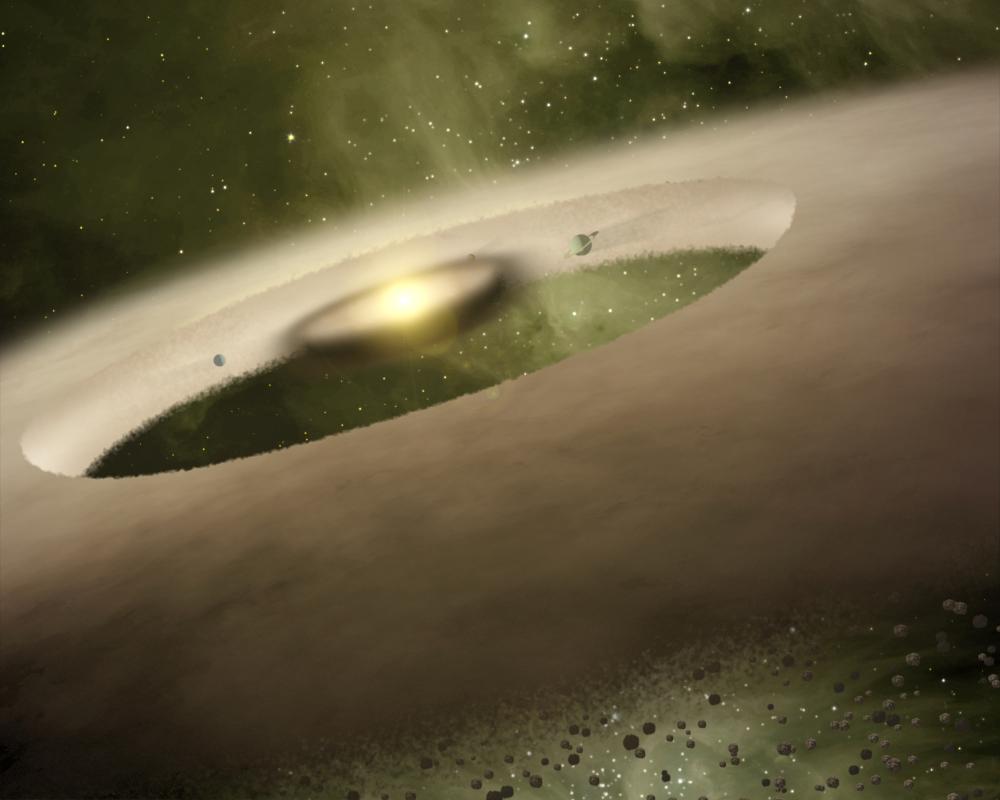
This is an artist's rendition of a sun-like star as it might have looked at one million years of age.

As a cosmochemist, the University of Chicago's Lawrence Grossman reconstructs the sequence of minerals that condensed from the solar nebula, the primordial gas cloud that eventually formed the sun and planets. 

Credit: NASA /JPL-Caltech /T. Pyle, SSC

A normally staid University of Chicago scientist has stunned many of his colleagues with his radical solution to a 135-year-old mystery in cosmochemistry.

"I'm a fairly sober guy. People didn't know what to think all of a sudden," said Lawrence Grossman, professor in geophysical sciences.

Lawrence Grossman
At issue is how numerous small, glassy spherules had become embedded within specimens of the largest class of meteorites—the chondrites. British mineralogist Henry Sorby first described these spherules, called chondrules, in 1877.

Sorby suggested that they might be "droplets of fiery rain" which somehow condensed out of the cloud of gas and dust that formed the solar system 4.5 billion years ago.

Researchers have continued to regard chondrules as liquid droplets that had been floating in space before becoming quickly cooled, but how did the liquid form? "There's a lot of data that have been puzzling to people," Grossman said.

Grossman's research reconstructs the sequence of minerals that condensed from the solar nebula, the primordial gas cloud that eventually formed the sun and planets.

He has concluded that a condensation process cannot account for chondrules. His favorite theory involves collisions between planetesimals, bodies that gravitationally coalesced early in the history of the solar system.

"That's what my colleagues found so shocking, because they had considered the idea so 'kooky,'" he said.

Cosmochemists know for sure that many types of chondrules, and probably all of them, had solid precursors. "The idea is that chondrules formed by melting these pre-existing solids," Grossman said.

One problem concerns the processes needed to obtain the high, post-condensation temperatures necessary to heat the previously condensed solid silicates into chondrule droplets.

Various astonishing but unsubstantiated origin theories have emerged. Maybe collisions between dust particles in the evolving solar system heated and melted the grains into droplets. Or maybe they formed in strikes of cosmic lightning bolts, or condensed in the atmosphere of a newly forming Jupiter.

"Impacts on icy planetesimals could have generated rapidly heated, relatively high-pressure, water-rich vapour plumes containing high concentrations of dust and droplets, environments favorable for formation of chondrules," Grossman said.

Grossman and his UChicago co-author, research scientist Alexei Fedkin, published their findings in the July issue of Geochimica et Cosmochimica Acta.

More information: "Vapour saturation of sodium: Key to unlocking the origin of chondrules," by Alexei V. Fedkin and Lawrence Grossman, Geochimica et Cosmochimica Acta, Vol. 112, July 2013, pages 226-250.

Friday, March 1, 2013

Feb 2013 video: Mount Etna erupts from 'new crater'


Europe's most famous active volcano has been erupting, sending plumes of ash into the air.

The activity at Mount Etna on the island of Sicily was reported to be taking place at a new crater at a height of 2,900m (9,500ft).

It is part of a series of eruptions, but the ash is not thought to have disrupted flights at the nearby Catania airport.

Thursday, June 10, 2010

The Earth And Moon Formed Later Than Previously Thought

The Earth And Moon Formed Later Than Previously Thought

The Earth and Moon were created as the result of a giant collision between two planets the size of Mars and Venus. Until now it was thought to have happened when the solar system was 30 million years old or approx. 4,537 million years ago.

But new research from the Niels Bohr Institute shows that the Earth and Moon must have formed much later - perhaps up to 150 million years after the formation of the solar system. The research results have been published in the scientific journal, Earth and Planetary Science letters.

"We have determined the ages of the Earth and the Moon using tungsten isotopes, which can reveal whether the iron cores and their stone surfaces have been mixed together during the collision", explains Tais W. Dahl, who did the research as his thesis project in geophysics at the Niels Bohr Institute at the University of Copenhagen in collaboration with professor David J. Stevenson from the California Institute of Technology (Caltech).

Turbulent collisions
The planets in the solar system were created by collisions between small dwarf planets orbiting the newborn sun. In the collisions the small planets melted together and formed larger and larger planets. The Earth and Moon are the result of a gigantic collision between two planets the size of Mars and Venus.

The two planets collided at a time when both had a core of metal (iron) and a surrounding mantle of silicates (rock). But when did it happen and how did it happen? The collision took place in less than 24 hours and the temperature of the Earth was so high (7000 degrees C), that both rock and metal must have melted in the turbulent collision. But were the stone mass and iron mass also mixed together?

Until recently it was believed that the rock and iron mixed completely during the planet formation and so the conclusion was that the Moon was formed when the solar system was 30 million years old or approximately 4,537 million years ago. But new research shows something completely different.