Showing posts with label UAS. Show all posts

Wednesday, October 8, 2014

NASA aeronautics research tests new wildfire detection tool

NASA researcher Mike Logan plans to use this small unmanned aerial vehicle to check for fires at a Virginia-North Carolina wildlife refuge as part of an agreement with the U.S. Fish and Wildlife Service. 

Credit: NASA Langley/David C. Bowman

NASA's research in unmanned aerial systems (UAS) may soon provide a means for early detection and mitigation of fires in the Great Dismal Swamp National Wildlife Refuge, a nearly 50,000-square-acre region centered on the Virginia-North Carolina border.

NASA's Langley Research Center, in nearby Hampton, Virginia, has signed a one-year agreement with the Department of the Interior's U.S. Fish and Wildlife Service (FWS) to test small UASs for the detection of brush and forest fires.

The research is part of the NASA Aeronautics Research Mission Directorate's UAS Integration in the National Airspace System (NAS) project.

"The U.S. Fish and Wildlife Service is evaluating the feasibility of airborne unmanned platforms and their ability to offer a safer and more cost-effective alternative for surveillance of potential areas of interest immediately following thunderstorm activity," said Great Dismal Swamp Refuge Manager Chris Lowie.

"The agency hopes to see a significant decrease in cost to survey the Great Dismal Swamp, as well as a reduction in time to detect nascent fires, which could potentially save millions of dollars to the taxpayer in firefighting costs," added Lowie.

Mike Logan, the research lead at Langley, came up with the idea after a forest fire in 2011 that lasted almost four months and cost more than $10 million to extinguish.

Smoke from that fire, which was caused by a lightning strike, traveled as far north as Maryland only three years after another $10-million blaze in 2008, according to FWS.

"I made a phone call to the local fire captain after days of inhaling peat bog smoke," said Logan. "I learned most fires are caused by lightning strikes and the only way they can spot them is by hiring an aircraft to do an aerial survey of the huge swamp. So I figured why not use a UAV as a fire detector?"

After approval from the Federal Aviation Administration, the team at Langley plans to fly a lightweight UAS equipped with cameras and transmitters over the wildlife refuge.

"One is an out-of-the-nose camera that can see smoke plumes as they are rising," Logan explained.

"The other is an infrared camera housed in the body of the plane that points down. It can find hot spots by detecting heat signatures."

Although the aircraft can fly as fast as 40 miles an hour, when used in this capacity it will be flown slower while it transmits video, allowing individuals on the ground to observe what is occurring in the live video.

The transmissions can be viewed on a laptop computer in a mobile ground station.

Logan says the drone, which weighs about 15 pounds and has an almost six-foot wingspan, has a range of about eight miles and can stay aloft as long as an hour, before the batteries need recharging.

The aircraft also can be programmed to fly on its own, but a safety pilot will monitor operations during the tests.

"This kind of application for unmanned aerial systems shows just one public benefit," said Dave Hinton, Langley associate director for UAS technologies and applications.

"They can be used to detect fires or locate people who are lost."

Monday, February 24, 2014

Thales WK450 Drone: UK Army using French Watchkeeper drones to police the UK skies


The Army's latest "spy in the sky" unmanned aircraft is due to begin flying over British skies this week.

Thales Watchkeeper WK450, a reconnaissance and surveillance unmanned air system (UAS), has a wingspan of 35 feet and can fly at an altitude of up to 16,000 feet.

It has been designed to loiter over areas of interest for "significantly longer" than existing systems, providing clear surveillance pictures to troops on the ground.

The aircraft boasts two sensors - a day and night camera which produces 24-hour high-definition images and a radar sensor, allowing it to see in all conditions.

These images are relayed in real time to a ground control station that acts as the aircraft's cockpit - reducing the need to deploy troops to "potentially dangerous" situations.

Watchkeeper, which has been tested in West Wales since 2010 and is nearing the end of its trials, is expected to take a "significant role" in future military campaigns.

This week, highly-skilled pilots will fly Watchkeeper in restricted airspace over the Ministry of Defence's Salisbury Plain Training Area in Wiltshire, overseen by military air traffic controllers.

The Army is due to begin its own training later this year.

Colonel Mark Thornhill, Commander of 1st Artillery Brigade said: "Watchkeeper is a state-of-the-art system coming in to service now. It can fly for longer, it flies off rough strips, it has better sensors.

"Watchkeeper is designed specifically to support worldwide operations in many different locations.

"Watchkeeper is a fantastic capability because it will allow us to provide real-time imagery back to the ground commander so that he can then take appropriate action depending on what he sees and what he learns from that imagery.

"Therefore, he will be able to perform in a much better fashion and make much better operational decisions based on the imagery we are providing to him."

Watchkeeper, which is being developed by the French corporation Thales in the UK, is unarmed and does not carry any weapons. It has already clocked up 500 hours of flying time in West Wales.

Sunday, December 8, 2013

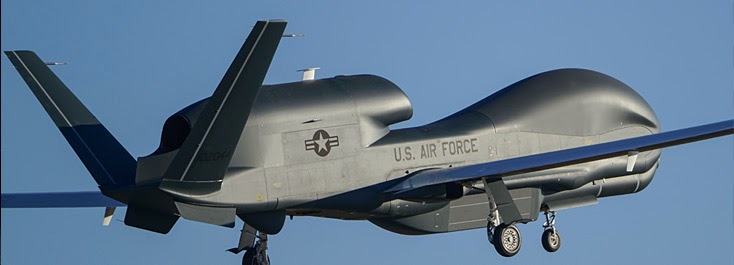
Northrop Grumman AF-18 UAS: Block 40 Global Hawk HALE, starts into production

The latest version of the RQ-4 Global Hawk high-altitude, long-endurance (HALE) unmanned aircraft system (UAS) took off from Northrop Grumman’s manufacturing plant in Palmdale, California, and flew to nearby Edwards Air Force Base on November 16.

Designated AF-18, the aircraft is a ‘Block 40’ version and the eleventh Global Hawk to arrive at Edwards.

Global Hawk production acceptance activities will now move from Edwards to ‘Air Force Plant 42’ in Palmdale, speeding up deliveries.

"AF-18 is the first of 15 Block 40 Global Hawk aircraft scheduled for fielding to Grand Forks Air Force Base, North Dakota, in 2010," said Steve Amburgey, Global Hawk programme director for the 303d Aeronautical Systems Group based at Wright-Patterson Air Force Base in Ohio.

The Block 40 aircraft feature ‘Multi-Platform - Radar Technology Insertion Program radar' (MP-RTIP), a "modular, active electronically scanned array radar system", primary improvements being an increase in resolution and an ability "to collect ground moving target indicator imagery and synthetic aperture radar still images simultaneously", according to manufacturer Raytheon.

The MP-RTIP radar uses active electronically scanned array (AESA) technology and commercial off-the-shelf hardware to deliver long range, very high-resolution synthetic aperture radar (SAR), ground moving target indicator (GMTI) capabilities and air target tracking.

Fundamental to the radar is its modular scalable design, which allows it to be applied to multiple airborne platforms.

MP-RTIP will provide war fighters improved combat identification, target tracking and time critical targeting, while adding an impressive new air-to-air capability to support cruise missile defense.

This powerful combination can aid commanders in developing predictive battlespace awareness and targeting solutions.

Scalable Agile Beam Radar (SABR) fitted to an F-16

Northrop Grumman RQ-180: US Air Force has secret new stealth drone

The RQ180, a large, classified unmanned aircraft developed by Northrop Grumman, is now flying—and it demonstrates a major advance in combining stealth and aerodynamic efficiency.

Defense and intelligence officials say the secret unmanned aerial system (UAS), designed for intelligence, surveillance and reconnaissance (ISR) missions, is scheduled to enter production for the U.S. Air Force and could be operational by 2015.

Funded through the Air Force’s classified budget, the program to build this new UAS, the RQ-180, was awarded to Northrop Grumman after a competition that included Boeing and Lockheed Martin.

The aircraft will conduct the penetrating ISR mission that has been left unaddressed, and under wide debate, since retirement of the Lockheed SR-71 (Blackbird) in 1998.

Neither the Air Force nor Northrop Grumman would speak about the classified airplane. When queried about the project, Air Force spokeswoman Jennifer Cassidy said, “The Air Force does not discuss this program.”

RQ-180
The RQ-180 carries radio-frequency sensors such as active, electronically scanned array (AESA) radar and passive electronic surveillance measures, according to one defense official. It could also be capable of electronic attack missions.

This aircraft’s design is key for the shift of Air Force ISR assets away from “permissive” environments—such as Iraq and Afghanistan, where Northrop Grumman’s non-stealthy Global Hawk and General Atomics’ Reaper operate—and toward operations in “contested” or “denied” airspace.

RQ-4B Global Hawk
The new UAS underpins the Air Force’s determination to retire a version of the RQ-4B Global Hawk after 2014, despite congressional resistance.

RQ-170 Sentinel
The RQ-180 eclipses the smaller, less stealthy and shorter-range RQ-170 Sentinel.

If the previous patterns for secret ISR aircraft operations are followed, the new UAV will be jointly controlled by the Air Force and the CIA, with the program managed by the Air Force’s Rapid Capabilities Office and flight operations sustained by the Air Force.

This arrangement has been used for the RQ-170, which is operated by the Air Force’s 30th Reconnaissance Sqdn., according to a fact sheet the Air Force released after one of the aircraft turned up in Iran.

Read the full story here

Friday, May 31, 2013

NASA 'Mighty Eagle' Test Flight - Video

The Mighty Eagle, NASA's robotic prototype lander managed out of NASA"s Marshall Space Flight Center, recently completed a test series to monitor its systems functionality after coming out of winter storage.

This latest series included a test flight that was recorded by the Quad-Copter—a small vehicle also developed at Marshall that was equipped with a video camera allowing for never-before-seen footage of the Mighty Eagle.

The Mighty Eagle, nicknamed after one of the characters in the popular Angry Birds game, is a three-legged prototype vehicle.

It is 4 feet tall, 8 feet in diameter and weighs about 700 pounds when fueled. It is a green vehicle, fueled by 90 percent pure hydrogen peroxide, and is guided by an onboard computer that activates the thrusters to power the craft's movements.

"We were approached by the Mighty Eagle team to film the vehicle in flight, and we thought it would be a great collaboration," said Garrick Merrill, a member of the Aero-M team and a computer engineer in the Space Systems Department at Marshall.

"It gave us an opportunity to test the copter in a flight situation, and we were really pleased with the results. It really was a win-win situation for both teams—giving us both important data we can use on future flights." 

The Quad-Copter is an achievement in itself. The vehicle was designed and built by the Aero-M team at Marshall as part of the 2012 Unmanned Aerial Systems, or UAS, competition between various NASA centers.

The Marshall team was made up of young engineers from across the center who were tasked with designing a vehicle that could perform an autonomous search and rescue mission to locate people after a small plane crash.

The Quad-Copter is built with off-the-shelf, hobbyist-grade parts and uses an open-source flight computer.

The initial design of the vehicle uses a two-megapixel IP camera, but for the Mighty Eagle flights the IP camera was removed and a GoPro video camera was attached to provide high-definition video.

Read the full article here

For more information on NASA's robotic landers, visit here.