Showing posts with label W. M. Keck Observatory. Show all posts

Thursday, November 20, 2014

NASA's Swift Mission Probes an Exotic Object: ‘Kicked’ Black Hole or Mega Star


Zoom into Markarian 177 and SDSS1133 and see how they compare with a simulated galaxy collision. 

When the central black holes in these galaxies combine, a "kick" launches the merged black hole on a wide orbit taking it far from the galaxy's core.

Related multimedia from NASA Goddard's Scientific Visualization Studio

An international team of researchers analyzing decades of observations from many facilities, including NASA's Swift satellite, has discovered an unusual source of light in a galaxy some 90 million light-years away.
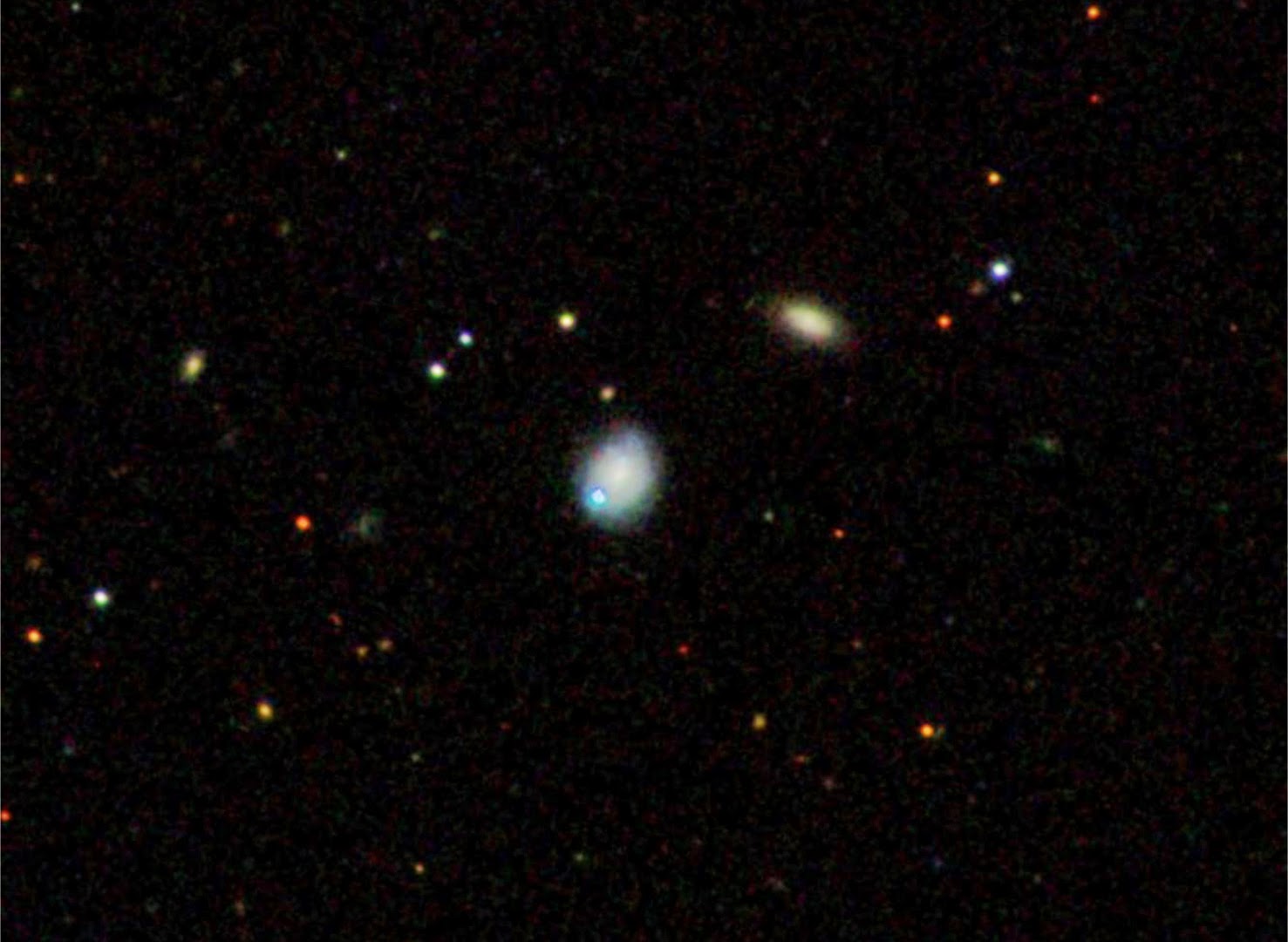
The dwarf galaxy Markarian 177 (center) and its unusual source SDSS1133 (blue) lie 90 million light-years away. 

The galaxies are located in the bowl of the Big Dipper, a well-known star pattern in the constellation Ursa Major.

Image Credit: Sloan Digital Sky Survey

The object's curious properties make it a good match for a supermassive black hole ejected from its home galaxy after merging with another giant black hole, but astronomers can't yet rule out an alternative possibility.

The source, called SDSS1133, may be the remnant of a massive star that erupted for a record period of time before destroying itself in a supernova explosion.

"With the data we have in hand, we can't yet distinguish between these two scenarios," said lead researcher Michael Koss, an astronomer at ETH Zurich, the Swiss Federal Institute of Technology.

"One exciting discovery made with NASA's Swift is that the brightness of SDSS1133 has changed little in optical or ultraviolet light for a decade, which is not something typically seen in a young supernova remnant."

Using the Keck II telescope in Hawaii, researchers obtained high-resolution images of Markarian 177 and SDSS1133 using a near-infrared filter. 

Twin bright spots in the galaxy's center are consistent with recent star formation, a disturbance that hints this galaxy may have merged with another.

Credit: W. M. Keck Observatory/M. Koss (ETH Zurich) et al.

In a study published in the Nov. 21 edition of Monthly Notices of the Royal Astronomical Society ("SDSS1133: an unusually persistent transient in a nearby dwarf galaxy"), Koss and his colleagues report that the source has brightened significantly in visible light during the past six months, a trend that, if maintained, would bolster the black hole interpretation.

To analyze the object in greater detail, the team is planning ultraviolet observations with the Cosmic Origins Spectrograph (COS) aboard the Hubble Space Telescope in October 2015.

Whatever SDSS1133 is, it's persistent. The team was able to detect it in astronomical surveys dating back more than 60 years.

The mystery object is part of the dwarf galaxy Markarian 177, located in the bowl of the Big Dipper, a well-known star pattern within the constellation Ursa Major.

Although supermassive black holes usually occupy galactic centers, SDSS1133 is located at least 2,600 light-years from its host galaxy's core.

In June 2013, the researchers obtained high-resolution near-infrared images of the object using the 10-meter Keck II telescope at the W. M. Keck Observatory in Hawaii.

They reveal the emitting region of SDSS1133 is less than 40 light-years across and that the center of Markarian 177 shows evidence of intense star formation and other features indicating a recent disturbance.

"We suspect we're seeing the aftermath of a merger of two small galaxies and their central black holes," said co-author Laura Blecha, an Einstein Fellow in the University of Maryland's Department of Astronomy and a leading theorist in simulating recoils, or "kicks," in merging black holes.

"Astronomers searching for recoiling black holes have been unable to confirm a detection, so finding even one of these sources would be a major discovery."

The collision and merger of two galaxies disrupts their shapes and results in new episodes of star formation.

If each galaxy possesses a central supermassive black hole, they will form a bound binary pair at the center of the merged galaxy before ultimately coalescing themselves.

Thursday, October 16, 2014

Scientists build first 3D map of hidden universe

3D map of the cosmic web at a distance of 10.8 billion light years from Earth. 

The map was generated from imprints of hydrogen gas observed in the spectrum of 24 background galaxies, which are located behind the volume being mapped. 

This is the first time that large-scale structures in such a distant part of the Universe have been mapped directly. 

The colouring represents the density of hydrogen gas tracing the cosmic web, with brighter colors representing higher density. 

Credit: Casey Stark (UC Berkeley) and Khee-gan Lee (MPIA)

A team led by astronomers from the Max Planck Institute for Astronomy has created the first three-dimensional map of the 'adolescent' Universe, just 3 billion years after the Big Bang.

This map, built from data collected from the W. M. Keck Observatory, is millions of light-years across and provides a tantalizing glimpse of large structures in the 'cosmic web', the backbone of cosmic structure.

On the largest scales, matter in the Universe is arranged in a vast network of filamentary structures known as the 'cosmic web', its tangled strands spanning hundreds of millions of light-years.

Dark matter, which emits no light, forms the backbone of this web, which is also suffused with primordial hydrogen gas left over from the Big Bang.

Galaxies like our own Milky Way are embedded inside this web, but fill only a tiny fraction of its volume.

Now a team of astronomers led by Khee-gan Lee, a post-doc at the Max Planck Institute for Astronomy, has created a map of hydrogen absorption revealing a three-dimensional section of the universe 11 billions light years away, the first time the cosmic web has been mapped at such a vast distance.

Since observing to such immense distances is also looking back in time, the map reveals the early stages of cosmic structure formation when the Universe was only a quarter of its current age, during an era when the galaxies were undergoing a major 'growth spurt'.

The map was created by using faint background galaxies as light sources, against which gas could be seen by the characteristic absorption features of hydrogen.

The wavelengths of each hydrogen feature showed the presence of gas at a specific distance from us.

Combining all of the measurements across the entire field of view allowed the team a tantalizing glimpse of giant filamentary structures extending across millions of light-years, and paves the way for more extensive studies that will reveal not only the structure of the cosmic web, but also details of its function, the ways that pristine gas is funneled along the web into galaxies, providing the raw material for the formation of galaxies, stars, and planets.

Credit: Casey Stark (UC Berkeley) And Khee-gan Lee (MPIA)

Using the light from faint background galaxies for this purpose had been thought impossible with current telescopes, until Lee carried out calculations that suggested otherwise.

To ensure success, Lee and his colleagues obtained observing time at Keck Observatory, home of the two largest and most scientifically productive telescopes in the world.

Although bad weather limited the astronomers to observing for only 4 hours, the data they collected with the LRIS instrument was completely unprecedented.

"We were pretty disappointed as the weather was terrible and we only managed to collect a few hours of good data, but judging by the data quality as it came off the telescope, it was clear to me that the experiment was going to work," said Max Plank's Joseph Hennawi, who was part of the observing team.

"The data were obtained using the LRIS spectrograph on the Keck I telescope," Lee said.

"With its gargantuan 10m-diameter mirror, this telescope effectively collected enough light from our targeted galaxies that are more than 15 billion times fainter than the faintest stars visible to the naked eye."

"Since we were measuring the dimming of blue light from these distant galaxies caused by the foreground gas, the thin atmosphere at the summit of Mauna Kea allowed more of this blue light to reach the telescope and be measured by the highly sensitive detectors of the LRIS spectrograph."

"The data we collected would have taken at least several times longer to obtain on any other telescope."

Their absorption measurements using 24 faint background galaxies provided sufficient coverage of a small patch of the sky to be combined into a 3D map of the foreground cosmic web.

A crucial element was the computer algorithm used to create the 3D map: due to the large amount of data, a naïve implementation of the map-making procedure would require an inordinate amount of computing time.

Casey Stark
Fortunately, team members Casey Stark and Martin White (UC Berkeley and Lawrence Berkeley National Lab) devised a new fast algorithm that could create the map within minutes.

"We realized we could simplify the computations by tailoring it to this particular problem, and thus use much less memory. A calculation that previously required a supercomputer now runs on a laptop", says Stark.

The resulting map of hydrogen absorption reveals a three-dimensional section of the universe 11 billions light years away, this is first time the cosmic web has been mapped at such a vast distance.

Since observing to such immense distances is also looking back in time, the map reveals the early stages of cosmic structure formation when the Universe was only a quarter of its current age, during an era when the galaxies were undergoing a major 'growth spurt'.

The map provides a tantalizing glimpse of giant filamentary structures extending across millions of light-years, and paves the way for more extensive studies that will reveal not only the structure of the cosmic web, but also details of its function, the ways that pristine gas is funneled along the web into galaxies, providing the raw material for the formation of galaxies, stars, and planets.

Wednesday, September 10, 2014

Hubble finds supernova companion star after two decades

This is an artist’s impression of supernova 1993J, which exploded in the galaxy M81

Using the Hubble Space Telescope, astronomers have identified the blue helium-burning companion star, seen at the center of the expanding nebula of debris from the supernova. 

Credit: NASA, ESA, G. Bacon (STScI)

Using NASA's Hubble Space Telescope, astronomers have discovered a companion star to a rare type of supernova.

The discovery confirms a long-held theory that the supernova, dubbed supernova 1993J, occurred inside what is called a binary system, where two interacting stars caused a cosmic explosion.

"This is like a crime scene, and we finally identified the robber," said Alex Filippenko, professor of astronomy at University of California (UC) at Berkeley.

"The companion star stole a bunch of hydrogen before the primary star exploded."

SN 1993J is an example of a Type IIb supernova, unusual stellar explosions that contains much less hydrogen than found in a typical supernova.

Astronomers believe the companion star took most of the hydrogen surrounding the exploding main star and continued to burn as a super-hot helium star.

"A binary system is likely required to lose the majority of the primary star's hydrogen envelope prior to the explosion."

"The problem is that, to date, direct observations of the predicted binary companion star have been difficult to obtain since it is so faint relative to the supernova itself," said lead researcher Ori Fox of UC Berkeley.

SN 1993J resides in the Messier M81 galaxy, about 11 million light-years away in the direction of Ursa Major, the Great Bear constellation.

Since its discovery 21 years ago, scientists have been looking for the companion star.

Observations at the W. M. Keck Observatory on Mauna Kea, Hawaii, suggested that the missing companion star radiated large amounts of ultraviolet (UV) light, but the area of the supernova was so crowded that scientists could not be sure they were measuring the right star.

The team combined optical light data and Hubble's UV light images to construct a spectrum that matched the predicted glow of a companion star, also known as the continuum emission. Scientists were only recently able to directly detect this light.

"We were able to get that UV spectrum with Hubble. This conclusively shows that you have an excess of continuum emission in the UV, even after the light from other stars has been subtracted," said Azalee Bostroem of the Space Telescope Science Institute (STScI) in Baltimore, Maryland.

Astronomers estimate a supernova occurs once every second somewhere in the universe, yet they don't fully understand how stars explode.

Further research will help astronomers better understand the properties of this companion star and the different types of supernovae.

The results of this study were published in the July 20 issue of the Astrophysical Journal.

More Information: "UNCOVERING THE PUTATIVE B-STAR BINARY COMPANION OF THE SN 1993J PROGENITOR" Authors: Ori D. Fox, K. Azalee Bostroem et al. - 2014 ApJ 790 17 doi:10.1088/0004-637X/790/1/17

Tuesday, August 5, 2014

W. M. Keck Observatory: Extreme Volcanic activity on Jupiter's moon Io

These are images of Io obtained at different infrared wavelengths (in microns, μm, or millionths of a meter) with the W. M. Keck Observatory's 10-meter Keck II telescope on Aug. 15, 2013 (a-c) and the Gemini North telescope on Aug. 29, 2013 (d). 

The bar on the right of each image indicates the intensity of the infrared emission. 

Note that emissions from the large volcanic outbursts on Aug. 15 at Rarog and Heno Paterae have substantially faded by Aug. 29. 

A second bright spot is visible to the north of the Rarog and Heno eruptions in c and to the west of the outburst in d. 

This hot spot was identified as Loki Patera, a lava lake that appeared to be particularly active at the same time. 

Credit: Imke de Pater and Katherine de Kleer, UC Berkeley.

Three massive volcanic eruptions occurred on Jupiter's moon Io within a two-week period last August, leading astronomers to speculate that these presumed rare "outbursts," which can send material hundreds of miles above the surface, might be much more common than astronomers thought.

"We typically expect one huge outburst every one or two years, and they're usually not this bright," said Imke de Pater, professor and chair of astronomy at the University of California, Berkeley, and lead author of one of two papers describing the eruptions.

"Here we had three extremely bright outbursts, which suggest that if we looked more frequently we might see many more of them on Io."

Io, the innermost of Jupiter's four large "Galilean" moons, is about 2,300 miles across, about the size of Earth's moon.

Aside from Earth, is the only known place in the solar system with volcanoes erupting extremely hot lava like that seen on Earth.

Because of Io's low gravity, large volcanic eruptions produce an umbrella of debris that rises high into space.

Images of Io were taken in the near-infrared with adaptive optics at the Gemini North telescope tracking the evolution of the eruption as it decreased in intensity over 12 days. 

Due to Io's rapid rotation, a different area of the surface is viewed on each night; the outburst is visible with diminishing brightness on Aug. 29 & 30 and Sept. 1, 3, & 10. 

Credit: Katherine de Kleer/UC Berkeley/Gemini Observatory/AURA

De Pater's long-time colleague and coauthor Ashley Davies, a volcanologist with NASA's Jet Propulsion Laboratory at the California Institute of Technology in Pasadena, Calif., said that the recent eruptions match past events that spewed tens of cubic miles of lava over hundreds of square miles in a short period of time.

"These new events are in a relatively rare class of eruptions on Io because of their size and astonishingly high thermal emission," he said.

"The amount of energy being emitted by these eruptions implies lava fountains gushing out of fissures at a very large volume per second, forming lava flows that quickly spread over the surface of Io."

All three events, including the largest, most powerful eruption of the trio on 29 Aug. 2013, were likely characterised by "curtains of fire", as lava blasted out of fissures perhaps several miles long.

The papers, one with lead author Katherine de Kleer, a UC Berkeley graduate student, and coauthored by UC Berkeley research astronomer Máté Ádámkovics, and the other coauthored by Ádámkovics and David R. Ciardi of Caltech's NASA Exoplanet Science Institute, have been accepted for publication in the journal Icarus.

More Information: Near-infrared monitoring of Io and detection of a violent outburst on 29 August 2013 - Authors: Katherine de Kleera, Imke de Patera, Ashley Gerard Daviesd, Máté Ádámkovicsa: DOI: 10.1016/j.icarus.2014.06.006

Thursday, July 24, 2014

Most precise measurement of an alien world's size: Kepler-93b

Using data from NASA's Kepler and Spitzer Space Telescopes, scientists have made the most precise measurement ever of the size of a world outside our solar system, as illustrated in this artist's conception.

Credit: NASA/JPL-Caltech

The size of the exoplanet, dubbed Kepler-93b, is now known to an uncertainty of just 74 miles (119 kilometers) on either side of the planetary body.

The findings confirm Kepler-93b as a "super-Earth" that is about one-and-a-half times the size of our planet. Although super-Earths are common in the galaxy, none exist in our solar system.

Exoplanets like Kepler-93b are therefore our only laboratories to study this major class of planet.

With good limits on the sizes and masses of super-Earths, scientists can finally start to theorize about what makes up these weird worlds.

Previous measurements, by the Keck Observatory in Hawaii, had put Kepler-93b's mass at about 3.8 times that of Earth.

The density of Kepler-93b, derived from its mass and newly obtained radius, indicates the planet is in fact very likely made of iron and rock, like Earth.

"With Kepler and Spitzer, we've captured the most precise measurement to date of an alien planet's size, which is critical for understanding these far-off worlds," said Sarah Ballard, a NASA Carl Sagan Fellow at the University of Washington in Seattle and lead author of a paper on the findings published in the Astrophysical Journal.

"The measurement is so precise that it's literally like being able to measure the height of a six-foot tall person to within three quarters of an inch, if that person were standing on Jupiter," said Ballard.

Kepler-93b orbits a star located about 300 light-years away, with approximately 90 percent of the sun's mass and radius.

The exoplanet's orbital distance, only about one-sixth that of Mercury's from the sun—implies a scorching surface temperature around 1,400 degrees Fahrenheit (760 degrees Celsius).

Despite its new found similarities in composition to Earth, Kepler-93b is far too hot for life.

To make the key measurement about this toasty exoplanet's radius, the Kepler and Spitzer telescopes each watched Kepler-93b cross, or transit, the face of its star, eclipsing a tiny portion of starlight.

Kepler's unflinching gaze also simultaneously tracked the dimming of the star caused by seismic waves moving within its interior.

These readings encode precise information about the star's interior. The team leveraged them to narrowly gauge the star's radius, which is crucial for measuring the planetary radius.

Spitzer, meanwhile, confirmed that the exoplanet's transit looked the same in infrared light as in Kepler's visible-light observations.

These corroborating data from Spitzer, some of which were gathered in a new, precision observing mode, ruled out the possibility that Kepler's detection of the exoplanet was bogus, or a so-called false positive.

Taken together, the data boast an error bar of just one percent of the radius of Kepler-93b.

The measurements mean that the planet, estimated at about 11,700 miles (18,800 kilometers) in diameter, could be bigger or smaller by about 150 miles (240 kilometers), the approximate distance between Washington, D.C., and Philadelphia.

More Information: Kepler-93b: A Terrestrial World Measured to within 120 km, and a Test Case for a New Spitzer Observing Mode - Authors: Sarah Ballard et al. 2014 ApJ 790 12. doi:10.1088/0004-637X/790/1/12

Thursday, April 17, 2014

Kepler-186f: First potentially habitable Earth-sized planet confirmed - water

The artist's concept depicts Kepler-186f, the first validated Earth-size planet orbiting a distant star in the habitable zone, a range of distances from a star where liquid water might pool on the surface of an orbiting planet.

The discovery of Kepler-186f confirms that Earth-size planets exist in the habitable zone of other stars and signals a significant step closer to finding a world similar to Earth.

The artistic concept of Kepler-186f is the result of scientists and artists collaborating to help imagine the appearance of these distant worlds. 

Credit: Danielle Futselaar.

The first Earth-sized exoplanet orbiting within the habitable zone of another star has been confirmed by observations with both the W. M. Keck Observatory and the Gemini Observatory.

The initial discovery, made by NASA's Kepler Space Telescope, is one of a handful of smaller planets found by Kepler and verified using large ground-based telescopes.

It also confirms that Earth-sized planets do exist in the habitable zone of other stars.

"What makes this finding particularly compelling is that this Earth-sized planet, one of five orbiting this star, which is cooler than the Sun, resides in a temperate region where water could exist in liquid form," says Elisa Quintana of the SETI Institute and NASA Ames Research Center who led the paper published in the current issue of the journal Science.

The region in which this planet orbits its star is called the habitable zone, as it is thought that life would most likely form on planets with liquid water.

Steve Howell, Kepler's Project Scientist and a co-author on the paper, adds that neither Kepler (nor any telescope) is currently able to directly spot an exoplanet of this size and proximity to its host star.

"However, what we can do is eliminate essentially all other possibilities so that the validity of these planets is really the only viable option."

With such a small host star, the team employed a technique that eliminated the possibility that either a background star or a stellar companion could be mimicking what Kepler detected.

To do this, the team obtained extremely high spatial resolution observations from the eight-meter Gemini North telescope on Mauna Kea in Hawai`i using a technique called speckle imaging, as well as adaptive optics (AO) observations from the ten-meter Keck II telescope, Gemini's neighbour on Mauna Kea.

Together, these data allowed the team to rule out sources close enough to the star's line-of-sight to confound the Kepler evidence, and conclude that Kepler's detected signal has to be from a small planet transiting its host star.

The diagram compares the planets of the inner solar system to Kepler-186, a five-planet system about 500 light-years from Earth in the constellation Cygnus. 

The five planets of Kepler-186 orbit a star classified as a M1 dwarf, measuring half the size and mass of the sun. 

The Kepler-186 system is home to Kepler-186f, the first validated Earth-size planet orbiting a distant star in the habitable zone—a range of distances from a star where liquid water might pool on the surface of an orbiting planet. 

The discovery of Kepler-186f confirms that Earth-size planets exist in the habitable zone of other stars and signals a significant step closer to finding a world similar to Earth. 

Kepler-186f is less than ten percent larger than Earth in size, but its mass and composition are not known. 

Kepler-186f orbits its star once every 130-days and receives one-third the heat energy that Earth does from the sun, placing it near the outer edge of the habitable zone. 

The inner four companion planets all measure less than fifty percent the size of Earth. Kepler-186b, Kepler-186c, Kepler-186d, and Kepler-186e, orbit every three, seven, 13, and 22 days, respectively, making them very hot and inhospitable for life as we know it. 

The Kepler space telescope, which simultaneously and continuously measured the brightness of more than 150,000 stars, is NASA's first mission capable of detecting Earth-size planets around stars like our sun. 

Kepler does not directly image the planets it detects. The space telescope infers their existence by the amount of starlight blocked when the orbiting planet passes in front of a distant star from the vantage point of the observer. 

The artistic concept of Kepler-186f is the result of scientists and artists collaborating to help imagine the appearance of these distant Credit: Credit: NASA Ames/SETI Institute/JPL-CalTech.

More information: "An Earth-Sized Planet in the Habitable Zone of a Cool Star," by E.V. Quintana et al. Science, 2014.