Showing posts with label beginning. Show all posts

Tuesday, April 8, 2014

CERN LHC: Team announces beginning of restart

The team of scientists working at CERN's Large Hadron Collider (LHC) facility has reported to the press that the process of restarting the massive experimental mechanism has begun—though it won't finish until sometime next year. 

The world's most complicated system of machines will have to be restarted in pieces to ensure that each is operating properly before the next can be brought online.

Though proving the existence of the Higgs boson was a major goal, and achieving it garnered a lot of headlines, the facility at CERN has made progress in other areas as well, the creation of quark, gluon plasma back in 2011, is but one example.

Now the facility is in the process of an upgrade, which has been in the planning stages for several years and will include upgrades to several pieces and parts of the facility that support the LHC as well as the main accelerator itself.

The team recognized that the facility had begun to suffer from diminishing returns and that many parts could be improved due to the development of new technology and improvements on old ways of doing things.

Thus, this past February the LHC, along with other parts and accelerators that feed it, was shut down.

The retooling has been forecast to total approximately $4.4 billion dollars.

Thus far, the team has successfully restarted the part they call the source—the piece of equipment responsible for stripping electrons off of hydrogen atoms for use in producing protons.

Next up the team plans to fire up Linac2, an accelerator whose job it is to give protons their initial push.

After that a booster will be started that will be used to push the protons even faster.

For the LHC to be used in its proper context, it must receive protons that are already moving exceedingly fast.

Team members have made much of the complete upgrade to the control system for the LHC, the part that integrates all of the systems and which of course will be central to a successful reboot.

They should know early on if there are any problems. In addition to swapping out parts for new and improved technology, technicians will also be replacing worn cables or other minor but necessary components.

If all goes well, the LHC should be ready and back in business sometime early next year. Projects in the pipeline include: ALICE, CMS, ATLAS and LHCb.

Sunday, December 8, 2013

UK Inmarsat begins Global Xpress roll-out

The Proton rocket carrying the first Inmarsat I-5 spacecraft leaves the misty Baikonur pad

The roll-out has begun for Britain's single biggest commercial space project.

The London-based Inmarsat company has launched the first spacecraft in what will be a new global telecommunications network for its on-the-move customers.


Inmarsat plans to launch up to three further spacecraft in its Ka-band Global Xpress (GX) system, representing an investment of £1bn ($1.6bn).

The initial I-5 F1 satellite was launched from Baikonur in Kazakhstan.

Its Proton rocket left the pad at 18:12 local time (12:12 GMT) on a long flight due to last over 15 hours.

Separation from the Proton's Breeze-M upper-stage on Monday (GMT) should put the I-5 in a supersynchronous transfer orbit that runs out to 65,000km above the planet.

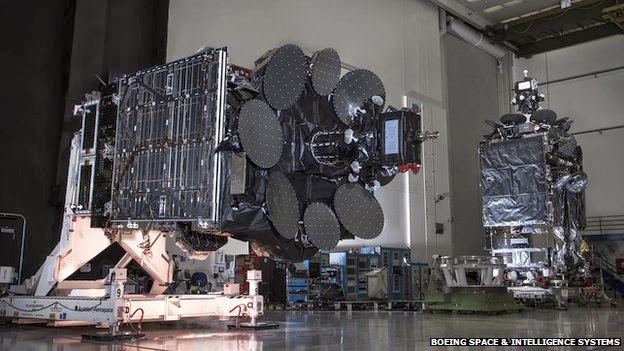
The Boeing-built, 6.1-tonne satellite will then use its own electric propulsion system to circularise this trajectory and move itself into a "stationary" position at 63 degrees East, some 36,000km above the Indian Ocean.

Inmarsat has become the dominant force in the so-called Mobile Satellite Services (MSS) market.

Its principal customer base is the shipping sector, but the company also caters for any groups that need connectivity away from a fixed line.

These include oil and gas installations, the aviation sector, armed forces, aid agencies and NGOs in disaster areas, and TV news crews reporting from trouble zones.

Customers can use Inmarsat services to make phone calls, to transfer audio-visual material or simple data.

Traditionally, the company has served these customers using the L-band part of the radio spectrum.

However, the new GX constellation will operate in the higher-frequency Ka-band, enabling much higher bandwidth connections - up to 50Mbps download, and 5Mbps upload.

A total of four I-5s have been ordered from the Boeing manufacturer

Monday, November 4, 2013

ESA's ATV-5 for launch by Arianespace begins its pre-flight checkout

The Automated Transfer Vehicle (ATV) "Georges Lemaitre" has begun pre-flight checkout in the Spaceport's clean room facilities, following its arrival in French Guiana for a scheduled Ariane 5 flight next year.

As the fifth and final ATV to be launched by Arianespace under current arrangements with the European Space Agency, this spacecraft's Integrated Cargo Carrier (ICC) has now been removed from its special shipping container in the S5C preparation hall.

The ICC makes up 60 percent of the Automated Transfer Vehicle's total volume, with the capacity of ferrying up to 6.6 metric tons of cargo - both dry and fluid - on the spacecraft's servicing mission to the International Space Station (ISS).

Incorporating a two-part design, the Integrated Cargo Carrier includes a pressurized module for docking to the space station, where all dry materials are contained.

Up to two ISS astronauts can access this section while the spacecraft is attached to the orbital facility, working to unload supplies or conduct experiments.

Fluid cargo - such as propellant for refueling of the International Space Station - is stored in the ICC's non-pressurized area and transferred to the space station through pipes or manually operated hoses.

Prior to Georges Lemaitre's ESA-targeted launch date in 2014, final assembly of the spacecraft will be carried out at the Spaceport, including the Integrated Cargo Carrier, the Service Module solar panels and the Separation and Distancing Module (SDM) that links the ATV to its Ariane 5 vehicle.

Designated Georges Lemaitre after the Belgian physicist and father of the Big Bang theory, the fifth Automated Transfer Vehicle will resupply the International Space Station, as well as perform maneuvers to maintain this manned facility's nominal orbit.

An Astrium-led industry consortium is responsible for producing this series of resupply spacecraft under the European Space Agency-managed program.

To date all four Automated Transfer Vehicles have been orbited by Ariane 5 ES launchers, beginning with "Jules Verne" in March 2008, which was followed by "Johannes Kepler" in February 2011, "Edoardo Amaldi" in March 2012, and this June's flight with "Albert Einstein."