Showing posts with label communication satellites. Show all posts

Monday, February 3, 2014

Iran unveils new home-made communication satellites

This file photo released June 16, 2011, shows launching the Safir, or Ambassador, satellite carrier, which carries Iran's Rasad, or Observation, satellite into earth orbit. Credit: Alalam news

Iran on Monday unveiled two domestically-made communication satellites, one to bolster its wireless connections and the other capable of taking high-resolution pictures, media reported.

Iran's space programme has prompted concern among Western governments, which fear Tehran is trying to master the technology required to deliver a nuclear warhead.

The Islamic republic insists that its nuclear programme is entirely peaceful and denies its space programme is linked in any way to its disputed nuclear ambitions.

The state-run IRNA news agency named the two satellites as Khalije Fars (Persian Gulf) and Tadbir (wisdom) and said they were built by scientists at local universities.

"Khalije Fars, designed and manufactured by researchers at Malek Ashtar University, is a small satellite which provides secure satellite wireless connections at national or regional scope," IRNA said.

"Tadbir was built by Tehran's University of Science and Industry and is capable of conducting photographic assignments with a resolution of 100 meters (yards)," the agency added.

The deputy head of Iran's space agency, Hamid Fazeli, meanwhile told Fars news agency that the Islamic republic will launch a satellite into orbit by the end of the Iranian year, which ends on March 21.

Fazeli said that Tadbir is among a number of satellites that are ready to be launched into space. He did not give further details.

In December, Iran said that it had safely returned a monkey to Earth after blasting it into space in the second such launch.

An earlier attempt had failed in September 2011.

Iran has already launched three satellites into space since 2009 and plans to send a human into orbit by 2020.

Sunday, December 8, 2013

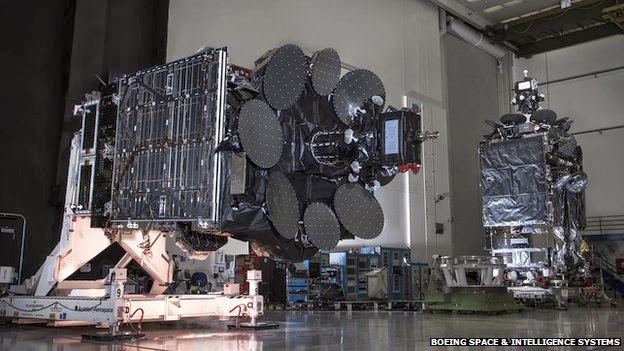
UK Inmarsat begins Global Xpress roll-out

The Proton rocket carrying the first Inmarsat I-5 spacecraft leaves the misty Baikonur pad

The roll-out has begun for Britain's single biggest commercial space project.

The London-based Inmarsat company has launched the first spacecraft in what will be a new global telecommunications network for its on-the-move customers.


Inmarsat plans to launch up to three further spacecraft in its Ka-band Global Xpress (GX) system, representing an investment of £1bn ($1.6bn).

The initial I-5 F1 satellite was launched from Baikonur in Kazakhstan.

Its Proton rocket left the pad at 18:12 local time (12:12 GMT) on a long flight due to last over 15 hours.

Separation from the Proton's Breeze-M upper-stage on Monday (GMT) should put the I-5 in a supersynchronous transfer orbit that runs out to 65,000km above the planet.

The Boeing-built, 6.1-tonne satellite will then use its own electric propulsion system to circularise this trajectory and move itself into a "stationary" position at 63 degrees East, some 36,000km above the Indian Ocean.

Inmarsat has become the dominant force in the so-called Mobile Satellite Services (MSS) market.

Its principal customer base is the shipping sector, but the company also caters for any groups that need connectivity away from a fixed line.

These include oil and gas installations, the aviation sector, armed forces, aid agencies and NGOs in disaster areas, and TV news crews reporting from trouble zones.

Customers can use Inmarsat services to make phone calls, to transfer audio-visual material or simple data.

Traditionally, the company has served these customers using the L-band part of the radio spectrum.

However, the new GX constellation will operate in the higher-frequency Ka-band, enabling much higher bandwidth connections - up to 50Mbps download, and 5Mbps upload.

A total of four I-5s have been ordered from the Boeing manufacturer

Wednesday, November 20, 2013

Roscosmos Ostapenko calls for end to Foreign communication satellites

Head of the Russian Federal Space Agency (Roscosmos) Oleg Ostapenko has sent a letter to Vice Premier Dmitry Rogozin suggesting giving up the practice of ordering civilian communication and broadcasting satellites abroad, Kommersant daily reported on Friday.

The new head of Roscosmos regards it as a form of covert subsidizing of foreign manufacturers.

As a result Europe's aerospace & defence corporation, EADS may lose part of Russian contracts and Information Satellite Systems (ISS) OJSC may become the sole supplier of civilian communication satellites, the newspaper concludes.

In this context the Roscosmos and the Federal Communication Agency will consider issues of developing delivery vehicles and guarantees of launching Express-AMU2, Express-AMU3 and Express-AMU4 satellites as they will be compiling the Federal Space Program for 2016-2025 "considering the placement of orders for the delivery of the said satellites from a sole supplier - ISS OJSC.

"However, Roscosmos does not conceal the fact that while fulfilling civilian orders ISS is forced to attract "foreign contactors."

Thus, a modification of Express-A series was developed together with Alcatel Space, while two direct broadcasting satellites Express-AT1 and Express-AT2 are being developed in partnership with the French division of Thales Alenia Space.

The newspaper adds that it follows from Ostapenko's letter that ISS has difficulties with the fulfillment of current orders.

Thus, Express-AM8 satellite can be launched in August 2014 the earliest "given delays in the delivery and repairs of onboard equipment," the letter says.