Showing posts with label flying. Show all posts

Tuesday, September 30, 2014

Flying underground: First hot air balloon flies into Mamet cave in Croatia


Ivan Trifonov, a seventy-year-old Austrian with a Croatian passport, was the first man to try, and succeed in flying a hot-air balloon underground.

This experienced hot-air balloon pilot is already a proud holder of 4 Guinness records, and flying into the Mamet Cave, touching it's bottom and successfully flying out of the Cave is likely to be his fifth record, since no-one has ever done such a thing before.

The inspiration of Trifonov's adventure was the famous Jules Verne's visionary book 'Journey to the Center of the Earth'.

Saturday, September 27, 2014

SPARKED: Cirque du Soleil's flying lampshades - Quadcopter technology - Video


Dance of the Quadcopters? Cirque du Soleil, ETH Zurich, and Verity Studios have partnered to develop a film that shows 10 quadcopters in performance.

What would one expect with the name-brand Cirque du Soleil? Humans and drones move in sync.

ETH Zurich comes into the mix with precise computer control for the performance of human and machine movements.

The technology team would be tasked with achieving seamless coordination of multiple vehicles, designing suitable trajectories and high-reliability infrastructure to pull off a successful film shoot.

Called SPARKED, this performance was fundamentally an exploration to see how state of-the-art technology can be used in the realm of entertainment.

The result was a human actor placed with quadcopters in a symbiotic, choreographed performance.

In achieving the magical visual effects, no CGI or wires, slow-mo or fast-forwards were used, said the creators.


Raffaello D'Andrea, professor at ETH Zurich, said he and his team have been doing research with flying machines and using algorithms they developed in order to dynamically control the machines with precision.

The ETH Zurich researchers have explored quad control and state estimation, trajectory generation, increased autonomy, adaptation and learning, high-precision flight maneuvers, aerial construction and cooperation among multiple vehicles.

At the start of this collaborative project, the creators thought about what types of interactions they would have.

Imaginations ran a wide course for potential effects. Welby Altidor, Executive Creative Director of Creations, Cirque du Soleil, said it was fun to imagine and ask what else we could put on them?

Is it possible to make them disappear?

"We came up with all kinds of ideas. We even had flying heads."

They talked about lights on the quadcopters and then "at some point, almost by accident," he said, some colleagues joked about lampshades, and that made him stop in his tracks.

"I said, wait a minute, did you say lampshades?" The concept sparked a workshop of flying lampshades.

The film shoot took place in the Flying Machine Arena at ETH Zurich, a space for work in autonomous flight.

Along with flying machines at this space, there is a high-precision motion capture system, wireless communication network and custom software at play for algorithms providing estimation and control.

According to the arena website, "The motion capture system can locate multiple objects in the space at rates exceeding 200 frames per second."

"While this may seem extremely fast, the objects in the space can move at speeds in excess of 10 m/s, resulting in displacements of over 5 cm between successive snapshots."

"This information is fused with other data and models of the system dynamics to predict the state of the objects into the future."

The system uses the knowledge to determine what commands the vehicles should execute to achieve moves such as high-speed flips, balancing objects, or playing paddle-ball.

Via wireless links, the system sends the commands to the vehicles, executing them with on-board computers and sensors such as rate gyros and accelerometers.

Prof. D'Andrea posed and answered the broader question: "Is there a future for this in performing arts? Absolutely. We're just getting started."

Sunday, December 1, 2013

New Wave Energy UK: Power plants in sky - Wireless Transmission Drones

Here is the idea: flying power plants in the sky as a means of providing clean, renewable energy.

Here is more of the idea: this would be a high-altitude aerial power plant that harvests energy from solar, wind and other sources, and beams it wirelessly to the ground.

Now the idea gets more interesting: The power plant would be using networks of unmanned drones.

The company is New Wave Energy UK, formed in 2012, self-described as "an upcoming energy provider within the UK currently working towards researching and constructing our own novel form of power plant." (New Wave Energy UK is not associated or affiliated with US-based New Wave Energy Corp.)

In a November 15 press release, the company announced that "A new and exciting venture into a whole new form of power plant is currently in incubation within the UK."

The company said the "patent pending technology" is a drone-based power plant for combined solar, wind, heat and emerging new forms of energy generation.

The technology is to incorporate wireless power transmission from the drones (and their wireless network) to the Earth's surface," according to the release.

Details about the drone are in a recent Gizmag article on New Wave Energy UK.

According to the article, the company's ambition is for each drone to have four rotors, multiple wind turbines and a flat base for generating solar power.

With energy harvested, the devices will power themselves and also 50 kW more that can be transmitted wirelessly to the ground.

Rectenna arrays installed inland or on offshore installations would receive electromagnetic waves and convert them into usable power.

According to New Wave Energy, "The technology is tailored to operate at 50,000 ft where wind patterns are more reliable, solar production is greater and there is little or no interference from weather patterns."

In the November 15 press release, the company said it was seeking further investment to advance the project.

New Wave Energy UK is turning to crowdfunding as one such step. "To raise such equity New Wave Energy UK Ltd are hoping to raise £300,000 through crowd funding on Kickstarter.

New Wave Energy UK Ltd also intend to acquire a total of £32 million from private investors during the crucial stages of the project to commercialise the application."

Friday, December 21, 2012

ESA News Update: Flying in Zero- Gravity - Video


If you fly a plane in the right way at the right speed, you can be weightless for a few seconds. By throwing the aircraft into an orbit-like path within Earth's atmosphere, you can enter the wonderful world of weightlessness.

It is one of the best ways to simulate the environment of space, and a valuable experimental tool for scientists with a special interest in microgravity.

If they want to find out how the brain works, study the natural posture of humans in space, or how water boils in a weightless environment, this is the way to do it. Take a journey into a free-floating world of the parabola in this edition of Space.

Tuesday, October 2, 2012

UK Scientists planning to put artificial bee brains in flying robots

Honey bees are fascinating creatures.

They live harmoniously in large communities, divided into different castes, with some of the worker bees heading out on daily expeditions to gather nectar and pollen from flowers.

Already, a study has suggested that the efficient method in which bees visit those flowers could inspire the improvement of human endeavours such as the building of faster computer networks.

An open-access paper describing the study was published on the journal PLOS Biology.

Now, scientists from the Universities of Sheffield and Sussex hope to build a computer model of the honey bee’s brain, with the ultimate hope of using it to control tiny autonomous flying robots.

The project is called Green Brain – a tip of the hat to IBM’s Blue Brain Project, the aim of which is to create a computer model of the human brain.

The Green Brain team, however, aren’t actually trying to recreate all of a bee’s mental processes. Instead, they’re focusing on the systems that control its vision and sense of smell.

Also, unlike the Blue Brain scientists, they’re not using supercomputers to create their model.

To get the performance they’ll need out of desktop PCs, they are using high-performance GPU (graphics processing unit) accelerators.

Donated by the NVIDIA Corporation, these GPUs are typically used to rapidly generate 3D graphics on home computers and gaming systems. For the Green Brain project, they will instead be used to quickly perform complex calculations.

So, why would anyone want a bee-brained flying robot? Well, in the same way that honey bees can sniff out and visually identify flowers, it is hoped that the autonomous robots could be used to trace odors or gases to their sources.

Not only could this have applications in fields such as environmental monitoring, but it could also prove useful for things like search-and-rescue operations.

The robots might also find use in the pollination of crops. Although real bees currently provide this service, that could change as worldwide bee populations continue to plummet.

On that note, the scientists also hope that by creating the model, they will be better able to understand the bees’ behaviour.

By doing so, they may then gain some insight into why honey bee populations are falling, and perhaps be able to do something about it.

Once it’s time to actually build the bee-bots, a team of scientists at Germany’s Bielefeld University may be able to help – they’ve been working on creating an artificial bee’s eye project, called FLINAVS, specifically for use in micro air vehicles.

A report outlining the Bielefeld team’s findings was published in the journal Bioinspiration & Biomimetics.

Source: University of Sheffield

Wednesday, April 4, 2012

PAL-V Flying Car - Maiden Flight - YouTube


This week the Dutch company PAL-V announced the first flights of its prototype "flying car".
This unique vehicle is called the PAL-V One, or the 'Personal Air and Land Vehicle', and It marks the start of a new era.

On the ground the vehicle drives like a sports car. Within minutes its rotor is unfolded and its tail is extended: then it is ready to take off thanks to the advanced gyrocopter technology.

With these successful test results it is proven that it is not only possible to build a flying car but also that it can be done within existing international rules for both flying and driving.

Having passed this important milestone the company is now inviting investors to join them in creating the future.

The next step will be the design of the first commercial production model of the PAL-V, and first deliveries are expected in 2014.

For 100 years people have dreamed of a flying car, and many attempts have been made to realize this dream, but now it has truly become a reality.

Thursday, February 2, 2012

Flying People in New York City - YouTube


Three people were spotted flying around the skies of lower Manhattan last Friday, causing dropped jaws from onlookers.

But while it appeared to be flying "death eaters" of  the "Harry Potter" series, it actually turned out to be a clever piece of viral marketing for this week's upcoming film "Chronicle."

In an interview to yahoo! James Percelay, the co-founder of Thinkmodo said he and his partner Michael Krivicka were approached by 20th Century Fox, the studio behind "Chronicle," and they came out with a plan for the viral video.

Those aren't people in the air, but some very intricately designed radio-controlled airplanes. Percelay has not disclosed who exactly was piloting the planes in the video. He only said: "They are expert AMA (Academy of Model Aeronautics) members with amazing skills."

Friday, October 28, 2011

UFO Pod: Theme room

Make your childhood fantasies come true by staying in a UFO for a night. 

The flying-saucer-shaped pod hovers above the ground in a forest at Treehotel near the Lule River in Harads, Sweden. 

The UFO room is one of five free-standing treehouse rooms, which also include the Bird's Nest, Mirrorcube and the Blue Cone.
 
Picture: Peter Lundstrom WDO/www.treehotel.se/Rex Features

Friday, March 25, 2011

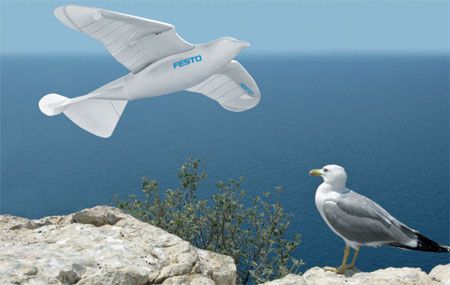
Festo - Flying SmartBird Video


Festo has a fairly fascinating, frankly fantastical, and frequently full-on fabulous history with the robotic systems that they develop in partnership with universities and research groups as part of their Bionic Learning Network.

In the past, we've seen flying penguins and jellyfish, as well as bio-inspired manipulators like this one.

Today, Festo has unveiled their 2011 Bionic Learning Network projects, the most awesome of which is definitely SmartBird. Watch it fly:


Unlike many of Festo's flying robots, SmartBird doesn't appear to rely on lifting gas at all. It weighs less than half a kilo, and is capable of autonomous take-off, flight, and landing using just its two meter-long wings.

SmartBird is modelled very closely on the herring gull, and controls itself the same way birds do, by twisting its body, wings, and tail. For example, if you look closely in the video, you can see SmartBird turning its head to steer.

Monday, June 21, 2010

Flying in formation, TanDEM-X and TerraSAR-X

Flying in formation, TanDEM-X and TerraSAR-X

  Flying in formation, TanDEM-X and TerraSAR-X

Flying in formation, TanDEM-X and TerraSAR-X

Germany's second Earth observation satellite, TanDEM-X, was launched successfully on 21 June 2010 at 04:14 Central European Summer Time (CEST, at 08:14 local time) from the Baikonur Cosmodrome in Kazakhstan.

Atop a Russian Dnepr rocket, the satellite, weighing more than 1.3 tons and five metres in length, started its journey into orbit. At 4.45 CEST first signal was received via Troll ground station in the Antarctic.


  Launch of Germany's Earth observation satellite TanDEM-X
Launch of Germany's Earth observation satellite TanDEM-X

The German Aerospace Center (Deutsches Zentrum für Luft- und Raumfahrt; DLR) manages TanDEM-X (TerraSAR-X add-on for Digital Elevation Measurement) via its ground segment, and is responsible for mission operations and for generating and utilising the scientific data.

"TanDEM-X is a key German project and will provide us with a homogeneous 3D elevation model of the Earth which will be an indispensable aid for a great many scientific and commercial avenues of enquiry," said DLR Chairman Prof. Dr Johann-Dietrich Wörner at the launch event held in the German Space Operations Center (GSOC) at the DLR site in Oberpfaffenhofen.

"This mission demonstrates Germany's expertise in satellite-based radar technology and is, in particular, the outcome of a consistent focus in the national space programme. Also, TanDEM-X demonstrates a successful public-private partnership," stressed Prof. Wörner.

Public-private partnership

TanDEM-X is being run as a public-private partnership (PPP) between the DLR Astrium GmbH, with DLR funding coming from the German Ministry of Economics and Technology. Infoterra GmbH, a subsidiary of Astrium, is responsible for the commercial marketing of the TanDEM-X data.

Astrium GmbH in Friedrichshafen built the satellite and is sharing the costs for its development and operation. The TanDEM-X mission has a total cost of 165 million Euros. DLR is contributing 125 million Euros and the European space company Astrium is contributing 40 million Euros.

TanDEM-X and its twin satellite, TerraSAR-X, will fly in formation

  TerraSAR-X and TanDEM-X flying in close formation
TerraSAR-X and TanDEM-X flying in close formation

Together with its twin satellite TerraSAR-X, in space since 2007, TanDEM-X will survey the entire land surface area of the Earth - a total of 150 million square kilometres - several times over.

It will accomplish this from an altitude of 514 kilometres within three years.

"This will be the first time we will ever have had a globally standardised 3D digital elevation model of Earth, and with a measuring point density of 12 metres, it will be incredibly accurate," said Prof. Dr Alberto Moreira, Science Director of the TanDEM-X mission and Director of the DLR Microwaves and Radar Institute.

Today, for large areas of Earth, there are only approximate, non-standardised or incomplete elevation models, and it is these gaps that the TanDEM-X mission is designed to fill.

To accomplish this, TanDEM-X and TerraSAR-X will fly just a few hundred metres apart and will constitute the first configurable synthetic aperture radar (SAR) interferometer in space.

With a conventional SAR, the radar on the satellite transmits microwave pulses that are reflected by the surface of the Earth and received back by the radar.

The distance between the satellite and the Earth's surface is calculated from the time it takes the signals to return.

Since the satellite is moving around the Earth, the radar 'illuminates' a strip along the ground, which gives the radar its synthetic aperture, much larger than its real one.

With SAR interferometry, a geographical area is imaged from two different viewing positions, giving different perspectives. This is similar to the way humans use their two eyes to get an accurate, 3D image.

The two 'radar eyes' are on the satellite duo TanDEM-X and TerraSAR-X, and produce an interferogram from the different distances the signals have to cover; elevation data is derived from this

Within three years, this will create a gigantic data record equivalent to the storage capacity of 200 000 DVDs. TanDEM-X is designed for a service life of at least five years and is scheduled to overlap the scheduled service life of TerraSAR-X for at least three of those years.

Satellite-based Earth measurement creates a globally homogeneous terrain model without interruptions at national borders or other inconsistencies (compared with aircraft-based measurements).

Radar can see through bad weather and operates regardless of lighting conditions. Today, this process is without competitors and enjoys considerable respect, especially in the USA.

Monday, March 1, 2010

Monday, August 10, 2009

Bio-diversity in Eastern Himalayas: 2 New Species of Frog Found


(Image: Murat Selam / WWF Nepal)
The Eastern Himalayas

The rich biodiversity of the Himalayas is at risk from climate change, according to the World Wide Fund for Nature.

A new study claims that many of the species only just discovered in the last 10 years, are already at risk.


(Image: Greater Mekong Programme / WWF International)

Smith's Litter frog Leptobrachium smithi


These odd-looking frogs were first identified in 1999, one of five new frog discoveries in the Himalayan region around the Indian state of Assam. Famous for its tea growing and production of a dark tea much favoured by the English

(Image: Totul Bortamuli / WWF Nepal)

Flying Tree frog (Rhacophorus suffry)

This bright green, red-footed tree frog was described in 2007.

It is called a "flying frog" because its long webbed feet allow it to glide when falling.

_