Showing posts with label solar panels. Show all posts

Monday, March 24, 2014

ESA ATV-5 Georges Lemaître: Testing the solar panels for ATV-5

The solar panels for ATV Georges Lemaître undergoing testing at Europe's Spaceport in Kourou, French Guiana. 

The launch of ATV-5 on board an Ariane-5 is scheduled for 25 July 2014.

Credits: ESA-CNES-Arianespace /Optique Video du CSG - S. Martin

Wednesday, March 12, 2014

ARCA: Air Strato Electric UAV completes rough landing tests


On February 13, 2014, Air Strato, electrical powered unmanned aerial vehicle performed the first take-off from rough, frozen ground.

The aircraft performed a short flight at 25 m altitude and then landed.

Air Strato was powered by four electrical engines. Two supplementary electric motors (engines) were added to boost power and shorten the take-off distance.

Additional suspension strengthening was installed on the wings and forward landing gear.

Despite this addition, the right landing gear suspension sustained some damage at touch down.

"The aircraft had only 10 percent of the batteries intended for the commercial version so we had to add ballast to simulate take-off weight."

"We also added two more electrical motors to increase thrust, needed on the rough ground to decrease take-off distance that, combined with the landing gear suspension, provided for a smooth taxi and take-off on rough terrain."

"It took less than 30 m to lift into the air at maximum thrust. Also we were impressed by the aircraft's rate of climb." - Teodor Diaconu, ARCA flight dynamics engineer.

Air Strato is a high altitude electrical powered unmanned aerial vehicle (UAV). It can reach altitudes of above 18 km and has an autonomy of 7 hours on internal batteries and 3 days using solar panels.

It can carry a variable payload up to 30 kg consisting of surveillance equipment or other scientific instruments.

Monday, December 2, 2013

Engineering antennas into solar panels

Researchers at EPFL have managed to combine antennas and solar cells to work together with unprecedented efficiency in a near future. 

This is a first step towards more compact and more lightweight satellites.

The technology could also be deployed in the autonomous antenna systems used in the aftermath of natural disasters.

Traditionally, telecommunication antennas and solar cells have never really worked well together, as they have to function independently of each other in order to avoid interference.

This has an impact on the weight and size of satellites - the surface area has to be large enough for both antenna systems, which emit and receive data, and solar panels, which supply the electricity.

For his master project, Philippe Dreyer, who is part of Julien Perruisseau-Carrier Group, has been working on ways to combine solar cells and antennas.

Julien Perruisseau-Carrier
In collaboration with the Transparent Conductive Oxides group (TCOs) which is part of the Photovoltaics and Thin Film Electronics Laboratory (PV-Lab), he has developed a mixed surface that allows both the antenna and the photovoltaic cell to perform extremely efficiently.

This could substantially reduce the volume, weight and cost of satellites but not only that. Mobile and autonomous communications systems are often necessary to keep in contact with people in the wake of a natural disaster.

This new technology would make these systems lighter and therefore easier to carry around. "Our device could also support flexible implementation.

It could be folded up so that it isn't deployed until the relief area has been reached," states Julien Perruisseau-Carrier, who supervised the project.

More information: "Copper and Transparent-Conductor Reflectarray Elements on Thin-Film Solar Cell Panels." Philippe Dreyer, Monica Morales-Masis, Sylvain Nicolay, Christophe Ballif, Julien Perruisseau-Carrier. arXiv:1311.4737 [physics.optics] arxiv.org/abs/1311.4737

Sunday, September 2, 2012

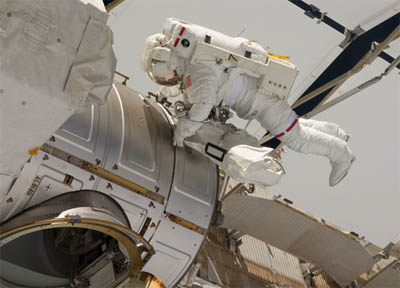
NASA ISS EVA: Spacewalkers to try power repair again Wednesday

Astronauts Sunita Williams and Akihiko Hoshide will venture back outside the International Space Station Wednesday for another attempt to install a replacement power switching unit that could not be plugged into the lab's electrical grid during a spacewalk last Thursday.

Equipped with an assortment of impromptu tools, the astronauts will attempt to clean the bolts needed to lock the 220-pound box in place, as well as the threaded bolt holes.

During Thursday's spacewalk, metal shavings were seen inside the bolt receptacles when main bus switching unit No. 1 -- MBSU No. 1 -- was removed.

While Williams and Hoshide attempted to blow out any remaining fragments using compressed nitrogen, they were unable to tighten down the replacement MBSU enough to engage cooling fins and gangs of electrical connectors.

Without MBSU No. 1, the space station was only drawing power from six of its eight solar panels, forcing flight controllers to carefully manage the lab's electrical useage while spacewalk planners studied the bolt problem and what might be done to fix it.

While that work was going on, the station's electrical system suffered an unrelated problem Saturday afternoon.

A direct current switching unit, or DCSU, dropped off line because of a presumed short somewhere in the system, effectively cutting a third solar array out of the station's power grid.

While the DCSU trip did not greatly worsen the station's power status, it marked the first time in several years that the lab complex has been forced to operate on just five of its eight power channels.

The DCSU problem will be addressed later, possibly with another spacewalk to install a replacement.

But in the near term, getting MBSU No. 1 bolted down and tied back into the lab's power system is the crew's top priority.

The space station is equipped with eight 115-foot-long solar panels, four on each end of a football-field-size truss that runs at right angles to the lab's pressurized modules.

The arrays rotate like giant paddle wheels as the station's orbits Earth to maximize power generation.

Each pair of arrays extend from integrated electronics assemblies containing batteries, cooling equipment, charge-discharge units and a direct current switching unit that passes power downstream to the station and back into the IEA.

Thursday, August 30, 2012

NASA ISS EVA: Astronauts stymied by sticky bolts

Sticky bolts proved too much for spacewalking astronauts Thursday, forcing them to leave a new power-switching box dangling from the International Space Station instead of firmly bolted down.

NASA scrambled to reduce the power demands of the orbiting lab and balance the electrical load, while mapping out a plan that could have the astronauts going back out as early as next week to tackle the problem.

Sunita Williams
It was a major disappointment for NASA's Sunita Williams and Japan's Akihiko Hoshide, who spent hours struggling with the bolts.

They used all sorts of tools and tactics as the spacewalk went into overtime, but nothing worked.

With time running out, Mission Control finally told them to tie down the box and head inside.

"We'll figure this out another day," Mission Control radioed.

Thursday's spacewalk was supposed to last 6½ hours but stretched past eight hours. It ended up in NASA's top 10 list for longest spacewalks -- at the No. 3 spot.

The power router is one of four, and NASA stressed that the other three are working fine. Nonetheless, electrical usage will need to be closely monitored at the 260-mile-high lab given Thursday's failed effort.

"The team may have to manage power loads a little bit, but this is familiar territory," said NASA's space station program manager, Mike Suffredini. "We'll be able to deal with that while we decide what our next plan is."

Akihiko Hoshide
While the space station remains in stable condition, NASA would like to take another crack at securing the box as soon as possible -- perhaps next week -- because of the mid-September departure of half the six-member crew, including the second U.S. astronaut, who ran the robot arm Thursday from inside the station.

And the longer this situation goes on, the more vulnerable the space station is to additional failures, Suffredini noted.

Until the problem is resolved, the space station is able to draw power from just three-quarters of its solar wings -- six instead of all eight.

The old switch box started acting up last fall, and NASA decided to replace it before it failed. This was the first spacewalk by Americans since the final shuttle flight a year ago.

Williams and Hoshide had trouble getting the old unit out because of two sticky bolts, and they found metal shavings in the sockets. They squirted in compressed nitrogen gas to clear the holes, and some debris came out. But still, the main bolt would not go in properly; the companion bolt was left undone.

The frustration mounted as the minutes and hours ticked by. At one point, Mission Control radioed, "We've tried almost every backup we have on this stupid bolt."

Mike Suffredini
At a news conference later in the day, NASA officials said possible solutions might involve lubricating the thick, sturdy bolts or applying more torque.

Putting in a new switching box was the No. 1 priority of the spacewalk. In separate work, the astronauts managed to hook up one power cable and get another cable halfway connected.

They never got around to replacing a bad camera on the space station's big robotic arm.

Mission Control did its best to cheer up the spacewalkers as they re-entered the space station. "You guys are rock stars, just so you know," Mission Control said.

It was the second spacewalk in less than two weeks. On Aug. 20, two Russians worked outside the orbiting complex, installing shields to protect against micrometeorite strikes.

It's no longer common for astronauts to step into the vacuum of space. That's because after almost 14 years, the space station is virtually complete. Plus NASA's shuttles are retired and now museum pieces.

Williams is the lone woman at the space station. She and Hoshide arrived a month ago, launching from Kazakhstan aboard a Russian rocket.

Thursday, October 13, 2011

PlanetSolar: Solar Powered Boat

PlanetSolar, the first solar-powered boat to attempt to travel around the world, arrives at the VivoCity shopping centre waterfront in Singapore.

The 31m by 15m white catamaran was unveiled to the world last year and embarked on a world tour from Monaco in September to promote solar energy for pollution-free shipping.

The Swiss-flagged boat, which was built in Germany and cost £16 million, is topped by 500 square metres of solar panels.

Picture: ROSLAN RAHMAN/AFP/Getty Images

Electric car charging from public solar panels


Electric car owners in Zurich who want to charge up with green energy can have their battery communicate with a local utility’s solar panels and find out whether the panels are producing at that point in time.

If they are, the battery can instruct the utility to send electricity.

It’s part of a small trial between IBM and Swiss utility EKZ involving an app, cloud computing services and a phonebook sized data-recording device installed on “several” EVs including a Renault Twingo, an IBM press release states.

The device was developed by Zurich University.

The app also lets the car owner hand over charging responsibility to EKZ, which can schedule charge-ups when sun and wind power is available, and better manage its peak load generation.

One knock on EVs is that they’re only as green as the form of electricity that feeds them – coal-base electricity does not reduce a car’s carbon footprint as much as renewable electricity does. But wind and solar sources do not furnish constant electricity the way coal does.

The app can help assure the car charges only when the sun shines or the wind blows. (Although the bigger step will come when utilities switch to 100 percent renewable, taking the guesswork out).

The app runs on mobile devices, tablets and web browsers.

In addition, owners can read the app while they’re away from their car – say, in the office or even thousands of miles away – to check how much charge remains.

All the more reason why cars might could one day come for “free” as part of a service package from a utility, a mobile phone company or an internet provider.

Photo: BP Solar

Tuesday, September 13, 2011

NASA ISS Image: The Brightness of the Sun in Space

The bright sun, a portion of the International Space Station and Earth's horizon are featured in this image photographed during the STS-134 mission's fourth spacewalk in May 2011.

The image was taken using a fish-eye lens attached to an electronic still camera.

Image Credit: NASA

Tuesday, October 20, 2009

Ultra Thin Flexible Solar Panels

There's no doubt solar energy is a compelling alternative to fossil fuels, but implementing it has traditionally meant installing the standard, costly and ungainly solar panel.

SRS Energy's dual-purpose roof tiles offer one way to get around that requirement; now another comes in the form of thin, flexible solar sheets that can be integrated with architectural building materials.
Iowa-based PowerFilm makes low-cost foldable and rollable solar panels in which the solar technology is monolithically integrated in a polyimide substrate that's flexible and durable, yet as thin as 0.025mm. With an absorber layer made of amorphous silicon, PowerFilm solar panels use as little as 1 percent of the amount of silicon used in traditional solar panels; they're also cadmium-free.

Since 2005 the company has been using its technology to manufacture solar field shelter tarps for military applications, and now it's developed the ability to combine it with standard building materials as well. Standing seam metal roofing, single-ply elastomeric membrane roofing and architectural fabric can all be combined with PowerFilm's flexible paneling for a variety of low-cost, building-integrated solar applications.

In such uses, the electricity generated by the solar panels is stored in local batteries and converted to 110 AC for general wall outlet use or—in some cases—used directly for low-voltage lighting systems. The buildings can be either off-grid or grid-connected. PowerFilm recently completed a 10-kilowatt demonstration and evaluation project on metal roofing, and is now in the final stages of developing the technology.

PowerFilm also makes a variety of portable solar chargers—one of which won second place in the Mobile CE Fashion & Lifestyle Products competition at CTIA Wireless 2009—and it manufactures for OEM and custom orders as well. The lightweight and durable nature of its thin paneling, meanwhile, seems eminently suitable for use in the developing world. One to get in on early for the application of your choice...?

Saturday, September 19, 2009

The All New Electric Powered Trabant

Among all of the glamorous cars at the Frankfurt motor show, the car that attracted the most attention was the electric-powered Trabant nT, with its solar panel on the roof

The makers say that this may be the only view of the new Trabby you will get, as it zooms past you on the open highway.

On the other hand, they do say that the only reason they have a heated rear window, is because you need to keep your hands warm when pushing it. Time, like your neighbours, will tell all!

Thursday, August 27, 2009

Green Technology: Solar Power Costs Fall 40%

There are brighter days ahead for solar shoppers these days. The price of installing solar power is perhaps not 'right', but it's certainly getting better.

Solar Panel prices have fallen about 40 percent since the middle of last year, driven down partly by an increase in the supply of a crucial ingredient for panels, according to commodity analysts.

The price drops, coupled with governmental support and incentives, could reduce the payback and return on investment (ROI) time. It can take solar panels a minimum of 16 years to pay for themselves and up to 22 years, in areas with higher electricity costs. That calculation does not include any 'green grants' or rebates, which will improve the economics considerably.

Consumers have the rest of the world to thank for the big solar price break. Until recently, panel makers had been constrained by limited production of polysilicon, which goes into most types of panels. Now, more factories have opened up that make the material, as have more solar panel assembly and production plants. Unfortunately most of these are in China.

At the same time, the global demand for solar panels has slowed enormously, particularly in Europe, previously the largest solar market. Photovoltaic installations in Europe are forecast to fall by 26 percent this year, compared with 2008.

Much of that decline can be attributed to a sharp slowdown in the Spanish market. Faced with high unemployment and a growing economic crisis, Spain slashed its generous subsidy for the panels last year because it was costing too much.