Showing posts with label Observing. Show all posts

Tuesday, October 7, 2014

Earth’s magnetic field: Observing the Birkeland currents

Plots of AMPERE magnetic perturbations and radial current density from the northern hemisphere for 24 February 2014 with start times from 1530 UT through 1700 UT.

When the supersonic solar wind hits the Earth’s magnetic field, a powerful electrical connection occurs with Earth’s field, generating millions of amperes of current that drive the dazzling auroras.

These so-called Birkeland currents connect the ionosphere to the magnetosphere and channel solar wind energy to Earth’s uppermost atmosphere.

Solar storms release torrential blasts of solar wind that cause much stronger currents and can overload power grids and disrupt communications and navigation.

Now for the first time, scientists are making continuous, global measurements of the Birkeland currents, opening a new window on our understanding of our home planet’s response to solar storms.

Using the Active Magnetosphere and Planetary Electrodynamics Response Experiment, based on the 66 Iridium satellites orbiting the Earth, authors of a Geophysical Research Letters study have discovered that Earth’s response to onsets in forcing from the solar wind occurs in two distinct stages.

Currents first appear near noon in the polar regions and remain steady for about half an hour.

Then the second stage begins, when strong currents appear near midnight and eventually join the initial currents near noon.

Most of the solar wind energy is deposited in the polar atmosphere by processes initiated in the second stage.

The authors note that scientists are working to understand how the delay between the first and second stages could give near-term warning of impending space weather disruptions.

Full Citation: Anderson, B. J., H. Korth, C. L. Waters, D. L. Green, V. G. Merkin, R. J. Barnes, and L. P. Dyrud(2014), "Development of large-scale Birkeland currents determined from the Active Magnetosphere and Planetary Electrodynamics Response Experiment" - Geophys. Res. Lett., 41, 3017–3025, doi:10.1002/2014GL059941.

Saturday, March 22, 2014

Hubble Image: Observing the Heart of NGC 5793

This new Hubble image is centered on NGC 5793, a spiral galaxy over 150 million light-years away in the constellation of Libra. 

This galaxy has two particularly striking features: a beautiful dust lane and an intensely bright center. much brighter than that of our own galaxy, or indeed those of most spiral galaxies we observe.

NGC 5793 is a Seyfert galaxy. These galaxies have incredibly luminous centers that are thought to be caused by hungry supermassive black holes, black holes that can be billions of times the size of the sun, that pull in and devour gas and dust from their surroundings.

This galaxy is of great interest to astronomers for many reasons. For one, it appears to house objects known as masers.

Whereas lasers emit visible light, masers emit microwave radiation. The term "masers" comes from the acronym Microwave Amplification by Stimulated Emission of Radiation.

Maser emission is caused by particles that absorb energy from their surroundings and then re-emit this in the microwave part of the spectrum.

Naturally occurring masers, like those observed in NGC 5793, can tell us a lot about their environment; we see these kinds of masers in areas where stars are forming.

In NGC 5793 there are also intense mega-masers, which are thousands of times more luminous than the sun.

Credit: NASA, ESA, and E. Perlman (Florida Institute of Technology)

Saturday, February 22, 2014

NASA SDO IRIS: Recording its largest Flare to date


On Jan. 28, 2014, NASA's Solar Observatory IRIS witnessed its strongest solar flare since it launched in the summer of 2013. Credit: NASA/IRIS

On Jan. 28, 2014, NASA's Interface Region Imaging Spectrograph (IRIS), witnessed its strongest solar flare since it launched in the summer of 2013.

Solar flares are bursts of x-rays and light that stream out into space, but scientists don't yet know the fine details of what sets them off.

IRIS peers, with unprecedented resolution, into a layer of the sun's lower atmosphere just above the surface, called the chromosphere, the second of the three main layers in the Sun's atmosphere that is roughly 2,000 kilometers deep.

However, IRIS can't look at the entire sun at the same time, so the team must always make decisions about what region might provide useful observations.

On Jan. 28, scientists spotted a magnetically active region on the sun and focused IRIS on it to see how the solar material behaved under intense magnetic forces.

At 2:40 p.m. EST, a moderate flare, labeled an M-class solar flare, which is the second strongest class flare after X-class solar flare, erupted from the area, sending light and x-rays into space.

IRIS studies the chromosphere, which is key to regulating the flow of energy and material as it travels from the sun's surface out into space.

Along the way, the energy heats up the upper atmosphere, the corona, and sometimes powers solar events such as this flare.

IRIS is equipped with an instrument called a spectrograph that can separate out the light it sees into its individual wavelengths, which in turn correlates to material at different temperatures, velocities and densities.

The spectrograph on IRIS was pointed right into the heart of this flare when it reached its peak, and so the data obtained can help determine how different temperatures of material flow, giving scientists more insight into how flares work.

On Jan. 28, 2014, NASA's recently-launched IRIS, observed its strongest solar flare to date. 

Credit: NASA /IRIS /SDO /Goddard Space Flight Center

The IRIS telescope was designed and built by the Smithsonian Astrophysical Observatory while Montana State University faculty and students assisted in the design of the spectrograph.

The Ames Pleiades supercomputer is used to carry out many of the numerical simulations that are led by the University of Oslo.

Friday, June 4, 2010

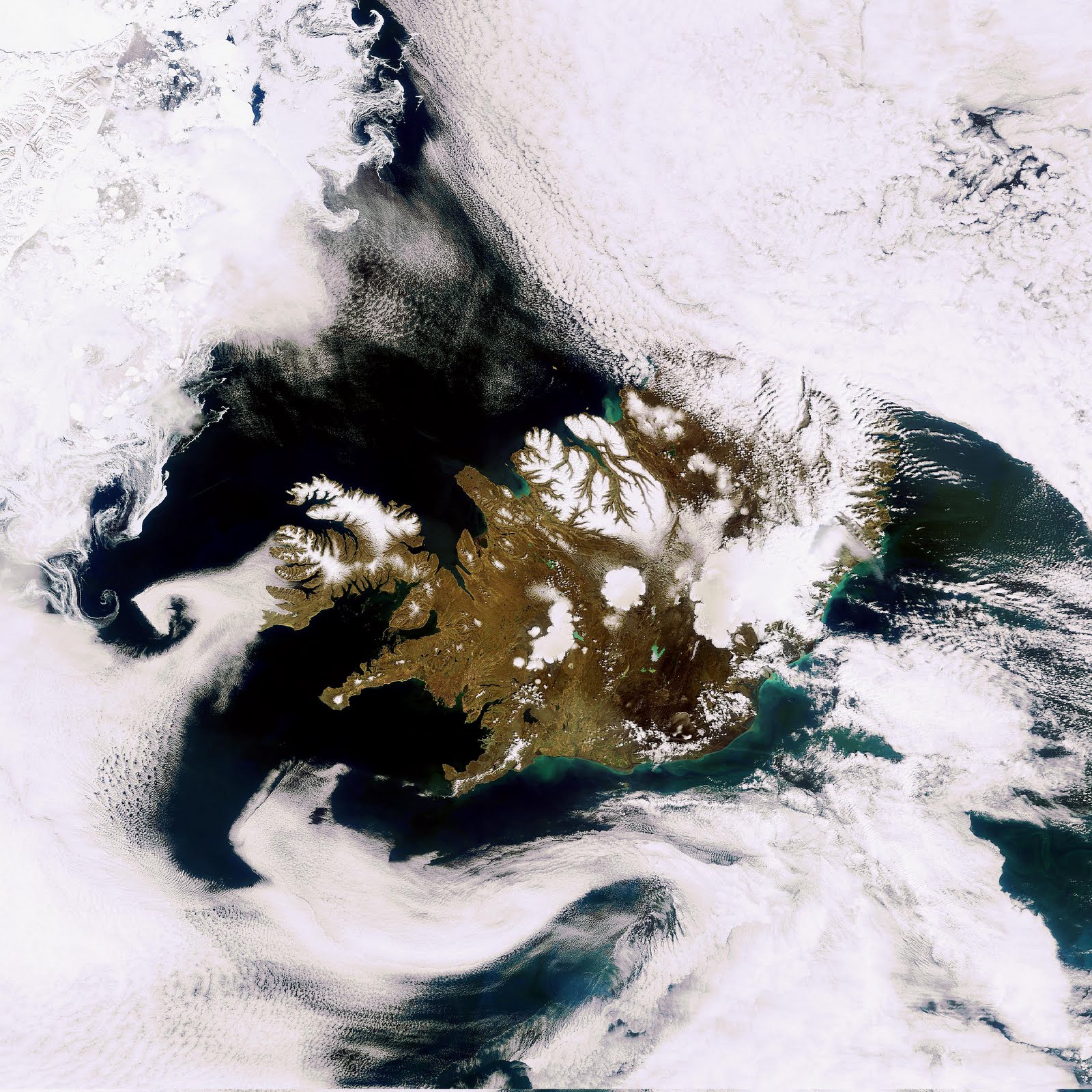
ESA Observing the Earth - Earth from Space: A smoke-free Iceland - images


ESA - Observing the Earth - Earth from Space: A smoke-free Iceland - images

This image, acquired by Envisat’s Medium Resolution Imaging Spectrometer on 24 May 2010, features a smoke-free Iceland.
The Eyjafjallajokull volcano, which had a series of eruptions in April and May, is visible in the dark area on the southern coast. The Vatnajokull glacier (visible in white northeast of Eyjafjallajokull) is the largest in Iceland and in Europe. The white circular patch in the centre of the country is Hofsjokull, the country’s third largest glacier and its largest active volcano. The elongated white area west of Hofsjokull is Langjokull, Iceland’s second largest glacier.

Friday, May 14, 2010

ESA Observing the Earth from Space: Plankton Bloom arrives in Scandinavia

ESA - Observing the Earth - Earth from Space: Plankton arrives in Scandinavia

Envisat captures a crescent-shaped string of plankton in the North Sea weaving through the Scandinavian region.

Norway (left) and Sweden (right), part of the Scandinavian Peninsula, are visible at the top, and Denmark is at bottom right.

The emerald green lake seen in Sweden is Vänern, the country’s largest.

The green water around Denmark is due to sediments being transported in the water. Also visible (image centre) is Norway’s second largest fjord, Hardangerfjord. Envisat's MERIS acquired this image on 3 May 2010 at a resolution of 300 m.

Credits: ESA