Showing posts with label Orion's Belt. Show all posts

Friday, July 27, 2012

NASA WISE Image: The Flame Nebula

The Flame Nebula sits on the eastern hip of Orion the Hunter, a constellation most easily visible in the northern hemisphere during winter evenings.

This view of the nebula was taken by WISE, NASA's Wide-field Infrared Survey Explorer.

This image shows a vast cloud of gas and dust where new stars are being born.

Three familiar nebulae are visible in the central region: the Flame Nebula, the Horsehead Nebula and NGC 2023.

The Flame Nebula is the brightest and largest in the image. It is lit by a star inside it that is 20 times the mass of the sun and would be as bright to our eyes as the other stars in Orion's belt if it weren't for all the surrounding dust, which makes it appear 4 billion times dimmer than it actually is.

Monday, October 17, 2011

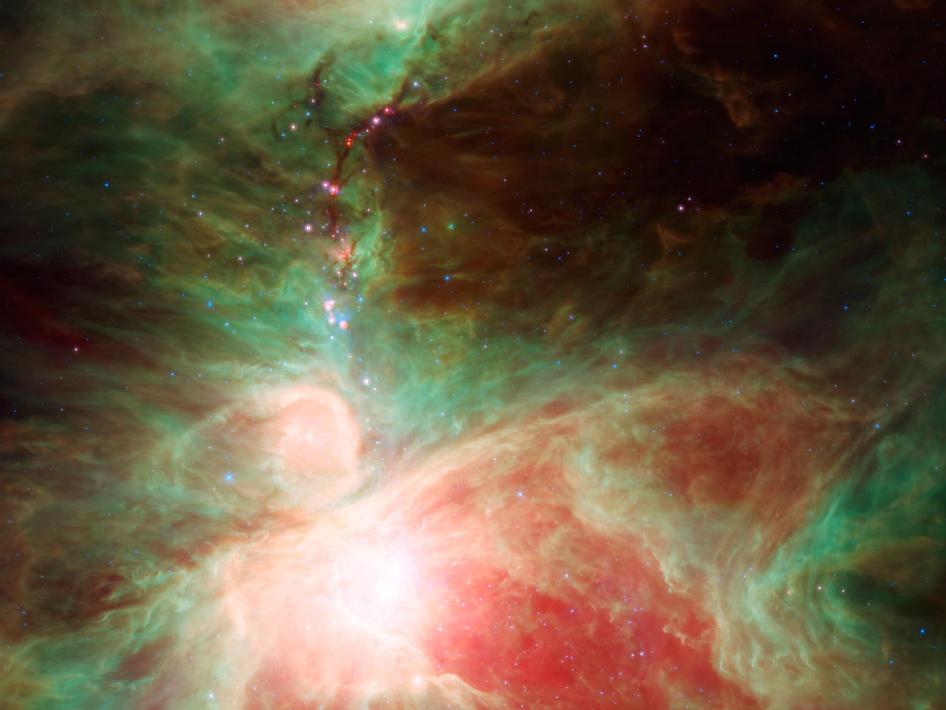
NASA Spitzer Image: Stars Adorn Orion's Sword

This image from NASA's Spitzer Space Telescope shows what lies near the sword of the constellation Orion, an active stellar nursery containing thousands of young stars and developing protostars. 

Many will turn out like our sun. Some are even more massive. 

These massive stars light up the Orion nebula, which is seen here as the bright region near the center of the image.

Image Credit: NASA/JPL-Caltech

Tuesday, October 11, 2011

NASA Spitzer Image: Making a Spectacle of Star Formation in Orion

Looking like a pair of eyeglasses only a rock star would wear, this nebula brings into focus a murky region of star formation.

NASA's Spitzer Space Telescope exposes the depths of this dusty nebula with its infrared vision, showing stellar infants that are lost behind dark clouds when viewed in visible light.

Best known as Messier 78, the two round greenish nebulae are actually cavities carved out of the surrounding dark dust clouds.

The extended dust is mostly dark, even to Spitzer's view, but the edges show up in mid-wavelength infrared light as glowing, red frames surrounding the bright interiors.

Messier 78 is easily seen in small telescopes in the constellation of Orion, just to the northeast of Orion's belt, but looks strikingly different, with dominant, dark swaths of dust. Spitzer's infrared eyes penetrate this dust, revealing the glowing interior of the nebulae.

A string of baby stars that have yet to burn their way through their natal shells can be seen as red pinpoints on the outside of the nebula. Eventually these will blossom into their own glowing balls, turning this two-eyed eyeglass into a many-eyed monster of a nebula.

This is a three-color composite that shows infrared observations from two Spitzer instruments. Blue represents 3.6- and 4.5-micron light, and green shows light of 5.8 and 8 microns, both captured by Spitzer's infrared array camera. Red is 24-micron light detected by Spitzer's multiband imaging photometer.

Image Credit: NASA/JPL-Caltech

Saturday, July 31, 2010

The Sword and The Rose - Orion's Belt

Astronomy photography competition

The Sword and The Rose, 10 January 2010. Lying just south of the three stars that form Orion's belt, Orion's sword contains the Great Orion Nebula. This hotbed of star formation lies about 1350 light years away, making it the brightest and closest star forming region to Earth.