Showing posts with label Wounded. Show all posts

Sunday, November 30, 2014

The Sylacauga meteorite: Mrs Hodges Struck and wounded

This image shows Ms Ann Hodges in hospital and clearly shows the severe bruising caused by the meteorite.

NB: An impact crater is called an "astrobleme."

Credit: Jay Leviton, Time & Life Pictures / Getty Images

60 years ago today, at 2:46 p.m. local time, a meteor burned over Sylacauga, Alabama.

Normally, this wouldn't be news, except that this fragment of interplanetary debris was pretty big, probably massing dozens of kilograms.

It broke up high over the ground, creating a fireball bright enough to be witnessed across three states.

Most of it became vapour and very small chunks, but one piece, with a mass of 3.9 kilos (8.5 pounds), survived its atmospheric entry.

Falling at terminal velocity, a couple of hundred kilometers per hour, it made it all the way to the ground.

Kinda, there were two things in its way: A house, and Ms Ann Hodges.

The rock (Sylacauga meteorite) slammed into the house, punching a hole in the roof.

Still moving rapidly, it hit a radio (at the time, a pretty large piece of furniture), careered off, and smacked into the hand and hip of Ms. Ann Hodges, who was napping on the couch nearby.

It left a fierce bruise on her side that. This event is the most well-documented case of a human hit by a meteorite in history.

Some believe the real story happened after Hodges was hit. There are some fairly complete articles about the aftermath at the Encyclopedia of Alabama and the Decatur Daily.

Basically, there was a big tussle over who owned the meteorite. Hodges and her husband were renting the house from one Birdie (or Bertie) Guy.
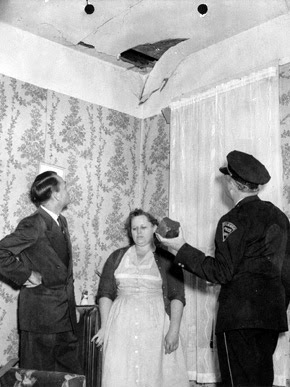
This picture shows the hole in the ceiling and the meteorite fragment held in the policeman's hand.

Mrs Hodges is standing next to the policeman.

Credit: Jay Leviton, Time & Life Pictures / Getty Images


Legally, Guy owned the meteorite, since it landed on her property, but public opinion, unsurprisingly, sided with Hodges to keep it.

The legal wrestling went on for some time until Guy gave up the lawsuit, but by that time interest had waned, and no one wanted to buy the rock.

Hodges initially used it as a doorstop but eventually she donated it to the Alabama Museum of Natural History, where it’s still on display in the Smith Hall, alongside the State Fossil of Alabama: Basilosaurus cetoides.

Thursday, December 13, 2012

Arsenal DARPA Foam: Saving Wounded Soldiers

Researchers working on a foam designed to limit internal bleeding of soldiers injured on the battlefield have received $15.5m (£9.6m) from the US military to continue their work.

The foam is formed by two liquids, injected into the body, which mix, expand and harden to create an internal dressing.

Arsenal Medical's product is funded by the Pentagon's Darpa research unit.

One UK surgeon said it could help those far away from a medical facility but the technology is still in early pre-clinical stages. It has already been tested on pigs but not humans.

The firm hopes that the polyurethane polymer foam will help control internal bleeding for at least an hour, increasing the survival chances of troops wounded on the battlefield.

Polyurethane foams are already widely used inside the metal and plastic walls of refrigerators or for thermal insulation.

Brian Holloway - DARPA
Once a wounded soldier is transferred to receive proper medical attention, the foam can be easily removed in minutes in a solid block.

According to the pre-clinical data presented at the 2012 annual meeting of the American Association for the Surgery of Trauma (AAST) in Kauai, Hawaii, the foam raised survival rates for liver injuries after three hours from 8% to 72%, and reduced blood loss sixfold.

"If testing bears out, the foam technology could affect up to 50% of potentially survivable battlefield wounds," said Brian Holloway of Darpa.

Dangerous haemorrhage
Abdominal injuries were especially dangerous, said Dr Michael Walsh, a surgeon at the Royal London Hospital, because traditional methods of stopping blood loss such as compression pads or tourniquets could not be applied.

"Currently for internal bleeding in the abdomen and chest there is nothing that is done pre-hospital to stop the bleeding," he said.

"The best policy currently is for the pre-hospital team to recognise the potential for internal bleeding and to transfer the patient to one of our now designated major trauma centres for rapid assessment and early surgery to stop the bleeding."

He said that the foam technology could be useful to control haemorrhages when a patient was far from a medical facility, or in the case of multiple injuries with competing priorities for treatment.

For example, a severe head injury could be treated once major internal bleeding in the abdomen had been stabilised but, he added, that more research was needed to "demonstrate the safety and efficacy of this product over and above current standards of care for internal bleeding".

Staff would also have to be trained to administer it properly but shows great promise.

The device still needs to be approved by the US Food and Drug Administration.