Showing posts with label heart rate. Show all posts

Wednesday, October 3, 2012

S-ICD, the new implanted defibrillator, offers alternative for heart beat regulation

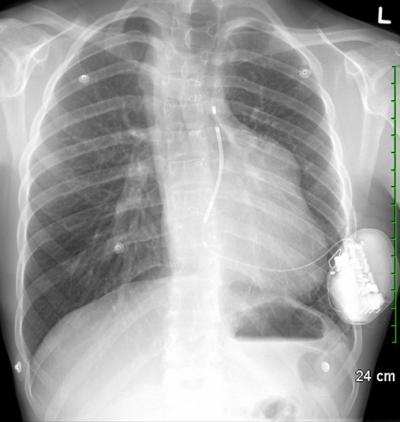
A new ground-breaking technology was recently used at the University of Ottawa Heart Institute (UOHI).

Two UOHI cardiologists, Dr. David Birnie and Dr. Pablo Nery, implanted a new innovative leadless defibrillator, the subcutaneous implantable cardioverter defibrillator (S-ICD), to a 18 year-old patient.

Under Health Canada’s special access program, this was only the third time this new type of ICD had been implanted in Canada.

Conventional defibrillators, known as transvenous defibrillators, are implanted with wires, called the leads, that snake through veins into the heart.

When the defibrillator identifies any dangerous heartbeat, it delivers a shock through the wires to return the heart to its normal rhythm and allow it to get back to pumping blood steadily throughout the body.

Not all patients are suitable for a conventional defibrillator. In some with congenital heart problems, there is no way to advance the leads into the heart through the veins.

Dr. Pablo Nery and Dr. David Birnie
Also, those wires may pose a danger due to the risk of blood clots or infection.

Patients often have to undergo a more complex and invasive surgery to attach the leads to the outer layer of the heart muscle to benefit from the use of a defibrillator

Conventional ICDs use leads that run from the device through major veins to an anchor point in the heart.

These transvenous leads can cause problems in the long term.

Despite decades of design improvements, leads can malfunction, break or stop working.

This is known as lead failure, and results in either inappropriate shocks or lack of proper regulation of the heartbeat.

What’s worse is that failed leads often must be removed, which poses serious risks to the patient.

What makes the new device special is that it is entirely subcutaneous. No part of it actually touches the heart. Instead, an electrode is implanted just under the skin near the heart.

The defibrillator is connected to the electrode, and monitors the heartbeat at all times. If needed, it delivers a shock to the heart muscle to restore its normal rhythm.

The goal of the subcutaneous ICD is to potentially reduce or eliminate these problems. “The subcutaneous ICD provides effective therapy for patients who are either not eligible for or are at high risk with a traditional ICD.

Such patients may now be able to receive protection from a subcutaneous ICD without the risks associated with the standard leads,” explained Dr. Nery.

That made the 18-year-old recipient of the S-ICD at the Heart Institute a perfect candidate. “The S-ICD offers advantages for particular patient sub-groups,” said Dr. Nery.

“This technology is now an alternative for young patients, in part because lead extraction can be avoided down the road.”

Saturday, October 29, 2011

Recycled Pacemakers: Safe for use in developing world

Recycled pacemakers donated from U.S. funeral homes could offer a safe way to get the heart devices to people in the developing world who otherwise might not be able to afford them, a U.S. study said.

An estimated 1 million to 2 million people around the world die each year because they have no access to a pacemaker, an implanted device that uses electrical pulses to the heart to maintain a normal heartbeat.

One potential, largely untapped source of pacemakers for the world's poor could be the significant number of people in the U.S. who die with a still-functioning device - some 19 per cent of the deceased, according to one survey of morticians in Michigan and Illinois.

The majority of those are buried with the body or, if removed, thrown away as medical waste but a small percentage are donated to developing nations through charities.

"Implantation of donated permanent pacemakers can not only save lives but also improve quality of life of needy poor patients," wrote study leader Bharat Kantharia, of the University of Texas Health Science Center, in the American Journal of Cardiology.

Kantharia and his team collected 122 pacemakers, half of which had enough battery life left - more than three years - to be used again. They were partially sterilized, then sent to a hospital in Mumbai, India, where they were sterilized again and implanted in 53 heart patients.

New pacemakers in India cost $2,200 to $6,600, not including doctor and hospital fees or the cost of the wires connected to the pacemaker.

All of the patients survived the surgery and fared well immediately afterwards, with no cases of infection or pacemaker malfunctions over an average follow-up of nearly two years.

All but two of the 40 patients reported a marked improvement in their symptoms and quality of life. Four died, but their deaths were not linked to the pacemakers.

A number of significant hurdles remain. One of the biggest is simply getting pacemakers from the U.S. to impoverished patients who need them.

Another is the need for further safety studies.

Monday, June 20, 2011

Small security system keeps hackers away from your implant

MIT and UMass scientists have designed a transmitter that jams wireless signals sent to medical implants by unauthorized users.

Pacemakers, drug pumps, defibrillators… they all have wireless connections that allow doctors to monitor vital signs or revise treatments. But this also leaves them vulnerable to attack.

A hacker could, conceivably, kill someone by instructing the implant to deliver lethal doses of drugs or electricity.

No such attacks have been documented… but with millions of Americans carrying implantable medical devices (IMDs) in them, and about 300,000 people getting new ones every year around the world, it’s really not a system you want compromised.

So, researchers created a system that has a second transmitter to jam unauthorized signals directly eavesdropping in an implant’s operating frequency. And it only allows authorized users to communicate with it (diagrammed above).

A doctor-sanctioned device, which has access to the implant, would send encrypted instructions to the second transmitter, which then decodes and relays them.

They call this jamming transmitter, the “shield.” And it’s small enough to wear as a necklace or watch.

A few years ago, a team led by Kevin Fu of the University of Massachusetts, Amherst demonstrated they could overhear defibrillators’ signals, learning things like patient names and diagnoses.

So they started experimenting with implantable defibrillators obtained secondhand from Boston-area hospitals, and programmable off-the-shelf radio transmitters simulated the shield.
  •  Without the shield, defibrillators obeyed commands from transmitters more than 40 feet away.
  • With the shield, potential harm-doers as close as 8 inches couldn’t control or listen in on the devices.
The shield, and not the implant, would handle the encryption and authentication. “It’s hard to put [encryption] on these devices,” says project researcher Dina Katabi of MIT. “There are many of these devices that are really small, so for power reasons, for form-factor reasons, it might not make sense to put the [encryption] on them.”

Some other smart things about having an external shield:
  • It would work with existing implantable devices.
  • It’ll be easier to upgrade or replace without surgery.
  • For emergency medical providers who need to communicate with an incapacitated patient’s implant, having to retrieve an encryption key could cause fatal delays. Whereas with this new security system, an emergency responder could just remove the shield.
The key is a new technique that allows the shield to simultaneously send and receive signals in the same frequency band. With ordinary wireless technology, the transmitted signal interferes with the received signal, making it unintelligible.

“Think of the jamming signal that we are creating as a secret key,” Katabi explains. “Everyone who doesn’t know the secret key just sees a garbage signal.” Because the shield knows the shape of its own jamming signal, however, it can, in effect, subtract it from the received signal.

The team will present the system [pdf] at the Association for Computing Machinery’s upcoming SIGCOMM conference in Toronto this August.

Via MIT News.

Tuesday, March 23, 2010

Men and women respond to stress in different ways

Men and women respond differently to stress ScienceBlog.com

Defensiveness is a trait characterised by avoidance, denial or repression of information perceived as threatening. In women, a strong defensive reaction to judgment from others or a threat to self-esteem will result in high blood pressure and heart rate. Contrarily, older men with low defensive reactions have a higher cardiovascular rates.

A study was conducted on 81 healthy working men and 118 women. According to Dr. Jean-Claude Tardif a Université de Montréal professor and Montreal Heart Institute researcher, the physiological response to stress in women and older men is linked to this desire of maintaining self-esteem and securing social bonds.

"The sense of belonging is a basic human need," says D'Antono. "Our findings suggest that socialising is innate and that belonging to a group contributed to the survival of our ancestors. Today, it is possible that most people view social exclusion as a threat to their existence. A strong defensive reaction is useful to maintain one's self-esteem faced with this potential threat."

As part of the experiment, participants completed four tasks of varying stress levels.
  • The first task involved reading a neutral text on Antarctica's geography before a person of the same sex.
  • The second and third tasks involved role-playing in which participants followed a script where they were sometimes agreeable and sometimes aggressive.
  • The final task involved a non-scripted debate on abortion.

Heart rate and blood pressure were measured during each of these tasks as was the level of cortisol in saliva. Results showed that women and older men had elevated cardiovascular, autonomic and endocrine responses to stress, all potentially damaging to their health.

However. the research team cautions that more studies are needed to evaluate the long-term effects of defensiveness and its association to stress response patterns in disease development.