Showing posts with label hot Jupiters. Show all posts

Sunday, September 1, 2013

HD 189733b: A Giant Blue Alien Planet where it Rains Molten Glass

This illustration shows HD 189733b, a huge gas giant that orbits very close to its host star HD 189733. 

The planet's atmosphere is scorching with a temperature of over 1000 degrees Celsius, and it rains glass, sideways, in howling 7000 kilometer-per-hour winds.

Credit: NASA, ESA, M. Kornmesser

There's a "blue marble" alien planet just 63 light-years from Earth, but the world is anything but friendly to life.

Researchers say the blue colour in the atmosphere likely comes from a rain of molten glass.

This super-hot glass rain is just one consequence of the close proximity between the gas giant alien planet HD189733b and its sun, which causes daytime temperatures to soar as high as 1,700 degrees Fahrenheit (930 degrees Celsius), scientists said.

A fresh set of observations of the planet in X-rays also suggest HD189733b has an outer atmosphere that is far larger than expected.

These surprise finds are all signals that so-called hot Jupiter alien planets are worthy of study on their own, even though they are hostile planets to life, researchers said.


Hot Jupiters are large, roughly Jupiter-sized planets that become very hot by circling tight around their stars.

These worlds have been described as planetary daredevils because they orbit so close to their parent stars that they risk being consumed.

Often, one side of the planet is tidally locked to the star, exposing that side to scorching hot temperatures, while leaving the other side permanently turned away.

Hot Jupiters are easy to spot from a distance because as they pass in front of a star, their disc blots out a large portion of the star's light; HD189733b causes a three per cent drop in its star's light, for example.

The planets' gravitational pull often causes their parent stars to wobble, too.

While common in the universe, however, Hot Jupiters are totally different than what denizens of Earth's solar system encounter.

In our case, small, rocky planets orbit close to the star and the gas giants are much farther out.

The latest observations of HD189733b are challenging some theories of planetary formation and are just one of the reasons Hot Jupiters are earning more attention from astronomers these days.

"At first considered to be the 'chaff' researchers would have to wade through to get to the fainter Earth-like worlds, hot Jupiters are now attracting their own attention," NASA scientists wrote in a recent Science@NASA post.

Monday, May 27, 2013

NASA Kepler: Big weather on hot Jupiters

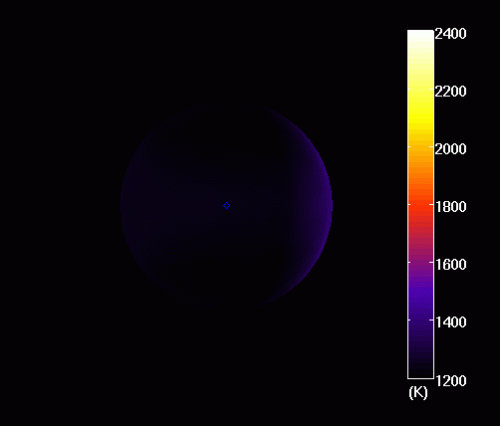
This exoplanet weather map shows temperatures on a hot Jupiter known as "HAT-P-2b". 

Among the hundreds of new planets discovered by NASA's Kepler spacecraft are a class of exotic worlds known as "hot Jupiters." 

Unlike the giant planets of our own solar system, which remain at a safe distance from the sun, these worlds are reckless visitors to their parent stars.

They speed around in orbits a fraction the size of Mercury's, blasted on just one-side by starlight hundreds of times more intense than the gentle heating experienced by Jupiter here at home."

Meteorologists watching this video are probably wondering what kind of weather a world like that might have.

Heather Knutson
The short answer is "big." Heather Knutson of Caltech made the first weather map of a hot Jupiter in 2007. "It's not as simple as taking a picture and—voila!—we see the weather," says Knutson.

These planets are hundreds of light years from Earth and they are nearly overwhelmed by the glare of their parent stars.

"Even to see the planet as a single pixel next to the star would be a huge accomplishment." Instead, Knutson and colleagues use a trick dreamed up by Nick Cowan of Northwestern University.

The key, she explains, is that "most hot Jupiters are tidally locked to their stars. This means they have a permanent dayside and a permanent night side.

Nick Cowan
As we watch them orbit from our vantage point on Earth, the planets exhibit phases—e.g., crescent, gibbous and full.

By measuring the infrared brightness of the planet as a function of its phase, we can make a rudimentary map of temperature vs. longitude."

NASA's Spitzer Space Telescope is the only infrared observatory with the sensitivity to do this work.

Since Knutson kick-started the research in 2007, nearly a dozen hot Jupiters have been mapped by astronomers using Spitzer.

Nikole Lewis
The most recent study, led by Nikole Lewis, a NASA Sagan Exoplanet Fellow working at MIT, shows a gas giant named HAT-P-2b.

"We can see daytime temperatures as high as 2400 K," says Lewis, "while the nightside drops below 1200K. Even at night," she marvels, "this planet is ten times hotter than Jupiter."

These exoplanet maps may seem crude compared to what we're accustomed to on Earth, but they are a fantastic accomplishment considering that the planets are trillions of miles away.