Showing posts with label results. Show all posts

Monday, March 31, 2014

NASA Gravity Probe B: Results of Epic Space-Time Experiment Announced

An artist's concept of GP-B measuring the curved spacetime around Earth.

Einstein was right again. There is a space-time vortex around Earth, and its shape precisely matches the predictions of Einstein's theory of gravity.

Researchers confirmed these points at a press conference today at NASA headquarters where they announced the long-awaited results of Gravity Probe B (GP-B).

"The space-time around Earth appears to be distorted just as general relativity predicts," says Stanford University physicist Francis Everitt, principal investigator of the Gravity Probe B mission.

"This is an epic result," adds Clifford Will of Washington University in St. Louis. An expert in Einstein's theories, Will chairs an independent panel of the National Research Council set up by NASA in 1998 to monitor and review the results of Gravity Probe B.

"One day," he predicts, "this will be written up in textbooks as one of the classic experiments in the history of physics."


Time and space, according to Einstein's theories of relativity, are woven together, forming a four-dimensional fabric called "space-time."

The mass of Earth dimples this fabric, much like a heavy person sitting in the middle of a trampoline. Gravity, says Einstein, is simply the motion of objects following the curvaceous lines of the dimple.

If Earth were stationary, that would be the end of the story. But Earth is not stationary. Our planet spins, and the spin should twist the dimple, slightly, pulling it around into a 4-dimensional swirl. This is what GP-B went to space in 2004 to check.

The idea behind the experiment is simple:

Put a spinning gyroscope into orbit around the Earth, with the spin axis pointed toward some distant star as a fixed reference point.

Free from external forces, the gyroscope's axis should continue pointing at the star--forever. But if space is twisted, the direction of the gyroscope's axis should drift over time.

By noting this change in direction relative to the star, the twists of space-time could be measured.

In practice, the experiment is tremendously difficult.

One of the super-spherical gyroscopes of Gravity Probe B.

The four gyroscopes in GP-B are the most perfect spheres ever made by humans.

These ping pong-sized balls of fused quartz and silicon are 1.5 inches across and never vary from a perfect sphere by more than 40 atomic layers.

If the gyroscopes weren't so spherical, their spin axes would wobble even without the effects of relativity.

According to calculations, the twisted space-time around Earth should cause the axes of the gyros to drift merely 0.041 arcseconds over a year. An arcsecond is 1/3600th of a degree.

To measure this angle reasonably well, GP-B needed a fantastic precision of 0.0005 arcseconds. It's like measuring the thickness of a sheet of paper held edge-on 100 miles away.

"GP-B researchers had to invent whole new technologies to make this possible," notes Will.

Thursday, February 20, 2014

LUX dark matter results confirmed

A new calibration technique fired neutrons directly into the Large Underground Xenon (LUX) dark matter detector, increasing calibration accuracy by a factor of 10. 

Analysis based on the calibration confirms that if "low-mass" dark matter particles had passed through the detector during its initial run, Large Underground Xenon would have seen them. 

Credit: Matt Kapust/Sanford Underground Research Facility

A new high-accuracy calibration of the LUX (Large Underground Xenon) dark matter detector demonstrates the experiment's sensitivity to ultra-low energy events.

The new analysis strongly confirms the result that low-mass dark matter particles were a no-show during the detector's initial run, which concluded last summer.

The first dark matter search results from LUX detector were announced last October.

The detector proved to be exquisitely sensitive, but found no evidence of the dark matter particles during its first 90-day run, ruling out a wide range of possible models for dark matter particles.

Previous experiments had detected potential signatures of dark matter particles with a very low mass, but LUX turned up no such signal.

This latest work was focused on demonstrating the high sensitivity of LUX to potential signals in the search for those low-mass particles.

Rick Gaitskell
"The new calibration improved our calibration accuracy by about a factor of 10," said Rick Gaitskell, professor of physics at Brown University and co-spokesperson for LUX.

"It demonstrates that our first dark matter search result, which showed no sign of low-mass particles, is absolutely robust."

The results of the new analysis were presented Wednesday, Feb. 19, 2014, at the Lake Louise Winter Institute in Alberta, Canada, by James Verbus, a graduate student at Brown who led the new calibration work.

Dark matter is thought to account for about 80 percent of the mass of the universe. Though it has not yet been detected directly, its existence is a near certainty among physicists.

Without the gravitational influence of dark matter, galaxies and galaxy clusters would simply fly apart into the vastness of space.

It's not clear exactly what dark matter is, but the leading idea is that it consists of subatomic particles called weakly interacting massive particles (WIMPs).

WIMPs are thought to be practically ubiquitous in the universe, but because they interact so rarely with other forms of matter, they generally pass right through the earth and everything on it without anyone knowing it.

The LUX is designed to detect those rare occasions when a WIMP does interact with other forms of matter.

The detector consists of a third of a ton of supercooled xenon in a tank festooned with light sensors, each capable of detecting a single photon at a time.

As WIMPs pass through the tank, they should, on very rare occasions, bump into the nucleus of a xenon atom.

Those bumps cause the nucleus to recoil, creating a tiny flash of light and an ion charge, both of which are picked up by LUX sensors.

The detector is more than a mile underground at the Sanford Underground Research Facility in South Dakota, where it is shielded from cosmic rays and radiation that might interfere with a potential dark matter signal.

This latest work was an entirely new way of calibrating the detector to recognize a WIMP signal.

Wednesday, November 6, 2013

Russian Chelyabinsk meteor: First study of results published

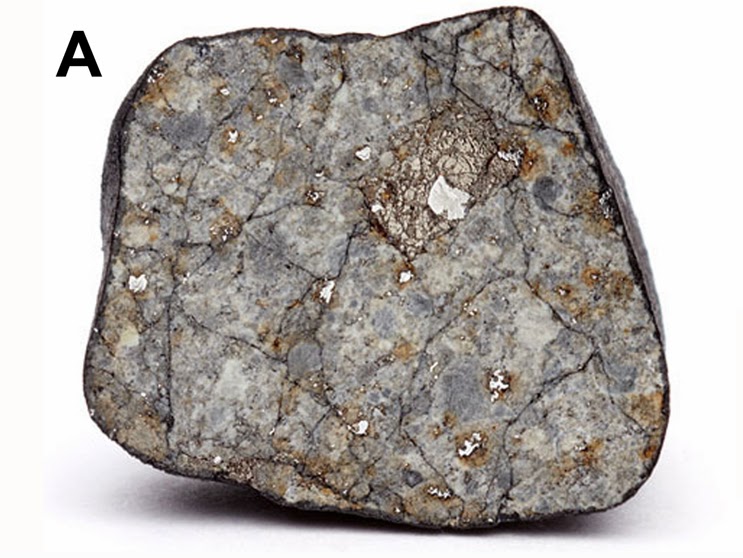
Chelyabinsk meteorite (diameter ~4 cm) showing shock veins. 

Credit: Science/AAAS 

The meteor that exploded over Chelyabinsk, Russia in February 2013 was "a wake-up call," according to a University of California, Davis scientist who participated in analyzing the event. 

The work is published November 7, 2013 in the journal Science by an international team of researchers.

"If humanity does not want to go the way of the dinosaurs, we need to study an event like this in detail," said Qing-Zhu Yin, professor in the Department of Earth and Planetary Sciences at UC Davis.

Chelyabinsk was the largest meteoroid strike since the Tunguska event of 1908, and thanks to modern technology from consumer video cameras to advanced laboratory techniques, provides an unprecedented opportunity to study such an event, the authors note.

The Chelyabinsk meteorite belongs to the most common type of meteorite, an "ordinary chondrite." If a catastrophic meteorite strike were to occur in the future, it would most likely be an object of this type, Yin said.

The team was led by Olga Popova of the Russian Academy of Sciences in Moscow, and by NASA Ames and SETI Institute meteor astronomer Peter Jenniskens, and included 57 other researchers from nine countries.

"Our goal was to understand all circumstances that resulted in the damaging shock wave that sent over 1200 people to hospitals in the Chelyabinsk Oblast area that day," said Jenniskens.

The explosion was equivalent to about 600 thousand tons of TNT, 150 times bigger than the 2012 Sutter's Mill meteorite in California.

Based on viewing angles from videos of the fireball, the team calculated that the meteoroid entered Earth's atmosphere at just over 19 kilometers per second, slightly faster than had previously been reported.

"Our meteoroid entry modeling showed that the impact was caused by a 20-meter sized single chunk of rock that efficiently fragmented at 30 km altitude," Popova said.

A meteoroid is the original object; a meteor is the "shooting star" in the sky; and a meteorite is the object that reaches the ground.

Iron grains line the rim of a shock melt vein in meteorite Chelyabinsk. 

Shock melt veins are weak sections along which meteorites can fragment. 

Credit: M. Zolensky/NASA JSC

The meteor's brightness peaked at an altitude of 29.7 km (18.5 miles) as the object exploded.

For nearby observers it briefly appeared brighter than the Sun and caused some severe sunburns.

The team estimated that about three-quarters of the meteoroid evaporated at that point.

Most of the rest converted to dust and only a small fraction (4,000 to 6,000 kilograms, or less than 0.05 percent) fell to the ground as meteorites. The dust cloud was so hot it glowed orange.

The largest single piece, weighing about 650 kilograms, was recovered from the bed of Lake Chebarkul in October by a team from Ural Federal University led by Professor Viktor Grokhovsky.

Main mass of the Chelyabinsk fall at the Chelyabinsk State Museum of Local History shortly after recovery from Chebarkul Lake. 

Photo courtesy of Andrey Yarantsev. 

For more information, please see Figure S53D in the Supporting Online Material. Credit: Science/AAAS

More information: "Chelyabinsk Airburst, Damage Assessment, Meteorite Recovery, and Characterization," by O.P. Popova et al. Science, 2013.