Showing posts with label DARPA. Show all posts

Friday, September 12, 2014

DARPA to Test Satellite Repair Droids in Orbit


The United States military's high-technology branch is hoping to test out on-orbit satellite servicing in orbit in the next five years.

Satellites that sit in geostationary orbit, which is about 22,000 miles (36,000 kilometers) above the Earth, are traditionally used for communications and surveillance because the length of the orbit is approximately the same as Earth's day.

This allows a satellite to gaze at the same area of Earth around the clock.

This location is too far away for conventional satellite servicing mission concepts, however, and at the end of the satellite's lifespan it needs to be moved away from that orbital slot to make way for new missions.

As such, the Defense Advanced Research Projects Agency (DARPA) is seeking some sort of a public-private partnership for satellite servicing.

The U.S. military's Defense Advanced Research Projects Agency is considering adding DARPA-developed space robotic technology to commercial spacecraft to create a robotic service droid capable of repairing satellites in geostationary orbits 22,000 miles above Earth. 

 Credit: Defense Advanced Research Agency

The partnership would be for both commercial and military owners with satellites in that space, possibly saving money since new satellites wouldn't need to be launched as often.

"The ability to safely and cooperatively interact with satellites in GEO [geostationary orbit] would immediately revolutionize military and commercial space operations alike, lowering satellite construction and deployment costs and improving satellite lifespan, resilience and reliability," DARPA officials wrote in a statement.

DARPA has put out a request for information looking for "technical, security and business insights" to make this service possible.

The agency is seeking technical information on a possible "robotic servicer" that would make use of previously developed DARPA space robotics.

Ideally, the robot would be able to fix mechanical problems like antenna issues, or inspect spacecraft that had operational problems, providing more information to controllers on Earth.

The servicer might even be able to move satellites into other orbits.

Responses to the request for information are due by Nov. 3. To learn more abotu DARPA's satellite servicing project requirements, read the full request for information.

“We’re asking the space community to think hard about how they want the future of space operations to look and how GEO robotics could help,” said Gordon Roesler, DARPA program manager.

“Their insights are essential as we take the first concrete steps toward viable satellite-servicing capabilities in GEO."

"If we’re successful, we will significantly accelerate development of a capacity to maximize the utility of current space infrastructure and enhance the capabilities of future systems.”

Monday, September 8, 2014

DARPA's Ground X-Vehicle Technology (GXV-T) program - Video

One of the key goals of DARPA's Ground X-Vehicle Technology (GXV-T) program is improving the survivability of ground-based armoured fighting vehicles by increasing vehicle agility. 

Vehicle agility involves the ability to autonomously avoid incoming threats, either by rapidly moving out of the way or reconfiguring the vehicle so incoming threats have a low probability of hitting and penetrating, all without injuring the occupants in the process.

This concept video illustrates three of many potential approaches: active repositioning of armour, burst acceleration and suspensions that would enable the vehicle to dodge.


Ground-based armoured fighting vehicles and their occupants have traditionally relied on armour and maneuverability for protection.

The amount of armour needed for today's threat environments, however, is becoming increasingly burdensome and ineffective against ever-improving weaponry.

GXV-T seeks to develop revolutionary technologies to enable a layered approach to protection that would use less armour more strategically and improve vehicles' ability to avoid detection, engagement and hits by adversaries.

Such capabilities would enable smaller, faster vehicles in the future to more efficiently and cost-effectively tackle varied and unpredictable combat situations.


Sunday, September 7, 2014

MIT ATLAS Robot demo shows advanced moves - Video


The bipedal robot ATLAS from MIT is moving on. Reacting to the recent video of "MIT Atlas truckin' with a truss," TechCrunch said, "We've seen the cute little guy walk, toddle, and climb over obstacles but now he can reach down, grab a heavy metal girder, and drag it around like a beast. Our little robo-monster is growing up!"

The Gizmodo header was the most fitting: "The ATLAS humanoid robot has advanced to the level of a lazy teenager."

Watching the video showing the robot in action from the DARPA Robotics Challenge (DRC) team at MIT, one can appreciate the resonance of asking a teenager to take out the trash or get ready for school; ATLAS moves slowly as it drags a big object around a spacious area. Nonetheless, the significance is clear.

As John Biggs wrote in TechCrunch: "This means the robot could carry differently weighted objects in each arm (a gun and a battle-ax or a baby and an adult) and can also assist in warehouses and deep inside an underground lair. It is, in short, now a humanoid robot that can do useful work."

The project is part of MIT's DARPA Robotics Challenge work and the team effort includes Scott Kuindersma, Frank Permenter, and Russ Tedrake.

The formal description of the video demo is "A simple demonstration of ATLAS walking using an implementation of and carrying an (unmodeled) aluminum truss."

In a paper submitted to the arXiv server earlier this year, the three authored "An Efficiently Solvable Quadratic Program for Stabilizing Dynamic Locomotion."

They wrote, "We describe a whole-body dynamic walking controller implemented as a convex quadratic program. The controller solves an optimal control problem using an approximate value function derived from a simple walking model while respecting the dynamic, input, and contact constraints of the full robot dynamics."

"By exploiting sparsity and temporal structure in the optimization with a custom active-set algorithm, we surpass the performance of the best available off-the-shelf solvers and achieve 1kHz control rates for a 34-DOF humanoid. We describe applications to balancing and walking tasks using the simulated Atlas robot in the DARPA Virtual Robotics Challenge."

The MIT DRC team home page describes ATLAS, saying that "Articulated, sensate hands will enable Atlas to use tools designed for human use.

ATLAS includes 28 hydraulically-actuated degrees of freedom, two hands, arms, legs, feet and a torso.

An articulated sensor head includes stereo cameras and a laser range finder. ATLAS is powered from an off-board, electric power supply via a flexible tether."

The DRC team also noted on their home page that in competition with 18 other academic and industry teams, they must enable the humanoid robot to walk over uneven terrain, climb stairs and ladders, enter and drive a small utility vehicle, handle debris and other objects, and use tools.

The DRC is a competition of robot systems and software teams that are working on robots capable of assisting humans in responding to natural and man-made disasters.

It was designed to be extremely difficult. The DRC finals at the end of 2014 will require robots to attempt a circuit of consecutive physical tasks, with degraded communications between robots and their operators; the winning team will receive a $2 million prize.

More information: arxiv.org/abs/1311.1839

Thursday, August 21, 2014

Northrop Grumman Developing XS-1 Spaceplane For DARPA

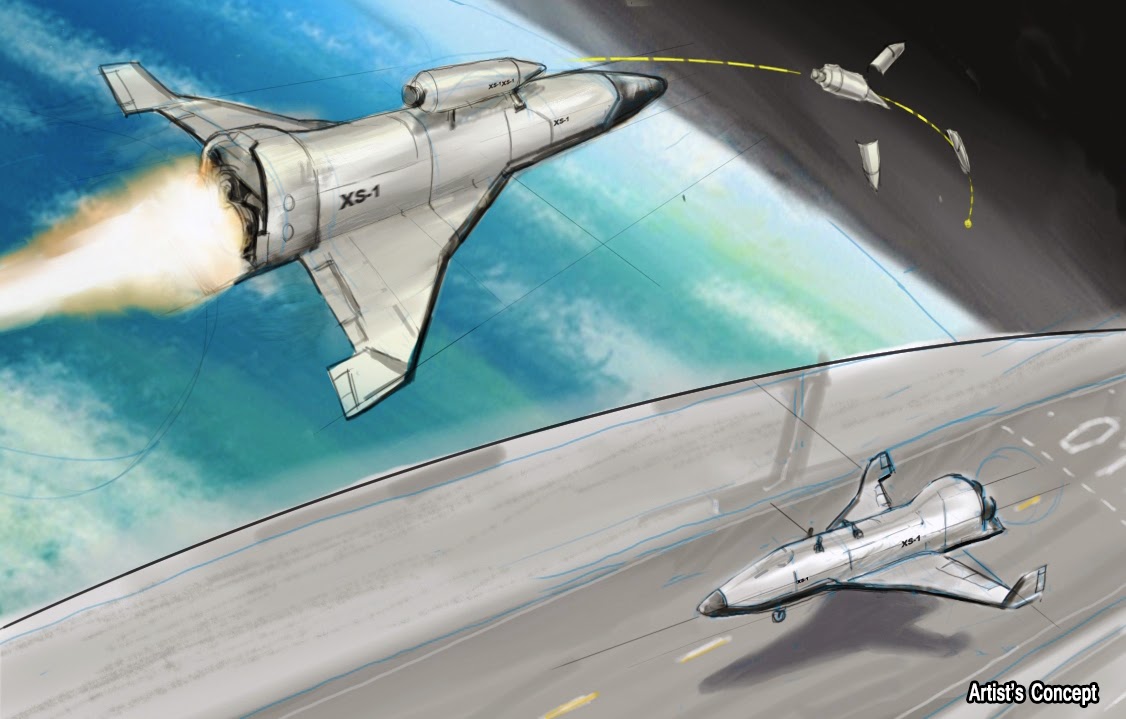
Northrop Grumman Corporation with Scaled Composites and Virgin Galactic is developing a preliminary design for DARPA's Experimental Spaceplane XS-1, shown here in an artist's concept. 

In addition to low-cost launch, the XS-1 will serve as a test-bed for a new generation of hypersonic aircraft. 

Credit: Northrop Grumman.

XS-1 has a reusable booster that when coupled with an expendable upper stage provides affordable, available and responsive space lift for 3,000-pound class spacecraft into low Earth orbit.

Reusable boosters with aircraft-like operations provide a breakthrough in space lift costs for this payload class, enabling new generations of lower cost, innovative and more resilient spacecraft.

The company is defining its concept for XS-1 under a 13-month, phase one contract valued at $3.9 million.

In addition to low-cost launch, the XS-1 would serve as a test-bed for a new generation of hypersonic aircraft.


A key program goal is to fly 10 times in 10 days using a minimal ground crew and infrastructure.

Reusable aircraft-like operations would help reduce military and commercial light spacecraft launch costs by a factor of 10 from current launch costs in this payload class.

To complement its aircraft, spacecraft and autonomous systems capabilities, Northrop Grumman has teamed with Scaled Composites of Mojave, which will lead fabrication and assembly, and Virgin Galactic, the privately-funded spaceline, which will head commercial spaceplane operations and transition.

“We chose performers who could prudently integrate existing and up-and-coming technologies and operations, while making XS-1 as reliable, easy-to-use and cost-effective as possible,” Jess Sponable, DARPA program manager.

“We’re eager to see how their initial designs envision making spaceflight commonplace, with all the potential military, civilian and commercial benefits that capability would provide.”

"Our team is uniquely qualified to meet DARPA's XS-1 operational system goals, having built and transitioned many developmental systems to operational use, including our current work on the world's only commercial spaceline, Virgin Galactic's SpaceShipTwo," said Doug Young, vice president, missile defense and advanced missions, Northrop Grumman Aerospace Systems.

"We plan to bundle proven technologies into our concept that we developed during related projects for DARPA, NASA and the U.S. Air Force Research Laboratory, giving the government maximum return on those investments," Young added.

The design would be built around operability and affordability, emphasizing aircraft-like operations including:

  • Clean pad launch using a transporter erector launcher, minimal infrastructure and ground crew;
  • Highly autonomous flight operations that leverage Northrop Grumman's unmanned aircraft systems experience; and
  • Aircraft-like horizontal landing and recovery on standard runways.


Monday, August 18, 2014

Wanted: Unmanned Space Plane to Fly On the Cheap

This artist's illustration depicts a rocket upper stage carrying a satellite payload launching into orbit. 

The U.S. military's XS-1 Experimental Spaceplane is a project overseen by the Defense Advanced Research Projects Agency (DARPA).

Credit: DARPA

It's a dream older than the Space Age itself: a fully reusable rocket that can fly into space, deploy its cargo, return to Earth and then do it again rapidly, cheaply and with minimal maintenance.

Despite billions of dollars and decades of work spent on projects as diverse as NASA's space shuttle, National Aerospace Plane and Rotary Rocket, cheap access to space is not yet a reality, making it difficult to unlock the enormous potential of outer space.

However, all that could change in the next few years, according to those working on a new set of vehicles.

"The need is there. The technology is ready. So, let's go do it," said Jeff Lane, chief engineer of Advanced High Speed Systems at Northrop Grumman Aerospace Systems, during a cheap access to space panel discussion during the NewSpace Conference in San Jose, California.

Lane's company leads one of three competing teams in the XS-1 program, which is the U.S. government's latest attempt at cheap access to space.


The program, led by the Defense Advanced Research Projects Agency (DARPA), aims to develop a fully-reusable unmanned vehicle with aircraft-like operations capable of delivering payloads weighing 3,000 to 5,000 lbs. (1,360 to 2,267 kilograms) to orbit for less than $5 million per flight.

The program's technical goals including being able to fly 10 times in 10 days.

DARPA awarded Northrop Grumman, which is teamed with Virgin Galactic, a one-year study contract.

The agency also awarded contracts to Masten Space Systems (teamed with XCOR Aerospace) and Boeing (teamed with Blue Origin).

Significant challenges lie ahead for whichever competitor(s) end up fielding an XS-1 test vehicle, according to Masten CEO Sean Mahoney.

"This is not going to be a simple thing to make a vehicle that can turn and fly 10 times in 10 days," Mahoney said during the panel.

"You don't get the option to refurbish the vehicle if you have to fly 10 times in 10 days."

Masten has experience in flying much smaller vehicles with rapid turnarounds using very small crews.

"One of the ways to reduce the cost of access to space is to employ fewer people," Mahoney said.

"That is something that is sometimes against the grain of, we have so many great trained people in the industry, but in order to reduce the cost of launch, we have to be able to operate with fewer people."

Dan Rasky, chief of the Space Portal Office at NASA Ames Research Center, pointed out that the XS-1 program is not the only effort being pursued that is aimed at making access to space cheaper.

For example, SpaceX is attempting to recover the first-stage of its Falcon 9 booster for reuse.

XCOR is also working on a fully-reusable suborbital space plane named the Lynx that will test out technologies for a reusable orbital system.

"The exciting thing right now, after all these long decades of chasing this problem, is that we're really in the era of what I call experimentation," Rasky said.

"If you look at other industries, cell phones, for example, you hit a point where there's a lot of different models being tried, a lot of different options being pursued, and you'll find that the dominant designs that work the best, and those become the iPhones and Androids hat dominate the market. We really haven't had this period of experimentation, in all honesty."

The renewed effort to develop cheap access to space is being driven not just by a desire to do more, but by economic necessity.

"The DOD [Department of Defense] and Space Command have come out and basically said that the fact the cost of getting to space is essentially getting so high that our national security is essentially put at risk," Rasky said."

"The biggest, deepest pockets in the world, the United States government, is finding itself unable to sustain the type of infrastructure we need to protect us, me, my family."

Sunday, April 20, 2014

US Military Developing Foldable Space Telescope - Video


The United States military's advanced research arm is working on a foldable space telescope that could image Earth in high resolution at a relatively low cost.

The Defense Advanced Research Projects Agency (DARPA) says the telescope design, known as the Membrane Optical Imager for Real-Time Exploitation, (MOIRE), would be of great use in geosynchronous Earth orbit, the spot 22,000 miles (35,000 kilometers) up where most telecommunications satellites reside.

"Membrane optics could enable us to fit much larger, higher-resolution telescopes in smaller and lighter packages," Lt. Col. Larry Gunn, MOIRE program manager, said in a statement.

The Membrane Optical Imager for Real-Time Exploitation (MOIRE) is in Phase 2 of ground testing. 

If it ever reaches orbit. the telescope is billed as lighter than conventional designs and able to get high-definiton pictures of Earth from geosynchronous orbit.

Credit: DARPA

"In that respect, we’re ‘breaking the glass ceiling’ that traditional materials impose on optics design," Gunn added.

"We’re hoping our research could also help greatly reduce overall costs and enable more timely deployment using smaller, less expensive launch vehicles."

MOIRE is now in Phase 2 of development since work began in 2010. When this phase is completed, a 16-foot (5 meters) prototype of the telescope's mirror should be completed for ground testing.

No space missions have been set for MOIRE yet, DARPA officials said.

There are both advantages and disadvantages to the MOIRE design. The membrane is not as efficient as the usual glass, but it is lighter, which allows prime contractor Ball Aerospace & Technologies Corp. to make larger lenses to increase the telescope's efficiency.

DARPA estimates that a membrane system should weigh 86 percent less than a more traditional system of the same resolution and mass.

The size of the Membrane Optical Imager for Real-Time Exploitation (MOIRE)'s mirror compared with that of the Hubble Space Telescope, the James Webb Space Telescope and Spitzer Space Telescope.

Credit: DARPA

Most telescopes either reflect light (using mirrors) or refract it (using lenses), but MOIRE's behaves differently.

Each membrane will instead diffract light using a piece of equipment known as a Fresnel lens.

"It is etched with circular concentric grooves like microscopically thin tree rings, with the grooves hundreds of microns across at the center down to only 4 microns at the outside edge," DARPA officials said in a statement. "The diffractive pattern focuses light on a sensor that the satellite translates into an image."

DARPA Airborne Satellite Launch Vehicle under an F-15E aircraft

Artist's concept of the DARPA Airborne Satellite Launch Vehicle under an F-15E aircraft.

Credit: Boeing

The next generation of small satellites may blast into orbit from the belly of a fighter jet.

The United States military's Defense Advanced Research Projects Agency (DARPA) gave Boeing a $30.6 million contract last month to develop a 24-foot (7.3-meter) launch vehicle that would attach to the bottom of an F-15E Strike Eagle.

The concept calls for the jet to drop this vehicle when it reaches an altitude of 40,000 feet (12,192 meters), at which point the craft's rocket engines would kick on, carrying onboard satellites into orbit.

This launch system could slash the cost of launching small satellites, those weighing up to 100 pounds (45 kilograms), by 66 percent if all goes well, Boeing officials said.

The fighter-jet system would not only be a cheaper approach than the usual throwaway rocket stages, officials added, but also would be a quicker way to send satellites into orbit.

The United States military would not need to wait around for a launch vehicle to be available or a launch window to open.

"We developed a cost-effective design by moving the engines forward on the launch vehicle," Steve Johnston, Boeing's director of advanced space exploration, said in a statement.

"With our design, the first and second stages are powered by the same engines, reducing weight and complexity."

Artist's concept of the DARPA Airborne Satellite Launch Vehicle under an F-15E aircraft.

Credit: Boeing

Tuesday, March 25, 2014

DARPA XS-1 Space Plane Project Seeks $27 Million in 2015 Funding

Artist's concept of DARPA's Experimental Spaceplane (XS-1), a proposed unmanned, hypersonic vehicle that the agency hopes will lower satellite launch costs substantially. 

Officials are targeting Mach 10 for the suborbital vehicle.

Credit: DARPA

The U.S. Defense Advanced Research Projects Agency expects to spend some $800 million on space programs from 2015 through 2018, an increase of $130 million over what was projected at this time last year, Defense Department budget documents show.

Nearly all of the targeted increase for DARPA's Space Programs and Technology Office is backloaded into the outyears, the documents show.

For 2015, the office is seeking nearly $180 million, only $7.5 million more than this year’s funding level.

DARPA's budget books break out funding on a program-by-program basis for the upcoming fiscal year only; outyear projections are provided only at the department level.

DARPA's mission, generally speaking, is to pursue high-risk, high-payoff technology development projects that could someday benefit the military.

These projects are taken on with the understanding that many, if not most, will fail. Defense Department officials often talk about "DARPA-hard" programs to describe their degree of difficulty.

For example, the 2015 request includes $27 million for XS-1, a concept for a reusable space plane that could ultimately fly 10 times in 10 days and boost payloads into low-Earth orbit for less than $5 million per launch. The program received $10 million in 2014.

"Technologies derived from the XS-1 program will enable routine space launch capabilities with aircraft-like cost, operability and reliability," a DARPA announcement from November 2013 reads.

"The long-term intent is for XS-1 technologies to be transitioned to support not only next-generation launch for Government and commercial customers, but also global reach hypersonic and space access aircraft."

The agency hopes to select a single vendor next year for the final design and development of the vehicle, which could make its initial test flight in 2018.

Friday, March 7, 2014

DARPA MUSE: Deep program analysis and big data analytics create a public database

DARPA's MUSE seeks to leverage deep program analyses and big data analytics to create a public database containing mined inferences about salient properties, behaviours and vulnerabilities of software drawn from the hundreds of billions of lines of open source code available today.

The program aims to make significant advances in the way software is built, debugged, verified, maintained and understood, and to enable the automated repair of existing programs and synthesis of new ones.

During the past decade information technologies have driven the productivity gains essential to U.S. economic competitiveness, and computing systems now control significant elements of critical national infrastructure.

As a result, tremendous resources are devoted to ensuring that programs are correct, especially at scale.

Unfortunately, in spite of developers' best efforts, software errors are at the root of most execution errors and security vulnerabilities.

To help improve this state, DARPA has created the Mining and Understanding Software Enclaves (MUSE) program.

MUSE seeks to make significant advances in the way software is built, debugged, verified, maintained and understood.

The collective knowledge gleaned from MUSE's efforts would facilitate new mechanisms for dramatically improving software correctness, and help develop radically different approaches for automatically constructing and repairing complex software.

Suresh Jagannathan
"Our goal is to apply the principles of big data analytics to identify and understand deep commonalities among the constantly evolving corpus of software drawn from the hundreds of billions of lines of open source code available today," said Suresh Jagannathan, DARPA program manager.

"We're aiming to treat programs—more precisely, facts about programs—as data, discovering new relationships (enclaves) among this 'big code' to build better, more robust software."

Central to MUSE's approach is the creation of a community infrastructure that would incorporate a continuously operational specification-mining engine.

This engine would leverage deep program analyses and foundational ideas underlying big data analytics to populate and refine a database containing inferences about salient properties, behaviours and vulnerabilities of the program components in the corpus.

If successful, MUSE could provide numerous capabilities that have so far remained elusive.

"Ideally, we could enable a paradigm shift in the way we think about software construction and maintenance, replacing the existing costly and laborious test/debug/validate cycle with 'always on' program analysis, mining, inspection and discovery," Jagannathan said.

"We could see scalable automated mechanisms to identify and repair program errors, as well as tools to efficiently create new, custom programs from existing components based only a description of desired properties."

Wednesday, February 12, 2014

DARPA Space Plane XS-1 Aims for 2017 Liftoff

Artist's concept of DARPA's Experimental Spaceplane (XS-1), a proposed unmanned, hypersonic vehicle that the agency hopes will lower satellite launch costs substantially. 

Officials are targeting Mach 10 for the suborbital vehicle. 

Credit: DARPA

The United States military is making progress toward developing a new unmanned space plane, which it aims to begin flight-testing in 2017.

The Defense Advanced Research Projects Agency (DARPA) plans to award the first design contracts for the vehicle project, known as Experimental Spaceplane, (XS-1), in May or thereabouts, officials said.

Current schedules call for the vessel to get off the ground for the first time in late 2017 and make an orbital test flight the following year.

DARPA has high expectations for the XS-1 program, which it hopes can eventually launch 3,000- to 5,000-lb (1,361 to 2,268 kilograms) payloads to orbit for less than $5 million per flight — and to do it at least 10 times per year.

"The vision here is to break the cycle of escalating space system costs, enable routine space access and hypersonic vehicles," XS-1 program manager Jess Sponable said Feb. 5 during a presentation with NASA's Future In-Space Operations (FISO) working group.

Jess Sponable
"We're interested not just in launch, but also in seeing if we can find a way to enable more affordable, more routine, simpler hypersonic vessels," he added.

Changing the cost equation
DARPA first announced the ambitious XS-1 program last September.

It's viewed as complementary to another agency effort known as ALASA (Airborne Launch Assist Space Access), which seeks to launch 100-lb (45 kg) satellites to orbit for less than $1 million apiece using traditional airplanes outfitted with expendable upper stages.

ALASA (Airborne Launch Assist Space Access)
DARPA officials laid out their broad vision of the robotic XS-1 vehicle in a press release issued in September:

"XS-1 envisions that a reusable first stage would fly to hypersonic speeds at a suborbital altitude," they wrote.

"At that point, one or more expendable upper stages would separate and deploy a satellite into low-Earth orbit."

"The reusable hypersonic aircraft would then return to earth, land and be prepared for the next flight."

But DARPA is leaving the specifics of the XS-1 system — which aims to provide routine, aircraft-like access to space — up its potential builders, Sponable said.

"We don't care if it's vertical take-off, horizontal land, vertical-vertical, which brings in a lot of the entrepreneurs," he said in the FISO presentation.

"We don't care if they air-launch it, air-tow it, whatever. So we've left all those wide open."

The XS-1 program has enough money for one design contractor, which it plans to choose in 2015 after assessing the work done by the first-round awardees.

However, Sponable holds out some hope that more than one vehicle could make it to the flight-test stage.

"I would love for somebody from NASA or the Air Force out there to step forward and say, 'Hey, there's obviously more than one of these things that we want to go flight-test; let's fly more than one," he said.

Monday, December 23, 2013

DARPA Robotics Challenge: Japan's SCHAFT team ahead on points

For those wondering who of 16 competing teams would walk away as top performers in the two-day DARPA Robotics Challenge in Florida over the weekend, the suspense is over.

SCHAFT, a Japanese military robotics company newly acquired by Google, won the most points, 27 out of a possible 32. SCHAFT outscored some formidable big-name contenders such as MIT, Carnegie Mellon, and NASA. IHMC Robotics placed second.

Third place went to Tartan Rescue, from Carnegie Mellon University, and fourth place was awarded to a team from the Massachusetts Institute of Technology.

The fifth-place went to RoboSimian, designed by NASA's Jet Propulsion Laboratory.

All in all, there were eight top scorers. Team TRACLabs, WRECS (Worcester Polytechnic Institute) and Team TROOPER (Lockheed Martin) were the next three.

The eight teams now have the opportunity to continue their work with the help of Defense Advanced Research Projects Agency (DARPA) funding and are to compete in the finals event where one team will net the $2 million prize at the end of 2014.

The Finals will require robots to attempt a circuit of consecutive physical tasks with degraded communications between the robots and their operators.

DARPA said that the 16 teams at this year's challenge in Miami represented a mix of government, academic and commercial backgrounds. They were not only from the United States, but also from South Korea and Japan.

SCHAFT's high scores were impressive as the DARPA Robotics Challenge (DRC), established to advance state of the art in humanoid robot competition, is considered as a baseline on the current state of robotics.

The event is a marker for assessing the evolution of robots in hazardous first-responder environments, a demonstration of what is so far possible in pushing technologies closer to the point where robots will help out in a range of rescue tasks quickly, efficiently and with minimal human interaction.

Tuesday, December 17, 2013

Boston Dynamics: Why does Google want access to DARPA robots?

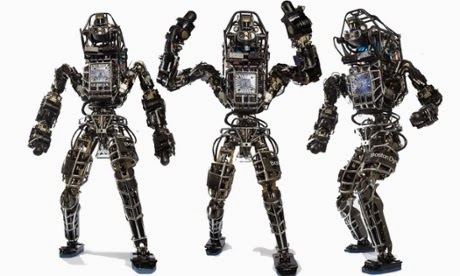
The Atlas humanoid robot is just one of the Boston Dynamics stable of advanced robotic platforms acquired by Google. 

Photograph: Boston Dynamics 

Google’s recent acquisition of Boston Dynamics marks its eighth robotics purchase in the past six months, showing Google’s “moonshot” robotics vision is more than just a pet project.

Boston Dynamics is the most high-profile acquisition, however, instantly adding world-leading robotics capability, including robots that can walk all on their own, to Google’s arsenal – as well as significant links to the US military – conjuring images of Skynet and the artificial intelligence-led robot uprising.

What is it?
Boston Dynamics is an engineering and robotics design company that works across a wide range of computer intelligence and simulation systems, as well as large, advanced robotic platforms.

The company was created as a technology spin-off from Massachusetts Institute of Technology by Prof Marc Raibert in 1992, then the founder and lead researcher of the Leg Lab – a research group focussed on systems that move dynamically, including legged robots.

What does it do?
Raibert describes the Boston Dynamics team as “simply engineers that build robots”, but in reality Boston Dynamics is much more than that.

Its robotics work is at the forefront of the technology creating the self-proclaimed “most advanced robots on Earth” particularly focused around self-balancing humanoid or bestial robots.

Funding for the majority of the most advanced Boston Dynamics robots comes from military sources, including the US Defence Advanced Research Projects Agency (Darpa) and the US army, navy and marine corps.

The terms of contracts currently held by Boston Dynamics with military bodies are unknown, although Google has committed to honouring existing contracts, including recent $10.8m funding from Darpa.


Read the full article here

Friday, December 6, 2013

DARPA MOIRE: First folding space telescope

Instead of using traditional glass mirrors or lenses, MOIRE seeks to diffract light with Fresnel lenses made from a lightweight membrane roughly the thickness of household plastic wrap. 

MOIRE would house the membranes in thin metal “petals” that would launch in a tightly packed configuration. 

Upon reaching its destination orbit, the satellite would then unfold the petals to create the full-size multi-lens optics.

The capability of orbital telescopes to see wide swaths of the earth at a time has made them indispensable for key national security responsibilities such as weather forecasting, reconnaissance and disaster response.

Even as telescope design has advanced, however, one aspect has remained constant since Galileo: using glass for lenses and mirrors, also known as optics.

High-resolution imagery traditionally has required large-diameter glass mirrors, which are thick, heavy, difficult to make and expensive.

As the need for higher-resolution orbital imagery expands, glass mirrors are fast approaching the point where they will be too large, heavy and costly for even the largest of today's rockets to carry to orbit.

DARPA's Membrane Optical Imager for Real-Time Exploitation (MOIRE) program seeks to address these challenges.

MOIRE aims to create technologies that would enable future high-resolution orbital telescopes to provide real-time video and images of the Earth from Geosynchronous Earth Orbit (GEO)—roughly 22,000 miles above the planet's surface.

Size and cost constraints have so far prevented placing large-scale imaging satellites in GEO, so MOIRE is developing technologies that would make orbital telescopes much lighter, more transportable and more cost-effective.

Currently in its second and final phase, the program recently successfully demonstrated a ground-based prototype that incorporated several critical technologies, including new lightweight polymer membrane optics to replace glass mirrors.

Membrane optics traditionally have been too inefficient to use in telescope optics. MOIRE has achieved a technological first for membrane optics by nearly doubling their efficiency, from 30 percent to 55 percent. The improved efficiency enabled MOIRE to take the first images ever with membrane optics.

With a proposed diameter of 20 meters, MOIRE’s membrane optic “lens” would be the largest telescope optics ever made and dwarf the traditional glass mirrors used in the world’s most famous telescopes.

MOIRE technology houses the membranes in thin metal "petals" that would launch in a tightly packed configuration roughly 20 feet in diameter.

Upon reaching its destination orbit, a satellite would then unfold the petals to create the full-size multi-lens optics.

The envisioned diameter of 20 meters (about 68 feet) would be the largest telescope optics ever made and dwarf the glass mirrors contained in the world's most famous telescopes.

Tuesday, November 26, 2013

Atlas teams head for DARPA Robotics Challenge


Team IHMC's Atlas Humanoid Robot walking over random stuff to simulate a rough terrain. 

While the robot has some impressive sensors, including the Carnegie Robotics sensor head, in this video the team has the robot walk over the obstacles without any sensing of them, to demonstrate some robustness to rough terrain. 

The tether provides electrical power to an onboard hydraulic pump. The overhead safety rope does not support any of the weight of the robot. It is there in the off chance that the robot falls. 

How often does the robot fall? Right now often, but much less than when the team started working with the robot, which was 2 months before this video was made.

While the robot is strong enough to get back up after a fall, it's hard to say if it is able to fall without damaging itself. 

December 20 is a big day for teams competing in the Defense Advanced Research Projects Agency (DARPA) Robotics Challenge.

The idea is to promote critical improvements in what robots can do to help out in disaster relief efforts, when human intervention is unsafe and time is of the essence, such as nuclear power plant disasters, oil spills, and wildfires.

The challenge is for robots to be agile and responsive enough to move through such disaster zones and do needed rescue tasks. Enter Atlas, the six-foot two, 330-pound robot developed by Boston Dynamics.

As part of the contest, DARPA has been furnishing some of the teams with Atlas units. The teams are expected to come to Florida prepared to put their Atlas robots through tough paces.

The Atlas factor in the competition is interesting because it calls upon team scientists and engineers to give their robot its "brains."

In December, the teams will need to show they are up to the challenge, having worked out code and customized software to put their Atlas machine into action.

Each team is to enter its own Atlas into the DARPA competition, performing tasks that prove their robot is disaster-site ready.

The original developer, Boston Dynamics, created Atlas to negotiate difficult outdoor terrain while picking up objects and carrying them in its arms.

In July, the seven teams that had progressed from DARPA's Virtual Robotics Challenge (VRC) arrived at the Boston Dynamics site in Waltham, Massachusetts, to meet the real Atlas.

Since then the teams have been preparing for next month's event by giving their Atlas the brains it needs to succeed in the challenge.

The Atlas is one of the most advanced humanoid robots ever built, but the teams are expected to take its physical shell and develop its software.

As DARPA points out, these seven teams are not starting from scratch.

With the physical modeling of the DARPA Robotics Challenge Simulator, software algorithms employed by teams in the VRC may transfer with minor tuning to Atlas hardware.

"The Virtual Robotics Challenge was a proving ground for teams' ability to create software to control a robot in a hypothetical scenario."

"The DRC Simulator tasks were fairly accurate representations of real world causes and effects, but the experience wasn't quite the same as handling an actual, physical robot," said Gill Pratt, program manager for the DARPA Robotics Challenge.

"Now these seven teams will see if their simulation-honed algorithms can run a real machine in real environments. And we expect all teams will be further refining their algorithms, using both simulation and experimentation."

One of the teams that was kitted out with an Atlas robot is the Florida Institute for Human and Machine Cognition (IHMC).

The video published earlier this month showed Atlas losing its walking grip, missing its step over a slab of wood, as it navigated its way through assorted debris purposely placed on the floor to tests its ability to walk on rough terrain.

Actually, the stumble indicates the hard tests the IHMC is putting its entry through, as the sophisticated sensors were purposely disabled, and yet the robot at least almost completed its way across the obstructive objects.

Wednesday, September 18, 2013

DARPA: Experimental Spaceplane (XS-1) shooting for 'aircraft-like' operations in orbit

DARPA’s new Experimental Spaceplane (XS-1) program seeks to lower satellite launch costs by developing a reusable hypersonic unmanned vehicle with costs, operation and reliability similar to traditional aircraft. 

XS-1 envisions that a reusable first stage would fly to hypersonic speeds at a suborbital altitude. 

At that point, one or more expendable upper stages would separate and deploy a satellite into Low Earth Orbit. 

The reusable hypersonic vehicle would then return to earth, land and be prepared for the next flight.

Commercial, civilian and military satellites provide crucial real-time information essential to providing strategic national security advantages to the United States.

The current generation of satellite launch vehicles, however, is expensive to operate, often costing hundreds of millions of dollars per flight.

Moreover, U.S. launch vehicles fly only a few times each year and normally require scheduling years in advance, making it extremely difficult to deploy satellites without lengthy pre-planning.

Quick, affordable and routine access to space is increasingly critical for U.S. Defense Department operations.

To help address these challenges, DARPA has established the Experimental Spaceplane (XS-1) program. The program aims to develop a fully reusable unmanned vehicle that would provide aircraft-like access to space.

The vehicle is envisioned to operate from a "clean pad" with a small ground crew and no need for expensive specialized infrastructure.

This setup would enable routine daily operations and flights from a wide range of locations. XS-1 seeks to deploy small satellites faster and more affordably, while demonstrating technology for next-generation space and hypersonic flight for both government and commercial users.

"We want to build off of proven technologies to create a reliable, cost-effective space delivery system with one-day turnaround," said Jess Sponable, DARPA program manager heading XS-1.

"How it's configured, how it gets up and how it gets back are pretty much all on the table—we're looking for the most creative yet practical solutions possible."

DARPA seeks ideas and technical proposals for how to best develop and implement the XS-1 program. The agency has scheduled an XS-1 Proposers' Day for Monday, October 7, 2013.

The agency also plans to hold 1-on-1 discussions with potential proposers on the following day, October 8, 2013. Advance registration is required; more information is available at www.sa-meetings.com/ 

Registration closes on Tuesday, October 10 2013, at 12:00 PM EDT. For more information, please email DARPA-SN-14-01@darpa.mil.

The DARPA Special Notice describing the specific capabilities the program seeks is available at go.usa.gov/DNkF.

A Broad Agency Announcement (BAA) for XS-1 is forthcoming and will be posted on the Federal Business Opportunities website.

Tuesday, July 16, 2013

Advanced Humanoid 'Atlas' Robot Unveiled - Video


Boston Dynamics developed the robot for DARPA. It will compete in the DARPA Robotics Challenge Trials at the Homestead-Miami Speedway in December 2013. 

Advancing the technology to assist humans in disaster response is the goal.

Thursday, May 2, 2013

DARPA Advanced Robotic Hand prototype shows its moves - Video


Robotic hands designed and engineered for versatility and dexterity in handling harmful, harmless, small, large, light, and heavy objects tease robotics teams today.

The US government's DARPA (Defense Advanced Research Projects Agency) is getting attention this month in its steps forward to develop robotic hands that can do the jobs of the human hand's advanced movements, but capable of being built at less prohibitive costs.

The recently released DARPA video reveals how far robotic hands have come in manipulative mastery.

The three-fingered hand, hardly human-like in appearance, nonetheless excels in function, as it is shown picking up objects from keys to transit cards to basketballs and heavy (50 pound) weights.

The DARPA-funded work was conducted by iRobot of Bedford, Massachusetts, with support from Harvard University and Yale University.

The hand prototype is part of DARPA's Autonomous Robotic Manipulation (ARM) project, on DARPA's ARM-H program track that looks at dexterous hands at a reasonable cost.

The GRAB Lab site at Yale reported that "We have developed a new hand design for the DARPA ARM-H program, in collaboration with iRobot Corporation and researchers at Harvard University.

This hand is underactuated, but retains critical in-hand manipulation capabilities such as reorienting grasped objects, and picking up small objects such as keys and pens.

Of the three designs submitted to DARPA, our hand was selected for distribution to all participants in the DARPA ARM-S program."

The government program is specifically interested in lower-cost robot manipulators that can handle things with less human control.

The interest is also in finding autonomous manipulation systems that can surpass the performance level of remote manipulation systems that are controlled directly by a human operator.

The iRobot, Harvard and Yale effort has resulted in a hand advanced enough to perform maneuvers that call for precision at a cost that makes a difference.

According to reports, the prototype could be made at $3,000 per unit in batches of 1,000 or more, in contrast to the $50,000 price of current technology.

Thursday, January 17, 2013

Raytheon to design DARPA new SEEME Military Imaging Satellites

Raytheon has been awarded a $1.5 million Defense Advanced Research Projects Agency (DARPA) contract for phase one of the agency's Space Enabled Effects for Military Engagements (SeeMe) program.

During the next nine months, the company will complete the design for small satellites to enhance warfighter situational awareness in the battlespace.

The SeeMe program will provide useful on-demand imagery information directly to the war-fighter in the field from a low-cost satellite constellation launched on a schedule that conforms to Department of Defense operational tempos.

"Leveraging our state-of-the-art missile assembly lines, we can mass produce these small, lightweight satellites quickly and affordably," said Tom Bussing, Raytheon Missile Systems' vice president of Advanced Missile Systems.

"As the world's only producer of exoatmospheric kill vehicles, we are already developing and building hardware to space standards."

For this contract, Raytheon has teamed with Sierra Nevada Corporation, University of Arizona and SRI International to assist with design work and eventually production.

Next year, in phase two of the SeeMe program, the Raytheon team would build six satellites for ground testing.

"We are pleased to be working with DARPA to solve the challenge of providing warfighters with a tactical space sensor capability at a production rate price," said Bussing.

Thursday, December 13, 2012

Arsenal DARPA Foam: Saving Wounded Soldiers

Researchers working on a foam designed to limit internal bleeding of soldiers injured on the battlefield have received $15.5m (£9.6m) from the US military to continue their work.

The foam is formed by two liquids, injected into the body, which mix, expand and harden to create an internal dressing.

Arsenal Medical's product is funded by the Pentagon's Darpa research unit.

One UK surgeon said it could help those far away from a medical facility but the technology is still in early pre-clinical stages. It has already been tested on pigs but not humans.

The firm hopes that the polyurethane polymer foam will help control internal bleeding for at least an hour, increasing the survival chances of troops wounded on the battlefield.

Polyurethane foams are already widely used inside the metal and plastic walls of refrigerators or for thermal insulation.

Brian Holloway - DARPA
Once a wounded soldier is transferred to receive proper medical attention, the foam can be easily removed in minutes in a solid block.

According to the pre-clinical data presented at the 2012 annual meeting of the American Association for the Surgery of Trauma (AAST) in Kauai, Hawaii, the foam raised survival rates for liver injuries after three hours from 8% to 72%, and reduced blood loss sixfold.

"If testing bears out, the foam technology could affect up to 50% of potentially survivable battlefield wounds," said Brian Holloway of Darpa.

Dangerous haemorrhage
Abdominal injuries were especially dangerous, said Dr Michael Walsh, a surgeon at the Royal London Hospital, because traditional methods of stopping blood loss such as compression pads or tourniquets could not be applied.

"Currently for internal bleeding in the abdomen and chest there is nothing that is done pre-hospital to stop the bleeding," he said.

"The best policy currently is for the pre-hospital team to recognise the potential for internal bleeding and to transfer the patient to one of our now designated major trauma centres for rapid assessment and early surgery to stop the bleeding."

He said that the foam technology could be useful to control haemorrhages when a patient was far from a medical facility, or in the case of multiple injuries with competing priorities for treatment.

For example, a severe head injury could be treated once major internal bleeding in the abdomen had been stabilised but, he added, that more research was needed to "demonstrate the safety and efficacy of this product over and above current standards of care for internal bleeding".

Staff would also have to be trained to administer it properly but shows great promise.

The device still needs to be approved by the US Food and Drug Administration.

Thursday, September 13, 2012

Spheres: Developing a Space Debris Removal Skill - YouTube


In-orbit rendezvous is a potential solution to address space debris removal, considered to be the predominant issue facing the arena of outer space security and safety.

DARPA, the US Defense Advanced Research Projects Agency, is using an unusual resource to develop rendezvous capability with out of control satellites: a high school competition.

“The control procedures that were developed for the Zero Robotics Challenge will certainly benefit the Phoenix program,” said Dave Barnhart, DARPA program manager.

He was referring to DARPA’s defunct satellite recycling project, “but they also potentially have much wider implications for space-based technologies.”

Participants in the Zero Robotics Autonomous Space Capture Challenge designed algorithms to control a bowling-ball-sized programmable satellite known as SPHERES.

There are three SPHERES currently aboard the ISS for use in such experiments in an environment where there is no risk of losing the test subjects.

The algorithms were applied across three different scenarios in which the SPHERES satellite simulated an active spacecraft approaching an object tumbling through space.

The Synchronized Position Hold, Engage, Reorient Experimental Satellites (SPHERES)

Through the Phoenix program, DARPA aims to catch retired communication satellites in geosynchronous orbit in order to collect and re-use some of their components.

To do this, the Phoenix spacecraft will have to perform a delicate dance to safely synchronize movements with tumbling satellites and to be able to deploy tools and attach or remove targeted parts.

Extended use of such a technology could allow the removal of more general space debris like fragments from collisions and exploded rocket bodies or objects from extravehicular activities.