Showing posts with label North Korea. Show all posts

Thursday, October 2, 2014

Satellite Data reveals North Korea has viable Satellite Launch Capability

Recent commercial satellite imagery indicates that North Korea has completed a yearlong project to upgrade its main satellite launching station, which is widely believed to be a test site for its intercontinental ballistic missile program, a United States research institute said on Wednesday.

Construction has been underway at the Sohae Satellite Launching Station in Tongchang-ri in northwestern North Korea since late last year.

It includes modifying the gantry tower and launchpad there, which analysts said would give North Korea a facility to launch a longer-range rocket that can carry a heavier payload.

North Korea successfully launched its Unha-3 space launch vehicle from the Sohae facility in December 2012, putting a small satellite into orbit.

The launch increased fears that the country was inching toward acquiring the ability to build an intercontinental ballistic missile with a nuclear warhead.

“North Korea is now ready to move forward with another rocket launch,” the U.S.-Korea Institute at Johns Hopkins University said in a report published on its website on Wednesday.

“Should a decision be made soon to do so in Pyongyang, and we have no evidence that one has, a rocket could be launched by the end of 2014.”

North Korea's Sohae satellite launch station. 

Credit: AFP/DigitalGlobe via Getty Images

If such a decision is made, the most likely candidate remains the existing Unha-3 rocket, it said, since “a much larger rocket, reportedly under development, is at least several years from becoming operational.”

The U.S.-Korea Institute is one of the American organizations that monitor North Korea’s nuclear and satellite launching sites using satellite images.

In its latest report, it said that imagery from mid-September showed tanks near the propellant storage buildings at the launchpad for the first time since the 2012 launch. The exact purpose of this activity remains unclear, it said.

A satellite photo of North Korea's Sohae missile launch site provided by 38 North, a website run by Johns Hopkins University. 

The photo shows that the North has carried out an engine test of its KN-08 intercontinental ballistic missile in mid-August. 

Credit: Yonhap

The institute said that technicians at the Sohae launch site had also been conducting a series of engine tests for North Korea’s KN-08 road-mobile intercontinental ballistic missile over the past couple years.

The KN-08 has never been test-launched, although it has been featured in military parades in Pyongyang.

The U.S.-Korea Institute said it had so far captured no sign of engine tests for a new rocket, bigger than the Unha-3, which North Korea was said to be developing.

North Korea’s launching of a rocket in 2012 and its third nuclear test in February last year prompted the United Nations to tighten sanctions against the country.

Under United Nations resolutions, North Korea was banned from testing technology used to develop ballistic missiles or nuclear weapons.

North Korea has vowed to build more powerful rockets and more sophisticated nuclear weapons as a deterrent against the United States.

Views of Punggye-riImages include material from Pleiades CNES 2014. 

Credit: EADS Airbus DS / Spot Image

Rocket tests at the Sohae site, coupled with nuclear tests in Punggye-ri in the northeast, are crucial parts of a North Korean effort to develop a long-range missile that is powerful enough to reach the United States mainland, as well as a nuclear warhead small and advanced enough to be fitted onto such a missile.

Saturday, June 21, 2014

Russia supplies KH-35 cruise missiles to North Korea

North Korea appears to have acquired a sea-based copy of a Russian cruise missile, the latest step in an effort to enhance its maritime strike capability, a US think-tank said Tuesday.

A state propaganda film disseminated on social media sites, including YouTube, provides a very brief glimpse of the missile being launched from a naval vessel.

Writing on the closely watched 38 North website of the US-Korea Institute at Johns Hopkins University, arms control expert Jeffrey Lewis said the missile would mark "a new and potentially destabilising addition" to North Korea's military arsenal.

Lewis identified the weapon as a copy of the Russian-produced KH-35, a sea-skimming anti-ship cruise missile developed during the 1980s and 90s.

Although the range and payload of the KH-35 fall below the threshold set by the Missile Technology Control Regime, any export of cruise missiles to North Korea would be a violation of UN sanctions.

"Although direct sale from Russia seems most likely, it is possible that North Korea obtained them from a third party like Myanmar," said Lewis, who is director for East Asia at the James Martin Center for Nonproliferation Studies.

As well as Myanmar, Russia has exported sea- and land-based cruise missiles to Algeria, India, Vietnam and Venezuela.

"The possibility that North Korea might sell KH-35 technology to others ... is not a happy thought," Lewis said.

The development of the North's conventional weaponry has largely been overshadowed by concerns over its nuclear weapons programmes.

Last month, 38 North published satellite photos showing two new North Korean warships, the largest it has constructed in 25 years.

The website said the two helicopter-carrying frigates represented an "important wake-up call" about the effectiveness of sanctions.

The flip-side of the North's naval capability was shown in pictures released Monday by the official KCNA news agency, showing supreme leader Kim Jong-Un riding in the turret of a rusted Romeo-class submarine developed by the Soviets in the 1950s.

"The submarines that our Navy holds are far superior," commented South Korean Defence Ministry spokesperson Kim Min-Seok.

Monday, April 15, 2013

North Korea's Unha-3 rocket: Analytical Graphics animation - Video


Analytical Graphics, Inc., video animation depicts North Korea's Unha-3 rocket and Kwangmyongsong-3 satellite in the last leg of a potential orbital launch in April 2012.

CREDIT: Analytical Graphics, Inc.

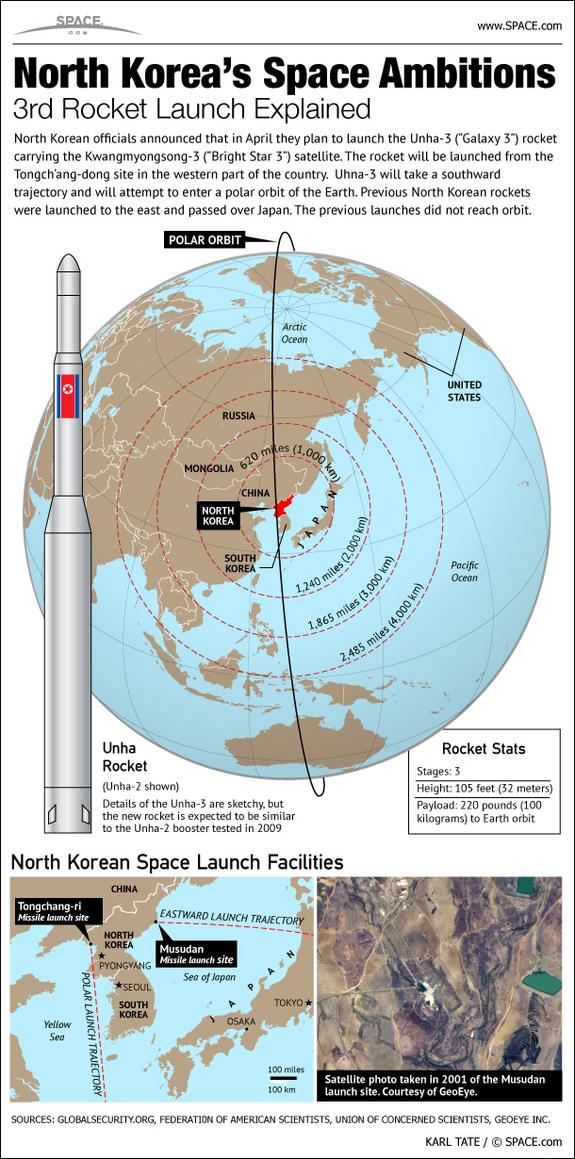
North Korea's Unha-3 Rocket Launch System - Infographics

Find out about North Korea's attempt to launch a satellite into Earth orbit, in this SPACE.com infographic.
Credit: SPACE.com

North Korea launched a new long-range rocket on April 13, which it said carried the country's first Earth-orbiting satellite, but the rocket broke apart shortly after liftoff and crashed into the sea.

The Unha-3 rocket launch was scheduled to mark the 100th birthday of North Korea's founder Kim il-Sung, who founded the communist state in 1948 and sparked criticism from the U.S. and other countries over the rocket's potential use as a military weapon.

Learn some of the scant details available of North Korea's April 2012 rocket launch plan in the infographic above.

North Korea's Rockets and Missile Threat Capability


North Korea's missile program is shrouded in secrecy, which helps the outlaw nation keep the rest of the world guessing.

But Western experts have learned a fair bit about Pyongyang's stable of rockets and missiles over the years by analyzing test flights, satellite photos and other data.

Soviet Origins:
The Hermit Kingdom's missile program is based primarily on Soviet Scuds, which apparently entered the country via Egypt in the 1970s.

North Korea was building its own Scud version, called the Hwasong-5, by the mid-1980s, and moved onto bigger and more powerful missiles after that.

Poor Accuracy:
North Korea's missiles have poor record of accuracy compared to those developed by the United States and other Western powers, experts say.

Pyongyang's Hwasong missiles, for example, can reach targets a few hundred miles away, but with an accuracy of just 0.3 miles to 0.6 miles (0.5 to 1 kilometer).

A missile called the Nodong (or Rodong -1 & -2) can fly 620 miles to 800 miles (1,000 to 1,300 km), but its estimated accuracy is even worse — 1.8 to 2.5 miles (3 to 4 km).

It is believed that these missiles can't reliably hit military targets, but they can certainly strike larger targets such as cities.

Cooperation with Iran:
North Korea has apparently cooperated extensively with fellow pariah nation Iran on rocket and missile technology.

For example, the third stage of Pyongyang's Unha-2 rocket is very similar to, and reported to be based on, the upper stage of Iran's Safir-2 launcher, physicists David Wright and Theodore Postol noted in a 2009 report.

Satellite Launch Success:
North Korea joined the ranks of satellite-launching nations last December, when its Unha-3 rocket launched a small satellite to Earth orbit.

This breakthrough came after three consecutive failures — one in 1998, one in 2009 and another in April 2012.

However, North Korean officials have never admitted to these mishaps, .

For example, they claimed that the Kwangmyongsong-1 ("Bright Star 1") satellite reached orbit in 1998 and then broadcasted patriotic songs into space but there is no evidence for this.

Nuclear Warheads Possible:
North Korea has been ratcheting up its bellicose rhetoric lately, threatening to launch nuclear strikes against Washington, D.C. and other American cities.

While the rogue nation's nuclear-weapons program is thought to be at a relatively primitive stage, Pyongyang may indeed already possess warheads small enough to be carried large distances by a ballistic missile, experts say. But the world have been misled by this kind of rhetoric in the past.

"Having something that's around 1,000 kilograms, or maybe somewhat smaller than that, unfortunately does not seem impossible," Wright reported.

"We don't really know, but I think you have to take seriously that they could well be there."

Most analysts doubt, however, that North Korean missiles are powerful enough to deliver a nuclear weapon to the American mainland.

The tough talk from Pyongyang is primarily bluster aimed at wringing concessions out of the international community and building support for young leader Kim Jong-Un at home, they say.

It also follows the blocking of international bank accounts for Kim Jon-Un and three of his senior generals.

These accounts are thought to contain $$billions belonging to the people of North Korea, allegedly. 

Monday, December 17, 2012

North Korean Satellite Tumbling and now Space Debris

Kwangmyongsong-3, the North Korean satellite launched into space by the Unha-3 rocket last week, is out of control and most likely dead, astronomers reported Monday.

The apparent failure will not cause the spacecraft to fall quickly back to earth but represents a major setback in Pyongyang’s bid to portray the launching as a patriotic and technological success.

“It’s tumbling and we haven’t picked up any transmissions,” said Jonathan McDowell, a Harvard astronomer who tracks global rocket launchings and space activity. “Those two things are most consistent with the satellite being entirely inactive at this point.”

North Korea’s state-run press, which was preoccupied on Monday with reporting on the somber one-year anniversary of the death of Kim Jong-il, the longtime leader, said nothing about the satellite’s dysfunction.

It has been describing the satellite launch as a triumphal achievement of Mr. Kim’s successor, his son Kim Jong-un, done in the face of worldwide criticism and United Nations sanctions on the North’s ballistic missile program.

The satellite, said to be about the size of a washing machine, reportedly carries an onboard camera to observe the earth. That mission requires the spacecraft’s orbit to be rock-steady.

Dr. McDowell said the tumbling implies that onboard systems meant to control and stabilise the craft had failed.

He added that radio astronomers had picked up no signals from the satellite and that optical astronomers had observed it brightening and dimming as it slowly tumbled end over end.

“It’s clear that the rocket part of this mission worked very well for the North Koreans,” Dr. McDowell said in an interview.

“They ended up in the right orbit. But the preponderance of the evidence suggests that the satellite failed either during the ascent or shortly afterwards.”

Friday, December 14, 2012

North Korea's Unha-3 (Milky Way 3) rocket

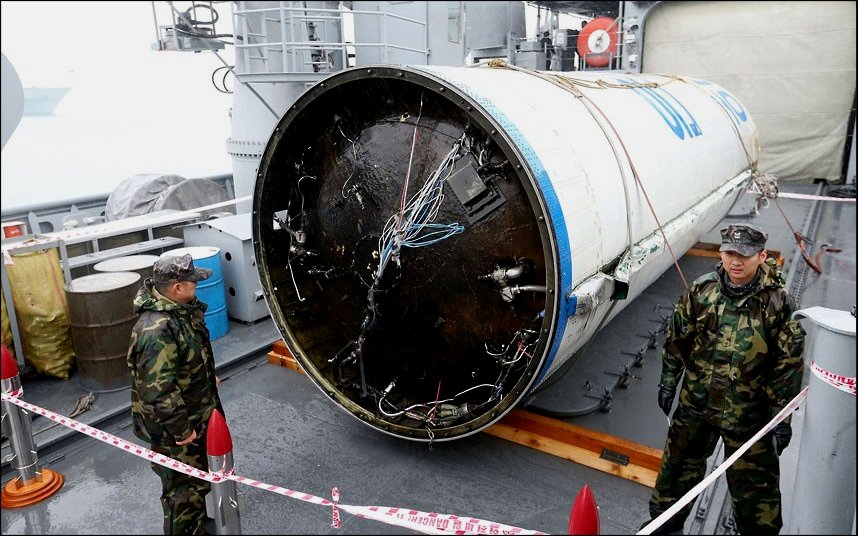
The first stage of North Korea's Unha-3 rocket is seen at the Second Fleet Command's naval base in Pyeongtaek, South Korea 

Picture: Yeong-Wook/DongA Daily/Getty Images


North Korean leader Kim Jong-un smokes a cigarette at the General Satellite Control and Command Centre at West Sea Satellite Launch Site in Cholsan county, North Pyongan province, after the launch of the Unha-3 (Milky Way 3) rocket carrying the Kwangmyongsong-3 satellite 

Picture: REUTERS/KCNA

Wednesday, December 12, 2012

Unha-3 Rocket: North Korea Successfully Launches Satellite

Sohae Launch Facility, North Korea, Nov. 26, 2012.

This satellite image of the Sohae Launch Facility on Nov. 26, 2012 shows a marked increase in activity at North Korea's Sohae (West Sea) Satellite Launch Station. 

This activity is consistent with launch preparations as witnessed prior to the failed April 13, 2012 launch of the Unha 3 (i.e., Universe or Galaxy 3) space launch vehicle (SLV) carrying the Kwangmyongsong 3 (i.e., Bright Lodestar 3). 

Given the observed level of activity noted of a new tent, trucks, people and portable fuel/oxidizer tanks, should North Korea desire, it could possibly conduct its fifth satellite launch event during the next three weeks (e.g., by mid-December 2012).

CREDIT: DigitalGlobe via Getty Images 

North Korea apparently succeeded in placing a satellite in Earth orbit after a Wednesday morning (Dec. 12) launch that is already drawing condemnation from the United States and other Western nations.

North Korea launched its long-range Unha-3 rocket at 9:49 a.m. Wednesday local time (7:49 p.m. EST on Tuesday) from Sohae Satellite Launch Station on the nation's northwest coast.

North Korean officials declared the launch a success shortly thereafter, claiming that the Unha-3 had delivered a scientific satellite to orbit as planned.

The rogue nation has a history of making such claims even after failed liftoffs, but it appears to be telling the truth this time.

"Initial indications are that the missile deployed an object that appeared to achieve orbit," the North American Aerospace Defense Command, a joint U.S.-Canadian effort, said in a statement.

"At no time was the missile or the resultant debris a threat to North America."

If it was indeed successful, the launch would end a string of rocket mishaps for North Korea. A satellite launch this past April failed shortly after liftoff, and similar attempts in 1998 and 2009 also flopped.

These past blastoffs drew condemnation from the United States, South Korea and other nations, which viewed them as thinly disguised missile tests.

Wednesday's launch has already elicited a strong reaction. The White House called it a "highly provocative act that threatens regional security," and United Nations Secretary-General Ban Ki-moon declared it a "clear violation" of a UN resolution.

Thursday, April 12, 2012

N-Korea's rocket crashes into sea

North Korea's much-anticipated rocket launch has ended in failure, splintering into pieces over the Yellow Sea soon after lift-off.

The reclusive communist state admitted in an announcement on state TV that a satellite launched hours earlier from the west coast failed to enter into orbit.

The US and South Korea also declared the launch a failure.

The Kwangmyongsong-3 satellite was fired from the Sohae Satellite Launching Station in Tongchang-ri, along the west coast, at 7.38am (11.38pm Thursday BST) but failed to reach orbit, the state-run Korean Central News Agency said.

"Scientists, technicians and experts are now looking into the cause of the failure," KCNA said.

US and South Korean officials said hours earlier that the rocket splintered into pieces about a minute after lift-off over the Yellow Sea, calling it a provocative failed test of missile technology.

In response to the launch, Washington announced it was suspending plans to contribute food aid to the North in exchange for a rollback of its nuclear programmes.

The US North American Aerospace Defence Command said it detected and tracked the launch of the rocket - which it called a missile - over the Yellow Sea; the first stage fell into the sea 100 miles west of Seoul, South Korea, while stages two and three failed.

"At no time were the missile or the resultant debris a threat," Norad said in a statement.

The US, Japan, Britain and other nations had been urging North Korea to cancel a launch seen as a covert test of the rocket technology also used to send a long-range missile to strike the US

North Korea refused to back down, saying the rocket would carry only a civilian satellite, touting it as a major technological achievement to mark the 100th anniversary of the birth of the country's founder, Kim Il Sung, on Sunday.

Tuesday, April 10, 2012

North Korea 'to mount satellite for rocket launch'

North Korea is poised to complete preparations for its rocket launch scheduled for later this week, an official said in Pyongyang.

A satellite will be installed on the Unha-3 rocket by the end of Tuesday, the official told foreign journalists in a rare press conference.


The official dismissed concerns that the launch was a cover for developing missile technology as "nonsense".

Three Asian airlines have made changes to flight paths to avoid the rocket.

"We are expecting to complete assembly by today," said Ryu Kum-chol, deputy director of the space development department at the Committee of Space Technology.

He said the launch - scheduled between 12-16 April - was part of the peaceful development of a space programme. North Korea says it will mark the 100th anniversary of the birth of late leader Kim Il-sung.

But the opponents of the move say it contravenes UN resolutions that were imposed after a similar launch in April 2009.

Russia said on Tuesday said that Pyongyang's plans showed ''disregard'' for the resolutions.

Tuesday, December 20, 2011

Korean pensinsula: Seoul and DMZ from ISS

Korean pensinsula from ISS, captured by @astro_paolo. You can see very well Seoul and part of the DMZ.

Tuesday, December 29, 2009

NKorea built plant to make gas for uranium enrichment

North Korea may have constructed a plant to manufacture a gas needed for uranium enrichment in a development that would indicate that Pyongyang had opened a second way to build nuclear weapons as early as the 1990s, The Washington Post reported late Sunday.

Citing a previously unpublicized account by Abdul Qadeer Khan, the father of Pakistan's atomic bomb program, the newspaper said North Korea may have been enriching uranium on a small scale by 2002, with maybe 3,000 or even more centrifuges.

Pakistan helped North Korea with vital machinery, drawings and technical advice for at least six years, the report said.

The Post said Khan's account could not be independently corroborated. But one US intelligence official and a US diplomat said his information adds to their suspicions that North Korea has long pursued the enrichment of uranium in addition to making plutonium for bombs.

It also may help explain Pyongyang's assertion in September that it is in the final stages of such enrichment, the paper noted.

Khan described his dealings with the country in official documents and in correspondence with a former British journalist, Simon Henderson, who said he thinks an accurate understanding of Pakistan's nuclear history is relevant for US policymaking, the report pointed out.

The Post independently verified that the documents were produced by Khan.

Khan's account of the pilot plant depicts relations between the two countries' scientists as exceptionally close for nearly a decade, the paper said.

Khan says, for example, that during a visit to North Korea in 1999, he toured a mountain tunnel, according to the report. There his hosts showed him boxes containing components of three finished nuclear warheads, which he was told could be assembled for use atop missiles within an hour.

His visit occurred seven years before the country's first detonation, prompting some current and former US officials to say that Khan's account, if correct, suggests North Korea's achievements were more advanced than previously known, and that the country may have more sophisticated weapons, or a larger number, than earlier estimated, The Post said.

But Siegfried Hecker, a former Los Alamos National Laboratory director who was allowed to see some North Korean plutonium during a visit to its nuclear facilities in January 2004, said after hearing Khan's description of the trip he remains unconvinced that the country in 1999 had enough fissile material on hand to make such weapons.

The Post quotes Hecker as saying that Khan may have tried to get himself "off the hook" by implying that his own illicit technical assistance to Pyongyang was irrelevant because "these guys already had nuclear weapons."

Wednesday, December 9, 2009

H1N1: North Korea finally confirms pandemic swine flu outbreak

Finally, North Korea announced for the first time that it has several cases of swine flu, confirming overseas reports of an outbreak in the secretive and impoverished communist state.

The health ministry has reported a total of nine cases of (A)H1N1 in the capital Pyongyang and the city of Sinuiju on the Chinese border, the official Korean Central News Agency said.

Authorities put a quarantine system in place and centres have been set up nationwide to check for new cases, it said.

The World Health Organisation is working with Pyongyang to help stem the outbreak and assess the scope of infections, WHO spokeswoman Aphaluck Bhatiasevi told South Korea's Yonhap news agency.

"We are working closely with the government to see what is required and if they need any assistance from WHO," she said.

Yonhap quoted Bhatiasevi as saying there are likely to be more cases of the virus than announced, as people who have mild symptoms are not tested.

The South's unification ministry said it would send a message to the North offering swift deliveries of Tamiflu and other medicine.

"Assistance must be provided swiftly as the disease could quickly spread in North Korea where conditions are not so good," President Lee Myung-Bak said.

Most government-to-government aid was suspended after cross-border relations worsened last year, although private South Korean groups still send shipments northwards.

Observers say the virus could pose a particular threat to the impoverished North because of malnutrition amid persistent food shortages and a lack of drugs.

Good Friends, a Seoul-based aid group with cross-border contacts, reported Monday the disease has been spreading rapidly because Tamiflu is rare there. Although, given the reported ineffectiveness of Tamiflu, it will be interesting to monitor how quickly the virus spreads.

It said seven youths died in Pyongyang in November while two others reportedly died in Pyongsong north of the capital.

Schools last Friday started their winter vacation a month early to guard against the spread of the disease, the group said.

Public health conditions are also dire with medical equipment and medicine in short supply and clean drinking water and sanitised items frequently problematic, it said.

Drugs for Leaders only

The conservative Dong-A Ilbo newspaper quoted unidentified sources as saying that North Korea has secured Tamiflu and other drugs through foreign missions in Europe but only for leader Kim Jong-Il and other top officials.

North Korea refused Tamiflu
In May, the WHO supplied a total of 2.4 million courses of Tamiflu to 72 countries, but Seoul officials said the North's likely share of this would be grossly inadequate.

"Considering the North's population is 24 million, and the infection rate going up to 20 to 30 percent in underdeveloped countries, the North would need the drug by the millions," said Kwon Jun-Wook, a swine flu specialist at the South Korean health ministry.

North Korea has a high death rate from pneumonia, which rises when there is a food shortage.

Kwon told Yonhap the (A)H1N1 virus has an even higher infection rate than pneumonia and would be more dangerous to the North Korean people.