Showing posts with label Unha-3 rocket. Show all posts

Thursday, October 2, 2014

Satellite Data reveals North Korea has viable Satellite Launch Capability

Recent commercial satellite imagery indicates that North Korea has completed a yearlong project to upgrade its main satellite launching station, which is widely believed to be a test site for its intercontinental ballistic missile program, a United States research institute said on Wednesday.

Construction has been underway at the Sohae Satellite Launching Station in Tongchang-ri in northwestern North Korea since late last year.

It includes modifying the gantry tower and launchpad there, which analysts said would give North Korea a facility to launch a longer-range rocket that can carry a heavier payload.

North Korea successfully launched its Unha-3 space launch vehicle from the Sohae facility in December 2012, putting a small satellite into orbit.

The launch increased fears that the country was inching toward acquiring the ability to build an intercontinental ballistic missile with a nuclear warhead.

“North Korea is now ready to move forward with another rocket launch,” the U.S.-Korea Institute at Johns Hopkins University said in a report published on its website on Wednesday.

“Should a decision be made soon to do so in Pyongyang, and we have no evidence that one has, a rocket could be launched by the end of 2014.”

North Korea's Sohae satellite launch station. 

Credit: AFP/DigitalGlobe via Getty Images

If such a decision is made, the most likely candidate remains the existing Unha-3 rocket, it said, since “a much larger rocket, reportedly under development, is at least several years from becoming operational.”

The U.S.-Korea Institute is one of the American organizations that monitor North Korea’s nuclear and satellite launching sites using satellite images.

In its latest report, it said that imagery from mid-September showed tanks near the propellant storage buildings at the launchpad for the first time since the 2012 launch. The exact purpose of this activity remains unclear, it said.

A satellite photo of North Korea's Sohae missile launch site provided by 38 North, a website run by Johns Hopkins University. 

The photo shows that the North has carried out an engine test of its KN-08 intercontinental ballistic missile in mid-August. 

Credit: Yonhap

The institute said that technicians at the Sohae launch site had also been conducting a series of engine tests for North Korea’s KN-08 road-mobile intercontinental ballistic missile over the past couple years.

The KN-08 has never been test-launched, although it has been featured in military parades in Pyongyang.

The U.S.-Korea Institute said it had so far captured no sign of engine tests for a new rocket, bigger than the Unha-3, which North Korea was said to be developing.

North Korea’s launching of a rocket in 2012 and its third nuclear test in February last year prompted the United Nations to tighten sanctions against the country.

Under United Nations resolutions, North Korea was banned from testing technology used to develop ballistic missiles or nuclear weapons.

North Korea has vowed to build more powerful rockets and more sophisticated nuclear weapons as a deterrent against the United States.

Views of Punggye-riImages include material from Pleiades CNES 2014. 

Credit: EADS Airbus DS / Spot Image

Rocket tests at the Sohae site, coupled with nuclear tests in Punggye-ri in the northeast, are crucial parts of a North Korean effort to develop a long-range missile that is powerful enough to reach the United States mainland, as well as a nuclear warhead small and advanced enough to be fitted onto such a missile.

Monday, April 15, 2013

North Korea's Unha-3 rocket: Analytical Graphics animation - Video


Analytical Graphics, Inc., video animation depicts North Korea's Unha-3 rocket and Kwangmyongsong-3 satellite in the last leg of a potential orbital launch in April 2012.

CREDIT: Analytical Graphics, Inc.

Monday, December 17, 2012

North Korean Satellite Tumbling and now Space Debris

Kwangmyongsong-3, the North Korean satellite launched into space by the Unha-3 rocket last week, is out of control and most likely dead, astronomers reported Monday.

The apparent failure will not cause the spacecraft to fall quickly back to earth but represents a major setback in Pyongyang’s bid to portray the launching as a patriotic and technological success.

“It’s tumbling and we haven’t picked up any transmissions,” said Jonathan McDowell, a Harvard astronomer who tracks global rocket launchings and space activity. “Those two things are most consistent with the satellite being entirely inactive at this point.”

North Korea’s state-run press, which was preoccupied on Monday with reporting on the somber one-year anniversary of the death of Kim Jong-il, the longtime leader, said nothing about the satellite’s dysfunction.

It has been describing the satellite launch as a triumphal achievement of Mr. Kim’s successor, his son Kim Jong-un, done in the face of worldwide criticism and United Nations sanctions on the North’s ballistic missile program.

The satellite, said to be about the size of a washing machine, reportedly carries an onboard camera to observe the earth. That mission requires the spacecraft’s orbit to be rock-steady.

Dr. McDowell said the tumbling implies that onboard systems meant to control and stabilise the craft had failed.

He added that radio astronomers had picked up no signals from the satellite and that optical astronomers had observed it brightening and dimming as it slowly tumbled end over end.

“It’s clear that the rocket part of this mission worked very well for the North Koreans,” Dr. McDowell said in an interview.

“They ended up in the right orbit. But the preponderance of the evidence suggests that the satellite failed either during the ascent or shortly afterwards.”

Friday, December 14, 2012

North Korea's Unha-3 (Milky Way 3) rocket

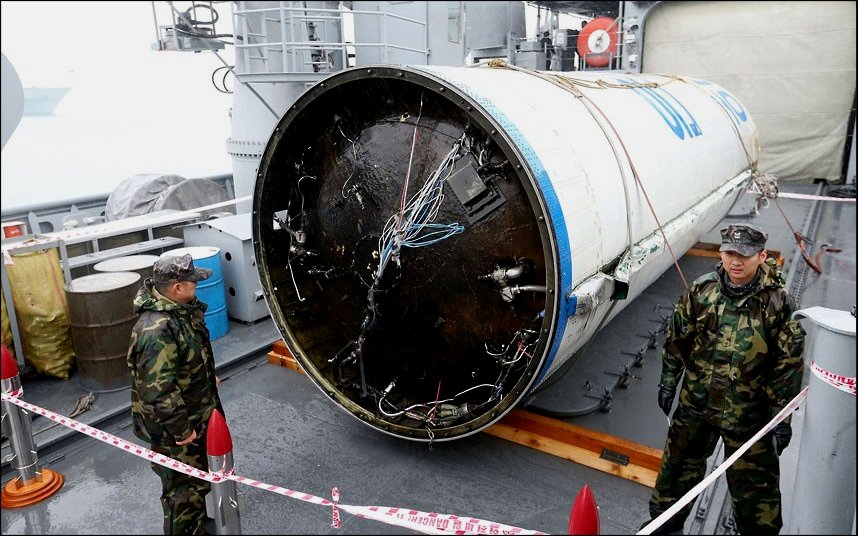
The first stage of North Korea's Unha-3 rocket is seen at the Second Fleet Command's naval base in Pyeongtaek, South Korea 

Picture: Yeong-Wook/DongA Daily/Getty Images


North Korean leader Kim Jong-un smokes a cigarette at the General Satellite Control and Command Centre at West Sea Satellite Launch Site in Cholsan county, North Pyongan province, after the launch of the Unha-3 (Milky Way 3) rocket carrying the Kwangmyongsong-3 satellite 

Picture: REUTERS/KCNA

Wednesday, December 12, 2012

Unha-3 Rocket: North Korea Successfully Launches Satellite

Sohae Launch Facility, North Korea, Nov. 26, 2012.

This satellite image of the Sohae Launch Facility on Nov. 26, 2012 shows a marked increase in activity at North Korea's Sohae (West Sea) Satellite Launch Station. 

This activity is consistent with launch preparations as witnessed prior to the failed April 13, 2012 launch of the Unha 3 (i.e., Universe or Galaxy 3) space launch vehicle (SLV) carrying the Kwangmyongsong 3 (i.e., Bright Lodestar 3). 

Given the observed level of activity noted of a new tent, trucks, people and portable fuel/oxidizer tanks, should North Korea desire, it could possibly conduct its fifth satellite launch event during the next three weeks (e.g., by mid-December 2012).

CREDIT: DigitalGlobe via Getty Images 

North Korea apparently succeeded in placing a satellite in Earth orbit after a Wednesday morning (Dec. 12) launch that is already drawing condemnation from the United States and other Western nations.

North Korea launched its long-range Unha-3 rocket at 9:49 a.m. Wednesday local time (7:49 p.m. EST on Tuesday) from Sohae Satellite Launch Station on the nation's northwest coast.

North Korean officials declared the launch a success shortly thereafter, claiming that the Unha-3 had delivered a scientific satellite to orbit as planned.

The rogue nation has a history of making such claims even after failed liftoffs, but it appears to be telling the truth this time.

"Initial indications are that the missile deployed an object that appeared to achieve orbit," the North American Aerospace Defense Command, a joint U.S.-Canadian effort, said in a statement.

"At no time was the missile or the resultant debris a threat to North America."

If it was indeed successful, the launch would end a string of rocket mishaps for North Korea. A satellite launch this past April failed shortly after liftoff, and similar attempts in 1998 and 2009 also flopped.

These past blastoffs drew condemnation from the United States, South Korea and other nations, which viewed them as thinly disguised missile tests.

Wednesday's launch has already elicited a strong reaction. The White House called it a "highly provocative act that threatens regional security," and United Nations Secretary-General Ban Ki-moon declared it a "clear violation" of a UN resolution.