Showing posts with label Soyuz launcher. Show all posts

Friday, August 22, 2014

ESA Galileo Launch - Video


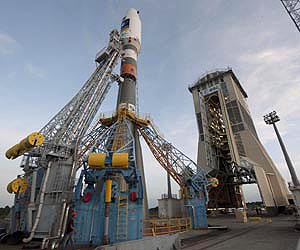
On 22 August, at 12:27 GMT/14:27 CEST, a Soyuz Flight VS09 launched Europe’s fifth and six Galileo satellites from Europe's Spaceport in Kourou, French Guiana.

These new satellites joined four Galileo satellites already in orbit, launched in October 2011 and October 2012 respectively.

This first quartet were ‘In-Orbit Validation’ satellites, serving to demonstrate the Galileo system would function as planned.

Now that work has been done, these ‘Full Operational Capability’ satellites are significant as the first of the rest of the Galileo constellation.

A steady stream of launches will follow to build the complete Galileo satellite constellation.

This deployment phase of the Galileo programme is being managed and funded by the European Commission, with ESA acting as design and procurement agent on behalf of the Commission.

Thursday, May 31, 2012

An Orthodox Priest Blesses the Soyuz Space Vehicle

This week, vivid photographs have been released of a Russian Orthodox priest annointing the Soyuz, the crew, and even the press in advance of the May 15 launch to the International Space Station from Baikonur Cosmodrome.

Blessing the crew is a tradition that began in 1994 by request of cosmonaut Alexander Viktorenko before his launch to Mir.

This is one of the few Russian pre-launch traditions that were not founded by or related to Yuri Gagarin, the first man in space, since religious expression was limited in the pre-1990 Soviet era.

Usually, a priest administers the blessing to Soyuz crew on the steps of their hotel. On this launch, however, a few additional blessings were included.

Tuesday, February 7, 2012

Damaged Russian Spaceship: Launch Delay for Next ISS Crew Uplift


A botched pressure test of a Russian space capsule slated to launch the next crew to the International Space Station has forced NASA and its partners to delay the planned liftoff for more than a month.

The Russian Soyuz spacecraft launch was originally slated for March 29, but now is targeted for no earlier than May 15, NASA's International Space Station program manager Mike Suffredini told reporters today (Feb. 2).

The Soyuz's crew capsule, one of three modules that make up the entire Soyuz TMA-04M vehicle, has been scrapped after an accident during testing caused it to spring a leak in one of its descent module's rocket thruster fuel tanks. Now Russia's main space contractor, RSC Energia, is readying the next spaceship on the line, though the issue will cause a lengthy delay.

"This particular event is very unfortunate, but you know this is a complicated business and things happen," Suffredini said. "To me this is not indicative of some overarching problem at the Energia corporation. I have every confidence that they'll figure out the cause of this and rectify it for the future."

Friday, January 13, 2012

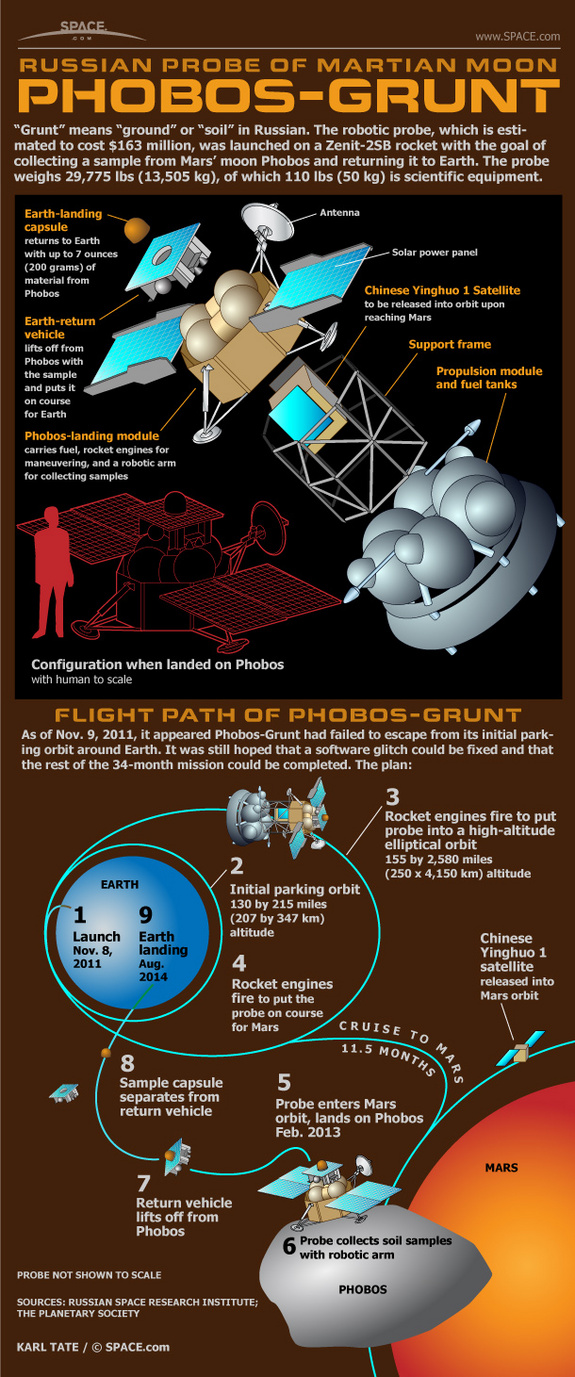
Did US shoot Phobos-Grunt down? No!

Sometime this weekend, Phobos-Grunt will crash into the Indian Ocean.

The Russian space probe was supposed to return a sample from Mars's moon Phobos (hence the name – grunt means "ground" in Russian).

Unfortunately, after its launch on 9 November, the upper stages failed, and it remained stuck in low Earth orbit – so low that atmospheric drag will draw it back to Earth and destroy it.

It took more than a decade and some $163 million to build Phobos-Grunt, so it its inexplicable failure was understandably frustrating for the Russians.

In a bizarre interview, Vladimir Popovkin, the head of Russia's space agency, alluded to foul play: "We don't want to accuse anybody, but there are very powerful devices that can influence spacecraft now. The possibility they were used cannot be ruled out," he said, in The New York Times's translation.

He insinuated that the US was to blame: "The frequent failure of our space launches, which occur at a time when they are flying over the part of Earth not visible from Russia, where we do not see the spacecraft and do not receive telemetric information, are not clear to us."

The claim that Phobos-Grunt was shot down is absurd but that's not because it would be hard to do. If you can launch satellites, it is easier to destroy them, and to do so with deniability isn't much harder.

Had the US wanted to destroy Phobos-Grunt, it could have but it's hard to fathom why – not least of all because doing so would have messed with a couple of scientific missions piggy-backed onto the Russian probe: a Chinese Mars orbiter and an experiment run by the Planetary Society, an American space advocacy group co-founded by Carl Sagan.

More importantly, there is a global taboo on war in space. The US would not have broken it arbitrarily to destroy a scientific probe.

No country has ever (so far as is known in the unclassified literature) attacked another's satellite.

When China tested an anti-satellite weapon against one of its own satellites in 2007, it provoked an international outcry because it created more than 4000 new bits of debris, increasing by almost half the amount of trackable "space junk".

The US broke a de facto moratorium on space weapon testing in 2008, when a missile launched from a navy cruiser destroyed an American satellite, the first such test since 1985 (when an F-15-launched missile was the weapon of choice).

The US has by far the most invested in space. That gives it the most to lose. Military hawks talk about space as the "ultimate high ground."

This is silly, space is high ground, sure enough, and tremendously useful militarily but spacecraft are (and always will be) fragile, vulnerable things, unlike castles or forts built on normal, non-ultimate high grounds.

Popovkin's speculation is almost certainly incorrect and comes from a paranoid nation. I also suspect it was likely to be deliberate nationalist pandering, perhaps not meant to be taken seriously but there are two reasons why this is worrisome.

The first is that it's hard to prove he's wrong, so when the next, more militarily useful, spacecraft fails, the accusation can resurface. The other is that Popovkin, and the Soyuzes he controls, are the only way to get American astronauts to the International Space Station.

Friday, December 30, 2011

Successful Russian Soyuz Launch: Six Communication Satellites in Payload

After suffering a setback when a rocket crashed early last week, Russia recovered with the successful launching of a Soyuz rocket with six communications satellites into orbit on Wednesday.

The Soyuz 2 rocket launched six satellites for Louisiana-based communications provider Globalstar at 12:09 p.m. EST (1709 GMT) from the snow-covered central Asian spaceport of Baikonur Cosmodrome in Kazakhstan, the same site used by another Soyuz 2 booster that earlier met with disaster when it crashed in Siberia, destroying a Russian military communications satellite.

Wednesday's launch used a Soyuz 2-1a version of Russia's usually dependable Soyuz workhorse rocket. The booster design uses an older third stage rocket engine than the one used in the Soyuz 2-1b booster that crashed on Dec. 23.

ussia's ITAR-Tass news service reported that the country's space agency, Roscosmos, is investigating the recent rocket failure and is expected to present an initial report to the Russian Deputy Prime Minister Dmitry Rogozin soon.

Roscosmos chief Vladimir Popovin said earlier that an engine failure was the most likely cause of the Dec. 23 rocket crash, though more investigation was needed to be sure.

The Soyuz 2 rocket launch, which was overseen by the European launch provider Arianespace via its Russian affiliate Starsem, carried six second-generation Globalstar satellites, each weighing 1,543 pounds (700 kilograms), into an initial 572-mile (920-km) orbit.

The mission is the third in a series of Globalstar satellite launches, with twelve satellites launched on two earlier missions. Another six satellites will be launched for Globalstar in 2012, Arianespace officials said.

Tuesday, December 27, 2011

Soyuz Rocket Debris Fireball

Astrophotographer Roman Breisch snapped this photo of a fireball created by a re-entering Russian rocket stage over Germany on Dec. 24, 2011. 

The rocket debris was part of a Soyuz rocket that successfully launched a new crew to the International Space Station on Dec. 21.
CREDIT: Roman Breisch

A dazzling fireball that lit up the night sky above Europe in a bright Christmas Eve display was no meteor or comet.

A falling piece of a Russian rocket created the light show to cap the end of its successful mission, scientists say.

The fireball was spotted over several European countries on the evening of Dec. 24. By Christmas Day, astronomers at the Belgium Royal Observatory pinned down the source of the night-sky fireworks.

"The fireball observed above Belgium, the Netherlands, France and Germany on December 24 around 17h30, was the re-entry of the third stage of the Soyuz rocket that transported the Dutch astronaut Andre Kuipers to the International Space Station," observatory officials said in a written update.

The rocket's spent upper stage then fell back to Earth in a fiery re-entry through the atmosphere. But despite the man-made nature of the fireball, it still amazed skywatchers who happened to look up as the rocket debris fell to Earth

Soyuz Launch of Proton-M carrier rocket postponed

The launch of a Russian Proton-M carrier rocket with a Dutch telecommunications satellite SES-4 (NSS-14) onboard was called off on Monday due to "technical problems", a spokesman for the Khrunichev State Research and Production Center said.

He said the new date for launch was being discussed. He did not elaborate on the cause of the delay.

The launch would have been the 70th commercial launch of a Proton carrier rocket since 1995 and the 10th launch of this type of carrier rocket this year.

The SES-4 satellite, built by U.S. company Space Systems/Loral for the Dutch operator Ses World Skies, is designed to provide various satellite services to customers in the Middle East, Europe, Africa and Latin America.


Russia has experienced a number of launch mishaps in the past 13 months, including the crash of a Meridian dual purpose satellite shortly after take-off last week.

That incident led the head of Russia's Roscosmos space agency to say the industry was "in crisis."

The rocket failures come on top of the loss of Phobos-Grunt, Russia's most ambitious planetary mission in decades.

It became stuck in Earth orbit after its launch in November and is expected to fall back to Earth in mid-January.


A Siberian resident miraculously escaped serious injury or even death when a fragment of a Russian communication satellite crashed through the roof of his house.

A Meridian satellite that was launched on Friday from the Plesetsk space center in northern Russia on board a Soyuz-2 carrier rocket crashed near the Siberian city of Tobolsk minutes after liftoff.

Eight satellite fragments were found in an area some 100 kilometers from the city of Novosibirsk.

One, a titanium ball of about five kilograms, fell on to the roof of a village house in the Ordyn district.

The house owner, Andrei Krivorukov, had gone out to the yard to fetch firewood minutes before the crash.

Sunday, December 25, 2011

Another Russian Soyuz-2 Rocket Fails to reach Orbit

An unmanned Soyuz-2 rocket carrying a Russian communications satellite lifted off from Russia's Plesetsk space center at 7:08 a.m. EST (1208 GMT), but failed to reach orbit after a third-stage engine failure.

The rocket and its payload crashed in Siberia, according to the Russian state news agency RIA Novosti.

There was no immediate word about whether the Soyuz-2 failure will impact upcoming launches, including a Soyuz flight slated for Wednesday to put six Globalstar mobile communications satellites into orbit.

The engine on the Soyuz-2 rocket lost Friday is different than the one used on the rocket that launches space station cargo and crews, NASA said.

"This is unlikely to have any effect on operations to the International Space Station," said NASA spokesman Joshua Buck.

Wednesday, December 21, 2011

NASA Expedition 30 Lifts Off at Baikonur

The Soyuz TMA-03M rocket launches from the Baikonur Cosmodrome in Kazakhstan on Wednesday, Dec. 21, 2011, carrying Expedition 30 Soyuz Commander Oleg Kononenko of Russia, NASA Flight Engineer Don Pettit and European Space Agency astronaut and Flight Engineer Andre Kuipers to the International Space Station.

Image Credit: NASA/Carla Cioffi

NASA: The Soyuz TMA-03M spacecraft lifted off at 8:16 a.m. EST from the Baikonur Cosmodrome in Kazakhstan


The Soyuz TMA-03M spacecraft lifted off at 8:16 a.m. EST from the Baikonur Cosmodrome in Kazakhstan.

Watch on NASA TV

Tuesday, December 20, 2011

NASA Expedition 30: Soyuz Rolls to Baikonur Launch Pad

The Soyuz TMA-03M spacecraft is rolled out by train on its way to the launch pad at the Baikonur Cosmodrome, Kazakhstan, Monday, Dec. 19, 2011.

The launch of the Soyuz spacecraft with Expedition 30 Soyuz Commander Oleg Kononenko of Russia, NASA Flight Engineer Don Pettit and European Space Agency astronaut and Flight Engineer Andre Kuipers is scheduled for 8:16 a.m. EST on Wednesday, Dec. 21.

Image Credit: NASA/Carla Cioffi

Friday, November 18, 2011

China's Yinghuo Mars Satellite Lost with Phobos Grunt


The loss of Russia's Phobos-Grunt mission has shocked the spaceflight community.

There's been plenty of attention placed on this high-profile mission, but relatively little coverage of its piggyback payload, Yinghuo-1.

This small satellite was set to become China's first Mars mission. The loss of Phobos-Grunt ended the mission of Yinghuo at the same time.

China's state media were fairly quick and frank to declare Yinghuo lost alongside Phobos-Grunt. In fact, they seemed to be far more direct in reporting the loss of the two spacecraft than Russia's own officials. Having stated this, there was no more reportage on Yinghuo-1.

This is understandable for three main reasons. There was little more that could be said about the fate of the probe, and little incentive to over-report on bad news. Also, China's aerospace reporters were preoccupied with another major story.

As Yinghuo was launched, China's Tiangong 1 space laboratory and Shenzhou 8 spacecraft were successfully operating in orbit. These twin missions have been the real stars of China's recent space activities, and they truly deserve the limelight.

But let's return to Yinghuo-1, which remains stored inside a truss structure beneath Phobos-Grunt. The two spacecraft will probably make an uncontrolled re-entry before the end of the year.

Yinghuo never even got a chance to unfurl its solar panels or perform any real operations in space. It would be tempting to declare this mission a total failure, but this is both unfair and untrue.

Yinhuo-1 was a fairly low-cost and low-key way for China to begin its planetary exploration program. If the program is treated as an exercise in starting such a program, it should be considered successful. Chinese engineers were able to design and assemble a flight-ready spacecraft.

They forged international partnerships for acquiring instrumentation. They developed procedures for controlling the spacecraft and analyzing its data. They probably uncovered technical and procedural gremlins along the way, and learned to defeat them.

Like the tip of an iceberg, the small Yinhuo spacecraft is just one part of a larger program, with infrastructure, personnel, and knowledge. The rest of this program is on the ground, and it remains intact.

Tuesday, November 15, 2011

Snow and Ice: Soyuz on the Launch Pad

The Soyuz TMA-22 rocket is seen on the launch pad during a snow storm the morning of the launch of Expedition 29 to the International Space Station at the Baikonur Cosmodrome in Kazakhstan, Monday, Nov. 14, 2011.

Image Credit: NASA/Carla Cioffi

Monday, November 14, 2011

Successful Soyuz launch in the Snow: Supporting ISS operations

(Image: Mikhail Klimentyev/AFP/Getty Images)
 
Snow and Icy temperatures didn't stop the long-awaited launch of the first crewed Russian Soyuz rocket since all such missions were suspended following the crash of a cargo module in August.


The rocket took off at 4:14 am GMT from the snowy Baikonur Cosmodrome in Kazakhstan, carrying two Russians and one American to relieve the current ISS crew.

With the US shuttle fleet now retired, NASA relies totally on Soyuz rockets to deliver fresh crew and supplies to the station. And, with the current ISS crew set to return to Earth on 21 November, there had been fears that the station would be left uncrewed for the first time.

With the success of today's launch, Soyuz rockets are set to resume full-time service ferrying astronauts to and from the ISS.

Despite the technology being almost half a century old, Soyuz looks likely to continue being the ISS's sole life-support system for at least the next several years.

Soyuz Successful Launch: ISS Crew 29 on its way to Space Station


A Russian spacecraft carrying three astronauts - two Russians and one American - has launched successfully from Kazakhstan.

They are the first to travel on a Russian Soyuz craft since a similar unmanned rocket carrying cargo crashed shortly after launch in August.

All manned space travel was suspended after that crash for almost three months.

The astronauts are on their way to the International Space Station (ISS).

The rocket lifted off from Russia's Baikonur cosmodrome in Kazakhstan's snow-covered steppes at 08.14 (04:14 GMT).

Once safely in orbit, the three astronauts gave a thumbs-up signal to cameras on board the craft and said: "Everything is normal and we are feeling fine". Applause broke out at the mission control centre in a northern Moscow suburb.

'We have faith'

The BBC's Daniel Sandford in Moscow says the Soyuz has historically been a relatively safe way of getting into space.

But on 24 August, a similar Russian-built Soyuz rocket taking supplies to the space station crashed soon after launch.

That led to the human space flight programme being suspended until now.

But in their final comments to the media before the launch, the three men insisted they were confident in the technology and had no concerns.

"We don't have any black thoughts. We have faith in our equipment," Anton Shkaplerov, 39, was quoted by Russian media as saying.

Mr Shkaplerov and fellow Russian Anatoly Ivanishin, 42, are making their first maiden space voyages. For veteran Nasa astronaut Dan Burbank, 50, it is his first voyage on board a Soyuz spacecraft.

After a two-day journey aboard the Soyuz capsule, the crew will dock with the space station, overlapping briefly with the current crew - station commander Mike Fossum of Nasa, Japan's Satoshi Furukawa and Russia's Sergei Volkov - who will then return to earth.

The launch is the first since the American space agency Nasa ended its 30-year shuttle programme in July, heralding a gap of several years when the 16 nations investing in the $100bn International Space Station will rely solely on Russia to ferry crews.

There had been fears that any problems with this launch could leave the ISS unmanned for the first time in more than a decade when the current crew leave on 21 November. Mr Shkaplerov, Mr Ivanishin and Mr Burbank are due to remain at the space station until March.

Moscow hopes a smooth mission to the ISS will begin to restore its reputation after more trouble last week when the $165m Phobos-Grunt probe destined for Mars' moon got stuck in orbit round the Earth.

Russia's space agency chief said the August rocket failure was an "isolated" glitch caused by a fuel pipe blockage.

Wednesday, November 9, 2011

ESA Eutelsats W3D To Launch on Soyuz Proton

An International Launch Services (ILS) Proton rocket will launch Eutelsat’s W3D satellite in late 2013 under a contract ILS announced Nov. 9.

The satellite, ordered by Paris-based Eutelsat in late 2010 following the loss of the W3B spacecraft, which failed just hours after launch when it developed a catastrophic leak in its fuel tank — will carry 56 Ku-band transponders and will be operated at Eutelsat’s 7 degrees east longitude orbital slot.

W3D, which like W3B is a Thales Alenia Space Spacebus 4000 model, is expected to weigh 5,400 kilograms at launch, Reston, Va.-based ILS said.

In a separate announcement, Eutelsat said its W3C satellite, launched aboard a Chinese Long March rocket Oct. 7, has entered commercial service at 16 degrees east.

Traffic from three other Eutelsat spacecraft, Eurobird 16, W2M and Sesat 1, have been transferred to W3C.

Eutelsat, whose recent quarterly financial results highlighted the company’s need for more in-orbit capacity to meet demand, is scheduled to launch six satellites between 2012 and 2014, including W3D.

Tuesday, November 8, 2011

ESA Soyuz: Six Astrium satellites on the same flight

The launching of six satellites in a single flight has been made possible thanks to the payload support structure developed at the Astrium site in Barajas, near Madrid.

Astrium is prime contractor for all six satellites to be launched in mid-December by the second Soyuz launcher to lift off from the Kourou spaceport in French Guiana.

The Pleiades 1 Very High Resolution (VHR) Earth observation satellite recently left Astrium's site in Toulouse for Kourou.

The four satellites of the Elisa constellation and the Chilean satellite SSOT arrived in Kourou on October 21.

This will be the first time that six satellites developed by Astrium are launched simultaneously.

Pleiades 1 is the first of two very high-resolution satellites manufactured by Astrium in Toulouse for CNES (the French Space Agency).

It will be joined in space by its twin, Pleiades 2, in approximately one year's time.

Once in orbit, each satellite will provide the French and Spanish defence ministries, and civilian users, with Very High Resolution (VHR) optical satellite imagery coupled with major operational advances.

They offer incomparable image acquisition capacity, remarkable agility (rapid area targeting) for multiple target modes (stereo, mosaics, corridor or target) and excellent operational flexibility.

At an altitude of 700 km, the Pleiades constellation will be capable, after processing, to provide 50-cm resolution products with a swath width of 20 km.

The four satellites for the ELISA demonstrator are developed jointly by Astrium Satellites and Thales Systemes Aeroportes for the French ministry of defence procurement agency (DGA) and CNES.

LISA will demonstrate spaceborne capabilities to map and characterise radar emissions from all around the globe. The four satellites are also based on the Myriade platform.


SSOT (Sistema Satelital para la Observacion de la Tierra) is the most recent space-based Earth observation system exported by Astrium, the world's number one exporter in the field.

Ordered by Chile in late 2008, SSOT is based on two product families: the Myriade platform developed in cooperation with the CNES, and Naomi optical instruments, made of silicon carbide and used with success by Astrium for many other optical imagery missions.


The launching of six satellites in a single flight has been made possible thanks to the payload support structure developed at the Astrium site in Barajas, near Madrid.

Sunday, October 30, 2011

Soyuz ISS Progress 45 Cargo Uplift Lift-off

The unpiloted ISS Progress 45 cargo craft launched from the Baikonur Cosmodrome in Kazakhstan at 6:11 a.m. EDT Sunday.

Less than nine minutes later, the Progress reached its preliminary orbit and deployed its solar arrays and navigational antennas.

The Russian cargo craft is scheduled to dock with the International Space Station on Wednesday at 7:40 a.m.

It contains 2.8 tons of food, fuel and supplies for the Expedition 29 crew, including 1,653 pounds of propellant, 110 pounds of oxygen and air, 926 pounds of water and 3,108 pounds of spare parts, experiment hardware and other supplies.

It replaces the trash-filled ISS Progress 42 cargo craft which undocked from the station’s Pirs docking compartment Saturday. (See below)

The unpiloted Progress 42, which arrived at the station in late April, was deorbited for a destructive re-entry into Earth’s atmosphere a few hours after undocking.

Once the station crew members have unloaded the cargo, Progress 45 will be filled with trash and station discards, then undocked from the station in late January.

Following its departure, controllers in Mission Control, Moscow, will raise its orbit to 310 miles (500 kilometers) so that they can deploy a microsatellite called Chibis.

Once the microsatellite is deployed, Progress 45 will be deorbited for a destructive re-entry into Earth's atmosphere.

› Read more about Progress resupply vehicles

Soyuz Progress cargo ship burns up in Earth's atmosphere

Mike Fossum (@Astro_Aggie): I Enjoy this picture taken from the ISS, of the Soyuz Progress cargo ship burning up in the atmosphere.

The Soyuz docking station on the ISS is now standing vacant and awaits the arrival of the new Progress supply vessel, launched today 29th Oct 2011.