Showing posts with label Baikonur. Show all posts

Tuesday, August 5, 2014

Russia threatens to cancel Baikonur finance in 2016

Baikonur, an international spaceport, was built in 1955.

Russian Ministry of Finance are threatening to stop financing Baikonur cosmodrome in 2016, Izvestia newspaper reported Friday citing a source in Roscosmos.

An official from the Federal Space Agency was quoted as saying "In previous versions of draft budget for 2016 it was planned to allocate a $705 million (2.5 billion rubles) subsidy for Baikonur maintenance."

"The money was supposed to be spent on salaries and field maintenance. We asked for more. But when our representative in Ministry of Finance was shown the final draft there was zero."

According to the newspaper, this could mean the specialist teams at Baikonur will be left without financing.

The report also said that Ministry of Finance allegedly made the decision due to the construction of the new Vostochniy cosmodrome, which will now receive the money that previously went to Baikonur.

Baikonur, an international spaceport, was built in 1955. Russia leases Baikonur from Kazakhstan for $115 million annually. The current lease contract between the two countries expires in 2050.

Wednesday, April 24, 2013

Soyuz Progress mission 51P Launches to ISS from Baikonur

Main engine ignition. Credit: NASA TV

Russian Progress cargo craft launched on a two-day track in pursuit of the International Space Station, reverting back to the old rendezvous style in preference to the six-hour sprint, employed recently.


Update: Once in orbit, an antenna used as a navigational aid on the Progress did not deploy. Russian ground controllers are assessing a fix.

Loaded with 3.1 tons of food, fuel and supplies, the freighter was boosted into orbit atop an unmanned Russian Soyuz booster from the Baikonur Cosmodrome at 6:12 a.m. EDT (1012 GMT).

The space station was located over the South Atlantic at the moment of launch.

The preliminary orbit was achieved after a nine-minute ascent provided by the three-stage rocket, and onboard commands were issued to unfurl the craft's communications and navigation antennas and extend two power-generating solar arrays that span 35 feet.

A series of precise engine firings over the next two days will guide the Progress toward an automated rendezvous with the station for docking Friday at 8:26 a.m. EDT (1226 GMT).

"Unlike its three predecessors, this Progress M-19M cargo craft is relegated to the typical two-day rendezvous because of the phasing and orbital mechanics associated with this launch date," NASA said.

The 24-foot long ship will attach itself to the aft port of the Zvezda service module, which became available last week when a previous Progress flew away to fly solo for daily thruster firings to help ground controllers in Russia calibrate radar systems before its eventual de-orbiting into the South Pacific on Sunday.

Today's launch was known in the station's assembly matrix as Progress mission 51P.

The spacecraft's formal Russian designation is Progress M-19M.

The craft will bring nearly three tons of supplies to the station.

The "dry" cargo tucked aboard the Progress amounts to 3,483 pounds in the form of food, spare parts, life support gear and experiment hardware.

The refueling module carries 1,764 pounds of propellant for transfer into the Russian segment of the complex to feed the station's maneuvering thrusters. The vessel also has 926 pounds of water and 48 pounds of oxygen and 57 pounds of air.

The cosmonauts will be standing by Friday to take over manual control of the approaching Progress spacecraft if the autopilot experiences a problem. They spent time Thursday checking out the backup system.

Monday, March 25, 2013

Russia's Soyuz TMA-08M spacecraft at Baikonur

Credit: NASA/Victor Zelentsov

The Soyuz TMA-08M spacecraft lowers into place March 22, 2013, during encapsulation into the third stage of a Soyuz booster rocket, at the Integration Facility of the Baikonur Cosmodrome in Kazakhstan.

Soyuz will launch March 29 (Kazakh time), carrying Expedition 35/36 Flight Engineer Chris Cassidy of NASA, Soyuz Commander Pavel Vinogradov and Flight Engineer Alexander Misurkin to the International Space Station for a 5-½ month mission.

Friday, February 8, 2013

Arianespace Launches Six Globalstar Satellites: Starsem Soyuz

Soyuz lifts off from Baikonur Cosmodrome on the fourth and final Arianespace /Starsem mission currently contracted by Globalstar for the deployment of its second-generation satellite constellation.

Wednesday's successful orbiting of six spacecraft on a Starsem Soyuz mission from Baikonur Cosmodrome marks the wrap-up of launch services currently contracted with Arianespace by Globalstar for the deployment of its second-generation constellation.

This was the fourth and final such Soyuz launch from Baikonur Cosmodrome performed on behalf of Arianespace by its Starsem affiliate, following similar missions in October 2010, July 2011 and December 2011 to fulfill Globalstar's plan of orbiting 24 second-generation satellites.

Additionally, it builds on an earlier series of eight Soyuz flights conducted by Starsem from 1999 to 2007, which deployed 32 of Globalstar's first-generation spacecraft.

Jean-Yves Le Gall, the Chairman and CEO of Arianespace and Starsem, noted that the initial Soyuz mission for Globalstar occurred almost exactly 14 years ago - on February 9, 1999 - making this provider of mobile satellite voice and data services the first-ever customer for Starsem's commercial launch services with the Russian-built vehicle.

"I would like to express my sincere appreciation to Globalstar for its constant confidence and support," Le Gall said. "Globalstar and Starsem have definitely formed close ties together on the path to success."

He also thanked the program partners, including Astrium; Russia's Roscosmos, TsSKB-Progress, NPO-Lavotchkin and KBOM; along with the teams at Starsem and Arianespace for today's close-out success.

"Once again, we have demonstrated that Soyuz and its Fregat upper stage represent an extremely reliable launch system and the workhorse for satellite constellation deployments! Bravo!"

Globalstar's second-generation spacecraft deployed by Soyuz weighed approximately 700 kg. each, and are three-axis-stabilised satellites built by Thales Alenia Space.

Tuesday, January 22, 2013

Baikonur: Soyuz Launch Site in Economic Crisis

Although its future might have appeared certain until 2050, Baikonur may not perhaps remain Russia's primary space hub after the Soviet Union's demise. Sooner or later, it has to be replaced.

Only 12 Proton-M launches were approved by Kazakhstan for 2013 instead of the planned 17.

The decision has put the future of Russian-Kazakh space cooperation under further threat. What does fate have in store for the famed launch pad in the near future?

It seems the status quo, which has survived in the space world for several decades, is to face an imminent challenge. Once again, Baikonur cosmodrome, Russia's main launch pad, is at the centre of the conflict.

Kazakhstan has refused to approve the limit of 17 Proton launches that Russia asked for in 2013, allowing only 12, even fewer than in 2012. Russia's response could be to reduce the annual rent paid to Kazakhstan for the site.

Proton-M, currently the heaviest launcher in the Russian space programme, provided 10 of the 24 launches in 2012 (plus an additional Proton-K launch, also from Baikonur).

Its capabilities could only be replaced by Angara, which is still-under-development. Moreover, as Russian space officials have announced, no launch pads for Protons are available other than those at Baikonur.

Should the available number of launches diminish, a good deal of the contracts with launch operators will come under threat of termination or penalty sanctions.

One apparent reason for the decision could be the Proton rocket's toxic propellant, perhaps a legitimate bargaining point. Last year also saw two failures, in August and December, fortunately, they occurred in space and had no impact on the environment. As a result, the next Proton launch was postponed until at least the end of March.

Few however doubt that the real cause of the tension is Russia's apparent future withdrawal from Baikonur. Kazakhstan is concerned about the future of the space port after the new Vostochnyi cosmodrome is up and running, which may be as soon as 2015.

Moreover, Vostochnyi also threatens Baiterek, the joint Russian-Kazakh endeavour at Baikonur, which was initially intended mainly for Angara launches. If Russia builds Vostochnyi, there will be no reason to maintain another launch pad incurring additional rental costs.

Russia has also announced that it is going to make more use of its northern Plesetsk cosmodrome, and launch the majority of state satellites from there, rather than Kazakhstan.

The conflict follows a statement by Talgat Musabaev, head of the Kazakh space agency, in early December 2012, blaming Russia for failing to follow the Baiterek agreement and calling for Proton launches to be cut. As the dispute heats up, both sides will have to make decisions with long-term consequences.

Although its future might have appeared certain until 2050, Baikonur may not perhaps remain Russia's primary space hub after the Soviet Union's demise. Sooner or later, it has to be replaced. On the other hand, Kazakhstan does have a usable cosmodrome, but who will use it?

Friday, December 28, 2012

Scotland's Clyde Space: Preparing for Soyuz-2 Launch, Baikonur

Scotland's first satellite will be launched from a Russian Soyuz-2 rocket in March 2013. UKube-1, built by Clyde Space in Glasgow, is now completing final testing at the company's headquarters before making the journey to the Baikonur Cosmodrome in Kazakhstan for the launch.

Confirming that agreement had been reached for the Russian rocket to carry UKube- 1, Clyde Space CEO Craig Clark, said: "UKube-1 aims to be the first of many nanosatellites produced at Clyde Space, and is a fantastic mission for us to demonstrate our capabilities as a spacecraft mission lead.

"I'm proud of the team here at Clyde Space in achieving such a critical milestone in the mission."

The UKube-1 nanosatellite has been designed and manufactured by Clyde Space at their high-tech facility on the West of Scotland Science Park in Glasgow.

The nanosatellite is one of the most advanced of its kind, the complexity of the spacecraft highlighted by the nature of the 6 independent, advanced payloads being flown by the mission.


NBThe UK Space agency has renamed the Clyde Space CubeSat product to make it sound politically more nationalistic and collaborative.

The satellite is one of the most advanced of its kind and the mission is the pilot for a collaborative, national CubeSat programme bringing together UK industry and academia to fly educational packages, test new technologies and carry out new space research quickly and efficiently.

Payloads in UKube-1 include the first GPS device aimed at measuring plasmaspheric space weather, a camera that will take images of the Earth and test the effect of radiation on space hardware using a new generation of imaging sensor and an experiment to demonstrate the feasibility of using cosmic radiation to improve the security of communications satellites and to flight test lower cost electronic systems.

In line with the Scottish philosophy of education, enlightenment and their historical technical heritage, the company has engaged with students, colleges and universities to involve them in the design of future payloads.

Therefore, the Clyde Space CubeSat (UKube-1) will also carry a payload made up of five experiments that UK students and the public can interact with and an outreach programme that also allows school children to interact with the spacecraft.

Thursday, December 20, 2012

NASA ISS Expedition 34 Launch Image

Nasa's ISS Expedition 34 crew were launched from Baikonur.

The crew are on board a Soyuz TMA-07M Space Transportation Module and are sited to dock with the ISS tomorrow.

Expedition 34 crew members are pictured on the front row are NASA astronaut Kevin Ford (left), commander; and Canadian Space Agency astronaut Chris Hadfield, flight engineer.

Pictured from the left (back row) are Russian cosmonauts Oleg Novitskiy, Evgeny Tarelkin, Roman Romanenko and NASA astronaut Tom Marshburn, all flight engineers.


Expedition 34 Crew Prior to Soyuz TMA-07M launch Baikonur

Expedition 34 Flight Engineer Chris Hadfield of the Canadian Space Agency (CSA), top, NASA Flight Engineer Tom Marshburn and Soyuz Commander Roman Romanenko wave farewell from the bottom of the Soyuz rocket at the Baikonur Cosmodrome in Baikonur, Kazakhstan, Wednesday, Dec. 19, 2012.

Their Soyuz TMA-07M rocket launched at 7:12 a.m. EST.

Image Credit: NASA/Carla Cioffi

Monday, December 17, 2012

NASA Soyuz Expedition 34 Rollout


The Soyuz rocket is rolled out to the launch pad by train on Monday, Dec. 17, 2012, at the Baikonur Cosmodrome in Kazakhstan.

Launch of the Soyuz rocket is scheduled for Dec. 19 and will send Expedition 34/35 Flight Engineer Tom Marshburn of NASA, Soyuz Commander Roman Romanenko and Expedition 35 Commander Chris Hadfield of the Canadian Space Agency (CSA) on a five-month mission aboard the International Space Station. 

Image Credit: NASA/Carla Cioffi

Thursday, December 13, 2012

NASA ISS Expedition 34: Flight Engineer Tom Marshburn Dress Rehearsal

At the Baikonur Cosmodrome in Kazakhstan, Expedition 34 Flight Engineer Tom Marshburn of NASA conducts a "fit check" dress rehearsal inside the Soyuz TMA-07M spacecraft on Dec. 7, 2012.

Along with Soyuz Commander Roman Romanenko and Flight Engineer Chris Hadfield of the Canadian Space Agency, who are not pictured, Marshburn is preparing for launch scheduled for Dec. 19 for a five-month mission on the International Space Station. 

Image Credit: NASA/Victor Zelentsov

Tuesday, August 7, 2012

Russian Proton rocket fails to put satellites into orbit - Britz-M Booster Failure

An unmanned Russian rocket failed to deliver two communications satellites to their proposed orbit when problems with a booster occurred after launch from the Baikonur Cosmodrome in Kazakhstan on Monday.

According to the Russian Space Agency, Roscosmos, the Britz-M secondary booster module of the Proton-M rocket shut down before it was supposed to.

The booster fired the engine on schedule during the third burn, but only burned for seven seconds of the scheduled eighteen minutes and five seconds needed to achieve the desired orbit.

There is no hope that the satellites will separate from the booster and reach the orbit they were supposed to.

The rocket carried the Indonesian Telkom-3, which was manufactured by Russia’s ISS-Reshetnev and was the first that Indonesia has bought from Russia.

The satellite included communications equipment that was constructed by Thales Alenia Space, a French-led satellite company.

The second communications satellite was owned by the Russian Satellite Communications Company (RSCC) and called Express MD2. The satellite was constructed by the Khrunichev State Research and Production Space Centre.

All Proton rocket launches are currently suspended until this failure has been thoroughly investigated.

Russia is currently responsible for nearly half of space launches around the world, and this is yet another blow to add to the list of recent failures that has unfortunately plagued Russia’s space program.

The same problem with a booster occurred last year when the Express AM-4 satellite failed to reach orbit, at a cost of £170 million.

Express AM-4 drifted in an unintended orbit for a few months until it landed in the Pacific Ocean during a controlled descent.

In addition, the unsuccessful Phobos Grunt mission crash landed on Earth two months its launch in November 2011. The proposed sample return mission to Mars’ moon Phobos suffered problems during the launch phase that left it in a decaying low Earth orbit.

The stranded satellites and booster are now classed as space debris, and will be monitored to track their positions. They currently pose no threat to International Space Station.

Thursday, July 26, 2012

The Soyuz TMA-05M rocket launch

The Soyuz TMA-05M rocket launches from the Baikonur Cosmodrome in Kazakhstan July 15, 2012. 

A trio of Russian, Japanese and U.S. astronauts blasted off aboard a Soyuz spaceship on Sunday for a four-month mission on the International Space Station (ISS).

Credit: NASA/Reuters

Monday, July 16, 2012

NASA Soyuz TMA-05M with Expedition 32 Launches

The Soyuz TMA-05M rocket launched from the Baikonur Cosmodrome in Kazakhstan at 10:40 p.m. EDT on Saturday, July 14, 2012, carrying Expedition 32 Soyuz Commander Yuri Malenchenko, NASA Flight Engineer Sunita Williams and JAXA (Japan Aerospace Exploration Agency) Flight Engineer Akihiko Hoshide to the International Space Station.

Image Credit: NASA/Carla Cioffi

Sunday, July 15, 2012

NASA Soyuz Expedition 32 Trio Launch - Video Gallery


Expedition 32 Flight Engineers Suni Williams, Yuri Malenchenko and Aki Hoshide launched aboard the Soyuz TMA-05M spacecraft at 10:40 p.m. EDT Saturday (8:40 a.m. Kazakhstan time on Sunday) from Baikonur Cosmodrome, Kazakhstan.

Thursday, May 31, 2012

An Orthodox Priest Blesses the Soyuz Space Vehicle

This week, vivid photographs have been released of a Russian Orthodox priest annointing the Soyuz, the crew, and even the press in advance of the May 15 launch to the International Space Station from Baikonur Cosmodrome.

Blessing the crew is a tradition that began in 1994 by request of cosmonaut Alexander Viktorenko before his launch to Mir.

This is one of the few Russian pre-launch traditions that were not founded by or related to Yuri Gagarin, the first man in space, since religious expression was limited in the pre-1990 Soviet era.

Usually, a priest administers the blessing to Soyuz crew on the steps of their hotel. On this launch, however, a few additional blessings were included.

Wednesday, April 4, 2012

ESA Arianespace's Starsem affiliate readies the launch

Credits: ESA 

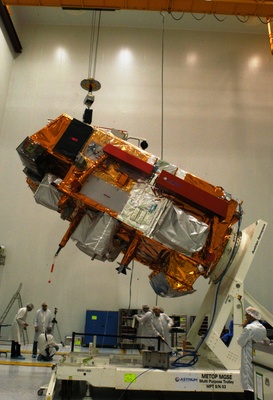
MetOp-B being readied for testing after arriving at the launch facilities at Baikonur.

ESA's MetOp-B is readied in Starsem’s facilities at Baikonur Cosmodrome, where the weather satellite will be orbited in May by a Soyuz launcher.

Preparations for the 25th mission of Arianespace’s Starsem affiliate are on schedule for a liftoff in the second half of May, using a Soyuz 2 launcher to orbit the European MetOp-B weather satellite from Kazakhstan’s Baikonur Cosmodrome.

With MetOp-B undergoing checkout since being delivered on March 6 to the cosmodrome, the launcher campaign has moved into a new phase with today’s arrival of the Soyuz vehicle’s Fregat M upper stage.

MetOp-B was developed as a joint undertaking between the European Space Agency and EUMETSAT (the European Organisation for the Exploitation of Meteorological Satellites).

It is the second of three nearly identical satellites to provide continuous weather observations until 2020, and follows MetOp-A – which was orbited by Starsem in October 2006 on a Soyuz mission from Baikonur Cosmodrome.

This upcoming flight uses a modernized Soyuz version of the workhorse Russian-built launcher, which also is in service with Arianespace at the Spaceport in French Guiana.

Starsem is Arianespace’s affiliate company created to operate commercial Soyuz missions from Baikonur Cosmodrome.

Its first launch was in February 1999, and the 24 flights performed to date have orbited a diverse range of payloads, including first- and second-generation satellites for Globalstar’s mobile voice and data services, the Cluster II and Corot scientific spacecraft, the Mars Express and Venus Express interplanetary probes, the Galaxy 14 and Amos 2 telecommunications platform, the GIOVE navigation satellite, an Inflatable Reentry and Descent Technology demonstrator, the Radarsat-2 Earth observation satellite, and MetOp-A.

Wednesday, December 21, 2011

Vega to fly ESA experimental reentry vehicle

Europe's ambition for a spacecraft to return autonomously from low orbit is a cornerstone for a wide range of space applications, including space transportation, exploration and robotic servicing of space infrastructure. 

Part of this goal will be achieved with IXV Intermediate eXperimental Vehicle, planned for launch in 2014.

Launched into a suborbital trajectory on ESA's Vega rocket from Europe's Spaceport in French Guiana, IXV will return to Earth as if from a low-orbit mission, to test and qualify new European critical reentry technologies such as advanced ceramic and ablative thermal protection. 

The 2 t IXV lifting body is about 5 m long, 2.2 m wide and 1.5 m high. Its hypersonic lift-to-drag ratio of 0.7 guarantees the required aerodynamic performance. Credits: ESA/J.Huart

The launch of ESA's IXV Intermediate eXperimental Vehicle on Europe's new Vega rocket is now in detailed planning, a major step towards the craft's flight in 2014.

Launched into a suborbital trajectory from Europe's Spaceport in French Guiana, IXV will return to Earth as if from a low-orbit mission, to test and qualify new critical technologies for future reentry vehicles.

It will attain an altitude of around 450 km, allowing it to reach a velocity of 7.5 km/s on entering the atmosphere. It will collect a large amount of data during its hypersonic and supersonic flight, while it is being controlled by thrusters and aerodynamic flaps.

IXV will then descend by parachute and land in the Pacific Ocean to await recovery and analysis.

ESA and the Arianespace launch provider signed a contract on 14 December to study the launch on Vega, as part of the VERTA - Vega Research and Technology Accompaniment - programme.

The rocket's qualification flight planned for liftoff at the end of January will pave the way for the next five VERTA missions that will demonstrate the system's flexibility.

At a planned rate of two launches per year, the programme will allow the smooth introduction of Vega for commercial exploitation.

Following development of critical technologies and completion of the design, the vehicle's manufacturing, assembly, integration and qualification is now under way for a flight window between January and September 2014.

Procurement of the ground network has begun, including the mission control centre, ground station telemetry kits, transportable antennas and communication network.

Vega is Europe's new, small launcher. Its performance perfectly complements that of the heavy Ariane 5 and medium Soyuz rockets launched from French Guiana.

It is designed to cope with a wide range of missions and payload configurations in order to respond to different market opportunities and provide great flexibility.

In particular, it offers configurations able to handle payloads ranging from a single satellite up to one main satellite plus six microsatellites.

Vega is compatible with payload masses ranging from 300 kg to 2500 kg, depending on the type and altitude of the orbit required by the customers. The benchmark is for 1500 kg into a 700 km-altitude polar orbit.

NASA: The Soyuz TMA-03M spacecraft lifted off at 8:16 a.m. EST from the Baikonur Cosmodrome in Kazakhstan


The Soyuz TMA-03M spacecraft lifted off at 8:16 a.m. EST from the Baikonur Cosmodrome in Kazakhstan.

Watch on NASA TV

Tuesday, December 20, 2011

NASA Expedition 30: Soyuz Rolls to Baikonur Launch Pad

The Soyuz TMA-03M spacecraft is rolled out by train on its way to the launch pad at the Baikonur Cosmodrome, Kazakhstan, Monday, Dec. 19, 2011.

The launch of the Soyuz spacecraft with Expedition 30 Soyuz Commander Oleg Kononenko of Russia, NASA Flight Engineer Don Pettit and European Space Agency astronaut and Flight Engineer Andre Kuipers is scheduled for 8:16 a.m. EST on Wednesday, Dec. 21.

Image Credit: NASA/Carla Cioffi

Wednesday, December 14, 2011

ESA: The launch of PromISSe Mission and Dutch astronaut André Kuipers

ESA astronaut André Kuipers is scheduled for launch to the International Space Station on 21 December.

André Kuipers will be launched on a Soyuz to the International Space Station on his five-month PromISSe mission at 14:16 CET (13:16 GMT) on 21 December from Baikonur cosmodrome in Kazakhstan.

PromISSe is Europe's fourth long-duration flight to the orbital outpost, and André's second mission to the Station.

His duties during the five-month mission will include being the prime operator for Europe's third supply spacecraft, ATV Edoardo Amaldi, when it arrives at the Station in March next year.

Similarly, André will be involved in berthing the visiting Cygnus and Dragon US cargo vehicles during their maiden demonstration flights to the Station.

He will also conduct an extensive programme of educational and scientific experiments, benefitting from his background as a medical doctor.

For more information about André and his PromISSe mission, please visit: www.esa.int/promisse