Showing posts with label Dragon V2. Show all posts

Friday, September 12, 2014

SpaceX Dragon V2: Next ISS cargo launch set for Sept 20

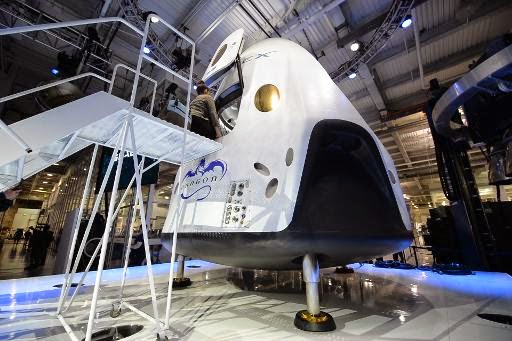
SpaceX's new seven-seat Dragon V2 spacecraft is seen at a press conference to unveil the new spaceship, in Hawthorne, California, May 29, 2014

SpaceX's next unmanned cargo trip to restock supplies at the International Space Station is scheduled for September 20, the US space agency said Friday.

The Dragon spacecraft will launch atop a Falcon 9 rocket at 2:16 am (0616 GMT) on September 20 from Cape Canaveral Air Force Station in Florida, NASA said.

"If for any reason the launch is postponed, the next launch opportunity is Sunday, Sept. 21 at approximately 1:53 am," it said in a statement.

The cargo ship will be loaded with more than 5,000 pounds (2,300 kilograms) of supplies and scientific experiments, including an ocean surface wind speed monitor, equipment for studying rodents in microgravity and cabbage-like plants to see how their growth adapts in space.

The mission, called SpaceX CRS-4, "is the fourth of 12 SpaceX flights NASA contracted with the company to resupply the space station," the space agency said.

The trip marks the fifth Dragon journey to the orbiting outpost, including its initial demonstration mission.

SpaceX and Orbital Sciences Corporation each have billion-dollar contracts with NASA to supply the space station over the coming years.

The retirement of the space shuttle program in 2011 has left the United States without a government spacecraft to transport cargo or crew to the space station.

Thursday, August 21, 2014

SpaceX's Dragon V2 Manned Spacecraft

Revealed on May 29, 2014, SpaceX's Dragon Version 2 capsule can carry a crew of seven astronauts to the International Space Station. 

The reusable Dragon is designed to last for up to 10 flights before needing significant refurbishment.

The capsule lands on the ground using its 16,000-pound thrust SuperDraco rocket engines and landing legs, with parachutes also on board as a backup.

Dragon V2 opens its nosecone to reveal its docking hatch for mating with the International Space Station. The capsule seats seven astronauts.

A control panel is folded out of the way until needed.

A steering joystick and physical buttons for critical functions occupy the center section of the control panel.

For landing, Dragon uses its eight SuperDraco rocket engines to touch down at a designated landing field.


Saturday, May 31, 2014

SpaceX unveils Dragon V2, an upgraded capsule to uplift astronauts to space - Video

The interior of SpaceX's new seven-seat Dragon V2 spacecraft, the company’s next generation version of the Dragon ship designed to carry astronauts into space, as seen at a press conference in Hawthorne, California, on May 29, 2014

A sleek, white gumdrop-shaped space capsule that aims to carry up to seven astronauts to the International Space Station and return to land anywhere on Earth was unveiled Thursday by SpaceX.

The Dragon V2, short for version two, is the first attempt by a private company to restore Americans' ability to send people to the orbiting space station in the wake of the space shuttle program's retirement in 2011.

"It's all around, I think, really a big leap forward in technology. It really takes things to the next level," said SpaceX CEO Elon Musk.


SpaceX is competing with other companies, including Boeing, Sierra Nevada and Blue Origin, to be the first commercial outfit to take astronauts to space, possibly as early as 2017.

Until then, the world's astronauts must rely on Russian Soyuz spacecraft at a cost of $70 million per seat.

The Dragon V2 was shown for the first time at a jam-packed evening press conference in Hawthorne, California.

The shiny Dragon V2 sat on a white stage floor, as a scorched Dragon cargo capsule was suspended above, bearing the blackened markings of a capsule that had returned to Earth from orbit.

SpaceX's Dragon capsule in 2012 became the first private spacecraft to carry supplies to the ISS and back.

Since then, Orbital Sciences has followed with its Cygnus, a capsule shaped like a beer keg that can carry supplies to the space station but burns upon re-entry to Earth's atmosphere.

SpaceX CEO Elon Musk introduces SpaceX's Dragon V2 spacecraft, the company's next generation version of the Dragon ship, designed to carry astronauts into space, at a press conference in Hawthorne, California, on May 29, 2014

Musk said a key feature of the Dragon V2 is that it will be able to "land anywhere on Earth with the accuracy of a helicopter."

The crew spacecraft will be able to use rocket propulsion and deploy legs to land, instead of using parachutes to make an ocean splash-landing the way the cargo capsule does.

It will however still have parachutes that it can use for a landing in case any engine problems are detected before touchdown on Earth.

The V2 also carries an improved heat shield and will be able to autonomously dock with the space station, instead of needing the space station's robotic arm to catch it and pull it in.

"That is a significant upgrade as well," Musk said.

SpaceX CEO Elon Musk introduces SpaceX's Dragon V2 spacecraft, the company's next generation version of the Dragon ship designed to carry astronauts into space, at a press conference in Hawthorne, California, on May 29, 2014

Musk touted the reusability of the Dragon V2, allowing it to cut back on expensive space journeys.

"You can just reload propellant and then fly again. This is extremely important for revolutionizing access to space," Musk said.

"Because as long as we continue to throw away rockets and spacecraft, we will never have true access to space. It will always be incredibly expensive," he added.

"If aircraft were thrown away with each flight, nobody would be able to fly."

The Internet entrepreneur and billionaire co-founder of PayPal did not say when the Dragon V2's first test flight would take place.

Wednesday, May 28, 2014

SpaceX CEO Elon Musk to Unveil Manned Dragon ‘Space Taxi’ on May 29

SpaceX Dragon cargo freighter berthed to the International Space Station during recently concluded SpaceX-3 mission in May 2014. 

An upgraded, manrated version will carry US astronauts to space in the next two to three years. 

Credit: NASA

SpaceX CEO, founder and chief designer Elon Musk is set to unveil the manned version of his firms commercial Dragon spaceship later this week, setting in motion an effort that he hopes will soon restore America's capability to launch US astronauts to low Earth orbit and the International Space Station (ISS) by 2017.

Musk will personally introduce SpaceX's 'Space Taxi' dubbed 'Dragon V2' at what amounts to sort of a world premiere event on May 29 at the company's headquarters in Hawthorne, CA, according to an official announcement this evening (May 27) from SpaceX.

"SpaceX's new Dragon V2 spacecraft is a next generation spacecraft designed to carry astronauts into space," according to the SpaceX statement.

The manned Dragon will launch atop the powerful SpaceX Falcon 9 v1.1 rocket from a SpaceX pad on the Florida Space Coast.

Dragon was initially developed as a commercial unmanned resupply freighter to deliver 20,000 kg (44,000 pounds) of supplies and science experiments to the ISS under a $1.6 Billion Commercial Resupply Services (CRS) contract with NASA during a dozen Dragon cargo spacecraft flights through 2016.

Musk is making good on a recent comment he posted to twitter on April 29, with respect to the continuing fallout from the deadly crisis in Ukraine which has resulted in some US economic sanctions imposed against Russia, that now potentially threaten US access to the ISS in a boomerang action from the Russian government:

"Sounds like this might be a good time to unveil the new Dragon Mk 2 spaceship that @SpaceX has been working on with @NASA."

"No trampoline needed," Musk tweeted. The 'Dragon V2' is an upgraded, man rated version of the unmanned spaceship that can carry a mix of cargo and up to a seven crewmembers to the ISS.

Dragon is among a trio of US private sector manned spaceships being developed with seed money from NASA's Commercial Crew Program in a public/private partnership to develop a next-generation crew transportation vehicle to ferry astronauts to and from the ISS by 2017, a capability totally lost following the space shuttle's forced retirement in 2011.

NASA astronauts and industry experts check out the crew accommodations in the Dragon spacecraft under development by SpaceX. 

The evaluation in Hawthorne, Calif., on Jan. 30, 2012, was part of SpaceX’s Commercial Crew Development Round 2 agreement with NASA’s Commercial Crew Program. 

Credit: NASA

Since that day, US astronauts have been totally dependent on the Russian Soyuz capsules for ferry rides to orbit and back.

The Boeing CST-100 and Sierra Nevada Dream Chaser 'space taxis' are also vying for funding in the next round of contracts to be awarded by NASA around late summer 2014.

All three company's have been making excellent progress in meeting their NASA mandated milestones in the current contract period known as Commercial Crew Integrated Capability initiative (CCiCAP) under the auspices of NASA's Commercial Crew Program.