Showing posts with label set. Show all posts

Friday, September 12, 2014

SpaceX Dragon V2: Next ISS cargo launch set for Sept 20

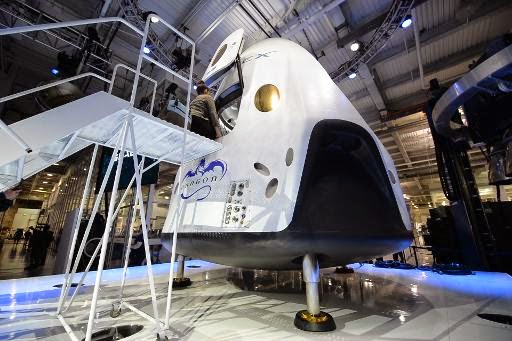
SpaceX's new seven-seat Dragon V2 spacecraft is seen at a press conference to unveil the new spaceship, in Hawthorne, California, May 29, 2014

SpaceX's next unmanned cargo trip to restock supplies at the International Space Station is scheduled for September 20, the US space agency said Friday.

The Dragon spacecraft will launch atop a Falcon 9 rocket at 2:16 am (0616 GMT) on September 20 from Cape Canaveral Air Force Station in Florida, NASA said.

"If for any reason the launch is postponed, the next launch opportunity is Sunday, Sept. 21 at approximately 1:53 am," it said in a statement.

The cargo ship will be loaded with more than 5,000 pounds (2,300 kilograms) of supplies and scientific experiments, including an ocean surface wind speed monitor, equipment for studying rodents in microgravity and cabbage-like plants to see how their growth adapts in space.

The mission, called SpaceX CRS-4, "is the fourth of 12 SpaceX flights NASA contracted with the company to resupply the space station," the space agency said.

The trip marks the fifth Dragon journey to the orbiting outpost, including its initial demonstration mission.

SpaceX and Orbital Sciences Corporation each have billion-dollar contracts with NASA to supply the space station over the coming years.

The retirement of the space shuttle program in 2011 has left the United States without a government spacecraft to transport cargo or crew to the space station.

Friday, January 29, 2010

Giant Laser set to trigger Fusion Reaction


The world's largest laser is approaching the long-sought goal of igniting a fusion reaction that produces more energy than the laser delivers.

Lasers are intended to do this by super-heating a fusion fuel pellet until it implodes, heating and compressing its central core to the temperatures and pressures needed for nuclear fusion.

Past experiments have been plagued by irregular implosions that wasted most of the input energy. But now, researchers led by Brian MacGowan of the Lawrence Livermore National Laboratory in California have managed to squeeze targets of material into spheres rather than pancakes or more lopsided shapes, paving the way for future attempts at fusion.

The work was performed at Livermore's 192-laser beam National Ignition Facility (NIF), which began operating in 2009.

The team used targets that did not contain the key ingredients for fusion – two isotopes of hydrogen known as deuterium and tritium. But the symmetrical implosion of the targets suggests that NIF should be able to ignite fusion with laser pulses of 1.2 to 1.3 megajoules – well below its full 1.8-megajoule capacity.

"From everything we can see, we're on the right path here," Jeff Wisoff, a top NIF manager told New Scientist.

Researchers spent last year slowly cranking up the output of the laser, ultimately reaching a total energy of more than 1 megajoules. Now they're pausing to mount new instruments on the 10-centimetre-thick aluminium target chamber and to install giant concrete doors to contain neutrons they expect to produce in future fusion experiments.

In a few months, they will begin testing a series of new targets designed to assess beam interactions and compression. If all goes well, they could try for fusion ignition by the end of the year.