Showing posts with label Extraterrestrial Intelligence. Show all posts

Wednesday, July 23, 2014

Search for extraterrestrial intelligence targeting alien polluters

In this artist's conception, the atmosphere of an Earth-like planet displays a brownish haze; the result of widespread pollution. 

New research shows that the upcoming James Webb Space Telescope (JWST) potentially could detect certain pollutants, specifically CFCs, in the atmospheres of Earth-sized planets orbiting white dwarf stars. 

Credit: Christine Pulliam (CfA)

Humanity is on the threshold of being able to detect signs of alien life on other worlds.

By studying exoplanet atmospheres, we can look for gases like oxygen and methane that only coexist if replenished by life but those gases come from simple life forms like microbes. What about advanced civilizations? Would they leave any detectable signs?

They might, if they spew industrial pollution into the atmosphere. New research by theorists at the Harvard-Smithsonian Center for Astrophysics (CfA) shows that we could spot the fingerprints of certain pollutants under ideal conditions. This would offer a new approach in the search for extraterrestrial intelligence (SETI).

"We consider industrial pollution as a sign of intelligent life, but perhaps civilizations more advanced than us, with their own SETI programs, will consider pollution as a sign of unintelligent life since it's not smart to contaminate your own air," says Harvard student and lead author Henry Lin.

"People often refer to ETs as 'little green men,' but the ETs detectable by this method should not be labeled 'green' since they are environmentally unfriendly," adds Harvard co-author Prof Avi Loeb.

The team, which also includes Smithsonian scientist Gonzalo Gonzalez Abad, finds that the upcoming James Webb Space Telescope (JWST) should be able to detect two kinds of chlorofluorocarbons (CFCs); ozone-destroying chemicals used in solvents and aerosols.

They calculated that JWST could tease out the signal of CFCs if atmospheric levels were 10 times those on Earth.

A particularly advanced civilization might intentionally pollute the atmosphere to high levels and globally warm a planet that is otherwise too cold for life.

There is one big caveat to this work. JWST can only detect pollutants on an Earth-like planet circling a white dwarf star, which is what remains when a star like our Sun dies.

That scenario would maximize the atmospheric signal. Finding pollution on an Earth-like planet orbiting a Sun-like star would require an instrument beyond JWST; a next-next-generation telescope.

The team notes that a white dwarf might be a better place to look for life than previously thought, since recent observations found planets in similar environments.

Those planets could have survived the bloating of a dying star during its red giant phase, or have formed from the material shed during the star's death throes.

While searching for CFCs could ferret out an existing alien civilization, it also could detect the remnants of a civilization that annihilated itself.

Some pollutants last for 50,000 years in Earth's atmosphere while others last only 10 years. Detecting molecules from the long-lived category but none in the short-lived category would show that the sources are gone.

"In that case, we could speculate that the aliens wised up and cleaned up their act. Or in a darker scenario, it would serve as a warning sign of the dangers of not being good stewards of our own planet," says Loeb.

Monday, January 27, 2014

Extraterrestrial Intelligence: The Challenge of Comprehending E.T.'s IQ

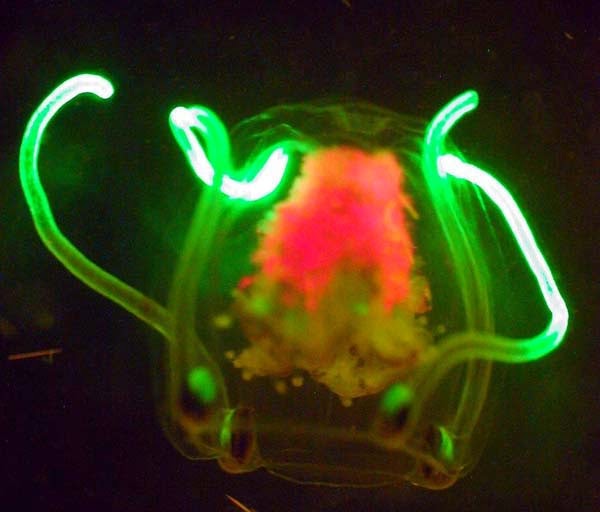
A tiny jellyfish with green-glowing, fluorescent tentacles and red fluorescence in its body, owing to the chlorophyll in gobbled-up algae. 

Could we detect any evidence of intelligent signaling in such a creature if it were an alien species? 

Credit: Mikhail Matz, Islands in the Stream 2002, NOAA-OER

Although we often ponder the possible otherworldly morphology of extraterrestrials, a harder exercise is conceiving alien intelligences.

An alien might have four limbs, just like we humans or it might sport 17 tentacles, depending on evolutionary pressures.

We can observe, quantify and describe such things. But how can we truly gauge the workings of an alien mind?

A new paper, publishing in Acta Astronautica in February, offers a preliminary exercise meant to get us to think outside our own box in assessing alien intellect.

The exercise is called COMPLEX, which stands for "COmplexity of Markers for Profiling Life in EXobiology."

The project compares various non-human intelligences—including animals, microbes and machines—to each other (rather than humans) and across several categories of behavior and mental capability.

Denise Herzing
"The goal of COMPLEX would be to prepare ourselves for assessing other species if we find life in space," said Denise Herzing, the study's author and a biologist at Florida Atlantic University.

The research could be critical to astrobiology, which relies heavily on understanding Earthlings to gauge what's possible on other planets.

Across the dizzying array of Earth's biota, "intelligence" is an awfully tricky thing to pin down.

Historically, we've often defined intelligence in other beings based on how much it resembles our own.

We collect sound patterns from whales that could qualify as language, seize upon rudimentary tool use by crows, and admire the social complexity of elephant societies.

Viewing these non-human intelligences through a human lens, however, might be shortchanging these creatures' intellectual abilities.

Furthermore, when applied to non-Earthly life forms, our bias towards human intelligence's characteristics might really miss the mark.

Denise Herzing's background has well-prepared her for such an astrobiological undertaking. She is the research director and founder of the Wild Dolphin Project, an organization that has studied a dolphin pod for nearly three decades to learn about the animals' behaviours, social structure and more.

Many scientists consider dolphins (technically, porpoises; "dolphin" is a common name given to the animal) among the most intelligent creatures on Earth, perhaps on par with non-human primates.

Read the full article here

More information: Denise L Herzing, "Profiling nonhuman intelligence: An exercise in developing unbiased tools for describing other "types" of intelligence on earth," Acta Astronautica, Volume 94, Issue 2, February 2014, Pages 676-680, ISSN 0094-5765, dx.doi.org/10.1016/j.actaastro.2013.08.007