Showing posts with label Challenge. Show all posts

Wednesday, October 1, 2014

Molybdenum Di-Sulphide (MoS2): A potential challenger to graphene

Sheets of tin sulphide - The diameter of the roll is about 10 times smaller than a human hair.

A team of researchers from the University of Southampton's Optoelectronics Research Centre (ORC) has developed a new way to fabricate a potential challenger to Manchester's Graphene.

Graphene, a single layer of carbon atoms in a honeycomb lattice, is increasingly being used in new electronic and mechanical applications, such as transistors, switches and light sources, thanks to the unprecedented properties it offers: very low electrical resistance, high thermal conductivity and mechanically stretchable yet harder than diamond.

Molybdenum Di-Sulphide (MoS2)
Now, ORC researchers have developed Molybdenum Di-Sulphide (MoS2), a similar material to graphene that shares many of its properties, including extraordinary electronic conduction and mechanical strength, but made from a metal (in this case molybdenum combined with sulphur).

This new class of thin metal/sulphide materials, known as transition metal di-chalcogenides (TMDCs), has become an exciting complimentary material to graphene.

However, unlike graphene, TMDCs can also emit light allowing applications, such as photodetectors and light emitting devices, to be manufactured.

Until recently, fabrication of TMDCs, such as MoS2, has been difficult, as most techniques produce only flakes, typically just a few hundred square microns in area.

Dr Kevin Huang, from ORC who has led the research, explains: "We have been working on the synthesis of chalcogenide materials using a chemical vapour deposition (CVD) process since 2001 and our technology has now achieved the fabrication of large area (>1000 mm2) ultra- thin films only a few atoms thick."

"Being able to manufacture sheets of MoS2 and related materials, rather than just microscopic flakes, as previously was the case, greatly expands their promise for nanoelectronic and optoelectronic applications."

Dr Huang and his team published their findings in the latest issue of the journal Nanoscale.

They are currently working with several UK companies and universities, as well as leading international centres at MIT and Nanyang Technological University (Singapore).

Dr Huang adds: "Our ability to not only synthesise large uniform thin films but also to transfer these films to virtually any substrate has led to increased demand for our materials."

More Information
"Scalable high-mobility MoS2 thin films fabricated by an atmospheric pressure chemical vapor deposition process at ambient temperature" Author: Chung-Che Huang, Feras Al-Saab, Yudong Wang, Jun-Yu Ou, John C. Walker, Shuncai Wang, Behrad Gholipour, Robert E. Simpsond and    Daniel W. Hewaka - Nanoscale, 2014, Advance Article DOI: 10.1039/C4NR04228J - Received 25 Jul 2014

Sunday, September 28, 2014

Sierra Nevada Corp (SNC) challenges Boeing and SpaceX spacecraft contract

An interior view of Boeing's CST-100 spacecraft.

Credit: Boeing

Sierra Nevada Corp (SNC) said it had filed a legal challenge to NASA’s award of contracts totaling $6.8 billion to Boeing and SpaceX to build commercially owned and operated “space taxis” to fly astronauts to the International Space Station.

NASA had considered a bid by privately owned Sierra Nevada, but U.S. officials said on Tuesday the U.S. space agency had opted to award long-time aerospace contractor Boeing and SpaceX with contracts to develop, certify and fly their seven-person capsules.

SNC said its bid could have saved up to $900 million and that NASA’s statements “indicate that there are serious questions and inconsistencies in the source selection process.”

SNC, therefore, feels that there is no alternative but to institute a legal challenge,” it added in a statement on Friday.

Boeing was awarded $4.2 billion and SpaceX $2.6 billion. SpaceX is run by technology entrepreneur Elon Musk, also chief executive of electric car manufacturer Tesla Motors Inc.

“With the current awards, the U.S. government would spend up to $900 million more at the publicly announced contracted level for a space program equivalent to the program that SNC proposed,” Sierra Nevada said.

It said a “thorough review must be conducted of the award decision.”

The space taxis would end U.S. dependence on Russia for rides to the space station.

The contract has taken on new urgency given rising tensions over Russia’s annexation of the Crimea region of Ukraine and support for rebels in eastern Ukraine.

Wednesday, June 4, 2014

Very Strong magnetic fields challenge the pull of supermassive black holes

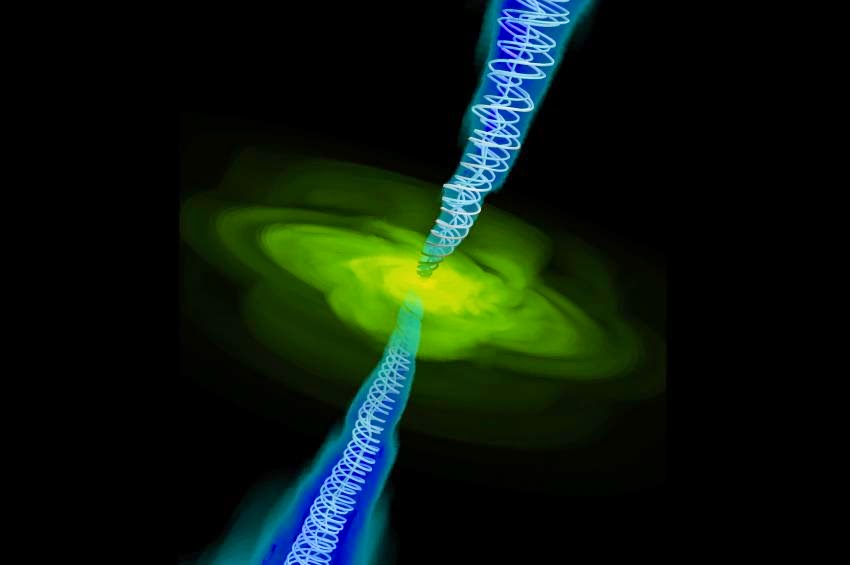
This is a computer simulation of gas (in yellow) falling into a black hole (too small to be seen). 

Twin jets are also shown with magnetic field lines. 

Credit: Alexander Tchekhovskoy, Berkeley Lab

A new study of supermassive black holes at the centers of galaxies has found magnetic fields play an impressive role in the systems' dynamics.

In fact, in dozens of black holes surveyed, the magnetic field strength matched the force produced by the black holes' powerful gravitational pull, says a team of scientists from the U.S. Department of Energy's Lawrence Berkeley National Laboratory (LBNL) and Max Planck Institute for Radio Astronomy (MPIfR) in Bonn, Germany.

The findings "Dynamically important magnetic fields near accreting supermassive black holesare published in this week's issue of Nature.

"This paper for the first time systematically measures the strength of magnetic fields near black holes," says Alexander Tchekhovskoy, the Berkeley Lab researcher who helped interpret the observational data within the context of existing computational models.

"This is important because we had no idea, and now we have evidence from not just one, not just two, but from 76 black holes."

Previously, Tchekhovskoy, who is also a postdoctoral fellow at the University of California, Berkeley, had developed computational models of black holes that included magnetic fields.

His models suggested a black hole could sustain a magnetic field that was as strong as its gravity, but there was not yet observational evidence to support this prediction.

With the two forces balancing out, a cloud of gas caught on top of the magnetic field would be spared the pull of gravity and instead levitate in place.

The magnetic field strength was confirmed by evidence from jets of gas that shoot away from supermassive black holes.

Formed by magnetic fields, these jets produce a radio emission. "We realized that the radio emission from black holes' jets can be used to measure the magnetic field strength near the black hold itself," says Mohammad Zamaninasab, the lead author of the study, who did the work while at MPIfR.

Other research teams had previously collected radio-emission data from "radio-loud" galaxies using the Very Long Baseline Array, a vast network of radio telescopes in the United States.

The researchers analyzed this pre-existing data to create radio-emission maps at different wavelengths. Shifts in jet features between different maps let them calculate the field strength near the black hole.

Based on the results, the team found not only that the measured magnetic fields can be as strong as a black hole's gravity, but that they are also comparable in strength to those produced inside MRI machines found in hospitals, roughly 10,000 times greater than the field of the Earth itself.

Tchekhovskoy says the new results mean theorists must re-evaluate their understanding of black-hole behaviour.

"The magnetic fields are strong enough to dramatically alter how gas falls into black holes and how gas produces outflows that we do observe, much stronger than what has usually been assumed," he says. "We need to go back and look at our models once again."

More information: Paper: Dynamically important magnetic fields near accreting supermassive black holes, DOI: 10.1038/nature13399

Monday, May 26, 2014

NASA WISE study challenges black hole 'doughnut' theory

Active, supermassive black holes at the hearts of galaxies tend to fall into two categories: those that are hidden by dust, and those that are exposed. 

Credit: NASA/JPL-Caltech

A survey of more than 170,000 supermassive black holes, using NASA's Wide-field Infrared Survey Explorer (WISE), has astronomers reexamining a decades-old theory about the varying appearances of these interstellar objects.

The unified theory of active, supermassive black holes, first developed in the late 1970s, was created to explain why black holes, though similar in nature, can look completely different.

Some appear to be shrouded in dust, while others are exposed and easy to see.

The unified model answers this question by proposing that every black hole is surrounded by a dusty, doughnut-shaped structure called a torus.

Depending on how these "doughnuts" are oriented in space, the black holes will take on various appearances.

For example, if the doughnut is positioned so that we see it edge-on, the black hole is hidden from view. If the doughnut is observed from above or below, face-on, the black hole is clearly visible.

However, the new WISE results do not corroborate this theory. The researchers found evidence that something other than a doughnut structure may, in some circumstances, determine whether a black hole is visible or hidden.

The team has not yet determined what this may be, but the results suggest the unified, or doughnut, model does not have all the answers.

"Our finding revealed a new feature about active black holes we never knew before, yet the details remain a mystery," said Lin Yan of NASA's Infrared Processing and Analysis Center (IPAC), based at the California Institute of Technology in Pasadena.

"We hope our work will inspire future studies to better understand these fascinating objects."

Yan is the second author of the research accepted for publication in the Astrophysical Journal.

The lead author is a post-doctoral researcher, Emilio Donoso, who worked with Yan at IPAC and has since moved to the Instituto de Ciencias AstronĂ³micas, de la Tierra y del Espacio (ICATE) in Argentina.

The research also was co-authored by Daniel Stern at NASA's Jet Propulsion Laboratory in Pasadena, California, and Roberto Assef of Universidad Diego Portales in Chile and formerly of JPL.

Every galaxy has a massive black hole at its heart. The new study focuses on the "feeding" ones, called active, supermassive black holes, or active galactic nuclei. These black holes gorge on surrounding gas material that fuels their growth.

With the aid of computers, scientists were able to pick out more than 170,000 active supermassive black holes from the WISE data.

They then measured the clustering of the galaxies containing both hidden and exposed black holes—the degree to which the objects clump together across the sky.

More information: The Angular Clustering of WISE-Selected AGN: Different Haloes for Obscured and Unobscured AGN, arxiv.org/abs/1309.2277

Monday, January 27, 2014

Extraterrestrial Intelligence: The Challenge of Comprehending E.T.'s IQ

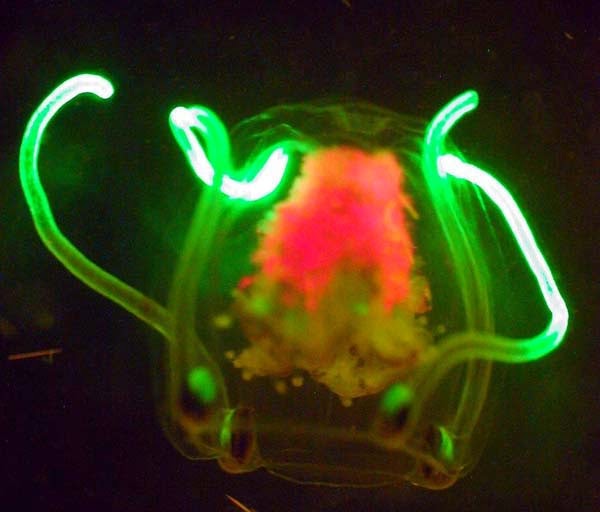
A tiny jellyfish with green-glowing, fluorescent tentacles and red fluorescence in its body, owing to the chlorophyll in gobbled-up algae. 

Could we detect any evidence of intelligent signaling in such a creature if it were an alien species? 

Credit: Mikhail Matz, Islands in the Stream 2002, NOAA-OER

Although we often ponder the possible otherworldly morphology of extraterrestrials, a harder exercise is conceiving alien intelligences.

An alien might have four limbs, just like we humans or it might sport 17 tentacles, depending on evolutionary pressures.

We can observe, quantify and describe such things. But how can we truly gauge the workings of an alien mind?

A new paper, publishing in Acta Astronautica in February, offers a preliminary exercise meant to get us to think outside our own box in assessing alien intellect.

The exercise is called COMPLEX, which stands for "COmplexity of Markers for Profiling Life in EXobiology."

The project compares various non-human intelligences—including animals, microbes and machines—to each other (rather than humans) and across several categories of behavior and mental capability.

Denise Herzing
"The goal of COMPLEX would be to prepare ourselves for assessing other species if we find life in space," said Denise Herzing, the study's author and a biologist at Florida Atlantic University.

The research could be critical to astrobiology, which relies heavily on understanding Earthlings to gauge what's possible on other planets.

Across the dizzying array of Earth's biota, "intelligence" is an awfully tricky thing to pin down.

Historically, we've often defined intelligence in other beings based on how much it resembles our own.

We collect sound patterns from whales that could qualify as language, seize upon rudimentary tool use by crows, and admire the social complexity of elephant societies.

Viewing these non-human intelligences through a human lens, however, might be shortchanging these creatures' intellectual abilities.

Furthermore, when applied to non-Earthly life forms, our bias towards human intelligence's characteristics might really miss the mark.

Denise Herzing's background has well-prepared her for such an astrobiological undertaking. She is the research director and founder of the Wild Dolphin Project, an organization that has studied a dolphin pod for nearly three decades to learn about the animals' behaviours, social structure and more.

Many scientists consider dolphins (technically, porpoises; "dolphin" is a common name given to the animal) among the most intelligent creatures on Earth, perhaps on par with non-human primates.

Read the full article here

More information: Denise L Herzing, "Profiling nonhuman intelligence: An exercise in developing unbiased tools for describing other "types" of intelligence on earth," Acta Astronautica, Volume 94, Issue 2, February 2014, Pages 676-680, ISSN 0094-5765, dx.doi.org/10.1016/j.actaastro.2013.08.007