Showing posts with label UK. Show all posts

Tuesday, January 13, 2015

Mars HiRise Image: UK's ill-fated Mars Probe Beagle 2 may have been spotted

More than 11 years after UK Mars probe Beagle 2 was lost, believed crashed, space scientists are set to reveal new findings about what hapened to the spacecraft.

Mystery surrounds exactly what will be disclosed by experts from the European Space Agency and the underfunded, struggling, UK Space Agency at the English National Academy of Science, known as the Royal Society in London on Friday, but it has raised hopes that orbiting spacecraft around Mars might have located the debris of the Beagle 2.

The probe was the brainchild of the eccentric, mutton-chopped Professor Colin Pillinger, of the UK’s Open University, who died suddenly in May 2014 from a brain haemorrhage.

Beagle 2 was carried to Mars by ESA’s Mars Express which remains in orbit to this day performing valuable surveys of the planet.

Beagle was due to land on Christmas Day 2003, but nothing was ever heard from the tiny craft.

Experts later concluded that its parachute had failed in the extra thin atmosphere and it hit the ground too hard.

Months later, Colin called an impromptu press conference, convinced that he had identified a speck in a photo of the martian surface as his lost probe, but later higher-resolution imagery from a NASA orbiter showed there was nothing.

This recent announcement would indicate that this time there is hope that something really has been spotted.

The panel at Friday’s announcement will include Beagle 2’s mission manager Professor Mark Sims, Dr John Bridges of Leicester University’s Space Research Centre, the European Space Agency’s director of science and robotic exploration Alvaro Giménez, and David Parker, of Durham University and the underfunded UK Space Agency.

A recent image from the HiRise camera on the NASA MRO. 

Credit: NASA, JPL, University of Arizona

All are remaining tight-lipped about what will be revealed, but interestingly, Dr Bridges is a member of the team working with the HiRISE camera aboard NASA's Mars Reconnaissance Orbiter, which is the only imager powerful enough to pick out the debris of Beagle 2, or any other probe, from orbit.

John Zarnecki, Emeritus Professor of Space Science, and Professor Pillinger’s former colleague, told reporters: “I don’t know what they will announce. All one can think of is that they might have got an image of the probe, but if Beagle 2 is in a thousand pieces, it is unlikely that we will have found the pieces.”

“When dear old Colin was alive, he imagined he could see the Beagle 2 in single pixels. None of us could see it, he was the only one who could. So if they really have found it this time, it would be wonderful.”

Professor Zarnecki, who headed the OU’s Planetary and Space Sciences department, said that finding Beagle 2 would be an important event, but there was no chance that it could still work.

He said: “The probe will be dead. There could be no battery life and it would have frozen probably. Electronic materials and components don’t like the cold of Mars very much.”

“The main thing is that it could tell us something about how and why it failed. We’re not going to get anything scientific out of it now, but anything we can learn about how and why it failed informs our designs for the future.

“One of the reasons why space missions on the whole are so successful is that we do learn from experience. It is similar to why flying by plane is so safe - we learn from failures.”

Professor Zarnecki had his own experiment on Beagle 2, a tiny device to measure temperature, air pressure, and wind-speed and direction, “like a weather station, but a fancy one”, he said.

Thursday, December 11, 2014

Severe North Atlantic cyclone strikes Ireland and UK

A very deep area of low pressure resulted in a North Atlantic cyclone (named Alexandra) which caused massive ocean surges and brought strong winds to parts of Ireland and the UK.

Met-10/Metop-B, 09 December 2014, 12:00 UTC 

Airmass RGB, with surface pressure and ASCAT winds 

Credit: EUMeTrain

Gale force gusts of more than 129 km/h (80 mph) were recorded at Tiree in Scotland and ocean waves over 15 m (50 ft) high were recorded by the K5 buoy off the north west coast of Scotland (59.10N, 11.40W)

The strong winds caused transport chaos and power outtages across the Northern parts of the UK.

The gales and ocean surges were caused by rapid or explosive cyclogenesis — an intense low pressure system with a central pressure that falls 24 hPa in a 24-hour period, referred to colloquially as a 'weather bomb'.

In EUMETSAT weather blog, ITV weather forecaster Liam Dutton explained how the jet stream caused the cyclogenesis.

The Airmass RGB image from 9 December 12:00 UTC (left side) shows the system had a central pressure of less than 950 hPa.

Met-10, 10 December 2014, 06:00 UTC.

Airmass RGB with 10 m ECMWF model winds 

Credit: EUMeTrain

The ASCAT instrument on Metop measured 60 knots (111 km/h), but the real winds were probably higher as ASCAT winds saturate at around 60 knots (higher winds than 60 knots do not produce a higher ASCAT signal).

Also striking in this image are the strong winds over the Western Mediterranean caused by Mistral winds (two storms caught in one image).

The Airmass RGB image from 10 December 06:00 UTC (right side) shows the very large fetch zone of the storm, which is ideal (conditions) for forming high (monster) waves and very large ocean surge.


Wednesday, November 19, 2014

Threadbare UK moon landing funded by Kickstarter, public charitable contributions - Video


A British-led consortium has outlined its plans to land a robotic probe on the Moon in 10 years' time, despite, and because of, UK government's lack of investment in science and innovation.

Its aim is to raise £500m for the project from Kickstarter, i.e. donations by the public.

In return, donors would be able to have photos, text and their DNA included in a time capsule which will be buried under the lunar surface.

Lunar Mission One aims to survey the Moon's south pole to see if a human base can be set up in the future.

The plan has received the endorsement of a host of well-known scientists and organisations.

These include Prof Brian Cox, the Astronomer Royal Lord Rees, and Prof Monica Grady of the Open University.

David Iron, who is leading the project, said he was setting up the initiative because governments were increasingly finding it difficult to fund space missions.

"Anyone in the world will be able to get involved for as little as just a few pounds. Lunar Mission One will make a huge contribution to our understanding of the origins of our planet and the Moon," he said.


Immortality

The team hope to raise £600,000, using the international crowd funding web service Kickstarter, in the next four weeks to fund the initial phase of the project.

For the next four years, funds will be received through contributions from the public, who will be able to buy digital storage space on the lander for their own personal text messages, pictures, music and videos.

They will also be able to pay for an immortality of sorts by sending up a strand of their hair, which the project team claim could survive for one billion years.

The cost of a short message will be a few pounds, a compressed photo will be a few tens of pounds while a short compressed video will be about £200. The cost of sending a hair sample will be around £50.

The lander will also contain a public digital archive of human history and science which will be compiled as a legacy which will survive even if our species becomes extinct.

Mr Iron believes the fact that people will have a stake in the mission will make it all the more engaging.

Legacy

"The project's long-term legacy will be a new way of funding space exploration," he told reporters.

"Rather than just watching the mission, people can be directly involved, not just through funding but helping to make key decisions such as the selection of the landing site or what should be included in the public archive."

All the money raised by the project will go to funding the mission, and any money left over will be put into a charitable trust whose proceeds will be spent on future space exploration. Mr Iron described it as "a Wellcome Trust for space exploration".

The mission will also have a scientific component. The aim is to drill and analyse a sample from underneath the lunar surface, something which has never been done before.

A key aim of the project is to educate and inspire a new generation to become engaged in science in the same way that the Apollo Moon landings did in the 1960s and 70s, and as indeed the Rosetta landing did just last week.

Wednesday, October 1, 2014

Molybdenum Di-Sulphide (MoS2): A potential challenger to graphene

Sheets of tin sulphide - The diameter of the roll is about 10 times smaller than a human hair.

A team of researchers from the University of Southampton's Optoelectronics Research Centre (ORC) has developed a new way to fabricate a potential challenger to Manchester's Graphene.

Graphene, a single layer of carbon atoms in a honeycomb lattice, is increasingly being used in new electronic and mechanical applications, such as transistors, switches and light sources, thanks to the unprecedented properties it offers: very low electrical resistance, high thermal conductivity and mechanically stretchable yet harder than diamond.

Molybdenum Di-Sulphide (MoS2)
Now, ORC researchers have developed Molybdenum Di-Sulphide (MoS2), a similar material to graphene that shares many of its properties, including extraordinary electronic conduction and mechanical strength, but made from a metal (in this case molybdenum combined with sulphur).

This new class of thin metal/sulphide materials, known as transition metal di-chalcogenides (TMDCs), has become an exciting complimentary material to graphene.

However, unlike graphene, TMDCs can also emit light allowing applications, such as photodetectors and light emitting devices, to be manufactured.

Until recently, fabrication of TMDCs, such as MoS2, has been difficult, as most techniques produce only flakes, typically just a few hundred square microns in area.

Dr Kevin Huang, from ORC who has led the research, explains: "We have been working on the synthesis of chalcogenide materials using a chemical vapour deposition (CVD) process since 2001 and our technology has now achieved the fabrication of large area (>1000 mm2) ultra- thin films only a few atoms thick."

"Being able to manufacture sheets of MoS2 and related materials, rather than just microscopic flakes, as previously was the case, greatly expands their promise for nanoelectronic and optoelectronic applications."

Dr Huang and his team published their findings in the latest issue of the journal Nanoscale.

They are currently working with several UK companies and universities, as well as leading international centres at MIT and Nanyang Technological University (Singapore).

Dr Huang adds: "Our ability to not only synthesise large uniform thin films but also to transfer these films to virtually any substrate has led to increased demand for our materials."

More Information
"Scalable high-mobility MoS2 thin films fabricated by an atmospheric pressure chemical vapor deposition process at ambient temperature" Author: Chung-Che Huang, Feras Al-Saab, Yudong Wang, Jun-Yu Ou, John C. Walker, Shuncai Wang, Behrad Gholipour, Robert E. Simpsond and    Daniel W. Hewaka - Nanoscale, 2014, Advance Article DOI: 10.1039/C4NR04228J - Received 25 Jul 2014

Sunday, June 1, 2014

SKYLON: Impoverished UK dreams of having a 'new' Spaceport on recycled aerodromes

Skylon, a concept space plane from Reaction Engines Ltd., is an entirely reusable single stage-to-orbit launch vehicle, based on revolutionary engine technology.

Credit: Adrian Mann

The UK, impoverished and technically challenged by a floundering coalition government, is hoping it could re-badge a derelict air force base as a spaceport by 2018.

Pending the usual convoluted administrative approach of a regulatory report to be published July 2014 and a technical feasibility study that is underway with the UK's National Space Technology Programme (NSTP), it may be possible that the country could convert an aging air base and claim that it hosts a spaceport, within the next five years.

A new National Space Flight Coordination Group, chaired by the UK's financially shackled Space Agency, will oversee these reports and the future work for this UK 'spaceport.'

UK Government officials made a political statement saying that they hoped this will be the start of commercial spaceflight for the country.

The politically appointed steering group and the 2018 date were announced with the publication of the "UK Government Response to the U.K. Space Innovation and Growth Strategy 2014-2030," published in November 2013 by friends in the UK aerospace industry.

This publication optimistically claims the UK's space sector could be worth 40 billion GBPs ($67 billion) by 2030. The industry is allegedly worth 9 billion GBP ($15 billion) today but most of it is sub-contracted to European (EADS) and US (Lockheed, Boeing, etc) corporations. Very little of the UK's aerospace industry is 'homegrown.'

"This [National Space Flight Coordination] group reports to [government] ministers," the government's response says.

"Its cross-cutting nature is recognition of the scale of the challenge inherent in identifying, approving and building a U.K. spaceport and in supporting all the necessary innovation and technology that it would require."


These are not the first attempts at reports and studies that the U.K. government has undertaken in its quest to appear to have a viable spaceport, it is merely the first time the government has set a date for the creation of such a facility.

In 2009, the British National Space Centre (BNSC), which preceded the U.K. Space Agency created in 2010, funded a study into spaceport candidate locations. That study concluded that Lossiemouth in Scotland would be the best site.

Located in northern Scotland, Lossiemouth is on the coast of the North Sea and has a recently-closed Royal Air Force base with a runway suitable for the types of launch systems that favour, UK Tax exile, billionaire and hedonist, Sir Richard Branson's Virgin Galactic.

The Scottish people have an excellent and long history of engineering and are renowned as innovative, motivated and dedicated engineers and scientists, but they are both politically and physically a long way from the decisions being made in London, by the London-based government, which favour developments that will boost its flagging popularity with voters in the South of England.

Thursday, May 15, 2014

UK MoD works on 'quantum compass' technology to replace GPS

UK scientists say they are three to five years away from creating a new navigation system that would not rely on space-based technologies. A "quantum compass" might replace the US's widely-used GPS, first in military and then on smartphones.

In 2013, the UK announced an investment of Pounds 270 million over five years to research the possibility of incorporating quantum science in new products and services, the Financial Times reports.

According to the FT newspaper, companies including Nokia, Hitachi and Toshiba have established quantum research laboratories in Britain.

The British Ministry of Defense is investing millions of pounds into the "earth-based" technology, which they hope may become an alternative to space-based GPS on board nuclear submarines and ships.

Part of the reason the MoD is so keen to develop a "quantum compass" is that GPS doesn't work underwater.

When submarines dive they navigate using accelerometers to register every twist and turn of the vessel. However, this method is not very accurate.

"Today, if a submarine goes a day without a GPS fix we'll have a navigation drift of the order of a kilometer when it surfaces," says Neil Stansfield from the UK Defense Science and Technology Laboratory (DSTL) at Porton Down that is working on the project.

Eventually, a "quantum compass" might be available for smartphone users who now use GPS to pinpoint their location.

The DSTL's team was inspired by the Nobel-prize winning discovery that revealed that lasers can trap and cool a cloud of atoms placed in a vacuum to less than a millionth of a degree above absolute zero, to temperatures a billion times colder than outer space.

At their lowest energies, the atoms become the coldest known bodies in the universe. Super-cooled low energy atoms are extremely sensitive to changes in the Earth's magnetic and gravitational field.

If trapped on a small device, their fluctuations can allow scientists to track their movements from great distances away and their locations pinpointed with extreme precision.

So far, the Defense Science and Technology Laboratory has developed a quantum navigation system resembling a "1-meter-long shoe box," according to Stansfield. Scientists are now focusing their efforts on miniaturizing the device, so that it can be used by soldiers and not just on board submarines and ships.

"Quantum TNS [Time, Navigation and Sensing] technologies could bring game-changing advantages to the UK defense sector and support markets measured in billions of pounds, here in the UK and around the world," Stansfield said.

Unlike GPS, the pioneer in the field of pinpointing locations, a "quantum compass" will be interference-proof. The US has repeatedly warned that its GPS is vulnerable to attacks and deliberate disruption.

A "quantum compass," may also be used to create the world's most accurate atomic clocks, scientists say.

Thursday, April 10, 2014

Mars Exploration in a UK Deep Mine

Scottish Prof. Charles Cockell collecting rock samples in Iceland. Image courtesy Aude Herrera.

This week, twenty European scientists will gather at the Science Facility Boulby mine in the UK to begin testing technologies for the exploration of Mars and hunting for deep subsurface life that will aid scientists in their search for extraterrestrial life.

The scientists are part of an exciting new European space exploration programme called MASE (Mars Analogues for Space Exploration) which will investigate how life adapts to Mars-like environments, such as the deep subsurface.

Boulby Mine, a 1.3 km-deep potash mine on the North East coast of England, offers the ideal environment to test procedures and technology required for the surface and subsurface exploration of Mars, whilst carrying out a programme of scientific research to understand life in the deep subsurface of the Earth.

In the process of doing this, new insights will be gained in technology transfer from the space exploration sector to the mining industry to improve mining safety and profitable mineral extraction, ensuring that space exploration and technologies directly benefit life here on Earth.

As a Mars analogue environment, Boulby mine's ecosystem has particular features and organisms that are of great interest for astrobiology in general and the MASE project in particular.

Professor Charles Cockell, scientific coordinator of the MASE programme and Director of the UK Centre for Astrobiology said, 'If we want to successfully explore Mars, we need to go to Mars-like places on Earth.

The deep, dark environment of Boulby mine is the ideal place to understand underground life and test space technologies for the exploration of Mars. In the process, we hope to aid the transfer of high technology from space exploration to safe, effective mining'.

The MASE programme is scientifically coordinated by the UK Centre for Astrobiology, which, in conjunction with Boulby Mine and the Science and Technology Facilities Councils (STFC) Boulby Underground Laboratory, also runs the MINAR (Mine Analogue Research) programme at Boulby, a programme to study how space technologies can be transferred into the mining sector at the same time as being used to explore the deep subsurface for life.

The MASE FP7 project and the related MINAR programme activities at Boulby are made possible by the cooperation of and support from the Boulby Mine operators, Cleveland Potash Limited.

Saturday, February 22, 2014

Google Acquisition Trail goes on: UK Spider provides Security

This is the image posted on UK's spider.io after Google's acquisition.

Google said Friday it was buying the British-based startup spider.io for its technology to weed out fraud in online advertising.

"Advertising helps fund the digital world we love today... but this vibrant ecosystem only flourishes if marketers can buy media online with the confidence that their ads are reaching real people, that results they see are based on actual interest," said Neal Mohan at Google's DoubleClick unit which develops targeted ads.

Neal Mohan
With the new acquisition, Mohan said, "our immediate priority is to include their fraud detection technology in our video and display ads products, where they will complement our existing efforts."

He added that "by including spider.io's fraud-fighting expertise in our products, we can scale our efforts to weed out bad actors and improve the entire digital ecosystem."

The move helps Google combat the practice of click fraud, where criminals use automatic programs to boost the number of clicks on an online ad to boost revenues. Terms of the deal were not disclosed.

Wednesday, February 12, 2014

UK RAF troop carrier Voyager planes 'grounded' after 'in-flight issue'

An RAF Voyager plane that got into difficulties has been grounded at Incirlik Air Base in Turkey.

Now the RAF has "grounded" its entire fleet of military Voyager transport planes following, what the UK Ministry of Defence calls an "in-flight issue" .

Reporters have been told a Voyager carrying British troops to Afghanistan suddenly lost height and dropped a few thousand feet while in Turkish airspace.

As a precaution the pilot diverted the plane to Incirlik - a US military base in southern Turkey.

About 200 military personnel were on board.

'Paramount concern'
A few passengers suffered minor injuries when the plane suddenly lost altitude last Sunday.

A UK Ministry of Defence (MoD) spokesman said: "The safety of all our aircrews and passengers is our paramount concern, therefore it's been decided to temporarily pause military registered Voyager aircraft flying while a full investigation is completed."

The version K Mk 2 (EADS Airbus A330 variant) 'Voyageraircraft only came into service with the RAF last year (2013).

A total of 14 of the planes are being leased for military use under a Private Finance Initiative (PFI) contract that is costing more than £10bn.

Lockheed Tristar refuelling aircraft 
The Voyager finally replaced the aging fleet of Tristar refuelling aircraft flying, but the Future Strategic Tanker Aircraft struggled to satisfy the selection criteria during its trials. 

Photograph: UK Ministry Of Defence

The MoD has replaced the RAF's Vickers VC-10 and Lockheed Tristar planes both as a transport plane, and as an air-to-air refuelling tanker.

RAF's Vickers VC-10
The modified Airbus A330 Voyager is now the largest aircraft in service with the RAF.

Only those Voyagers fitted with military Defensive Aid Suites (DAS) or air-to-air refuelling have been affected.

So far the MoD has not given a figure of the number of planes affected, but A330s without the military fit are still being used.

An MoD spokesman said flights would resume as soon as possible, but only "when we are confident it is safe to do so".

It is understood that there are now some delays in flying military personnel to and from Afghanistan.

Those troops returning to the UK for rest and recuperation will be given priority.

Tuesday, February 11, 2014

US NASA and France CNES sign deal for 2016 Mars lander - Video

This artist's concept depicts the stationary NASA Mars lander known by the acronym InSight at work studying the interior of Mars. 

Image credit: NASA/JPL-Caltech

The United States and France Monday unveiled plans to collaborate on a new Mars mission, two years after NASA withdrew from a European partnership to send a probe and lander to the Red Planet.

The project aims to send an unmanned lander to study the deep interior of the dry, dusty planet that is Earth's neighbour, and will be called InSight, short for the Interior Exploration Using Seismic Investigations, Geodesy, and Heat Transport.


The agreement was signed by NASA Administrator Charles Bolden and Jean-Yves Le Gall, president of the National Center of Space Studies of France (CNES) at the Mandarin Hotel in Washington.

The mission is scheduled to launch in March 2016 and would arrive on Mars six months later.

"The research generated by this collaborative mission will give our agencies more information about the early formation of Mars, which will help us understand more about how Earth evolved," said Bolden.

Not only would the lander return details about how Mars, a rocky planet like Earth, first formed, it would also probe the how tectonic activity and meteorite impacts shaped the Red Planet.

Other partners on the project's science instruments include; DLR, the German Aerospace Center, United Kingdom Space Agency, and the Swiss Space Office.

The deal comes two years after NASA, citing budget constraints, killed a partnership with European Space Agency (ESA) on project ExoMars.

Sunday, February 9, 2014

UK Lord Dyson invests £5m in AI Robotic Vision lab

Lord James Dyson considers himself a UK evangelist for engineering.

Dyson, the engineering company best known for its bagless vacuum cleaners, is to invest £5m in a Robotics Vision lab at Imperial College, London.

The research will focus on vision systems that can help robots understand and adapt to the world around them, the company said.

Below is a video of one of their projects SLAM++.


Dyson has been working on robotics with Imperial's Prof Andrew Davison since 2005, and he will run the new lab.

The research will cover domestic robots as well as his speciality, robotic vacuum cleaners.

James Dyson said: "My generation believed the world would be overrun by robots by the year 2014. We now have the mechanical and electronic capabilities, but robots still lack understanding - seeing and thinking in the way we do.

"Mastering this will make our lives easier and lead to previously unthinkable technologies."

Dyson's prototype DC06 robotic cleaner never made it to market 

Although the UK may believe it's a pioneer in this field, a number of other small robotic vacuum cleaners, such as LG's Hom-Bot and iRobot's Roomba, have come on to the market and are achieving great success.

iRobot also has a long-standing history with AI robotics for the military and enforcement authorities.

The five-year investment, supplemented by an additional £3m of match-funding from other sources, will pay for 15 scientists, including some of Dyson's own engineers, the company said.

Prof Davison, currently head of robot vision at Imperial's department of computing, is a collaborative team member for the Simultaneous Localisation and Mapping (SLAM++) systems. (see the video above).

The innovative group's work on SLAM++ is led by Renato Salas-Moreno.

Davison says: "A truly intelligent domestic robot needs to complete complex everyday tasks while adapting to a constantly changing environment.

"We will research and develop systems that allow machines to both understand and perceive their surroundings - using vision to achieve it."

UK engineering and robotic innovative projects are still bogged down in wrangles over meagre budgets, nepotism, cronyism, administrative hurdles and stifling red tape, resulting in mediocre products that are a mere shadow imprint of their original concepts.

Academic institutes fight each other over the financial scraps thrown to them by a UK government focussed only on boosting the enormous profits of the financial institutes to which they are connected.

Let's wish this project one more success, given that it is fronted my a real live English Lord. Who else would be allowed to rise above their station and receive the meagre financial backing of an elitist government in a democratically failing UK.

Wednesday, February 5, 2014

Taranis: UK BAe Systems new drone


Taranis, one of the latest creations from UK's BAE Systems. The innovative British aerospace company has been showing off its flying characteristics in a high-profile launch this week, although the project has been in development for a number of years.

It’s roughly the same size as a small fighter jet but that’s where the similarity stops, because Taranis is an unmanned drone, designed to take combat and aerial observation into a whole new dimension.

Named after the Celtic god of thunder, the concept is the result of years of hard work by engineers here in the UK who have combined around 1.5 million man hours to build a vision of future warfare.

Scientists, aerodynamicists and systems engineers have all worked together to create the ambitious project, which has been unveiled by BAE Systems today.

Its manufacturers hope that it clearly illustrates the ability of UK boffins to produce an unmanned aerial system that can not only carry out hostile strikes when needed, but will also prove a formidable force when it comes to surveillance and information gathering.

What’s more, it can all be done by a human operator who is located thousands of miles away from the battle zone.

Taranis has hoovered up around £185 million of joint funding provided by the MOD and UK industry.

The first incarnation of Taranis was revealed back in 2010, but such is the complexity of this design that it is only now that the near-to-completion model has made it to the runway.

Taranis made its maiden flight in August of 2013, under the watchful eye of BAE Systems’ test pilot Bob Fraser.

Monday, February 3, 2014

Antarctic ice: UK Geologists find Massive valley deeper than Grand Canyon

Antarctic field camp located on the ice sheet surface directly over the hidden Ellsworth Trough 

Credit: Neil Ross 

A massive ancient subglacial trough, deeper than the Grand Canyon, exists under the ice of Antarctica, a team of UK experts says.

Scientists from Bristol UniversityNewcastle University and the British Antarctic Survey discovered the massive valley during three seasons of charting the Ellsworth Subglacial Highlands, an ancient mountain range buried beneath several kilometers of antarctic ice.

They used data from satellites and ice-penetrating radars towed behind snowmobiles and on-board small aircraft.

The massive subglacial valley is almost 2 miles deep, almost 190 miles long and up to 15 miles wide. In places, the floor of this valley is more than 6,500 feet below sea level, the researchers said.

Neil Ross
"The discovery of this huge trough, and the characterization of the surrounding mountainous landscape, was incredibly serendipitous," Newcastle University physical geographer Neil Ross said.

"We had acquired ice penetrating radar data from both ends of this huge hidden valley, but we had no information to tell us what was in between," he said.

"Satellite data was used to fill the gap, because despite being covered beneath several kilometers of ice, the valley is so vast that it can be seen from space."

A moving ice field carved the deep valley and its surrounding mountains millions of years ago, the scientists said.

"To me, this just goes to demonstrate how little we still know about the surface of our own planet," Ross said.

"The discovery and exploration of hidden, previously unknown landscapes is still possible and incredibly exciting, even now."

More information: 'Evidence from ice shelves for channelized meltwater flow beneath the Antarctic Ice Sheet' - Nature Geoscience 6, 945–948 (2013) doi:10.1038/ngeo1977

Thursday, January 23, 2014

UK Holiday jet in near miss with UFO over London

Thomas Cook A320, with the registration G-KKAZ involved in UFO report over London. 

Credit: Telegraph

The captain of a Thomas Cook airliner flying tourists back from the Spanish holiday island to the north of England reported a "near miss" with a "rugby ball"-shaped UFO, which passed within feet of his jet.

The encounter, over Reading, Berks, was reported to the aviation authorities, who launched an investigation. But no earthly identity for the object could be established.

The encounter was disclosed earlier this month by the Telegraph, following the publication of a report into the inquiry. The document did not identify the aircraft involved.

However, following an analysis of flight data recorded on the internet, it was established that the jet was a Thomas Cook leased Boeing A320, with the flight number TCX24HX and the registration G-KKAZ, which was made in 2003.

The jet was flying to Manchester International airport, from Ibiza, on July 19th 2013. For years, the island has enjoyed a hedonistic reputation, attracting thousands of tourists each summer, many attracted to its vibrant nightlife.

The aircraft was flying at 516mph, at an altitude of 34,000ft, when it was passed by the UFO.

The encounter occurred in daylight, at around 6.35pm. It only emerged following publication of the report, which concluded it was “not possible to trace the object or determine the likely cause of the sighting”.

The captain said he spotted the object travelling towards the jet out of a left hand side, cockpit window, apparently heading directly for it. He said there was no time to for the aircrew to take evasive action.

He told investigators he was certain the object was going to crash into his aircraft and ducked as it headed towards him.

Weather Balloon
The incident was investigated by the UK Airprox Board, which studies “near misses” involving aircraft in British airspace.

The report states: “(The captain) was under the apprehension that they were on collision course with no time to react.

His immediate reaction was to duck to the right and reach over to alert the FO (First Officer); there was no time to talk to alert him.”

It adds: “The Captain was fully expecting to experience some kind of impact with a conflicting aircraft.”

He told investigators he believes the object passes “within a few feet” above the jet.

He described it as being “cigar/rugby ball like” in shape, bright silver and apparently “metallic” in construction.

Once it had passed, the captain checked the aircraft’s instruments and contacted air traffic controllers to report the incident. However, there was no sign of the mystery craft.

As part of the inquiry, data recordings were checked to establish what other aircraft were in the area at the time. However, all were eliminated.

Experimental Weather Balloon
The investigation also ruled out meteorological balloons, after checking none were released in the vicinity.

Toy balloons were also discounted, as they are not large enough to reach such heights. Military radar operators were contacted but were unable to trace the reported object.

The presence of other nations flying stealth aircraft missions over the UK and Europe is not uncommon but, as it was not possible to positively identify the object, the country of origin, and its intention, remain a mystery.

A spokesman for Thomas Cook Airlines said, “All our pilots are trained and required to report any unexpected events that occur during the flight to the aviation authorities.”

The UK Ministry of Defence closed its UFO desk in December 2009, along with its hotline for reporting such sightings.

Following that change, the UK Civil Aviation Authority took the decision that it would continue to look into such reports, from aircrew and air traffic controllers, because they could have implications for “flight safety”.

In 2012, the head of the UK National Air Traffic Control Services admitted staff detected around one unexplained flying object every month.

Friday, December 27, 2013

UK Met Office to offer Space Weather forecasts

Solar flares and eruptions in the Sun's atmosphere are sources of potentially destructive storms

The UK Meteorological Office is to begin offering daily forecasts about the weather in space.

The 24 hour service will aim to help businesses and government departments by providing early warnings of solar storms that can disrupt satellites, radio communications and power grids.

The first forecast is expected to be available next spring.

The Department for Business will support the scheme with £4.6m of funding over the next three years.

The UK Met Office will aim to develop better ways of predicting space weather in collaboration with the US National Oceanic and Atmospheric Administration.

UK partners involved in the project include the British Geological Survey, Bath University and RAL Space.


Met Office - Space Weather from If...Media on Vimeo.

Solar flares and eruptions in the Sun's atmosphere - known as coronal mass ejections (CMEs) - are powerful sources of potentially destructive solar storms.

Mark Gibbs, head of space weather at the Met Office, said: "Space weather is a relatively immature science but understanding is growing rapidly."

He said the Met Office collaboration aimed to "accelerate the development of improved space weather models and prediction systems to make more effective use of space weather data".

Mr Gibbs added: "This investment will enable the Met Office to complete the space weather forecasting capability that it has been developing over the past two years and begin delivering forecasts, warnings and alerts to key sectors to minimise the impact to the technology-based services we all rely on."

Sunday, December 8, 2013

UK Inmarsat begins Global Xpress roll-out

The Proton rocket carrying the first Inmarsat I-5 spacecraft leaves the misty Baikonur pad

The roll-out has begun for Britain's single biggest commercial space project.

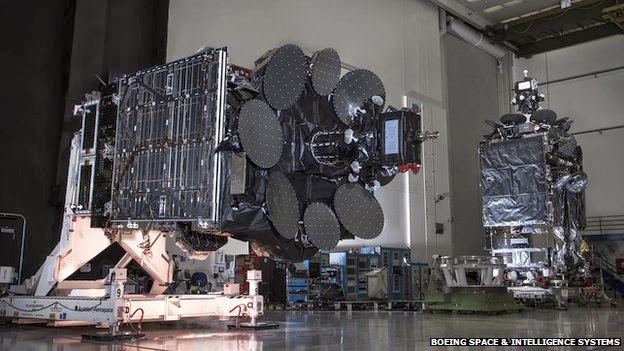
The London-based Inmarsat company has launched the first spacecraft in what will be a new global telecommunications network for its on-the-move customers.


Inmarsat plans to launch up to three further spacecraft in its Ka-band Global Xpress (GX) system, representing an investment of £1bn ($1.6bn).

The initial I-5 F1 satellite was launched from Baikonur in Kazakhstan.

Its Proton rocket left the pad at 18:12 local time (12:12 GMT) on a long flight due to last over 15 hours.

Separation from the Proton's Breeze-M upper-stage on Monday (GMT) should put the I-5 in a supersynchronous transfer orbit that runs out to 65,000km above the planet.

The Boeing-built, 6.1-tonne satellite will then use its own electric propulsion system to circularise this trajectory and move itself into a "stationary" position at 63 degrees East, some 36,000km above the Indian Ocean.

Inmarsat has become the dominant force in the so-called Mobile Satellite Services (MSS) market.

Its principal customer base is the shipping sector, but the company also caters for any groups that need connectivity away from a fixed line.

These include oil and gas installations, the aviation sector, armed forces, aid agencies and NGOs in disaster areas, and TV news crews reporting from trouble zones.

Customers can use Inmarsat services to make phone calls, to transfer audio-visual material or simple data.

Traditionally, the company has served these customers using the L-band part of the radio spectrum.

However, the new GX constellation will operate in the higher-frequency Ka-band, enabling much higher bandwidth connections - up to 50Mbps download, and 5Mbps upload.

A total of four I-5s have been ordered from the Boeing manufacturer

Monday, November 25, 2013

Urthecast: Canadian video camera launches to International Space Station

A Russian Progress freighter has launched to the International Space Station (ISS) carrying a pair of Canadian Earth observation cameras, built in the UK.

One of the imagers is a high-resolution video unit that will return short snatches of the planet's surface up to about 150 times a day.

The Rutherford Appleton Laboratory in Oxfordshire made the cameras for a Canadian start-up called Urthecast.

The company hopes to build a business around space station imagery.

One of the customer sectors for the hi-res video, for example, is likely to be news organisations that want moving pictures of major events, such as war zones and regions of the Earth hit by natural disasters.

This space camera is one of two developed by Vancouver-based Urthecast that were launched Monday, bound for the International Space Station, where they’re expected to transmit images of Earth on the Internet.

Photograph by: HO, THE CANADIAN PRESS

The movie camera should be able to pick out details as small as a metre across from the ISS's altitude of 400km.

This means it ought to be possible to discern large crowds and moving vehicles.

The second camera will provide static imagery at a resolution of 5m per pixel.

Urthecast hopes to have both units operational in the New Year, shortly after they have been installed on a special gantry at the rear of the station by spacewalking astronauts.

The Progress-53 cargo ship lifted clear of the Baikonur Cosmodrome in Kazakhstan atop a Soyuz rocket at 02:53 local time (Tuesday, 26 November - 20:53 GMT, Monday).

Scott Larson, the CEO of Urthecast, was at the Kazakh spaceport to witness launch.

"There are a lot of very happy Canadians, a lot of very happy Brits and a lot of very happy Russians," he said.
"It is truly spectacular. We are just incredibly grateful and thankful to have the opportunity to come here, and for all the hard work that has gone into it."

The Progess docking at the ISS is planned for Friday. As well as the cameras, the freighter is carrying general hardware, food, and fuel needed by the station's astronauts.

Wednesday, October 30, 2013

Sky at Night returns to UK BBC4 following 40,000-signature petition

Over 40,000 fans signed a petition in support of the show, which was presented by Sir Patrick Moore until his death last December. 

Photograph: Roger Bamber/Rex Features

The sun will not set on the The Sky at Night after the BBC announced the long-running science show would move to a new slot on BBC4 following a petition signed by 40,000 viewers who feared it would be axed.

The astronomy show, first broadcast in 1957, will lose its slot on BBC1 but will be expanded from 20 to 30 minutes in its new monthly home on BBC4, with a repeat on BBC2.

The future of the series appeared to be in doubt last month after the corporation declined to confirm its future beyond the end of the year.

More than 40,000 fans signed an online petition in support of the show, which was presented by Sir Patrick Moore until his death last December, aged 89.

The programme will be off air in January, when the gap will be filled by BBC2's live astronomy series, Stargazing Live, presented by Professor Brian Cox and Dara O Briain, before returning in February.

Kim Shillinglaw, head of commissioning science and natural history, said: "Sir Patrick Moore inspired generations of astronomers and The Sky at Night will enthuse further generations about the wonder of the night sky."

Losing its BBC1 slot is likely to deprive the show of its biggest audiences. The show's last BBC1 outing, on 6 October, was watched by 655,000 viewers.

No decisions have been made about the presenter's role on the show which has been filled by a series of guest hosts following Moore's death.

Moore presented a total of 721 episodes, missing just one outing in the programme's history, when he was struck down by food poisoning.

Friday, July 5, 2013

UK astronomers to co-ordinate their search for alien signals

British scientists are to make a concerted effort to look for alien life among the stars.

Academics from 11 institutions have set up a network to co-ordinate their Search for Extra-Terrestrial Intelligence (Seti).

The English Astronomer Royal, Sir Martin Rees, will act as patron.

The group is asking funding agencies for a small - about £1m a year - sum of money to support listening time on radio telescopes and for data analysis.

It would also help pay for research that considered new ways to try to find aliens.

Currently, most Seti work is done in the US and is funded largely through private donation.

UK Seti Research Network (UKSRN) co-ordinator Alan Penny said there was important expertise in Britain keen to play its part.

"If we had one part in 200 - half a percent of the money that goes into astronomy at the moment - we could make an amazing difference. We would become comparable with the American effort," the University of St Andrews researcher told BBC News.

"I don't know whether [aliens] are out there, but I'm desperate to find out. It's quite possible that we're alone in the Universe. And think about the implications of that: if we're alone in the Universe then the whole purpose in the Universe is in us. If we're not alone, that's interesting in a very different way."

The UKSRN held its first get-together at this week's National Astronomy Meeting.

British researchers and facilities have had occasional involvement in Seti projects down the years.

The most significant was the use in 1998-2003 of Jodrell bank, and its 76m Lovell radio telescope, in Project Phoenix. This was a search for signals from about 1,000 nearby stars. Organised - and paid for - by the Seti Institute in California, it ultimately found nothing.

Jodrell has since been updated, linking it via fibre optics into a 217km-long array with six other telescopes across England. Known as eMerlin, this system would be a far more powerful tool to scan the skies for alien transmissions.

And Jodrell's Tim O'Brien said Seti work could be done quite easily without disturbing mainstream science on the array.

"You could do serendipitous searches. So if the telescopes were studying quasars, for example, we could piggy-back off that and analyse the data to look for a different type of signal - not the natural astrophysical signal that the quasar astronomer was interested in, but something in the noise that one might imagine could be associated with aliens. This approach would get you Seti research almost for free," the Jodrell associate director explained.

"There are billions of planets out there. It would be remiss of us not to at least have half an ear open to any signals that might be being sent to us."

Monday, May 20, 2013

ESA New UK Astronaut: Tim Peake

Tim Peake, a former British Army Air Corps helicopter pilot, has been chosen to visit the International Space Station in November or December 2015. 

The 41-year-old is expected to spend six months aboard the ISS which is orbiting 390km above the Earth. 

Peake isn't the first Briton to go into space, but he's been described as the first "official" British astronaut. Sheffield-born chemist Helen Sharman secured private funding to fly to the Mir space station in 1991, reports the Daily Telegraph.

Three other British-born astronauts - Michael Foale, Piers Sellers and Nicholas Patrick – flew into space under the American flag. Peake will be making his trip under the Union flag.

His selection for the 2015 mission is the result of increased investment by the UK Space Agency in Europe's space programme, including a £16 million contribution to the ISS.


Canadian astronaut Chris Hadfield set a new benchmark for engaging an Earth-bound audience from space using social media. His version of David Bowie's Space Oddity - recorded on the ISS – was an instant hit with the 770,000 people who follow him on Twitter. Says Peake: "I do play the guitar – very badly – and I wouldn't inflict my singing on anyone."

Peake, along with his Russian and American colleagues, lived in a cave in Sardinia for two weeks to get used to living and co-operating in cramped conditions.

"The cave environment is great because you've got high levels of isolation," he told the Royal Aeronautical Society's website. "It takes about eight hours just to get to the base camp in the caves and there is lots of vertical ascent and descent."

Although he's the wrong side of 40, Peake says he's yet to, erm, reach his peak. "The average age of an astronaut is quite high, it's up in the high 40s if not low 50s, because you have to attain so much experience before being selected and then the training takes so long," he told reporters.

In Space Oddity, David Bowie sings the plaintive line: "Tell my wife I love her very much…" Peake says his biggest worry is being away from his wife and two sons, aged four and 18 months.

"Over those six months in space, I will be in no position to provide them with any help or support," he told reporters. "That is my greatest apprehension."