Showing posts with label Antarctic Ice. Show all posts

Monday, February 3, 2014

Antarctic ice: UK Geologists find Massive valley deeper than Grand Canyon

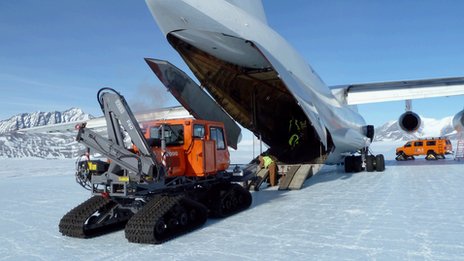
Antarctic field camp located on the ice sheet surface directly over the hidden Ellsworth Trough 

Credit: Neil Ross 

A massive ancient subglacial trough, deeper than the Grand Canyon, exists under the ice of Antarctica, a team of UK experts says.

Scientists from Bristol University, Newcastle University and the British Antarctic Survey discovered the massive valley during three seasons of charting the Ellsworth Subglacial Highlands, an ancient mountain range buried beneath several kilometers of antarctic ice.

They used data from satellites and ice-penetrating radars towed behind snowmobiles and on-board small aircraft.

The massive subglacial valley is almost 2 miles deep, almost 190 miles long and up to 15 miles wide. In places, the floor of this valley is more than 6,500 feet below sea level, the researchers said.

Neil Ross
"The discovery of this huge trough, and the characterization of the surrounding mountainous landscape, was incredibly serendipitous," Newcastle University physical geographer Neil Ross said.

"We had acquired ice penetrating radar data from both ends of this huge hidden valley, but we had no information to tell us what was in between," he said.

"Satellite data was used to fill the gap, because despite being covered beneath several kilometers of ice, the valley is so vast that it can be seen from space."

A moving ice field carved the deep valley and its surrounding mountains millions of years ago, the scientists said.

"To me, this just goes to demonstrate how little we still know about the surface of our own planet," Ross said.

"The discovery and exploration of hidden, previously unknown landscapes is still possible and incredibly exciting, even now."

More information: 'Evidence from ice shelves for channelized meltwater flow beneath the Antarctic Ice Sheet' - Nature Geoscience 6, 945–948 (2013) doi:10.1038/ngeo1977

Thursday, May 16, 2013

IceCube Detector under Antarctic ice may have seen first cosmic neutrinos

IceCube, the giant experiment buried beneath the South Pole's ice has recorded the first neutrinos ever detected originating outside our solar system, researchers say.

Neutrinos are produced in our atmosphere but the IceCube experiment -- a cubic kilometer of sensitive detectors sunk into the Antarctic ice -- has seen the first "cosmic neutrinos," they said.

IceCube consists of 86 strings, each with 60 sensitive light detectors strung along it like "fairy lights," sunk deep into the ice.

Rare collisions of neutrinos with the nuclei of atoms in the ice produce a brief flash that the detectors can catch.

With more than 5,000 detectors catching the flashes the direction of the neutrinos' arrival on Earth can be determined, the researchers said.

Neutrinos can be produced in the Earth's atmosphere -- IceCube picks up about 100,000 of that variety a year -- but previous attempts to isolate neutrinos created in far-flung cosmic processes had all failed.

However, in April the IceCube research team reported detecting two neutrinos -- nicknamed Bert and Ernie -- with energy levels high enough to suggest a cosmic rather than atmospheric origin.

The team has now reported 26 more events of similar energy that they expect will also be confirmed as cosmic in origin.

Francis Halzen
Detection is just a first step and "of course, there's much more to do," IceCube principle investigator Francis Halzen told reporters.

"It's after you find them that the work starts; these events are very difficult to analyze."

The study results were presented Wednesday at the IceCube Particle Astrophysics Symposium in Madison, Wis.

Tuesday, March 13, 2012

Exploding iceberg in Antarctica! - YouTube


The terrifying scene of a collapsing Antarctic iceberg has been captured by tourists.

Seeing icebergs in the Antarctic region is a common phenomenon, but seeing a huge iceberg self-destruct, with icy chunks flying out close to passengers in an inflatable boat, has left them shaken and horrified.

Some of the passengers, who saw the last moment of the iceberg with the flying debris of ice, screamed out with fear.

Dutch video editor Lex Coppoolse, who captured the footage in Wihelmina Bay, Antarctica: "The thing just exploded very close to our boat - or I should say imploded! It spat big chunks of thousands year old ice to our heads."

Seeing the video, some people left comments saying, "It is a natural occurring event", or "It must be warning of 'global warming'."

Friday, January 20, 2012

An iceberg floating in Neko Harbour, Antarctica

An underwater/above-water split picture of an iceberg floating in Neko Harbour in the Antarctic. 

Brazilian photographer, Daniel Botelho, captured not only the tip of the iceberg but the massive hunks of underwater ice as well.

Picture: Daniel Botelho / Barcroft USA

Monday, January 16, 2012

Antarctic lake drilling mission edges closer

An ambitious plan to explore a vast lake trapped beneath the Antarctic ice is a step closer to becoming reality.

An advance party has braved freezing temperatures to set up vital equipment and supplies at Lake Ellsworth.

The project by UK engineers to drill through the two-mile-thick ice-sheet is scheduled for the end of the year.

The aims are to search for signs of life in the waters and to extract sediments from the lake floor to better understand the past climate.

It is is one of the most challenging British scientific projects for years.

The task is so complex that preparations have had to be spread over two Antarctic summer seasons.

In the first phase a "tractor train" has just hauled nearly 70 tonnes of equipment from an ice runway at Union Glacier through the Ellsworth mountains to the lake site.

1. A hot water drill will melt through the frozen ice sheet, which is up to 3km (2 miles) thick. After drilling, they will have an estimated 24 hours to collect samples before the borehole re-freezes
2. A probe will be lowered through the borehole to capture water samples
3. A specialised corer will then recover sediment from the floor of the lake through the same borehole
Watch the team's animated explation of the planned drill.

Sunday, January 15, 2012

Deep sea methane: Energy Saviour Or Impending Disaster?


In December 2003, an international team of geologists announced that they had successfully tapped a new energy source.

Methane hydrate, a solidified form of natural gas bound into ice, lurks under the seafloor along the margins of every continent and under the Arctic permafrost.

On the Mackenzie River delta in the Canadian Northwest Territories, engineers drilled hundreds of meters below the permafrost into the hydrate deposits.

They punched fractures into the layers of sediment and pumped hot water into the earth, releasing the natural gas from its icy prison.

This first harvest of methane hydrate could mark a new direction for the energy industry. Engineers once assumed that the energy costs of melting the frozen fuel would outweigh the gains but rising oil and gas prices and creative uses of existing technology, like the recent test in the Canadian Arctic, are beginning to change their minds.

The United States Geological Survey estimates that the total amount of natural gas in methane hydrates surpasses all of the known oil, coal, and gas deposits on Earth in energy content, although only a fraction of the frozen fuel will be extractable.

The hydrates can form at any latitude on Earth if temperature and pressure conditions are right, and are usually mixed with sediment under the ocean floor.

There is a catch, however. Methane hydrates offer the energy industry dangers as well as opportunities, warns Charlie Paull, a geochemist at Monterey Bay Aquarium Research Institute in Moss Landing, Calif.

Deep-sea drilling operations that melt seafloor deposits of the icy fuel might set off an underwater accident under certain circumstances.

Friday, November 25, 2011

BBC Nature: 'Brinicle' ice finger of death filmed in Antarctic - YouTube


Source: http://www.bbc.co.uk/nature/15835017 (video extracted with StreamTransport)

As brine from the sea ice sinks, a 'brinicle' forms threatening life on the sea floor with a frosty fate.

A bizarre underwater "icicle of death" has been filmed by a BBC crew.

With timelapse cameras, specialists recorded salt water being excluded from the sea ice and sinking. The temperature of this sinking brine, which was well below 0C, caused the water to freeze in an icy sheath around it.

Where the so-called "brinicle" met the sea bed, a web of ice formed that froze everything it touched, including sea urchins and starfish. The unusual phenomenon was filmed for the first time by cameramen Hugh Miller and Doug Anderson for the BBC One series Frozen Planet.

Creeping ice
The icy phenomenon is caused by cold, sinking brine, which is more dense than the rest of the sea water. It forms a brinicle as it contacts warmer water below the surface. Mr Miller set up the rig of timelapse equipment to capture the growing brinicle under the ice at Little Razorback Island, near Antarctica's Ross Archipelago.

"When we were exploring around that island we came across an area where there had been three or four [brinicles] previously and there was one actually happening," Mr Miller told BBC Nature.
The diving specialists noted the temperature and returned to the area as soon as the same conditions were repeated.

"It was a bit of a race against time because no-one really knew how fast they formed," said Mr Miller. "The one we'd seen a week before was getting longer in front of our eyes... the whole thing only took five, six hours."

Against the odds
The location - beneath the ice off the foothills of the volcano Mount Erebus, in water as cold as -2C - was not easy to access. "That particular patch was difficult to get to. It was a long way from the hole and it was quite narrow at times between the sea bed and the ice," explained Mr Miller.

"I do remember it being a struggle... All the kit is very heavy because it has to sit on the sea bed and not move for long periods of time." As well as the practicalities of setting up the equipment, the filmmakers had to contend with interference from the local wildlife.

The large weddell seals in the area had no problems barging past and breaking off brinicles as well as the filming equipment. "The first time I did a timelapse at the spot a seal knocked it over," said Mr Miller.
But the team's efforts were eventually rewarded with the first ever footage of a brinicle forming.

HOW DOES A BRINICLE FORM?
Dr Mark Brandon
Polar oceanographer, The Open University

Freezing sea water doesn't make ice like the stuff you grow in your freezer. Instead of a solid dense lump, it is more like a seawater-soaked sponge with a tiny network of brine channels within it.

In winter, the air temperature above the sea ice can be below -20C, whereas the sea water is only about -1.9C. Heat flows from the warmer sea up to the very cold air, forming new ice from the bottom. The salt in this newly formed ice is concentrated and pushed into the brine channels. And because it is very cold and salty, it is denser than the water beneath.

The result is the brine sinks in a descending plume. But as this extremely cold brine leaves the sea ice, it freezes the relatively fresh seawater it comes in contact with. This forms a fragile tube of ice around the descending plume, which grows into what has been called a brinicle.

Brinicles are found in both the Arctic and the Antarctic, but it has to be relatively calm for them to grow as long as the ones the Frozen Planet team observed.

Thursday, November 17, 2011

BAS Fly-through of Antarctica's Gamburtsev 'ghost mountains'

Click on the Image to visit BBC website and activate the Animation.

Scientists think they can now explain the existence of what are perhaps Earth's most extraordinary mountains.

The Gamburtsevs are the size of the European Alps and yet are totally buried beneath the Antarctic ice.

A geophysical survey of the range was conducted in 2008/9. This allowed researchers to assess the mountains' origin.

In this video, Fausto Ferraccioli from the British Antarctic Survey takes us on a virtual fly-through of the Gamburtsevs.

Animation courtesy of the British Antarctic Survey.

Sunday, July 31, 2011

Antarctica rising as ice caps melt

ANTARCTICA is rising like a cheese soufflĂ©: slowly but surely. 

Lost ice due to climate change and left-over momentum from the end of the last big ice age mean the buoyant continent is heaven-bound.

Donald Argus of NASA's Jet Propulsion Laboratory in Pasadena, California, and colleagues used 15 years of GPS data to show that parts of the Ellsworth mountains in west Antarctica are rising by around 5 millimetres a year (Geophysical Research Letters, DOI: 10.1029/2011gl048025). 

Elsewhere on the continent, the rise is slower.

A faster rise has been seen in Greenland, which is thought to be popping up by 4 centimetres a year.

Ongoing climate change could be partly to blame: Antarctica is losing about 200 gigatonnes of ice per year, and for Greenland the figure is 300 gigatonnes. Earth's continents sit on viscous magma, so the effect of this loss is like taking a load off a dense foam mattress.

But there is another possible contributor. "The Earth has a very long memory," says Argus. As a result, "there is also a viscous response to ice loss from around 5000 to 10,000 years ago going on".

Despite this effect, the known ice loss at both poles suggests that embedded in the local rises is a signal of current climate change - researchers just have to tease it out.

Thursday, May 27, 2010

NASA: Phoenix Mars Lander crushed by ice

NASA's Phoenix Mars Lander has ended operations after repeated attempts to contact the spacecraft were unsuccessful. A new image transmitted by NASA's Mars Reconnaissance Orbiter shows signs of severe ice damage to the lander's solar panels.

"The Phoenix spacecraft succeeded in its investigations and exceeded its planned lifetime," said Fuk Li, manager of the Mars Exploration Program at NASA's Jet Propulsion Laboratory in Pasadena, Calif. "Although its work is finished, analysis of information from Phoenix's science activities will continue for some time to come." Phoenix has returned a wealth of data for astrobiologists studying the potential for past or present life on Mars.

Last week, NASA's Mars Odyssey orbiter flew over the Phoenix landing site 61 times during a final attempt to communicate with the lander. No transmission from the lander was detected. Phoenix also did not communicate during 150 flights in three earlier listening campaigns this year.

Tuesday, March 16, 2010

NASA: Surprise Shrimp Visitor Under Antarctic Ice


Credit: NASA

At a depth of 600 feet beneath the West Antarctic ice sheet, a small shrimp-like creature managed to brighten up an otherwise gray polar day in late November 2009.

This critter is a three-inch long Lyssianasid amphipod found beneath the Ross Ice Shelf, about 12.5 miles away from open water. NASA scientists were using a borehole camera to look back up towards the ice surface when they spotted this pinkish-orange creature swimming beneath the ice.